Power outage right now? The five things to do immediately
If you are reading this by flashlight, here are the essentials. The rest of the article will help you decide what to do next.
- Stop opening the freezer. Every opening swaps cold air for room air, and the cold reserve melts away much faster than most people expect. If you absolutely must take something out, do it once, quickly.
- Write down the time the power went off. Everything else follows from it: when to act, what to keep, what to throw away (see the “hour by hour” table below).
- Check that the outage is on the grid. See whether your neighbors are in the dark too and whether a breaker has simply tripped in your panel, then contact your utility (the outage number is on your bill, and many utilities publish an outage map) to ask for an estimated restoration time.
- Do not throw anything away during the outage. Sorting happens when the power returns, with a thermometer rather than by eye. The one exception is the refrigerator, which only holds about 4 hours.
- Prepare plan B now, not at hour twenty. A power station, a neighbor’s freezer, a cooler with ice: if no restoration time is announced after a few hours, assume the outage will last more than a day.
How long does a freezer last without power?
With the door closed, the food safety guidance published by the FDA gives three benchmarks: about 48 hours for a full freezer, about 24 hours for a half-full one and about 4 hours for a refrigerator (FDA chart). The Government of Québec and the UK’s Food Standards Agency publish the same orders of magnitude. These are estimates, not guarantees: they vary with insulation, how full the freezer is and the temperature of the room. Ready.gov sums up the golden rule: keep freezers and refrigerators closed.
| Appliance, door closed | Estimated time | What to watch |
|---|---|---|
| Full freezer | about 48 h | Food still hard, temperature close to 0 °F (-18 °C) |
| Half-full freezer | about 24 h | Same, but half the margin |
| Sparsely filled freezer | under 24 h (no official figure) | The riskiest case: lots of air to keep cold, little ice to hold the cold |
| Freezer compartment of a fridge-freezer | much less | Food thaws faster there (Government of Québec) |
| Refrigerator | about 4 h | Perishable food that has been above 40 °F (4 °C) for more than 2 hours is thrown away (FDA) |
Why a full freezer matters so much. The food itself stores the cold. Volume for volume, frozen food holds hundreds of times more cold than the air around it, and the ice it contains has to melt before its core warms up. A full freezer is a cold battery; a half-empty one is mostly an insulated box of air.
The three thresholds to know
- 0 °F (-18 °C): the freezer target in US food safety guidance, and the normal storage temperature.
- 40 °F (4 °C): the limit for the refreezing rule. Food that has partly thawed but still contains ice crystals, or is at 40 °F or below, can be refrozen; perishable food that has been above 40 °F for more than 2 hours goes in the trash (FDA).
- 16 °F (-9 °C): the limit used by European rules to define a freezer’s “autonomy in case of power failure”, in other words how long it takes to go from 0 °F to 16 °F once the power is cut. This figure is often on a data sheet: the 7 cu ft (200 L) chest freezers we looked at quote between 26 and 41 hours. Look for the equivalent in your appliance’s manual, it is the most reliable number for your exact model.
Chest, upright, fridge-freezer: each appliance has its own rules
Not all freezers behave alike in an outage, and they do not all draw the same amount of electricity. Both criteria matter equally when choosing a power station. On a US appliance, the yellow EnergyGuide label gives the estimated yearly use in kWh; the ranges below come from the European EPREL register, whose figures are of the same order of magnitude for freezers of the same size.
| Type | Typical capacity | Annual consumption (label) | Per day | Cold retention | Good to know |
|---|---|---|---|---|---|
| Chest freezer | 7 to 21 cu ft (200 to 600 L) | 95 to 318 kWh | 0.26 to 0.87 kWh | Best: the lid opens upwards | Pack in layers, with a basket to find things quickly |
| Upright (drawers or shelves) | 7 to 14 cu ft (200 to 400 L) | 105 to 329 kWh | 0.29 to 0.90 kWh | Average: cold air spills out at every opening, drawers limit the loss | One drawer at a time, briefly |
| Compact (countertop or under-counter) | 3 to 9 cu ft (80 to 250 L) | 82 to 270 kWh | 0.22 to 0.74 kWh | Low: small volume, small cold reserve | Fill it as full as possible |
| Freezer compartment of a fridge-freezer | a few cubic feet | included in the fridge-freezer | about 0.25 to 0.5 kWh for a recent fridge-freezer as a whole | The shortest | Save what matters most first, or move it to a proper freezer |
The average freezer in use consumes around 300 kWh a year according to the French energy agency ADEME (relayed by Selectra): an older appliance generally uses more than the recent models in the table, which directly affects the size of the power station you need.
Room temperature: a factor of 1 to 1.7
The heat passing through a freezer’s walls is proportional to the temperature difference between the inside and the room. The cooler the room, the longer the cold reserve lasts and the less the compressor works, as the Government of Québec also notes. For an interior at 0 °F (-18 °C):
| Room | Difference with the inside | Heat getting in (basement = 100%) |
|---|---|---|
| Cool basement or garage, 50 °F (10 °C) | 50 °F (28 °C) | 100% |
| Kitchen or laundry room, 68 °F (20 °C) | 68 °F (38 °C) | about 135% |
| Sunroom, garage or kitchen in summer, 86 °F (30 °C) | 86 °F (48 °C) | about 170% |
In late fall, an unheated garage, basement or laundry room is therefore rather an ally for a freezer without power. Conversely, a freezer next to a radiator, an oven or a sunny window can use up to 30% more electricity (Selectra) and warms up that much faster.
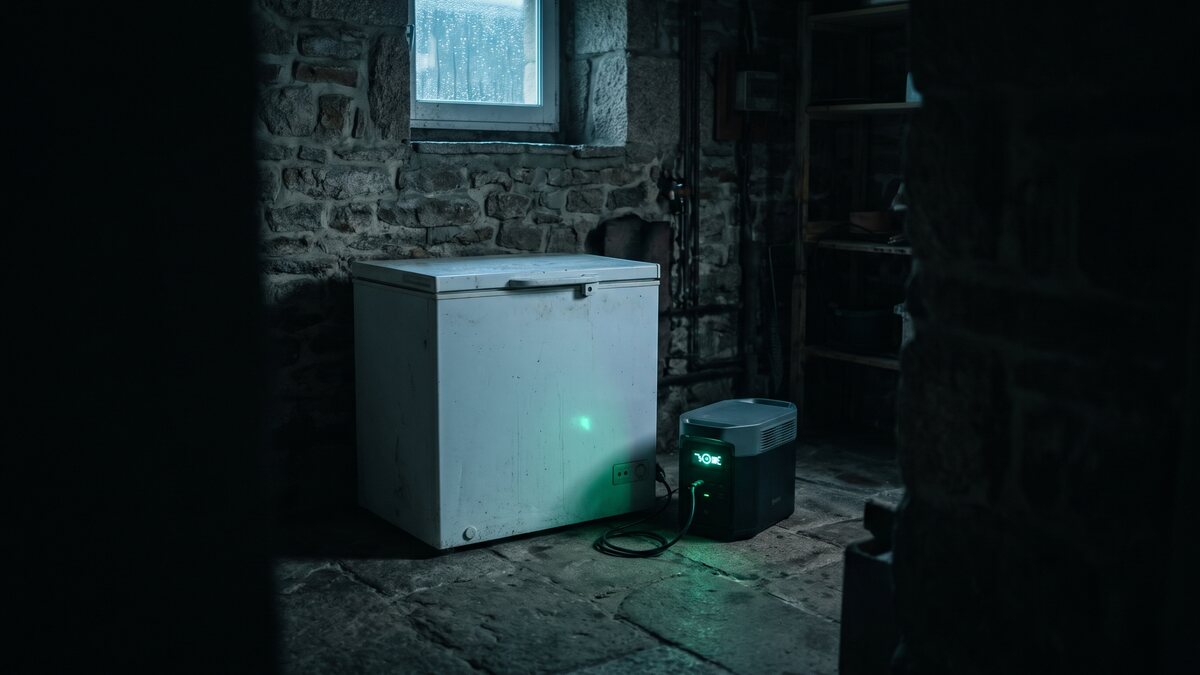
One precaution for power stations installed in a garage or basement: lithium iron phosphate (LFP) batteries must not be charged below 32 °F (0 °C). When discharging they tolerate the cold: down to 14 °F (-10 °C) for the EcoFlow Delta 3, Delta 3 Max and Delta Pro 3, down to -4 °F (-20 °C) for the Anker Solix C2000 Gen 2 (manufacturer values). In plain terms, a power station can run a freezer in a freezing garage, but cannot recharge there.
How long will the outage last? The numbers
This is the real difficulty: the freezer may hold for 48 hours, but nobody tells you in the first hour whether the outage will last three hours or three days. A few benchmarks to decide without illusions.
In the United States: hours a year, driven by storms
The average US electricity customer lost power for 11 hours in 2024, nearly twice the average of the previous decade, according to the Energy Information Administration. Eighty percent of those hours came from just three hurricanes, Beryl, Helene and Milton. Outside major events, outages average about two hours a year. In other words, the ordinary fault is short and the storm is what counts, exactly the case a freezer owner has to plan for.
In a major storm: a long tail
Two European storms show the shape of the problem. In Britain, Storm Arwen (November 2021) cut power to nearly one million homes: 82% had it back within 24 hours, but nearly 4,000 homes were without power for over a week (Ofgem). In France, storm Ciaran of 2 November 2023 left more than 1.2 million homes without electricity at 7 am, 780,000 of them in Brittany. Six days later, more than 30,000 Breton homes were still without power, and the last customer was only reconnected on 21 November, nineteen days after the storm.
Ciaran is an extreme event, not an ordinary storm. Keep the shape rather than the figures: the vast majority of homes get power back within the day, a minority waits for days, and nobody knows in advance which group they will be in.
And elsewhere?
| Country | What the figures say | Source |
|---|---|---|
| United States | 11 hours of interruption per customer in 2024, nearly double the decade average, 80% of it due to hurricanes Beryl, Helene and Milton | EIA |
| United Kingdom | Storm Arwen (2021): nearly 1 million homes cut, 82% restored within 24 h, nearly 4,000 homes for over a week | Ofgem |
| Germany | 11.7 minutes of interruption per consumer in 2024, excluding force majeure | Bundesnetzagentur |
| Italy | 62 minutes per low-voltage user in 2021, of which 21 minutes due to external causes, mostly exceptional events | ARERA |
| Spain | General blackout of 28 April 2025: started around 12:30 pm, more than 99.5% of supply restored at 6 am the next day | SmartGridsInfo |
The practical consequence
An outage shorter than 4 hours asks nothing of you: the closed freezer does not suffer. Between 4 and 24 hours is the most likely case and all you have to do is leave the door shut. Beyond 24 hours everything is at stake: a half-full freezer is at its limit, a full one has about a day left, and you need a plan. Decide early. Waiting for the forty-eighth hour to look for a solution means looking for it when every store and every neighbor is in the same situation.
When the outage lasts more than 24 hours: the five solutions
| Solution | Strengths | Limits |
|---|---|---|
| Do nothing, keep the door shut | Free, enough for the first 24 to 48 hours if the freezer is full | A gamble if the outage lasts; nothing is protected beyond that |
| Power station in backup mode | The cold is kept without interruption, silent, can be used indoors, can be recharged by solar or at a relative’s home | Limited capacity, price, energy to be replenished after 1 to 4 days depending on the model |
| Generator | Long running time as long as there is fuel | Outdoors only, at least 20 feet from windows, doors and attached garages (Ready.gov); noisy, fuel to store, connection to do properly |
| Dry ice or ice packs | No electricity needed | Hard to find in the middle of a storm; dry ice burns skin and releases CO2: 50 lb for a fully stocked 18 cu ft freezer for two days according to the US Department of Agriculture (USDA) |
| Move the contents | Free: neighbor, family, butcher, grocery store, business with a walk-in cooler; sealed, well-kept food can be shared with neighbors | Logistics, cold chain to maintain in a cooler during transport |
A power station is the only solution that protects without supervision, fuel or a stock of ice, and that stays useful the rest of the year (router, lighting, camping, job site). It is therefore the one detailed below. A generator remains relevant for a multi-day outage, but never indoors or in an attached garage: carbon monoxide is colorless, odorless and deadly, and Ready.gov recommends battery-backup carbon monoxide detectors on every level of your home.
What capacity do you need?
The decisive question comes down to one sentence: how many watt-hours (Wh) will the freezer draw from the power station each day? The method fits on a sheet of paper.
- Find the annual consumption on the EnergyGuide label (in kWh per year), or measure it with a plug-in power meter left for 24 hours between the outlet and the appliance.
- Divide by 365 to get kWh per day.
- Multiply by 1.5 to 2 to go from the “label” consumption to the energy actually drawn from the power station.
- Multiply by the number of days you want to last, then compare the result with the usable energy of the power station (its “delivered energy”), not its advertised capacity.
The 1.5 to 2 factor has three causes. The power station converts its battery’s direct current into alternating current, with 10 to 15% losses. Its AC output also consumes power at idle as soon as it stays on, in the order of 10 to 25 W depending on the model (check the data sheet of yours), or 0.25 to 0.6 kWh a day, a huge item for an appliance that only draws 0.5. Finally, door openings and food to be chilled add their share. This factor is a rule of thumb from our editorial team, not a measurement.
| Profile | Label | Per day | Need on the power station | Used in our calculations |
|---|---|---|---|---|
| Small 5 cu ft chest freezer | 200 kWh/year | 0.55 kWh | 0.8 to 1.1 kWh per day | 0.9 kWh per day |
| 9 cu ft upright | 250 kWh/year | 0.68 kWh | 1.0 to 1.4 kWh per day | 1.1 kWh per day |
| Large 14 cu ft chest freezer or older appliance | 300 kWh/year | 0.82 kWh | 1.2 to 1.6 kWh per day | 1.5 kWh per day |
Economy mode: up to 1.5 times longer
A full, closed freezer does not need to be powered continuously: it holds for 24 to 48 hours on its own. If you leave the power station’s AC output off, then switch it on for an hour or two each time the thermometer climbs towards 5 °F (-15 °C), the compressor “recharges” the cold and the inverter only runs a few hours a day, which removes its idle consumption. By our estimates, running time can gain up to 50% this way. The method only suits a well-filled freezer and never a refrigerator, which holds for too short a time; it requires regular monitoring with a temperature probe inside and a display outside.
Power is almost never the problem
A freezer compressor draws 70 to 150 W when running, and a few hundred watts to over 1,000 W for a fraction of a second at start-up, three to six times its rated power. The power stations below all handle peaks of 3,000 W and more. Only the very small 300 W units, limited to 600 W peaks, risk tripping on a large compressor.
Which power station to choose? Our selection by scenario
The five power stations below share the essentials: an LFP battery (lithium iron phosphate, 4,000 cycles advertised), a backup mode (UPS) that switches over in 10 milliseconds according to the manufacturers, fast recharging from the wall (49 to 68 minutes advertised for the first four) and a five-year warranty. What sets them apart is the usable energy, and therefore the running time for a given freezer.
| Power station | Usable energy | Small 5 cu ft chest (0.9 kWh/day) | 9 cu ft upright (1.1 kWh/day) | Large 14 cu ft chest or older (1.5 kWh/day) |
|---|---|---|---|---|
| Anker Solix C1000 | 920 Wh | 25 h | 20 h | 15 h |
| EcoFlow Delta 3 | 860 Wh | 23 h | 19 h | 14 h |
| Anker Solix C2000 Gen 2 | 1,850 Wh | 49 h (2.0 days) | 40 h | 30 h |
| EcoFlow Delta 3 Max | 1,900 Wh | 51 h (2.1 days) | 41 h | 30 h |
| EcoFlow Delta Pro 3 | 3,999 Wh | 107 h (4.5 days) | 87 h (3.6 days) | 64 h (2.7 days) |
Our editorial estimates, based on the usable energy in each product page and needs of 0.9, 1.1 and 1.5 kWh a day, AC output on continuously. In economy mode, allow up to 1.5 times longer. These are calculations, not measurements.
The 1 kWh step: a small freezer and a one-day outage
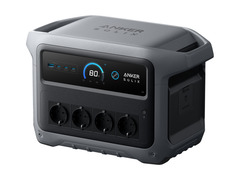
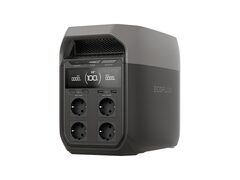
The Anker Solix C1000 (1,024 Wh, 24.9 lb (11.3 kg), 2,000 W and 3,000 W peak, full recharge in 49 minutes advertised) and the EcoFlow Delta 3 (1,024 Wh, 27.6 lb (12.5 kg), 1,800 W and 3,600 W peak, recharge in 56 minutes) cover a small chest freezer or a fridge-freezer for a day. The Delta 3 has an asset the C1000 lacks: it is expandable up to 5,120 Wh with extra batteries, so you can start small and grow. The C1000 is a little lighter and designed to be carried around. Our detailed reviews: Anker Solix C1000 and EcoFlow Delta 3.
The 2 kWh step: the right compromise for a household
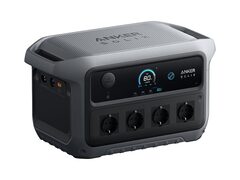
The Anker Solix C2000 Gen 2 (2,048 Wh, 41.7 lb (18.9 kg), 2,400 W and 4,000 W peak, 30 dB, expandable up to 4,096 Wh, solar input up to 800 W) and the EcoFlow Delta 3 Max (2,048 Wh, 44.8 lb (20.3 kg), 2,400 W and 4,800 W peak, 25 dB, not expandable, solar input up to 500 W) keep a standard upright or chest freezer going for a day and a half to two days, with the router and a few lamps on top. This is the right step if you want to sleep soundly through a multi-day storm without spending a small car’s budget. Our reviews: C2000 Gen 2 and Delta 3 Max.
The 4 kWh and above step: the long storm
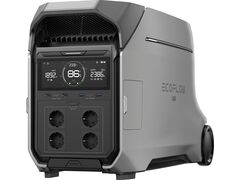
The EcoFlow Delta Pro 3 (4,096 Wh, expandable up to 12,288 Wh, 4,000 W and 8,000 W peak, 113.5 lb (51.5 kg) with wheels, 5 outlets) adds the refrigerator, the router and the furnace blower for three to four days. It accepts up to 2,600 W of panels, enough to recharge seriously even under a winter sky if you have several 220 W solar panels. A single panel will only produce a fraction of its rating in November: expect 200 to 300 Wh a day at northern latitudes, an order of magnitude rather than a promise. Our review: EcoFlow Delta Pro 3.
What is not enough
Small 250 to 300 Wh units, such as the EcoFlow River 3 or the Anker Solix C300, are excellent for an evening, a router and phones, but they only last about 5 to 6 hours with a small freezer: one night at best, with an output limited to 300 W. Keep them for what they do well.
To compare more models of this kind, see our selection of expandable LiFePO4 power stations for home backup, and to find out what other appliances ask of your reserve, our guide what appliances can a power station run.
Plugging the freezer into a power station: the safe method
- Read the freezer’s rating plate (power in W, or amps at 120 V) and check that the power station’s output comfortably exceeds that figure multiplied by three.
- Plug the freezer directly into an outlet on the power station, not into a cheap power strip. If an extension cord is unavoidable, take the shortest possible, heavy-duty and of adequate gauge (14 AWG or heavier).
- Place the power station between the wall outlet and the freezer, backup (UPS) mode on: the power station stays connected to the grid, the freezer to the power station. If the power disappears, it switches over in a claimed 10 milliseconds, without the compressor noticing. Check this function in your model’s manual or app.
- Test before the storm: simply unplug the power station from the wall outlet to simulate an outage, check that the freezer keeps running, then plug it back in.
- Fit a probe thermometer, display outside, probe inside (its thin wires pass under the door gasket): you read the temperature without opening.
- When the power returns, do not touch anything: the power station recharges by itself. Our guide to the power outage explains why the return of the grid is the riskiest moment for appliances.
Before the storm: the preparation checklist
- As soon as a storm is forecast, set the freezer to its coldest setting. You will put it back to normal after the outage: it gives you a margin before reaching 0 °F (-18 °C).
- Fill the gaps. Water bottles filled three-quarters full (ice expands), ice packs or bags of ice cubes turn air into a cold reserve. A half-empty freezer holds half as long as a full one.
- Group the sensitive items (meat, fish) in the center or at the bottom, surrounded by ice packs.
- Take stock with a list or a photo: useful for sorting, and for any insurance claim.
- Fit an appliance thermometer with a remote probe, a few dollars.
- The coin test: freeze a cup of water and put a coin on top. If, when the power returns, the coin is at the bottom of the cup, everything thawed at some point, even if everything is hard again. It is a field trick that complements the thermometer without replacing it.
- Charge the power station to 100%, test it, store it somewhere dry with its cables, and check its charge level each month during storm season.
- Get coolers ready and ice packs for the refrigerator, which only holds about 4 hours.
- Plan the human plan B: who among your friends and family has a working freezer or a generator, and where can you recharge the power station (work, relatives)?
During the outage: hour by hour
| Hours without power | What is happening | What to do |
|---|---|---|
| 0 h | The outage begins | Note the time, do not open, check it is the grid, plug the freezer into the power station if it is not already in backup mode |
| 3 to 4 h | The refrigerator is reaching its limit | Perishable food that has been above 40 °F (4 °C) for more than 2 hours is discarded (FDA). Move the most perishable items to a cooler with ice from the third hour, opening only once. If it is below 46 °F (8 °C) outside, the UK’s FSA allows storage in a sealed container outdoors, out of the sun and away from animals. |
| 12 h | No restoration time announced | Trigger plan B: power station, a neighbor’s freezer, cooler. Read the probe temperature. |
| 24 h | Limit of a half-full freezer | Without a power station, move the contents or pool them in a single neighbor’s freezer |
| 48 h | Limit of a full freezer | Beyond that, consider the contents compromised and sort them when the power returns |
With a power station the table changes: as long as it powers the freezer, you are outside this timetable. Your new deadline is the time at which the battery will be empty, given by the running-time table above. Plan a recharge (solar, generator outdoors, at a relative’s home) before that time, not after.
The power is back: refreeze, cook or throw away?
When the power returns, trust neither appearance nor smell nor taste. Rely on the thermometer and on the state of the packaging, following the FDA chart: food that is partly thawed with ice crystals, or at 40 °F (4 °C) or below, can be refrozen, and, as Ready.gov puts it, anything with an unusual odor, color or texture goes in the trash. The rules of the Government of Québec are consistent.
| Condition found | Decision |
|---|---|
| Ice crystals in the packaging, center still hard | Can be refrozen (quality drops a little) |
| Thawed but kept at 40 °F (4 °C) or below: raw meat and fish | Cook straight away, or refreeze after cooking |
| Completely thawed and gone above 40 °F (4 °C): meat, poultry, fish, seafood, dairy, eggs, ready meals | Throw away |
| Bread, pastries without cream, cakes, hard cheeses, pasteurized juices, fruit | Can be refrozen if packaging is intact (Québec) |
| Melted ice cream and frozen desserts | Throw away |
| Duration or temperature impossible to reconstruct | Throw away: when in doubt, throw it out |
Young children, pregnant women, older adults and people with underlying conditions are at higher risk: take extra care with them, particularly with deli meats and smoked fish, and serve food steaming hot.
Compensation and insurance
Do not count on an automatic payment: unlike the flat payments paid in France after 5 hours without power or in Britain after 48 hours, and which never cover lost food either, there is no such national scheme in the United States. Check your homeowners or renters policy first, to see whether food spoiled in an outage is covered, and ask your utility. Keep your inventory, photos and receipts.
Special cases: garage, apartment, neighbors, medicines
- Freezer in the garage or basement. A cool room in winter, so an advantage for the cold, but keep the power station dry and clear of flooding; no recharging below 32 °F (0 °C) (see above).
- Apartment, no yard. A generator is out of the question, the power station is the only electrical solution; otherwise, coolers and a relative’s freezer.
- Outage in summer or a heat wave. The hotter the room, the faster heat gets in (about 70% more at 86 °F (30 °C) than at 50 °F (10 °C), see above): act in the first hour, not the twelfth.
- Several freezers in the neighborhood. Pooling food in a single appliance powered by a single power station is possible and saves energy. Pass the power station round to recharge in turn.
- Medicines that need to be kept cold (insulin, for example). Ready.gov advises working with your medical provider on a plan for refrigerated medicines, and discarding them after a day without power unless the label says otherwise. A small cooler with ice packs is the simplest stopgap.
- Large stocks of value (harvests, game, a business). Aim for the 4 kWh step or an expandable system and tell your insurer about the risk in advance.