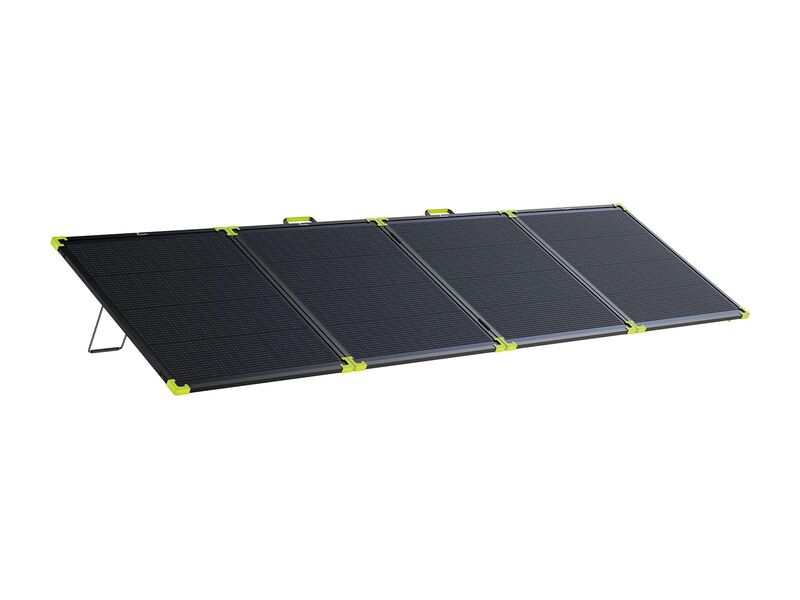
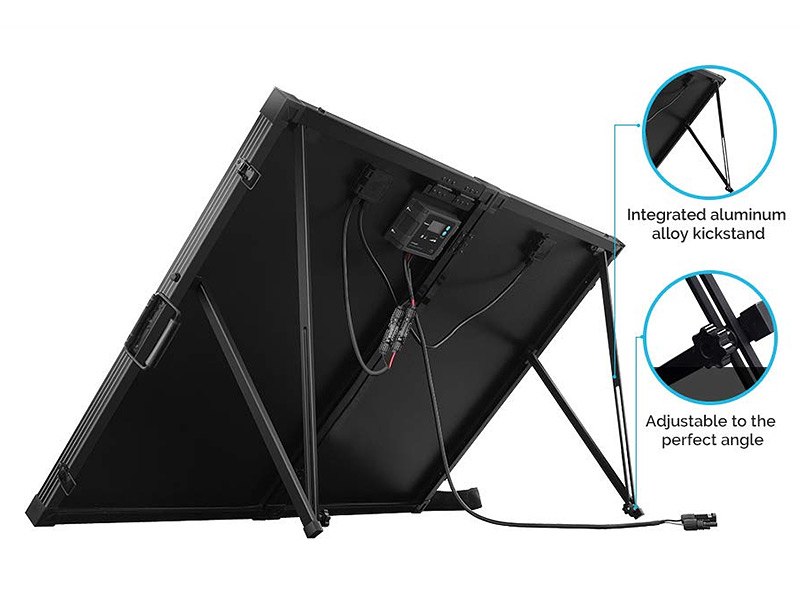
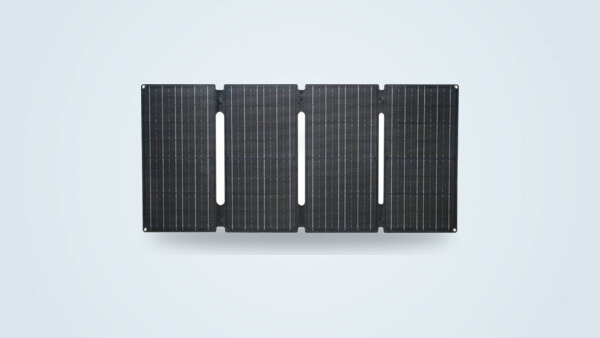
Portable solar panels

A portable solar panel comes down to three figures that spec sheets rarely give together: real yield under cloud, folded weight and the output connector.

The peak wattage printed on the box is measured in a laboratory, under perfect sunlight and at 25 °C. In real use, expect 60 to 75 per cent of that figure in full summer sun, and considerably less under a hazy sky. That is why we publish what we actually measured for each model rather than the manufacturer's number alone. The second criterion is the folded format: a 200 W panel that will not fit in a car boot is of no use. The third is the connector, MC4, XT60, XT60i or Anderson, which decides whether the panel will talk to your power station without an adapter.

▽
No product matches these criteria.

Our selection

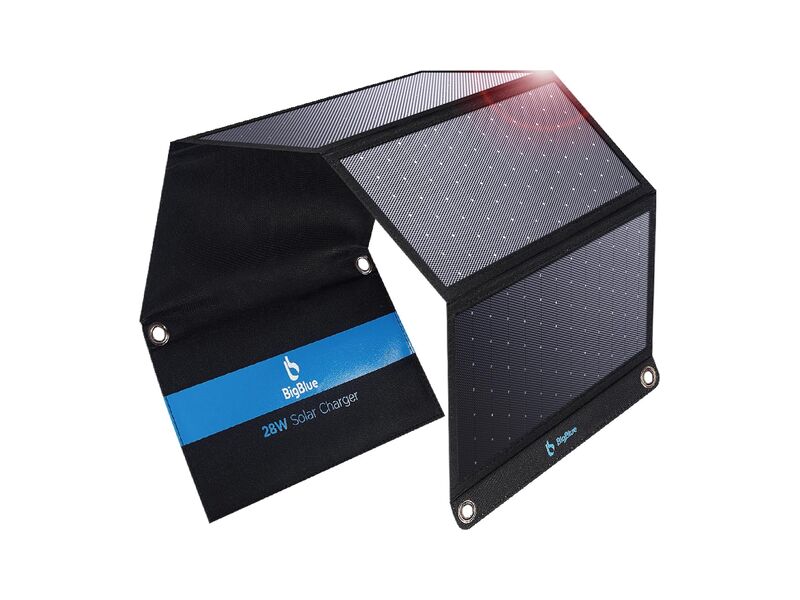
28W BigBlue 28W foldable solar charger
Sale

BigBlue 28W

See price and availability (48)

A panel that folds into your pack and charges three devices at once in the sun: high-efficiency cells, three USB ports, and real weather resistance.

  • Power: 28W
  • Ports: 3 (2 USB-C + 1 USB-A), 5V/4.8A combined
  • Cells: Monocrystalline N-type (~25%)
  • Resistance: IP44 (rain, splashes)
  • Charges 3 devices at once, high-efficiency cells
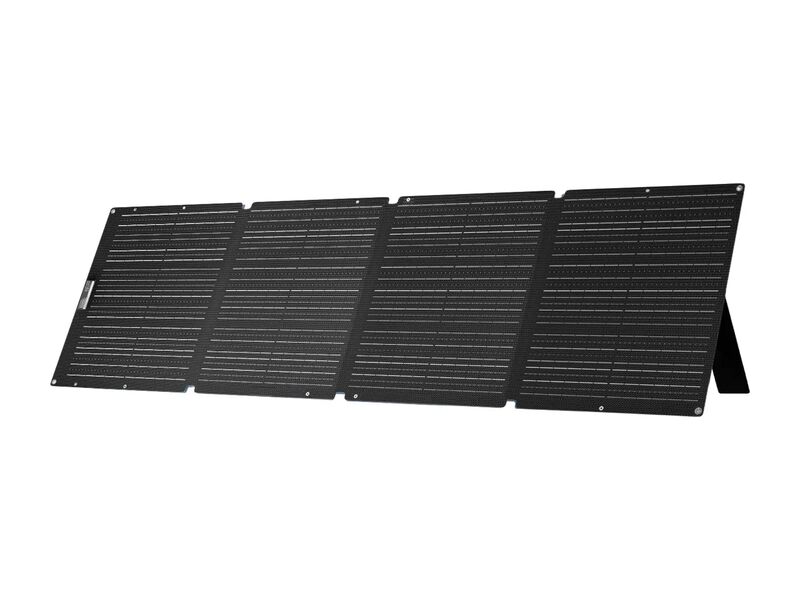
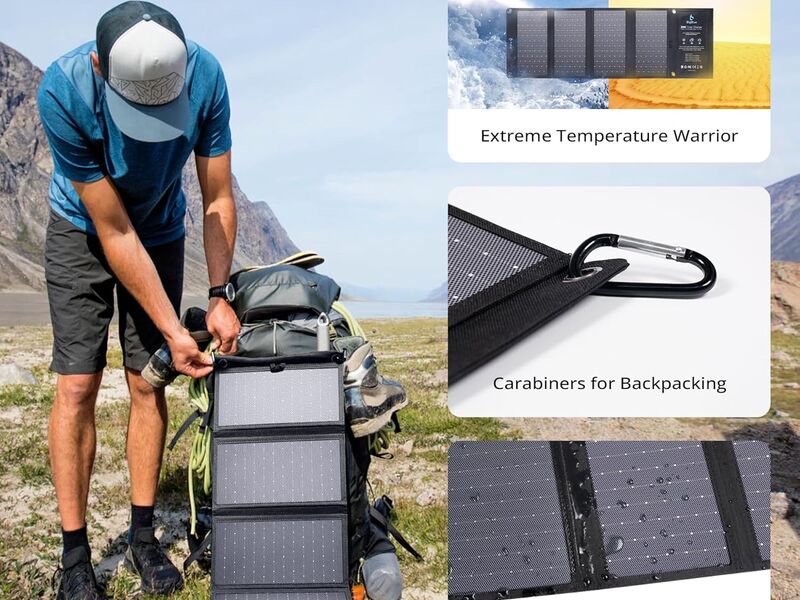
The BigBlue 28W is a foldable solar charger built for hiking, backpacking, and emergency kits. Its monocrystalline N-type cells convert around 25% of sunlight into power, among the best for a panel this size. Three ports, two USB-C and one USB-A, deliver up to 5V/4.8A combined, enough to charge a phone, a power bank, and earbuds at once. Light and IP44 splash resistant, it folds to roughly the size of a hardcover book and clips onto a pack with the included carabiners. Note: it has no battery, it only produces power in direct sunlight.
In-depth reviewRead our full review → 3.7/5 The BigBlue 28W is the kind of gear you toss in a pack without a second thought and end up relying on daily. On a multi-day backpacking trip, clipped to the outside of a pack with the included carabiners, it kept a power bank topped off in full sun, often at a speed close to a wall outlet. Having three ports matters more than it sounds: one afternoon it charged a phone and a headlamp battery at the same time with no real slowdown. The N-type cells hold up better than budget panels once a few clouds roll in, they keep producing rather than stalling out. Build quality is solid, reinforced fabric, sturdy stitching, and it folds down small enough for a side pocket. Two honest caveats: there is no battery inside, so pair it with a power bank to actually store the energy, and like any panel, output drops fast once it is in the shade or angled away from the sun. For a dependable, affordable way to keep devices charged off the grid, it is easy to recommend.
View product page
Solax SE200 Allpowers 200W portable solar panel
Promo

Allpowers Solax SE200

$319.00 $139.00 (24)

Foldable, IP68 waterproof and up to 25% efficient, the Allpowers Solax SE200 solar panel charges power stations anywhere, at $139 on Amazon.com.

  • Power: 200 W
  • Efficiency: 23 to 25%
  • Cells: Monocrystalline
  • Rating: IP68 waterproof
  • 23-25% efficiency, foldable, IP68, 2,015 Amazon ratings
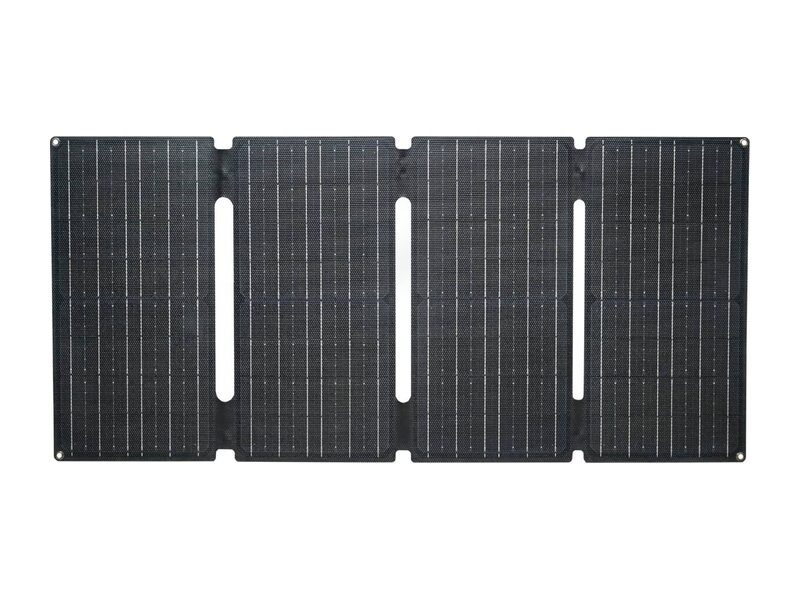
The Allpowers Solax SE200 delivers 200W from high-efficiency monocrystalline cells rated 23 to 25%. Foldable with adjustable kickstands, it deploys in seconds to recharge a power station while camping, in a van or during an outage, and its IP68 rating handles rain and dust. On Amazon.com, this exact panel is a well-established listing with 2,015 ratings across its size range and real buyers logging output from under 40W to over 300W depending on conditions and station. Compatible with most power stations on the market.
In-depth reviewRead our full review → 4.0/5 With over 2,000 ratings on Amazon.com and a real track record going back years, the Solax SE200 is one of the more battle-tested portable panels in its price range, and real owner reports paint an honest picture. Output varies a lot by conditions and connected station, as it does with any portable panel: some buyers report 120 to 140W in good sun, in line with the usual 60 to 70% of rated peak, while a few report struggling to clear 35 to 40W and needed Allpowers support to swap a defective unit, which the company did. The foldable kickstand design draws consistent praise for being genuinely field-ready, and the parallel wiring (rather than series) is a real plus if part of the panel ends up in shade. At $139, discounted from $189, it undercuts many rivals with similar efficiency claims by a wide margin. Two honest notes from real buyers: unfolded it is a genuinely large panel at over six feet long, and the included adapters do not fit every station out of the box, so check your station's input before ordering. For the price, it remains easy to recommend.
View product page
Solax SE60 Allpowers Solax SE60 60W portable solar panel
Promo

Allpowers Solax SE60

$99.99 $65.99 (24)

60W of light, foldable solar power: the Allpowers Solax SE60 recharges phones, power banks and small stations, at $59.55 on Amazon.com.

  • Power: 60 W (monocrystalline)
  • Efficiency: Up to 25%
  • Ports: USB-A, USB-C, DC
  • Format: Foldable, about 3 lbs
  • 60W foldable, 25% efficiency, 3 USB/DC ports
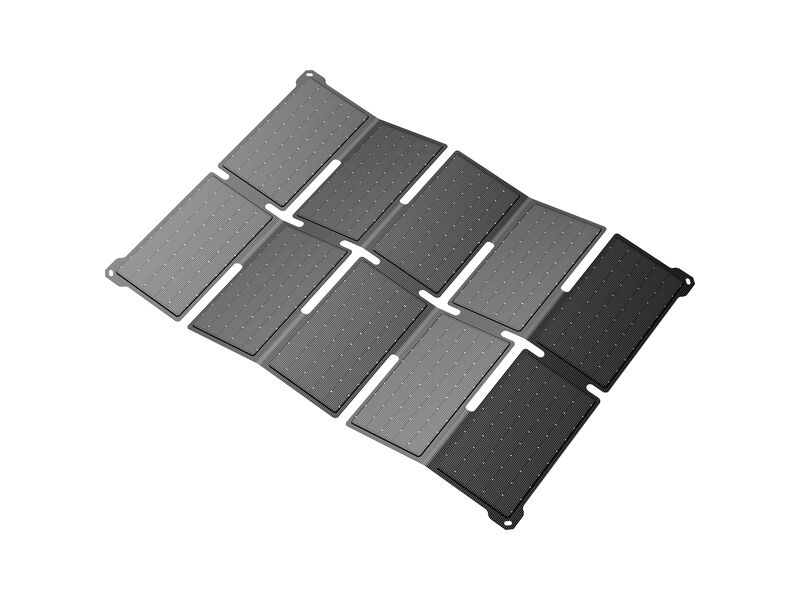
The Allpowers Solax SE60 is a 60W portable solar panel built for mobility, with monocrystalline cells rated up to 25% efficiency. Foldable and light at about 3 pounds, it slips into a backpack and deploys in seconds to recharge a phone, power bank or small station in the sun. On Amazon.com, the exact same listing sold as the 200W SE200 shares a combined 2,015-rating history at 4.2 stars, and this smaller 60W size is currently in stock at $59.55.
In-depth reviewRead our full review → 3.7/5 The SE60 shares its Amazon listing and review history with the larger SE200, so its 4.2-star average across 2,015 ratings reflects the whole Allpowers Solax panel line rather than this size alone, worth knowing going in. That said, the story real buyers tell fits the smaller panel well: light, genuinely pocketable at about three pounds, and enough to keep a phone or small power bank topped up through a day outdoors. One Amazon reviewer testing a similar small panel logged around 50 watts of real output at midday in decent sun, a strong result for this class. USB-A, USB-C and DC ports cover most small devices without extra adapters, and the IP68 build shrugs off a light shower. Keep expectations realistic, as with any small panel: 60 watts is meant for topping off phones, power banks and compact stations, not quickly refilling anything larger, and output drops fast the moment a cloud or shadow crosses it. At $59.55, discounted from $65.99, it is an easy, low-cost way to add real solar charging to a hiking or camping kit.
View product page

BigBlue P35

See price and availability (22)

An ultralight 1.54 lb (0.7 kg) foldable solar panel that charges fast with PD 25W and a dual parallel circuit, even when part of it sits in the shade.

  • Power: 35W (USB-A QC 18W + 2 USB-C incl. PD 25W)
  • Weight: 1.54 lb (0.7 kg), folds to 8.3 x 4.8 x 1.9 in (21 x 12.3 x 4.8 cm)
  • Cells: Monocrystalline, 25.4% efficiency
  • Waterproofing: IP68 (panel)
  • Keeps charging in the shade via its dual parallel circuit
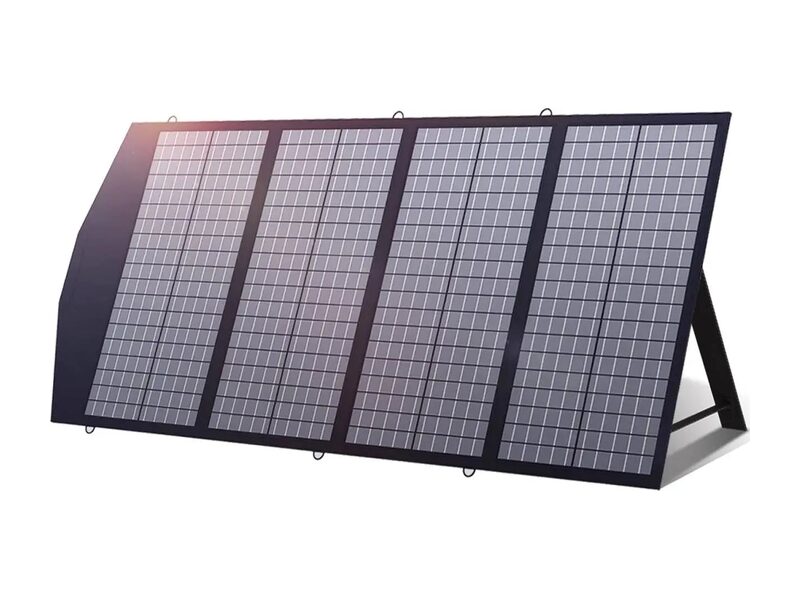
The BigBlue P35 is a foldable solar panel built for hiking and RV trips. Its monocrystalline cells reach 25.4% efficiency and deliver up to 35W across three ports (USB-A QC 18W plus two USB-C, one of them PD 25W with PPS). Its dual parallel circuit keeps producing power even if one section falls into shade. Folded down to the size of a paperback (8.3 x 4.8 x 1.9 in), IP68 waterproof and weighing just 1.54 lb (0.7 kg), it has no built-in battery: it charges directly in the sun, so pair it with a power bank to store the energy.
In-depth reviewRead our full review → 4.0/5 The BigBlue P35 has been riding in my pack for the past few camping trips, and the first thing you notice is the weight: at just 1.54 lb (0.7 kg), it disappears into a side pocket without adding real bulk. Laid flat on a rock in full sun, it topped off a 20,000 mAh power bank in a single good day, and the PD 25W port makes quick work of an almost dead battery. The two carabiners clip straight onto a pack strap, handy on the trail. One honest downside, echoed by plenty of other owners: under a hazy sky or at a less than ideal angle, real output drops well below the advertised 35W, some report barely 15 to 20W in those conditions. The dual parallel circuit does help once part of the panel slips into shade, but it will not work miracles in bad weather. With no built-in battery, you will need a power bank to actually store what it produces. Even so, for a lightweight, waterproof solar charger you can toss in any pack, it remains an easy one to recommend.
View product page

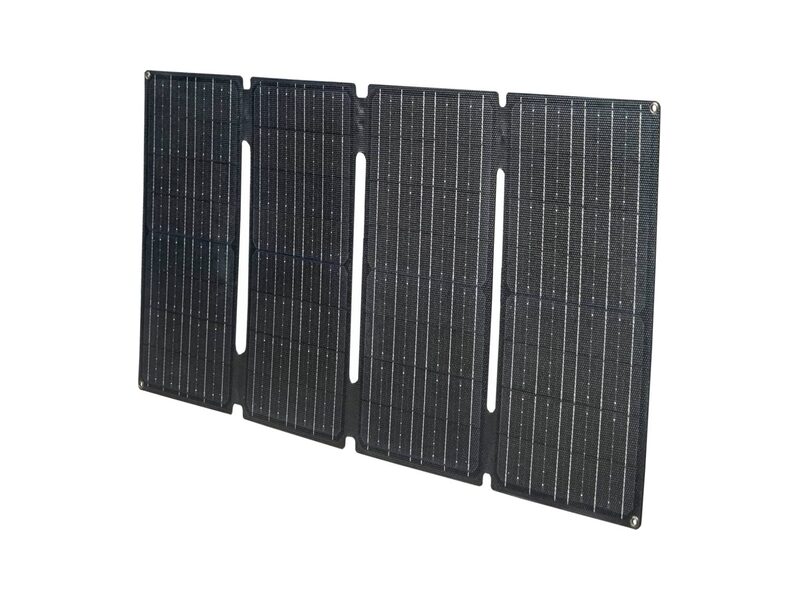
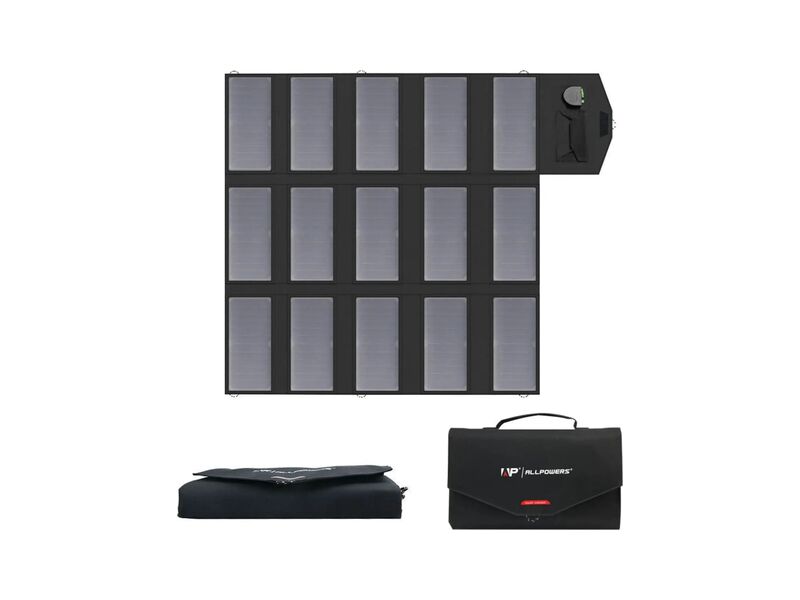
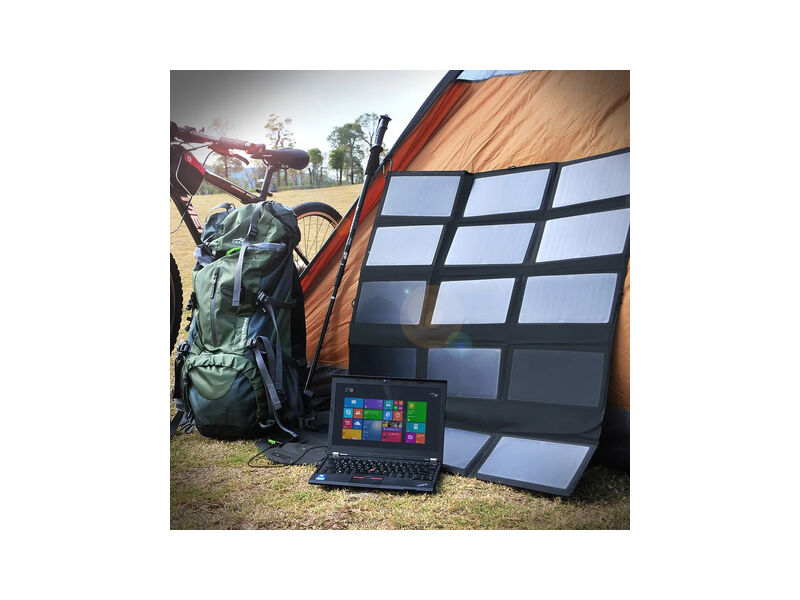
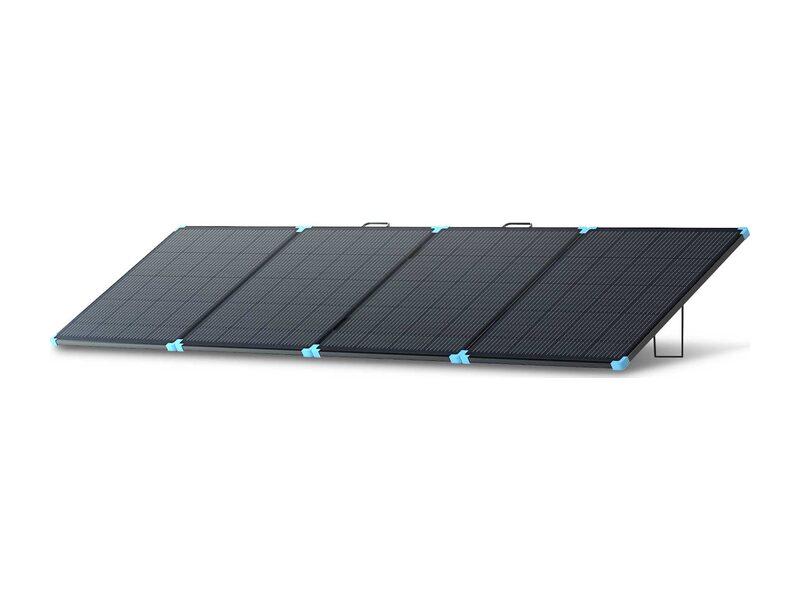
Allpowers SP029 Solar Panel 140W

$132.00 (11)

Four panels, 140 watts and an MC4 output rated for 25 amps: enough to refill a power station over a day, then fold the whole thing under your arm.

  • Output: 140 W, cells rated at 22 % efficiency
  • Main connector: MC4 up to 25 A, 10 A DC port
  • Direct outputs: 2 USB 5 V/2.4 A and 18 V/3 A
  • Format: 4 folding panels, 9.9 lb (4.49 kg), stand included
  • The 25 A MC4 fits almost every power station
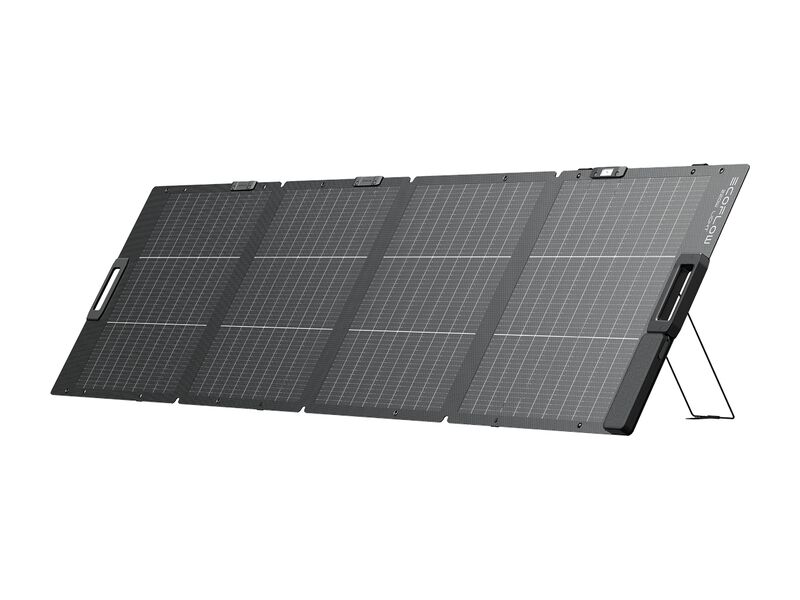
The SP029 is the big foldable in the Allpowers range, the one aimed at refilling a power station rather than rescuing a phone. Its four panels deliver 140 watts through an MC4 connector rated for up to 25 amps, the standard that almost every solar generator on the market expects. Two 5 V/2.4 A USB ports and an 18 V DC socket round things off, so you can power a phone or a laptop directly without going through a battery. At 9.9 lb (4.49 kg) it stays portable, and the built-in stand lets you tilt it towards the sun.
In-depth reviewRead our full review → 3.9/5 The SP029 has a very clear place in the Allpowers line-up: it is the panel you buy when you already own a power station and want to refill it without a gas generator. The advertised 140 watts is a laboratory peak figure, and in real use you should expect 90 to 110 watts on a good summer day, less as soon as the sun drops or the sky hazes over. That is the industry norm rather than a flaw specific to this model, but it is worth knowing before planning your day around it. The real argument lies elsewhere: the MC4 output accepts 25 amps, which makes it compatible with almost every solar generator sold today, and the bundled cable kit covers Anderson plugs, common DC barrel connectors and alligator clips for a car battery. The two USB ports and the 18 V socket also let you use it on its own, without a station, which not every competitor offers. The four panels unfold to a little over 5.2 ft (1.6 m), so you need space and reasonably flat ground, and the 9.9 lb (4.5 kg) make themselves felt on a backpack, even if they remain reasonable for the deployed area. The product is easy to sum up: solid and versatile, without being the best performer or the best finished in its category. For the money, it is a very coherent companion to a power station.
View product page

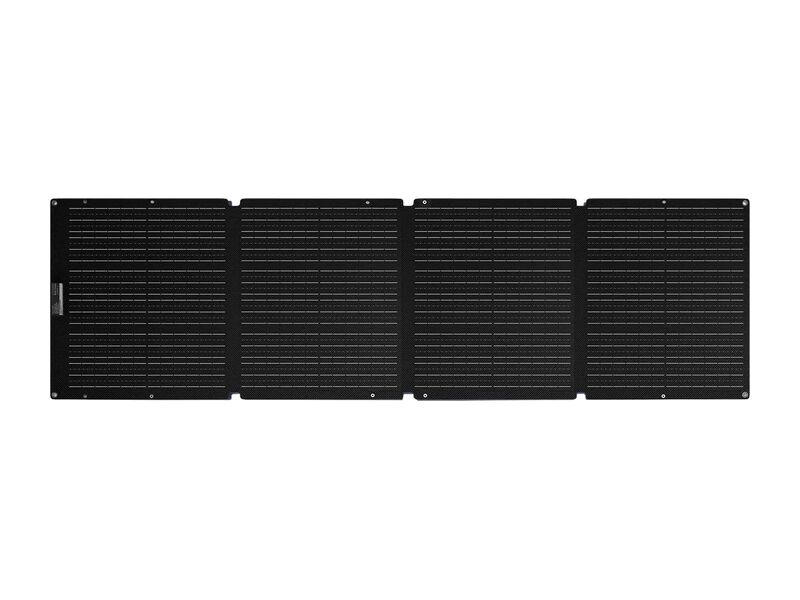
EcoFlow 220W solar panel

See price and availability (10)

A bifacial panel that catches the sun on both sides: up to 25% efficiency, built-in XT60 cable, adjustable 30 to 60° stand and IP68 protection for every trip.

  • Power: 220W, bifacial design (up to 25%)
  • Connection: Built-in XT60 cable (EcoFlow stations)
  • Stand: Adjustable 30 to 60°, angle guide
  • Durability: IP68 rating, 5-year warranty
  • Bifacial up to 25%, foldable, IP68
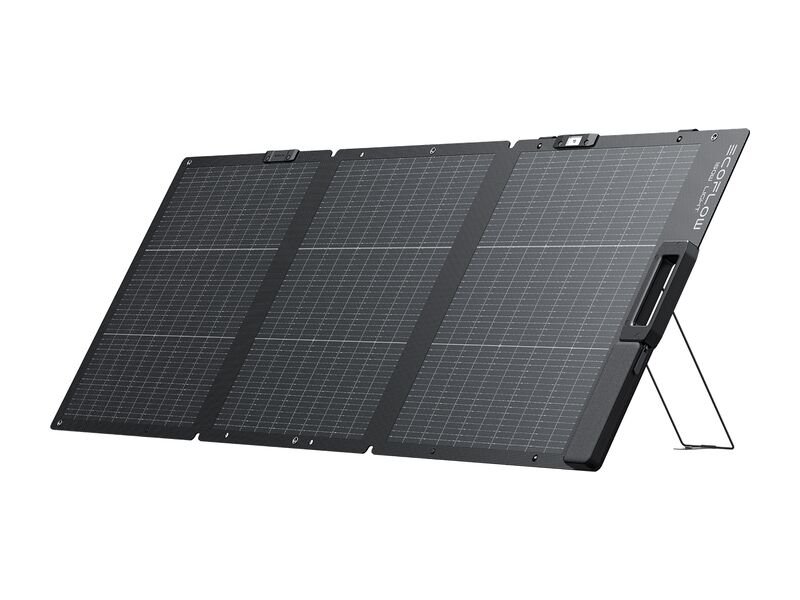
The EcoFlow 220W portable solar panel uses a bifacial design: its front face catches direct sun, its rear face recovers reflected light, for a conversion efficiency of up to 25%. Foldable and light, it travels easily and deploys on an adjustable 30 to 60° stand, with a built-in solar angle guide to aim for the best sunlight. Its XT60 cable is built in for easy storage and direct connection to EcoFlow power stations (River and Delta series). IP68 certified against water and dust, it carries a 5-year warranty, ready for camping, van life or off-grid autonomy.
In-depth reviewRead our full review → 4.1/5 We used this 220W panel to recharge a power station while wild camping, and the bifacial design really makes a difference: placed on a light surface or grass, it grabs extra watts through its rear face, and you feel the gain on recharge time compared with a classic panel of equivalent power. The built-in solar angle guide is clever, you tilt the stand between 30 and 60° until you find the best yield, no guesswork. The already-integrated XT60 cable avoids carrying adapters and plugs straight into our EcoFlow stations. It folds neatly into its case and stays transportable, though it must be said that at 220W it is not the lightest, around 11.2 lb (5.1 kg). The IP68 rating is reassuring when the weather turns, we left it out in a shower with no issue. Two honest caveats: the 25% efficiency depends on ideal placement (a reflective surface behind), and its deployed footprint needs a bit of space. But to quickly recharge a station in the sun, it is an excellent portable panel.
View product page

EcoFlow 400W solar panel

$743.35 (9)

Big portable solar power: 400W bifacial up to 25% efficiency, a 3-angle stand and a built-in XT60 cable to recharge a large station in record time.

  • Power: 400W, bifacial design (up to 25%)
  • Connection: Built-in XT60 cable (EcoFlow stations)
  • Stand: 3 angles (30/45/60°) + sun guide
  • Durability: IP68 rating
  • 400W bifacial, 3-angle stand, IP68
The EcoFlow 400W portable solar panel is the most powerful in the portable range: its bifacial design catches the sun on both faces for a conversion efficiency of up to 25%, enough to recharge a large power station in record time. Despite its power, it stays foldable and transportable, and deploys on a three-angle stand (30°, 45°, 60°) with a built-in sun exposure guide. Its XT60 cable is built in for easy storage and direct connection to EcoFlow stations. IP68 certified against water and dust, it is the portable panel of choice for off-grid autonomy.
In-depth reviewRead our full review → 3.8/5 At 400W, this panel plays in a different league from classic portable models: it is the one you bring out to quickly recharge a large power station, and it delivers. In full sun, the bifacial design grabs extra watts from the rear, and we saw our station climb noticeably faster than with a 200W panel. The three-angle stand (30, 45, 60°) and the built-in exposure guide help find the best yield with no guesswork, and the already-in-place XT60 cable plugs straight into our EcoFlow stations. It stays foldable and transportable, but let's be clear: at 400W it is large once deployed and needs space, this is not a panel you carry for a simple day trip. The IP68 rating is reassuring when the weather turns. One point to note: EcoFlow advises against leaving it hung permanently outside or on a vehicle, it is made to be deployed then stowed, not for a fixed installation. To quickly recharge a large station while camping or off-grid, it is the most efficient panel in the range.
View product page

EcoFlow 110W solar panel

$201.75 (9)

The compact, clever portable panel: bifacial design up to 25% efficiency, built-in XT60 cable, adjustable 30 to 60° stand and IP68 protection for every trip.

  • Power: 110W, bifacial design (up to 25%)
  • Connection: Built-in XT60 cable (EcoFlow stations)
  • Stand: Adjustable 30 to 60°, sun guide
  • Durability: IP68 rating, 5-year warranty
  • Bifacial up to 25%, compact, IP68
The EcoFlow 110W portable solar panel brings the range's bifacial design in a compact, affordable format: its front face catches direct sun, its rear face recovers reflected light, for a conversion efficiency of up to 25%. Light and foldable, it deploys on an adjustable 30 to 60° stand with a built-in sun exposure guide. Its XT60 cable is built in for direct connection to EcoFlow power stations (River and Delta series). IP68 certified against water and dust and backed by a 5-year warranty, it is the ideal solar companion to recharge a compact station as the sun moves.
In-depth reviewRead our full review → 4.0/5 The EcoFlow 110W panel is the solar companion you take without thinking: light, compact once folded, it slips easily into the van or the trunk. Once deployed on its stand, you aim it between 30 and 60° using the exposure guide, and the bifacial design, taken from the more powerful models, grabs a few watts from the rear as soon as you place it on a light surface. The already-integrated XT60 cable plugs straight into our compact EcoFlow stations, no adapter. On a sunny camp, it kept a River charged effortlessly, and the IP68 rating let us leave it out without worry. Two honest caveats: 110W is a modest power, ideal for a top-up or a compact station but not enough to quickly recharge a large station (for that, aim for the 220W or 400W), and like any bifacial panel, maximum yield depends on good placement. But for a versatile, light and durable portable panel at a contained price, it is a very good entry into the range.
View product page

Fossibot SP200 Pro

$256.00 (8)

Foldable and bifacial, the Fossibot SP200 Pro solar panel captures light on both sides to produce more over snow, sand or bright concrete.

  • Power: 200W bifacial (+10 to 15%)
  • Efficiency: Up to 25%
  • Waterproofing: IP67
  • Weight: 14.3 lb (6.5 kg)
  • Bifacial +15%, IP67, just 14.3 lb (6.5 kg)
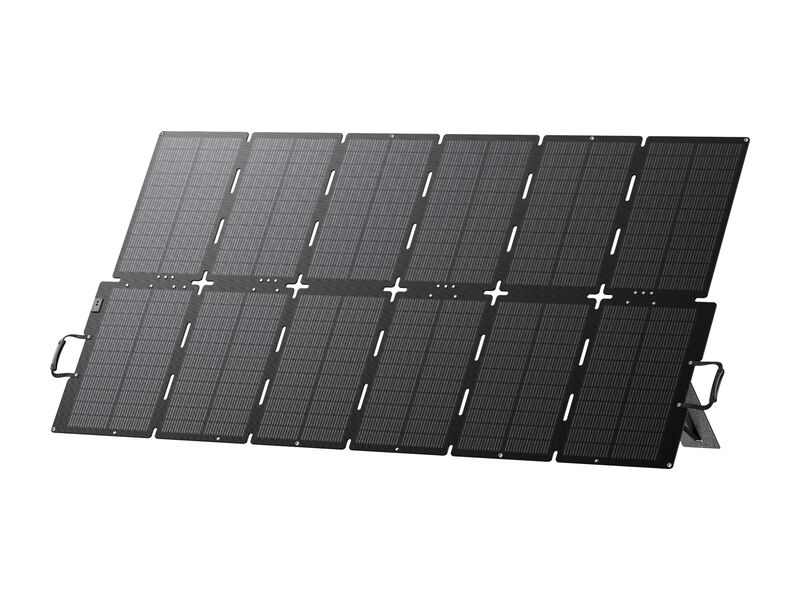
The Fossibot SP200 Pro is a portable bifacial 200W solar panel, able to produce 10 to 15% extra energy by capturing light reflected off snow, sand or concrete. It succeeds the SP200 with more efficient cells, a reinforced aluminum frame and bypass diodes that prevent overheating in shade. Rated IP67 and built to operate from 14 °F to 158 °F (-10 °C to 70 °C), it is about 20% lighter than its predecessor and folds into four sections, with a universal MC4 connector and an included MC4-to-XT60 cable.
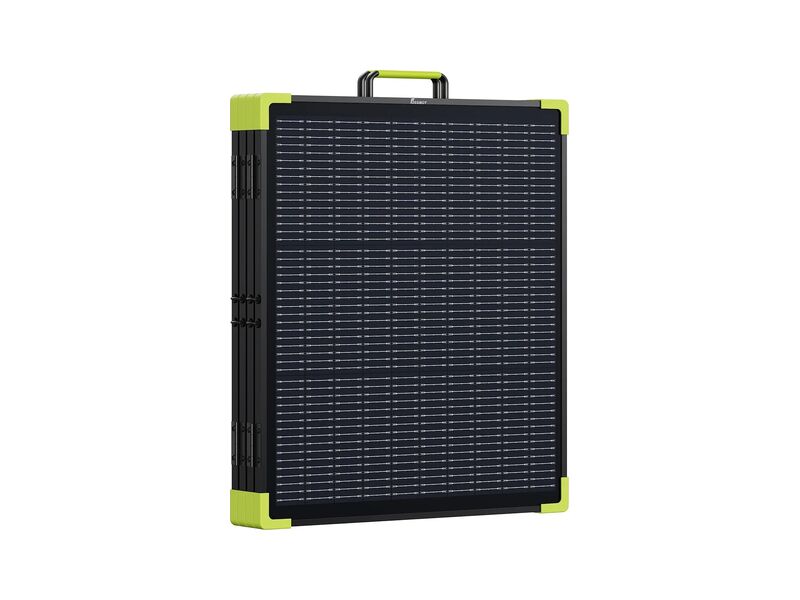
In-depth reviewRead our full review → 3.9/5 The SP200 Pro wins you over first with its format: folded into four sections it fits in a 23.7 x 20.5 in (60 x 52 cm) square with its carry handle, and at 14.3 lb (6.5 kg) it is easy to move around, about 3.4 lb (1.5 kg) less than the old SP200. Unfolded, the rear side does its job mostly over a bright surface (concrete, gravel, snow): the 10 to 15% quoted by Fossibot is a ceiling, not an average, and grass or dark soil add almost nothing. Fossibot itself states that real output sits between 70 and 85% of peak power, so roughly 140 to 170W, which is normal for a panel of this class. Two honest gripes: the angle is fixed at 35° with no adjustment, so you have to turn the whole panel toward the sun, and the 2-year warranty is shorter than the 5 years offered by some rivals. The supplied MC4-to-XT60 cable is 4.9 ft (1.5 m) long, so bring an extension if the station stays under cover. For the money, a light, sturdy bifacial 200W panel that sits well next to a Fossibot station.
View product page

Goal Zero Nomad 100

See price and availability (8)

100W foldable, built-in Yeti-compatible cables and a fold-out kickstand: Goal Zero's nomad solar panel for van life, hiking or home backup.

  • Power: 100W
  • Weight: 10.1 lb (4.6kg)
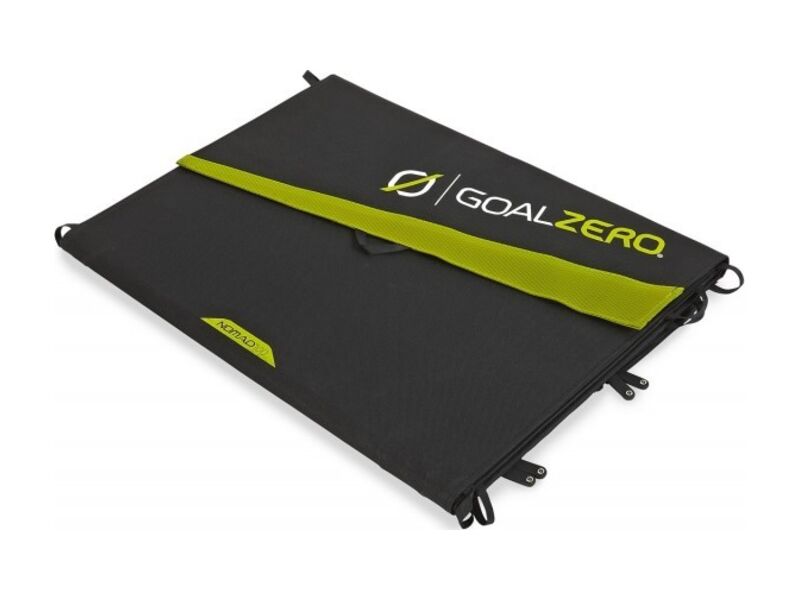
  • Dimensions: 20.5x59.5 in (52x151cm) unfolded, 20.5x15.5 in (52x39cm) folded
  • Compatibility: Yeti X range, 0.3 in (8 mm) connector
  • Built-in Yeti-compatible cables, monocrystalline cells
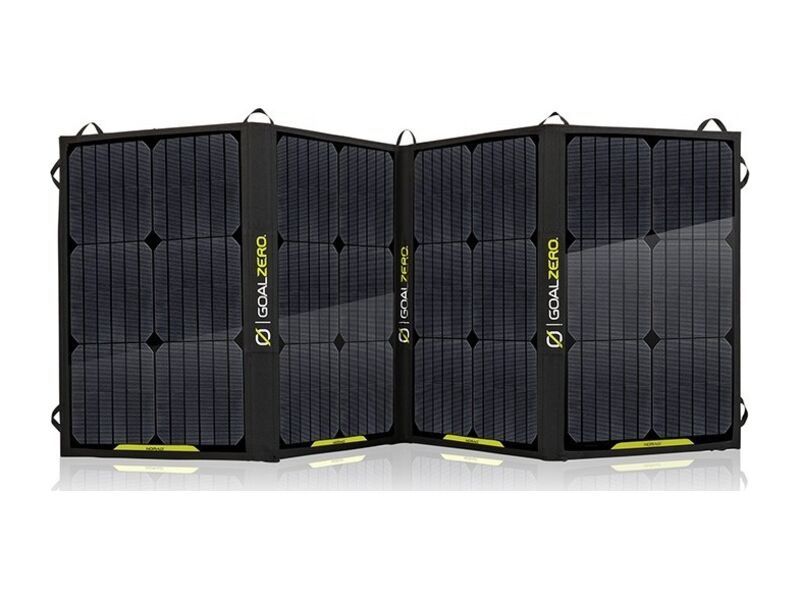
The Goal Zero Nomad 100 is a foldable 100W portable solar panel with monocrystalline cells, designed to recharge Goal Zero's Yeti power stations directly through its built-in cable and proprietary 0.3 in (8 mm) connector. Fitted with a fold-out kickstand for easy sun angling, it folds down to 20.5x15.5x2 in (52x39x5cm) for van, hiking or camping travel. Unlike some rival nomad panels, it has no direct USB output: it needs to be connected to a station to charge a device.
In-depth reviewRead our full review → 3.7/5 The Nomad 100 wins you over with its simplicity: the cable is already built into the panel, and its 0.3 in (8 mm) connector plugs directly into the whole Yeti X range with no adapter to hunt down. Its fold-out kickstand is well designed for quickly angling the panel toward the sun, a real plus over panels you have to prop up with whatever's at hand. Unfolded (20.5x59.5 in), it captures light efficiently in good weather thanks to its monocrystalline cells. Folded to 20.5x15.5x2 in, it packs easily into a van or a backpack, though 10.1 lb is noticeable on a lightweight trek. The real downside: no direct USB output, unlike some rivals that let you charge a phone without a station in between. As with any solar panel, the rated 100W is only reached in ideal sunlight conditions. For anyone who already owns a Yeti X, it's a straightforward, hassle-free choice; for more general use with direct USB charging, other panels are a better fit.
View product page

Anker Solix PS200

See price and availability (7)

200W bifacial and barely 10.6 lb (4.8 kg): the foldable solar panel that captures light on both faces to produce up to 10% more energy. The lightest in its class.

  • Power: 200 W bifacial (N-type cells)
  • Efficiency: Over 25%, +10% bifacial
  • Weight: 10.6 lb (4.8 kg), foldable
  • Protection: IP68, adjustable stand 30-80°
  • 200W bifacial, 10.6 lb (4.8 kg), IP68
The Anker Solix PS200 is a 200 W bifacial portable solar panel that captures light on both faces: the rear side recovers reflected light (sand, snow, concrete) to add up to 10% energy. Its next-generation N-type cells exceed 25% efficiency, and it weighs just 10.6 lb (4.8 kg), over 30% less than a classic 200W panel. IP68 certified, it resists water and dust, and its adjustable multi-angle stand (30 to 80°) orients it ideally toward the sun. Compatible with Anker Solix stations (F2000, C1000X, C800X, C300X) and any generator with an MC4 input.
In-depth reviewRead our full review → 4.2/5 The PS200 wowed us on two points: its lightness and its bifacial design. At 10.6 lb (4.8 kg), it is one of the rare 200 W panels you carry without complaint, and the adjustable stand is genuinely well thought out, you set the angle in seconds depending on the sun's position. The rear face is no gimmick: placed on light sand, a concrete terrace or snow, you really do gain a few percent of output, which counts at the end of the day. The N-type cells keep their promises in good weather, and the IP68 rating is reassuring, you do not stress if a shower catches the bivouac. Compatibility with Anker Solix stations (F2000, C1000X, C800X, C300X) via MC4 is a real plus to stay in the ecosystem. Two honest caveats: like any portable panel, orientation remains decisive and output drops fast in the shade, and the bifacial gain depends heavily on the ground surface. But for a 200 W panel that is light, rugged and smart all at once, it is a very fine success.
View product page

EcoFlow 60W solar panel

$99.00 (5)

A pocket EcoFlow solar panel: charge your phone or tablet via its USB-C port (15W), or a power station at full power via its included DC5521 to XT60i cable, in a format as thin as a book.

  • Power: 60W via DC5521 connector (cable included), USB-C port capped at 15W
  • Efficiency: Up to 25% (TOPCon technology)
  • Format: 4-fold, 12.5 x 12.2 x 1.8 in (317 x 309 x 45 mm) folded
  • Durability: ETFE, fiberglass, IP68
  • Ultra-compact, TOPCon 25%, dual USB-C/DC5521 output
The EcoFlow 60W portable solar panel is designed for two uses: its USB-C port charges phones, tablets and air pumps directly in the sun, capped at 15W, while a second DC5521 connector delivers the full 60W to an EcoFlow RIVER series power station via the included DC5521-to-XT60i adapter cable. Its four-fold structure measures just 12.5 x 12.2 x 1.8 in (317 x 309 x 45 mm) when folded, as thin as a book, and slips into a bag. Thanks to TOPCon solar technology, a first on compact panels, it reaches a conversion efficiency of up to 25%. Rugged (fiberglass circuits, ETFE coating) and IP68 certified, it withstands harsh conditions: the ultra-portable solar companion.
In-depth reviewRead our full review → 4.1/5 This 60W panel won us over for its different approach: here, no need for a power station, you plug the phone or tablet straight into its USB-C output and charge in the sun. It is strikingly simple on a hike or a light camp, you hang it on the bag or set it facing the sun, and devices climb back up. The format is its big asset: folded in four, it is as thin as a book and slips in anywhere, we carried it without even feeling it. The TOPCon technology, rare on such a compact panel, pushes efficiency up to 25%, which shows in charging speed compared with small entry-level panels. The fiberglass construction and ETFE coating, with IP68 certification, are reassuring for outdoor exposure. Two honest caveats: the USB-C port caps at 15W, perfect for small USB devices but not enough for a laptop (for the full 60W towards a RIVER power station, you need the DC5521 connector and its included cable), and real yield depends heavily on orientation and sunlight. But to charge your gadgets directly in the sun in a pocket format, it is exactly what you need.
View product page

Jackery SolarSaga 40W Mini

$126.22 (5)

The smallest SolarSaga: 40 W in a 2.6 lb (1.2 kg) foldable panel that slips into a backpack to feed a compact station at camp.

  • Power: 40 W (4 folding panels)
  • Efficiency: Around 23% (monocrystalline)
  • Weight: 2.6 lb (1.2 kg), backpack format
  • Durability: IP68, hanging carabiners and loops
  • 40 W for 2.6 lb (1.2 kg), genuinely hike-portable
The SolarSaga 40W Mini is the entry format of Jackery's solar range, designed for those who carry their gear rather than drive it around. At 2.6 lb (1.2 kg) with a four-panel fold, it stows flat against the back of a bag and deploys in seconds. Its monocrystalline cells reach around 23% efficiency, an excellent figure that offsets its small surface. It is ideal for feeding a compact station such as an Explorer 100 or 240, or for maintaining the charge of a portable battery over a multi-day hike.
In-depth reviewRead our full review → 4.0/5 We took this SolarSaga 40W Mini on a three-day trek, and it is the first Jackery panel we genuinely agreed to carry on our backs. The 2.6 lb (1.2 kg) goes unnoticed once strapped to a hiking pack, where a 100 W at 4 or 11 lb (5 kg) makes itself felt on the first climb. Deployment is immediate: two panels to unfold, and two carabiners to hang it from the pack or a branch, a practical solution even on stony ground. In full mountain sun, it kept an Explorer 240 station afloat throughout the trip, partially recharging it each afternoon during breaks. You have to be realistic about what 40 W represents: this is not a panel that fills a large station in a day, but a charge maintainer and a top-up for small devices. Seen that way, it does exactly its job. Build quality is Jackery's usual standard, with a solid fabric cover and a practical handle. Two caveats: the price per watt stays high compared with bigger panels, and under cloud cover output drops fast given the small surface. For hiking and light bivouac, it is still the most sensible format.
View product page

Sunslice Fusion Flex 12W

$135.39 (4)

A flexible 12W solar panel weighing just 8.5 oz (240 g), folding down to A4 size: the ultra-light way to recharge your phone while hiking or bikepacking.

  • Power: 12 W (CIGS cells, 16.5%)
  • Weight: 8.5 oz (240 g), folds to A4 size
  • Ports: 2x USB-A, 5V/2.4A
  • Durability: Scratch and water resistant ETFE coating
  • Ultra-light and flexible, unbreakable, pocket size
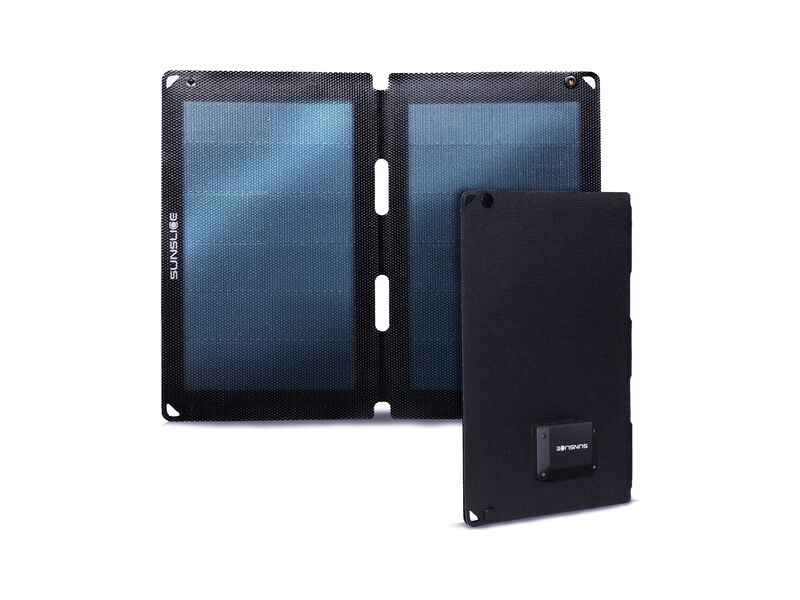
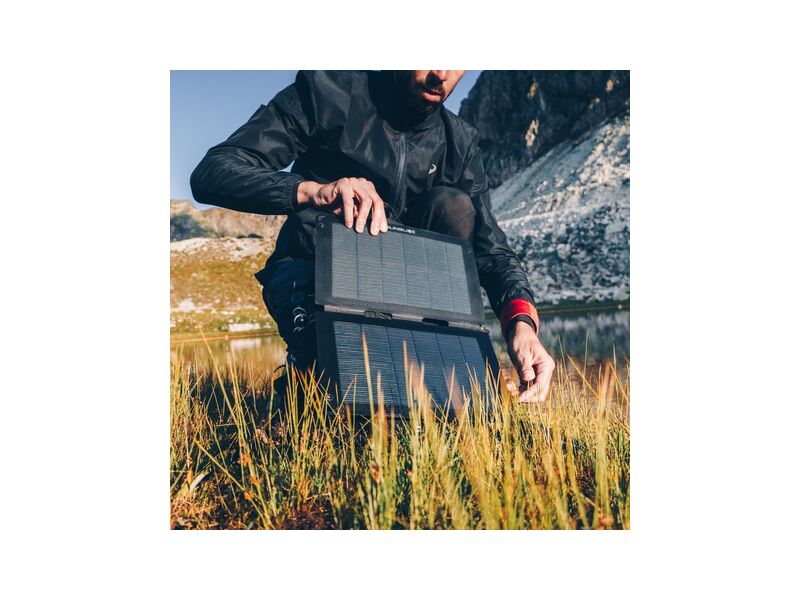
The Sunslice Fusion Flex 12W is an ultra-light 8.5 oz (240 g) portable solar panel built for hiking, bikepacking and self-sufficient travel. Its flexible CIGS cells, protected by a scratch-resistant, water-resistant ETFE coating, reach 16.5% efficiency, among the best for a flexible panel this size. Folded, it fits in a pocket at A4 size and weighs barely more than a smartphone. Its two USB-A ports with a charge indicator let you recharge two devices at once, without an intermediate battery.
In-depth reviewRead our full review → 3.4/5 The Fusion Flex 12W quickly earned its place in my hiking pack. Clipped by its corner loops to the back of the bag, it keeps producing while I walk, and I find a full powerbank waiting in the evening without ever thinking about it during the day. The LED indicator is a smart touch, one glance tells you if the angle is right without pulling out your phone. Its flexibility is genuinely impressive too, folded and unfolded dozens of times, set down on rocks, stuffed into a compression sack, without a single mark. One honest downside, with 12W and no built-in battery, you really need direct sun to notice fast charging, output drops noticeably under a hazy sky. As a genuinely light backup charger for trekking or cycling, it is a safe bet.
View product page

Bluetti MP200 200W

$399.00 (4)

200 W of foldable solar power to take anywhere: monocrystalline cells up to 23.4%, ETFE coating rated IP67 and adjustable kickstands to capture the best of the sun.

  • Power: 200 W (monocrystalline)
  • Efficiency: Up to 23.4%
  • Protection: IP67, ETFE coating
  • Connectivity: MC4, adjustable kickstands
  • 17.9 lb (8.14 kg), folds into four sections
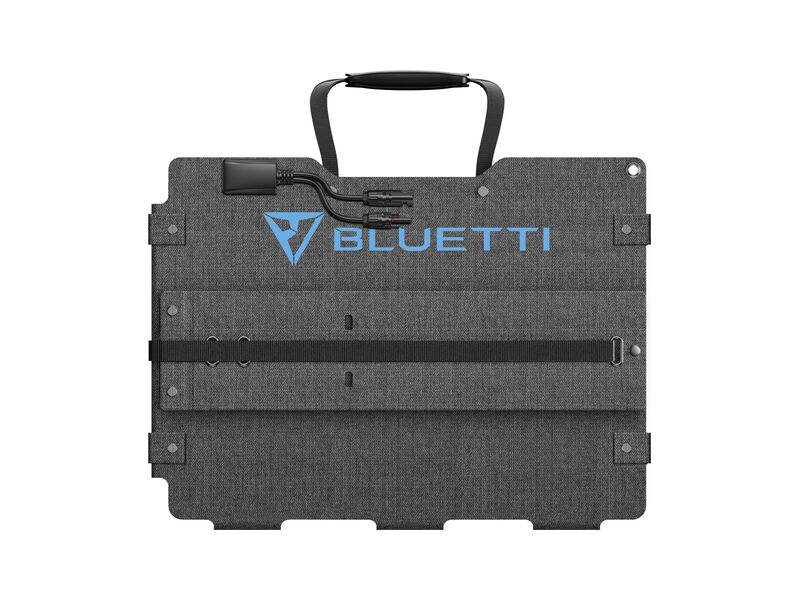
The Bluetti 200W, sold under the MP200 reference, is a 200 W portable solar panel designed to recharge your power stations in the sun. The current spec sheet quotes monocrystalline cells up to 23.4% efficiency, a 24.6 V open-circuit voltage, 17.9 lb (8.14 kg) on the scales and an IP67 rating. Foldable into four sections, it carries like a briefcase and deploys in under a minute thanks to its adjustable kickstands. Its standard MC4 output powers Bluetti stations but also most solar generators on the market. One thing to know before buying: Bluetti now groups several generations of 200 W panel under a single reference and warns that the model shipped can vary, so rely on the manual supplied with the unit you receive.
In-depth reviewRead our full review → 3.8/5 On paper this 200 W ticks the right boxes for a portable panel: four sections, a carry handle, adjustable kickstands and a universal MC4 output that makes it compatible with almost every station on the market, Bluetti or not. The quoted 23.4% efficiency puts it in the upper half of the category, and the claimed IP67 rating is more ambitious than the IP65 usually seen at this price. At 17.9 lb (8.14 kg) it stays easy to load into a van or a trunk, far less so to carry on a long hike. The real point of caution is commercial rather than technical: Bluetti now sells several panels under a single 200 W reference that share neither the same weight, nor the same open-circuit voltage, nor necessarily the same ingress rating, and warns itself that the model shipped can vary. Two buyers can therefore receive two different panels. You have to check the manual supplied with your unit before connecting it, and above all avoid wiring two different versions together. That reservation aside, it is a versatile and well equipped 200 W for extending the runtime of a power station.
View product page

Bluetti PV60 60W

$149.37 (4)

60W of solar power in barely 3.1 lb (1.4 kg): the ultralight foldable panel that slips into your bag to recharge phone, power bank and small stations out in nature.

  • Power: 60 W (monocrystalline)
  • Efficiency: Up to 24.7%
  • Weight: 3.1 lb (1.4 kg), foldable
  • Protection: IP65, ETFE coating
  • 60W, just 3.1 lb (1.4 kg), ultra-portable
The Bluetti PV60 is a 60 W portable solar panel built for mobility. At just 3.1 lb (1.4 kg), it folds into a compact format that slips easily into a backpack, onto a bike or into a tent. Its monocrystalline cells reach up to 24.7% efficiency, and its ETFE coating combined with an IP65 rating let it face dust and splashes. Ideal for recharging a phone, a power bank or a small Bluetti station (AC50P, AC180P, Premium 30 V2) on a hike, a bivouac or a day out.
In-depth reviewRead our full review → 3.9/5 The PV60 plays the lightness card and plays it well: at 3.1 lb (1.4 kg), you take it without a second thought, folded in the backpack or strapped to a bike. Deployed, it is plenty to keep a phone, a power bank or a small station charged during a bivouac or a long day outdoors. The ETFE coating and finish inspire confidence for a panel this size, and the IP65 rating is reassuring in case of morning dew or a short shower. You do need realistic expectations, though: 60 W is meant for portable top-ups, not for recharging a big station in a few hours, and like any small panel, it is very sensitive to orientation and shadows, output drops as soon as a cloud passes or a branch casts its shade. Well oriented in full sun, it nonetheless keeps its promises. For the hiker, cyclist or camper looking for genuinely portable solar for their small devices, it is a discreet and effective companion.
View product page
SP033 200W Allpowers SP033 200W foldable portable solar panel
Deal

Allpowers SP033 200W

$346.22 $218.85 (4)

200W of foldable solar power, a third lighter than average: the versatile portable panel that recharges your station in the sun, compatible with most generators.

  • Power: 200 W
  • Efficiency: Up to 22%
  • Weight: About 1/3 lighter, foldable
  • Compatibility: Anderson adapters, multi-connector
  • 200W foldable, light, multi-compatible
The Allpowers SP033 is a 200 W portable solar panel that aims for the best value. With an efficiency of up to 22% and a weight about a third lower than a classic panel of the same power, it efficiently recharges your power stations in the sun. Foldable and fitted with kickstands, it deploys in a minute and angles toward the sun. Its universal connectivity (with Anderson adapters and various connectors) makes it compatible with most solar generators on the market. A versatile portable panel for camping, the van or backup.
The SP033 plays the value card, and plays it well. Deployed, it unfolds in a minute, the kickstands hold decently, and it is easy to angle south to maximize the harvest. In strong sun, it easily recharges a several-hundred-Wh station over the day, enough to clearly extend runtime in a van or camping. We really appreciate its lightness, noticeably lower than classic 200 W panels, which changes everything when you have to move or store it. Its versatile connectivity, with Anderson adapters and various connectors supplied, makes it compatible with the vast majority of stations on the market, a real asset. Two honest caveats: like any panel, output drops fast as soon as a cloud passes or a shadow crosses the surface, so you have to reposition it, and the rated 200 W remains a theoretical value reached only in ideal conditions. To recharge a station in the sun without breaking the bank, it is an excellent choice.
View product page

Jackery SolarSaga 100W

$215.29 (4)

100W of solar power in a light, foldable panel with kickstands and USB outputs: enough to recharge a Jackery station or your devices straight from the sun.

  • Power: 100W (monocrystalline cells)
  • Efficiency: Up to 25%
  • Outputs: DC (Explorer stations), USB-C, USB-A
  • Design: Foldable, built-in kickstands, splash-resistant
  • Foldable 100W with direct USB outputs
The Jackery SolarSaga 100W is a portable, foldable solar panel with monocrystalline cells, offering a conversion efficiency of up to 25%. Designed to recharge Jackery Explorer power stations via its DC output, it also has USB-C and USB-A ports to power smartphones, tablets and cameras directly. Foldable with a handle and adjustable built-in kickstands, splash-resistant, it deploys in seconds and carries easily while camping or in a van.
In-depth reviewRead our full review → 4.0/5 The SolarSaga 100W is the logical companion for a Jackery station, and it does the job with real seriousness. Unfolded, it sets up in seconds thanks to its built-in kickstands, and well-aimed in full sun it easily climbs to around 60 to 70 real watts, enough to recharge an Explorer 300 or 500 within the day. What we like most is the versatility: on top of the DC output for stations, its USB-C and USB-A ports let you plug in a phone or a tablet directly, handy on a hike when you leave the station behind. Foldable and fitted with a handle, it slides flat into the trunk. Two honest gripes: like any panel, its output drops fast under hazy skies, and you have to re-aim it at the sun regularly to get the most out of it. For reliable, portable solar charging, it is a safe bet.
View product page

Callsun 110W N-Type Solar Panel

See price and availability (4)

N-Type cells at 25 % efficiency, an IP67 rating and 3.64 kilos: the foldable that bets on technology rather than surface area.

  • Output: 110 W, 19.8 V, N-Type 16BB cells
  • Efficiency: 25 %, against under 18 % for PERC
  • Weatherproofing: IP67, ETFE coating
  • Format: 8 lb (3.64 kg), folded 62 x 22.8 in (58 cm), 2 kickstands
  • 25 % efficiency for just 8 lb (3.64 kg)
The Callsun 110W plays a different card from its rivals: instead of piling on watts, it fits monocrystalline N-Type cells with sixteen busbars, a newer generation than the usual PERC cells, quoted at 25 % efficiency against under 18 %. The result shows in the power-to-weight ratio: 110 watts for just 3.64 kilos, folding down to 62 by 58 centimeters. The IP67 rating and ETFE coating make it indifferent to rain, and the supplied five-in-one universal cable covers XT60, Anderson and the most common DC plugs, plus two USB ports so you can do without a station.
In-depth reviewRead our full review → 4.0/5 The Callsun 110W arrived on the European market recently and it brings something the established foldables do not yet have: N-Type cells with sixteen busbars. Behind the jargon the idea is simple. The classic PERC cells fitted to most portable panels top out around 17 to 18 % efficiency. N-Type cells lose less performance as temperature rises and age more slowly, which explains the 25 % quoted here. In the field that mostly translates into an excellent power-to-weight ratio: 3.64 kilos for 110 watts, where many 100 watt panels exceed four and a half. Folded, it is the size of a large, slightly thick laptop, which makes it genuinely carryable by hand or strapped to the side of a bag. The IP67 rating is the other good news: most rivals settle for a vague "splash resistant" with no official figure, whereas here the value is stated and means temporary immersion is tolerated. You can therefore leave it out in a shower without rushing. The supplied five-in-one cable covers XT60, Anderson and DC 5521 and 7909 plugs, which settles compatibility with almost every station, and two USB ports let you use it on its own. The reservation concerns track record: the model is too recent for there to be data on how it holds up over time, where an established brand offers more reassurance. For a light, well-equipped panel under $176.02 the proposition remains very attractive.
View product page

Anker Solix PS400

See price and availability (4)

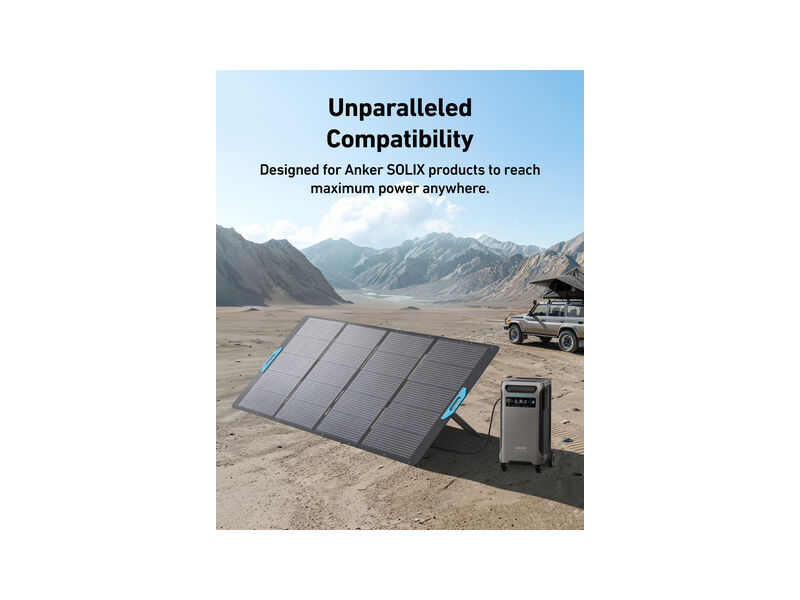
400W in monocrystalline cells at 23% efficiency, 4-angle stand and IP67 waterproofing: the portable panel built for Anker Solix power stations.

  • Power: 400W, monocrystalline cells (up to 23%)
  • Connection: MC4 connector
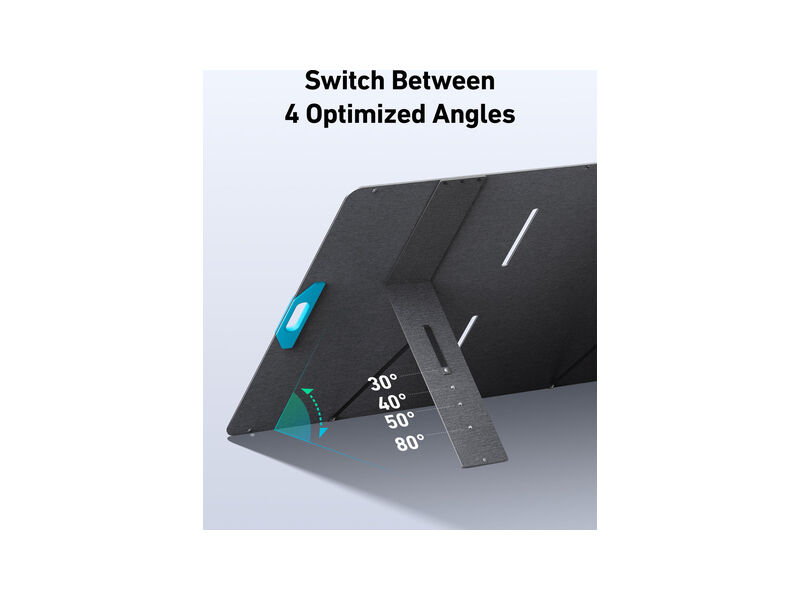
  • Stand: 4 adjustable angles (30/40/50/80°)
  • Durability: IP67 waterproofing
  • 400W, 4 adjustable angles, 2-year warranty
The Anker Solix PS400 portable solar panel delivers 400W using monocrystalline cells optimized for up to 23% conversion efficiency, 1.5 times more captured power than a standard panel according to Anker. Its built-in stand offers 4 adjustable angles (30°, 40°, 50°, 80°) to optimize sun exposure throughout the day. Fitted with an MC4 connector and IP67 rated, it remains foldable and transportable despite its power (35.1 lb (15.9 kg) unfolded at 2591 x 35.9 in (913 mm)). Backed by a 2-year warranty, it is built to quickly recharge large Anker Solix power stations.
In-depth reviewRead our full review → 3.9/5 The PS400 does exactly what you'd expect from a large portable panel: once unfolded, its 400W visibly recharges a large power station faster than an entry-level panel. The 4-angle stand (30 to 80°) is a real plus over conventional 2 or 3-notch stands, letting you fine-tune exposure by season and time of day. IP67 waterproofing is reassuring against a surprise shower while camping, and the MC4 connector remains the most widely used standard, compatible with most stations on the market via an adapter. Our main reservation: at 35.1 lb (15.9 kg) unfolded (2.6 m long), this is clearly not a panel for light nomadic use, more suited to a fixed base camp. Anker also states it is not built to stay installed outdoors permanently. For quickly recharging a large Anker Solix station on a van trip or extended camping, it does the job without surprises.
View product page
SP012 100W Allpowers SP012 100W foldable solar panel
Promo

Allpowers SP012 100W

$219.99 $189.00 (3)

100W of foldable solar with a dual USB output: the nomadic panel that directly charges your devices AND your power station, camping or on the road.

  • Power: 100 W
  • Efficiency: Up to 23.5%
  • Outputs: 2x USB and DC5525 (adapters included)
  • Compatibility: S200, S300, S700 and most power stations
  • 100W monocrystalline, dual USB output, cross-brand compatible
The Allpowers SP012 is a foldable portable solar panel with 100W and monocrystalline cells, reaching up to 23.5% efficiency. Unlike many nomadic panels, it offers a dual USB output alongside its DC5525 connector, to directly recharge a phone or tablet without going through a power station. It is explicitly compatible with the Allpowers S200, S300 and S700 power stations, and the included kit (5 connection adapters) makes it usable with most solar generators on the market. Light and foldable to 32×19×3.1 in (8 cm), it travels easily while hiking, in a van or camping.
In-depth reviewRead our full review → 3.6/5 The SP012 stands out for its dual USB output, a genuine convenience for directly recharging a phone or tablet without going through a power station. Its monocrystalline cells deliver good efficiency (up to 23.5%), and its kit of 5 connection adapters plus the DC5525 to DC5521 cable make it compatible with most power stations on the market, Allpowers and otherwise. Once unfolded to a 37 in (94 cm) square, it captures light efficiently in good weather; folded down to 32×19×3.1 in (8 cm) with its pouch, it travels easily while hiking or in a van. As with any solar panel, real-world yield depends heavily on orientation and sunlight, and the nominal 100W is only reached under ideal conditions. A handful of reviews mention the panel underperforming its rated output in cloudier conditions, worth keeping in mind if you're relying on it as a primary charging source. For directly recharging devices in the sun while keeping the option to plug in a power station, it remains a versatile, well-equipped choice.
View product page

EcoFlow 45W solar panel

See price and availability (3)

The smallest EcoFlow solar panel in the range: charge your phone or tablet via its USB-C port (15W), or a power station at full power via its included DC5521 to XT60i cable, in a mini format as thin as a book.

  • Power: 45W via DC5521 connector (cable included), USB-C port capped at 15W
  • Efficiency: Up to 25% (TOPCon technology)
  • Format: 4-fold, 8.7 x 12.2 x 1.6 in (222 x 309 x 40 mm) folded
  • Durability: ETFE, fiberglass, IP68
  • Mini format, TOPCon 25%, dual USB-C/DC5521 output
The EcoFlow 45W portable solar panel is the most compact in the range: its USB-C port charges phones, tablets and air pumps directly in the sun, capped at 15W, while a second DC5521 connector delivers the full 45W to an EcoFlow RIVER series power station via the included DC5521-to-XT60i adapter cable. Its four-fold structure measures just 8.7 x 12.2 x 1.6 in (222 x 309 x 40 mm) when folded, as thin as a book, and slips in anywhere. Thanks to TOPCon solar technology, a first on mini portable panels, it reaches a conversion efficiency of up to 25%. Rugged (fiberglass circuits, ETFE coating) and IP68 certified, it is the pocket solar charger to take everywhere.
In-depth reviewRead our full review → 4.0/5 The 45W is the newest addition to the EcoFlow solar range, and it is the one you take when every gram counts. You plug the phone straight into its USB-C output and charge in the sun, with no station: ideal on a hike, where it slips into the bag without weighing anything or taking up space, as thin as a book once folded in four. Despite its mini size, the TOPCon technology does the job, you gain charging speed compared with an entry-level solar charger, and the fiberglass construction with ETFE coating and IP68 certification make it reassuring outdoors. We hung it on the backpack for a full day of walking, and the phone stayed charged without us worrying about it. Two honest caveats: the USB-C port caps at 15W, enough for small devices only (for the full 45W towards a RIVER power station, you need the DC5521 connector and its included cable), and in overcast weather the output drops noticeably, as on any small panel. But to charge your gadgets in the sun in the smallest possible format, it is exactly what you need.
View product page

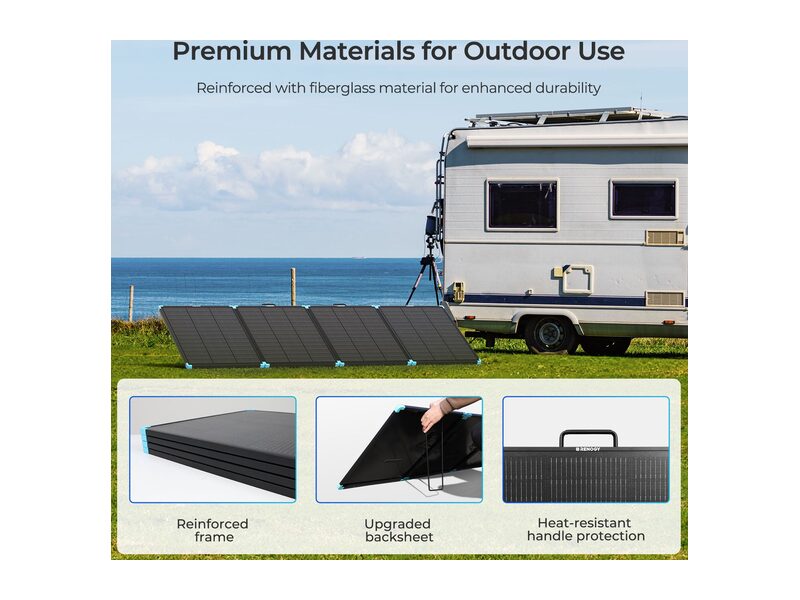
Renogy Lightweight solar suitcase 400W

See price and availability (3)

400 W of portable output in a 30.2 lb (13.7 kg) suitcase: four folding panels, reinforced ETFE coating and solid kickstands to refill a power station in one day.

  • Power: 400 W (4 folding panels)
  • Efficiency: 23% (monocrystalline cells)
  • Weight: 30.2 lb (13.7 kg) (fiberglass ETFE)
  • Durability: IP67, adjustable kickstands, MC4
  • 400 W portable for 30.2 lb (13.7 kg), folds into a suitcase
The Renogy 400 W solar suitcase is for those who want serious power without a fixed installation. Its four panels unfold in seconds and post 23% efficiency, enough to recharge a 1 kWh station over a day. Where most 400 W units exceed 44.1 lb (20 kg), this one weighs just 30.2 lb (13.7 kg) thanks to a fiberglass-reinforced ETFE coating, far lighter than tempered glass. IP67 certified and fitted with sturdy kickstands, it sits on the ground facing the sun, folds back into a suitcase with a handle and follows a motorhome, a van or an off-grid trip.
In-depth reviewRead our full review → 3.8/5 We took this Renogy 400 W suitcase in a motorhome for three weeks, and it is the power-to-weight ratio that strikes you first. A 400 W suitcase that weighs only 30.2 lb (13.7 kg) can be carried one-handed over a few dozen meters, where an equivalent tempered-glass model would have wrecked our backs. Unfolding the four panels takes about thirty seconds, the kickstands hold well even on uneven ground, and you only need to reorient it two or three times through the day to stay near peak. On a fine July day, we filled a 1 kWh station between morning and mid-afternoon without straining. The fiberglass-reinforced ETFE coating inspires confidence: it takes knocks and scratches far better than a glass panel, and the IP67 rating lets you leave it out in a shower without stress. Two caveats: unfolded, it takes up a fair amount of ground, so you need space in front of the vehicle, and the 47.2 V open-circuit voltage means checking your station's input range before buying. For serious portable use, it is one of the most convincing suitcases around.
View product page

Jackery SolarSaga 80W

See price and availability (3)

A panel that captures light from both sides: the dual-sided Jackery SolarSaga 80W reaches 25% efficiency, is waterproof (IP68), in a rigid, rugged build that's easy to carry thanks to its built-in handle.

  • Power: 80W
  • Technology: Dual-sided monocrystalline (25%)
  • Protection: IP68, 0.1 in (2.8 mm) toughened glass
  • Weight: About 11 lb (5 kg) (rigid build)
  • Dual-sided 25% efficiency panel, light and waterproof
The Jackery SolarSaga 80W is a rigid, portable solar panel with a dual-sided monocrystalline design. Thanks to extra-white back glass, it captures light from both sides and reaches a 25% conversion efficiency, among the highest on the market. Light at about 11 lb (5 kg) with its built-in handle, it is IP68 certified (waterproof and dustproof) and made of 0.1 in (2.8 mm) toughened glass. Compatible with Jackery power stations, it comes with a 2m extension cable and a carrying case.
In-depth reviewRead our full review → 3.8/5 The Jackery SolarSaga 80W stands out for its dual-sided technology, still rare on portable panels. By capturing light from the front and the back (thanks to the extra-white glass on the rear), it gains efficiency and climbs to 25% conversion, which is excellent for a portable panel. In use, it efficiently recharges a Jackery station in full sun, and its build inspires confidence: toughened glass, corners protected by rubber bumpers, IP68 certification making it impervious to rain and dust. Its built-in handle and contained weight, around 11 lb (5 kg), make it easy to carry hiking or camping. Points to note: like any solar panel, its real output depends heavily on sunlight and orientation (you rarely get the theoretical 80W). It's also worth noting this specific model has become harder to find at longtime US retailers, even as it remains actively sold in France and across Europe through Jackery's own store. But technically, it is an excellent portable panel, rugged and high-performing.
View product page

BioLite SolarPanel 10+

See price and availability (3)

The rare portable panel that stores what it captures: the BioLite SolarPanel 10+ has a 3200 mAh onboard battery and a 360° kickstand to charge day and night.

  • Power: 10W
  • Battery: Onboard 3200 mAh
  • Output: USB-A
  • Aiming: 360° kickstand + sundial
  • Portable panel with onboard battery that stores energy
The BioLite SolarPanel 10+ is a 10W single-piece solar panel with a rare feature: a 3200 mAh onboard battery. It captures energy by day and stores it to deliver later, even at night, through its USB-A port. Its 360° kickstand and built-in sundial make it easy to angle optimally toward the sun on uneven ground. Light at 19.4 oz (550 g) and rugged, it suits camping, bivouacs and outdoor weekends. Ideal for recharging a smartphone far from any socket, with the bonus of an energy buffer that smooths over cloudy spells.
In-depth reviewRead our full review → 3.7/5 The BioLite SolarPanel 10+ stands out for a clever idea: a 3200 mAh battery built right into the panel. In practice, that is very handy at a bivouac, you set it on a rock or hang it from the tent with the 360° kickstand, aim it with the little sundial (a centered shadow means optimal orientation), and let it work through the day. In the evening, you draw on the stored charge to recharge your phone, even after the sun has set. That energy buffer also smooths over cloudy spells, where a plain panel simply stops. BioLite's finish is careful, the metal kickstand is solid and the format stays compact. Two honest reservations, which explain mixed customer reviews: first, 10W and 3200 mAh are enough for a smartphone but not to quickly charge a tablet or a large power bank; second, in prolonged full sun, the battery can heat up and temporarily go into protection above around 100 °F (38 °C). Kept within its intended use (recharging a smartphone on light camping trips), it is a smart and practical portable panel.
View product page

Jackery SolarSaga 200W

$540.25 (3)

200W and bifacial technology at 25% efficiency: Jackery's premium solar panel to recharge a station far faster, even under cloudy skies.

  • Power: 200W (bifacial IBC cells)
  • Efficiency: Up to 25%
  • Waterproofing: IP68, weatherproof
  • Design: Foldable, built-in kickstands, DC output
  • Bifacial 200W at 25% efficiency
The Jackery SolarSaga 200W is a premium portable, foldable solar panel with bifacial IBC cells, offering a conversion efficiency of up to 25%, among the best on the market. Its rear side captures reflected light for extra output. IP68 waterproof and built to withstand the weather, it powers Jackery Explorer stations via its DC output and deploys with built-in kickstands. A powerful panel for fast solar charging in an RV or off-grid.
In-depth reviewRead our full review → 3.7/5 The SolarSaga 200W clearly plays in the premium panel league. Its bifacial technology is not just a marketing claim: placed on a light surface or sand, we saw output climb noticeably thanks to the rear side. In full sun, it charges a large station far faster than a 100W, and its 25% efficiency shows even when the sky hazes over a little. The IP68 rating is reassuring: we left it out under a passing shower without worry. In return, it is a large, heavy panel at 14.3 lb (6.5 kg), better suited to an RV or a semi-fixed setup than to hiking. It also has no USB outputs, being designed to recharge a station via its DC output. For anyone wanting serious, fast solar charging, it is one of the best portable panels on the market.
View product page
SP001 21W Allpowers SP001 21W USB portable solar panel
Deal

Allpowers SP001 21W

$99.00 $39.00 (3)

21W foldable and just 1.3 lb (610g): the little USB solar panel that charges a phone, tablet or power bank anywhere in the sun, with no outlet or bulk.

  • Power: 21 W (monocrystalline)
  • Outputs: USB-A and USB-C (18W max each)
  • Format: Foldable, 1.3 lb (610g)
  • Use: Phone, tablet, power bank
  • 21W foldable, ultralight, 2 USB ports
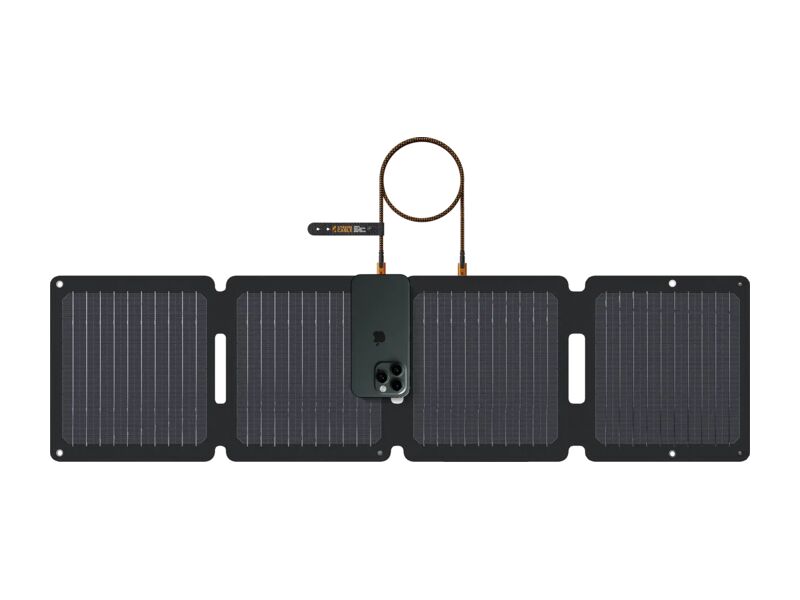
The Allpowers SP001 is an ultralight 21 W foldable solar panel, one of the lightest and most compact in its class at just 1.3 lb (610g). Its two USB ports (USB-A and USB-C, up to 18W each) charge a phone, tablet or power bank directly in the sun, no outlet needed. Folding into three panels, it slips into a bag or sits on a ledge and unfolds in an instant. Light, discreet and practical, it is a clever top-up accessory so you never run out of battery while hiking, camping or traveling.
In-depth reviewRead our full review → 3.8/5 The SP001 is a clever little solar charger, light and foldable, worth keeping in a bag so you never run out of battery on a phone or tablet out in nature. Its two USB ports (USB-A and USB-C) reach up to 18W each, a ceiling close to the panel's own rated output: unlike several other small panels on the market, the ports themselves are almost never the bottleneck, the amount of sunlight available is. We like its featherweight (1.3 lb / 610g) and its ultra-compact folded format. The limits are obvious and accepted: at 21W, real-world output stays modest and depends heavily on orientation, the connector housing is not built to be waterproof despite the fabric's IP67 rating, and the warranty covers only one year. To top up a phone or tablet while hiking or traveling, at this price, it is a genuinely handy accessory.
View product page

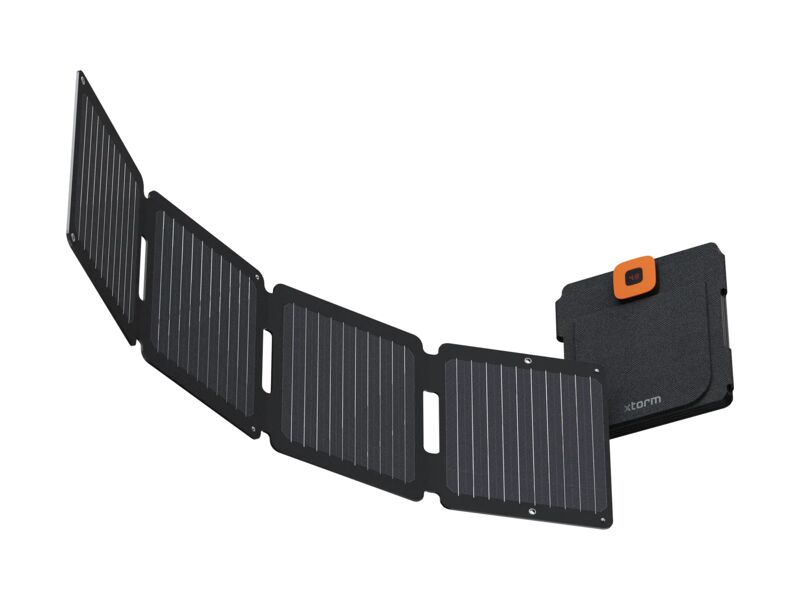
Xtorm SolarBooster 28W

$173.07 (2)

The Xtorm SolarBooster 28W foldable solar panel turns sunlight into power for your phone, tablet or GoPro, wherever your next outdoor trip takes you.

  • Power: 28W, 4 monocrystalline SunPower cells
  • Outputs: USB-A + USB-C, 15W each (5V/3A)
  • Weight: 2.01 lb (910 g) folded, backpack-friendly
  • Water resistance: IPX4 (splash resistant)
  • LCD output screen, built-in kickstand and carabiner
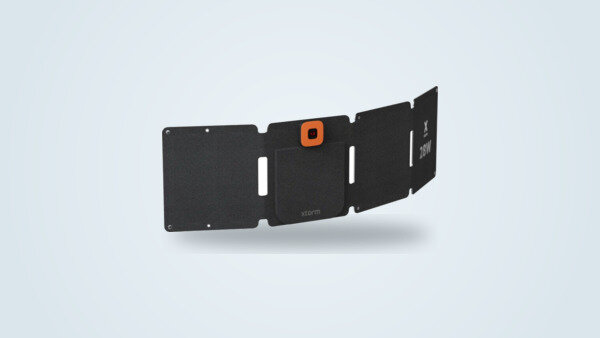
The Xtorm SolarBooster 28W is a foldable, portable solar panel built around four monocrystalline SunPower cells, an LCD output screen and two charging ports, USB-A and USB-C, each rated at 15W. Compact at 2.01 lb (910 g) folded, with a built-in kickstand and carabiner, it charges a phone, tablet or power bank straight from the sun on hikes, van trips or campsites, with no mains socket and no internal battery.
In-depth reviewRead our full review → 3.3/5 We took the SolarBooster 28W on a week-long hiking trip, clipped to the backpack with its carabiner during the day's walk. The LCD screen is genuinely useful: tilt the panel slightly and watch the amp reading climb to find the best angle for the sun. In full sun, charging a phone over USB-C is fast and steady; under overcast skies, output drops off noticeably, so you really need direct sunlight to get the most out of it. Unfolded on the ground with its built-in kickstand, it stays put well, but the hinges between the four panels are quite stiff, and the outer sections tend to fold back in on themselves if nothing holds them open, a small gripe several other users mention too. At 2.01 lb (910 g) it is still easy to carry without being ultra light, and the included pouch protects the cells well in transit. Overall, a solidly built panel for topping up solar power on a trek or in a van, as long as you accept its limits on cloudy days.
View product page

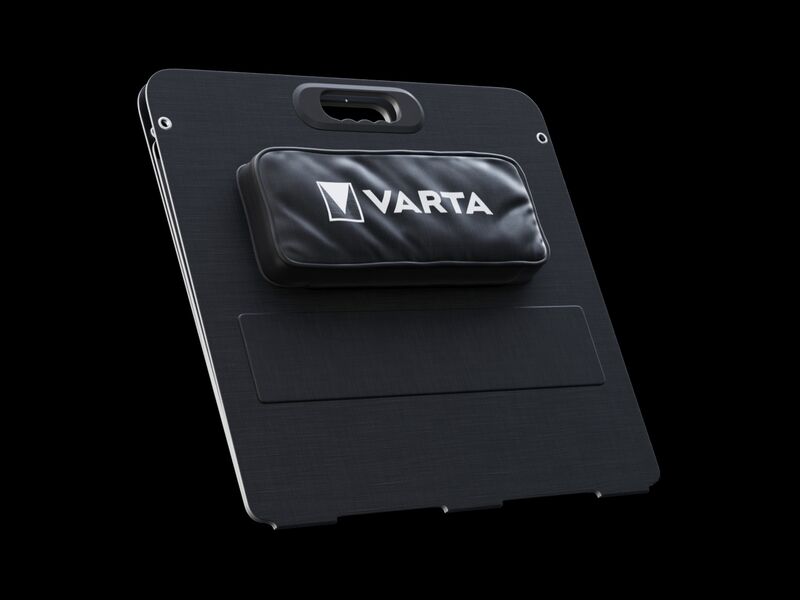
Varta VS200

$579.99 (2)

Foldable, IP67-rated and rated at 22.6% efficiency, the Varta VS200 solar panel delivers 200W to recharge the VP500 power station outdoors.

  • Power: 200W (monocrystalline cells)
  • Efficiency: 22.6% rated
  • Ingress protection: IP67 (rain, dust, splashes)
  • Weight: 18.7 lb / 8.5 kg (foldable, adjustable stand)
  • 22.6% efficiency, IP67 rated, compatible with the VP500
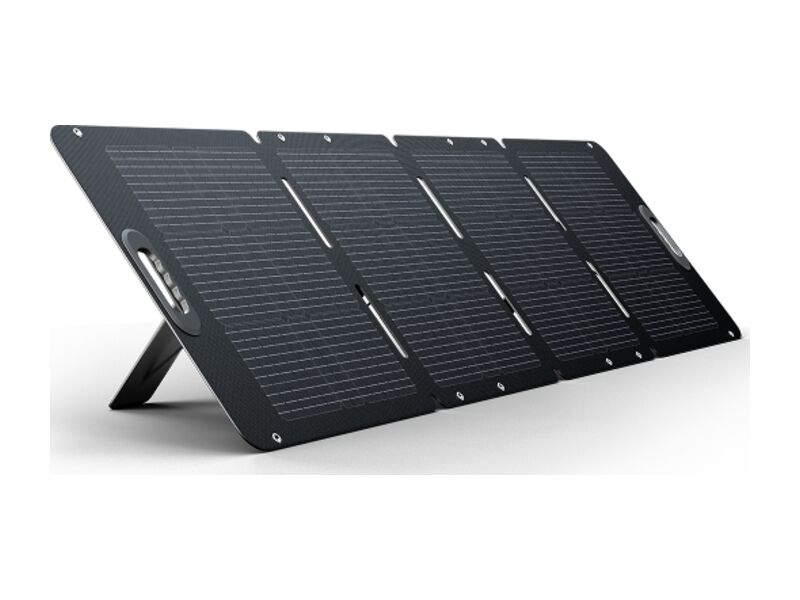
The Varta VS200 portable solar panel delivers up to 200W thanks to monocrystalline cells with a rated efficiency of 22.6%. Foldable and fitted with an adjustable stand, it sets up in seconds to charge the Varta VP500 power station or any other MC4-compatible device. Its IP67 rating protects it from rain, splashes and dust. Weight: 18.7 lb (8.5 kg). Supplied with an MC4 to DC(XT60) cable for a direct connection to the VP500.
We tested the VS200 alongside the VP500, and the pairing works well: the supplied MC4 to DC(XT60) cable plugs straight in, no adapter needed. Once unfolded and well angled thanks to the adjustable stand, output climbs quickly in good weather. The ETFE coating and IP67 rating are reassuring, a surprise shower isn't a concern. One practical downside: at 18.7 lb (8.5 kg) and once unfolded, it stays bulky to carry and pack away, like most 200W panels of this format. We also missed a manufacturer figure for open-circuit voltage, useful for checking compatibility with stations other than the VP500. For anyone who already owns a VP500, it's a logical, well-matched companion.
View product page

Bluetti SORA 500

$849.00 (1)

500W of portable solar that folds into one compact block: N-type TOPCon cells up to 25% efficiency, IP67 and an MC4 connector to charge a big power station.

  • Power: 500W, N-type TOPCon cells
  • Efficiency: Up to 25%
  • Format: Folded 22.4 x 17.5 x 3.3 in (570 x 445 x 85 mm), 28.4 lb (12.9 kg)
  • Durability: IP67, -13 to 149 °F (-25 to 65 °C)
  • 500W folded to 22.4 x 17.5 in, XT60 cable included
The Bluetti SORA 500 is the most powerful portable solar panel in the SORA range: 500W of peak power from N-type monocrystalline (TOPCon) cells rated up to 25% efficiency. It folds into a 22.4 x 17.5 x 3.3 in (570 x 445 x 85 mm) block with a carry handle, has an ETFE coating and an IP67 rating, and connects through MC4 with a 4.9 ft (1.5 m) MC4-to-XT60 cable included. Built to recharge a big power station quickly in an RV or backyard, it requires checking the station's input: its 49.1V open-circuit voltage limits panel pairing.
On paper, the SORA 500 ticks every box of a high-end portable panel: 500W, N-type cells, IP67 and above all a folded size of 22.4 x 17.5 x 3.3 in (570 x 445 x 85 mm) that slips into a trunk or under an RV bench seat, where a standard 400W panel needs far more room. The handle and 28.4 lb (12.9 kg) make it easy to carry for a few dozen yards, less so on a hike. Published tests confirm the appeal of the format while tempering the numbers: in deep winter, an Elite 300 was receiving around 400W on average, and unfolding it alone in strong wind is quickly a chore. The real point of caution is electrical: at 49.1V open-circuit, a single panel works with an Elite 100 V2, but two panels exceed its limits, which restricts expansion. The price, close to $1.70 per watt, is high, but 500W this compact is rare: it is the right choice for anyone short of space rather than budget.
View product page

BougeRV CIGS 200W Flexible Panel

See price and availability

200W in CIGS thin-film flexible to 360°, shade-tolerant and ultra-light: the BougeRV panel fits on the curved roofs of RVs, vans or boats.

  • Power: 200W (CIGS thin-film technology)
  • Flexibility: 360°, fits curved surfaces
  • CIGS asset: Shade and heat tolerance
  • Format: Ultra-light, 6 lb (2.7 kg), 0.1 in (2.5 mm), IP68
  • Flexible 360° CIGS, shade-tolerant
The BougeRV CIGS 200W is a new-generation flexible solar panel, based on CIGS thin-film technology rather than conventional monocrystalline silicon. The result: 360° flexibility, excellent tolerance to partial shading and heat, and a featherweight, about 6 lb (2.7 kg), at 0.1 in (2.5 mm) thick. IP68 waterproof and pre-drilled for mounting, it installs on curved or uneven surfaces (RV, van, boat, cabin roof) where a rigid panel cannot go.
The BougeRV CIGS 200W does not play in the same category as conventional flexible panels. Its CIGS (thin-film) technology changes the game on two points you really notice in use: first the flexibility, impressive, letting it wrap onto a curved van roof where a rigid mono panel would be impossible to fit; second the shade tolerance, where CIGS keeps producing far more stably when a branch or a roof accessory casts a partial shadow, while a mono panel collapses. Its featherweight and thinness make it easy to handle and stick down, and the IP68 rating is reassuring in marine or rainy use. In return, CIGS efficiency per square meter stays lower than a good mono: at equal surface, it produces a little less in full direct sun, and its price is higher. But for mounting on a curved or shade-prone surface, it is a genuinely clever solution.
View product page

EcoFlow NextGen 160W Solar Panel

$449.00

EcoFlow's light, versatile solar companion: bifacial design up to 25% conversion, a built-in XT60 cable, adjustable 30° to 60° stand and IP68 protection.

  • Power: 160W, bifacial design (up to 25%)
  • Connection: Built-in XT60 cable (EcoFlow stations)
  • Stand: Adjustable 30° to 60°, angle guide
  • Durability: IP68 rating, 5-year warranty
  • Bifacial up to 25%, lightweight, IP68
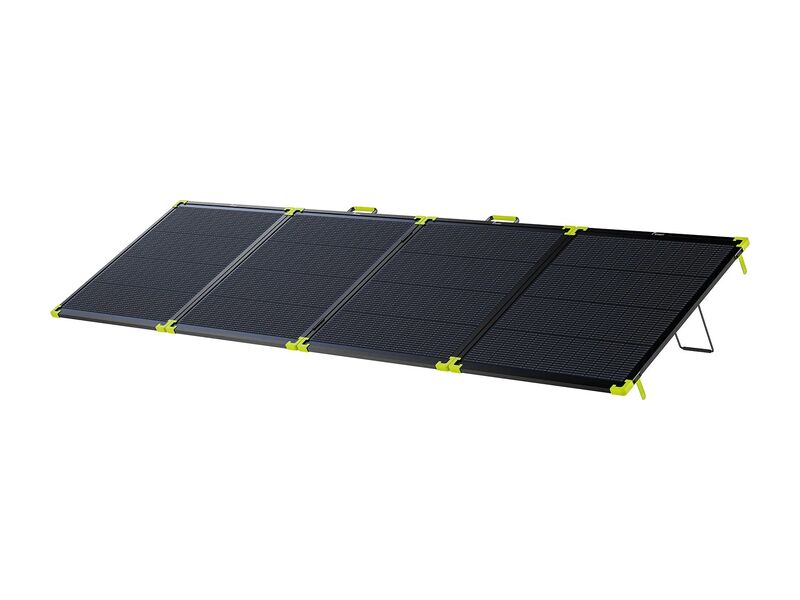
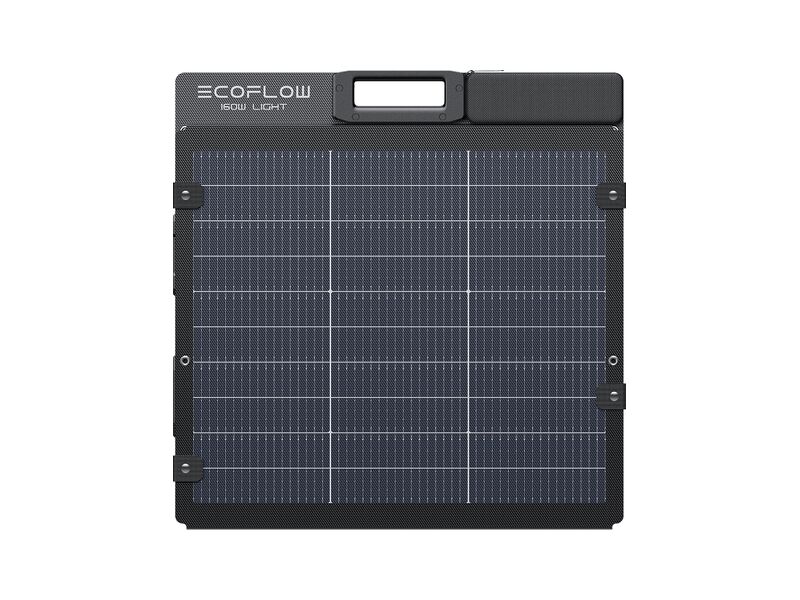
The EcoFlow NextGen 160W portable solar panel brings the line's bifacial design into a lighter, more affordable format: the front face catches direct sun while the back recovers reflected light, for a conversion rate of up to 25%. Foldable, it deploys on an adjustable 30° to 60° stand with a built-in angle guide. Its XT60 cable comes built in for a direct connection to EcoFlow stations. IP68 certified and backed by a 5-year warranty, it is the balanced portable panel for camping, van life, or a station top-up on the road.
In-depth reviewRead our full review → 4.0/5 The NextGen 160W is the panel we point people to when they want the core of a good EcoFlow setup without stepping up in size or price. Lighter and more compact than the 220W, it travels easily and pops open in seconds on its adjustable stand. The bifacial design earns its keep as soon as you set it on a light surface, a concrete pad or a light-colored tarp, and the extra watts show up without effort, while the built-in angle guide takes the guesswork out of aiming at the sun. The already-attached XT60 cable plugs straight into EcoFlow stations, no adapter to dig for. On a car camping trip, it recharged a compact station in a few hours of good sun, and the IP68 rating meant leaving it out overnight with no worry about dew or a surprise shower. Two honest notes: 160W suits compact to mid-size stations best, for a bigger battery go with the 220W or two panels wired together, and like any bifacial panel, real-world output depends a lot on what surface it sits on. For a durable, well-thought-out panel that covers most weekend setups, it is a strong pick, if you shop around for the price.
View product page
SP400 Pro Fossibot 400W bifacial foldable solar panel
Promo

Fossibot SP400 Pro

$694.60 $532.12

Foldable, bifacial and IP67 rated, the Fossibot SP400 Pro solar panel captures up to 15% more power thanks to its active rear side, at just 19.8 lb (9 kg).

  • Power: 400W bifacial (+10 to 15%)
  • Efficiency: 25%
  • Waterproofing: IP67
  • Weight: 19.8 lb (9 kg)
  • Bifacial +15%, IP67, just 19.8 lb (9 kg)
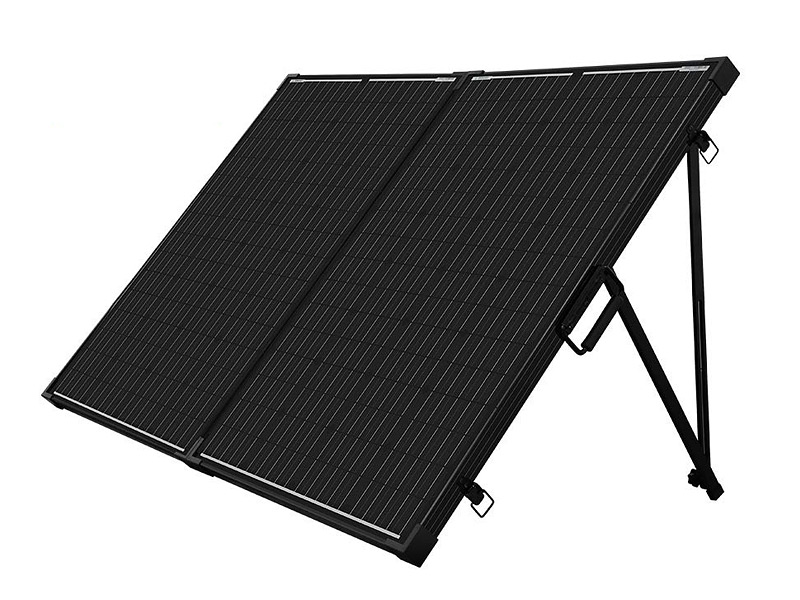
The Fossibot SP400 Pro is a portable bifacial 400W solar panel, generating 10 to 15% extra energy by capturing light reflected off snow, sand or concrete. Its advanced cells reach a 25% conversion efficiency. Rated IP67 and built to operate from 14 °F to 158 °F (-10 °C to 70 °C), it features a reinforced aluminum frame and bypass diodes that prevent overheating in partial shade. At just 19.8 lb (9 kg), 36% lighter than the previous generation, it folds down easily, with a universal MC4 connector.
We set up the SP400 Pro on a temporary job site, propped against a light concrete wall, the perfect terrain to judge the bifacial gain. The difference shows most in early morning and late afternoon, when the sun sits low and the rear panel picks up a real bonus from ground reflection. The first thing that stands out is the weight: at 19.8 lb (9 kg), it carries and unfolds with barely any effort, well below the 13 to 35.3 lb (16 kg) solar cases common in this segment. The aluminum frame feels reassuring, and the bypass diodes did their job without a hiccup the day a branch cast partial shade over one panel. Two honest caveats: the included 1.5m MC4-to-XT60 cable is on the short side if the station stays sheltered, and like any bifacial panel, the real gain depends heavily on what is underneath it, on grass or dark soil the difference against a regular panel stays marginal. For anyone after a light, sturdy 400W panel that outperforms average, the SP400 Pro earns its place.
View product page
Solar Suitcase 200W Renogy 200W foldable solar panel with charge controller
Favorite

Renogy Solar Suitcase 200W

See price and availability (7)

Plenty of solar power, portable anywhere: two 100W panels on a folding frame, with a built-in controller and a carry case, ready to charge your batteries.

  • Power: 200W monocrystalline (2 x 100W)
  • Controller: Built-in Renogy Voyager 20A
  • Weight / Transport: 35.9 lb (16.3 kg), semi-rigid case
  • Output: Pre-wired MC4 cables
  • Built-in controller, adjustable folding frame, rugged
When a small foldable panel lacks power and a fixed panel is too bulky to move, the solar suitcase is the ideal solution. Renogy's brings together two 100W monocrystalline panels on a folding steel frame, pre-wired with a Renogy Voyager 20A charge controller and MC4 cables, so it is usable straight away. Rugged and well designed, supplied in a semi-rigid carry case, it easily charges a 12V battery or a power station in a motorhome, a van, on a boat or at an off-grid site.
In-depth reviewRead our full review → 3.5/5 The Renogy Solar Suitcase 200W delivers on a promise few panels of this power still offer: a Voyager 20A controller already wired in, IP67 rated, able to recognize a lead-acid, AGM, gel, or lithium battery automatically and charge it directly, with nothing extra to buy or set up. Its LCD readout shows voltage, current, charged capacity, and temperature, a level of detail few nomad panels offer natively, and its warranty (10 years on parts, 25 years at 80% guaranteed power) is among the longest in the segment. That build comes at a cost: at 35.9 lb (16.3 kg), it's by far the heaviest 200W nomad panel around, up to 3.4 times the weight of a direct rival, and its PWM controller doesn't recover the panels' full optimal voltage against a 12V battery the way an MPPT one would. With no USB output at all, it isn't aimed at power-station buyers: it targets direct 12V charging for an RV, van, boat, or off-grid site, where it remains a complete solution.
View product page

← Back to Solar

Related questions

In full sun a 100 watt panel produces 60 to 70 real watts, so 350 to 450 Wh over a good day. That is enough to recharge a 300 Wh station, run a 45 watt cool box continuously, or fill a phone about ten times. It is the entry-level output for van life and camping.

Reckon on 200 watts for simple summer use (lighting, phones, water pump), 300 to 400 watts if you add a compressor fridge, and 500 watts or more to live aboard year round. In winter production drops by 60 to 75 per cent: that season is what should dictate your sizing.

With a multimeter, in full sun and with the panel disconnected. First measure open-circuit voltage (Voc) at the terminals: it should be close to the figure printed on the back, often 18 to 24 V on a 12 V model. Then short-circuit current (Isc) on the amps range. A gap of more than 20 per cent points to a failing cell or a damaged cable.

Rarely in real conditions. The 100 watts are measured in a lab at 25 °C and 1,000 W per m2. In the field, heat, angle of incidence and dust bring output down to 60 to 75 per cent of nominal. That is normal and applies to every brand, which is why we always reason in real output.

MC4 is the standard on the panel side, but stations usually expect an XT60, an Anderson or an 8 mm DC jack depending on the brand. An adapter is generally supplied. Above all check that the panel's open-circuit voltage stays under the station's input limit, otherwise the controller shuts down protectively.

Repositioning a portable panel three times a day yields 20 to 30 per cent more output than leaving it flat. Ideally place it perpendicular to the sun, roughly 30° in summer and 60° in winter at our latitudes. It is the single most profitable habit in portable solar.
Need help choosing?

Further reading on the blog

Compare