What the rated 220W output is really worth
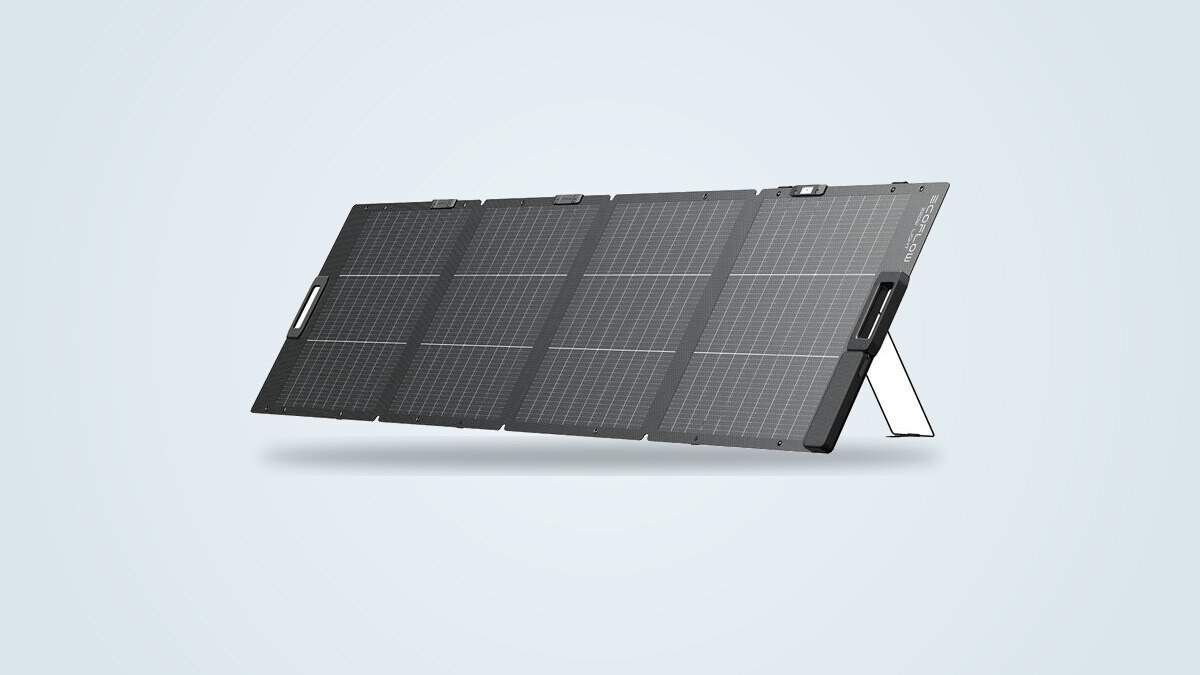
The EcoFlow 220W solar panel is rated for a conversion efficiency of up to 25% on its N-type monocrystalline cells, a figure standardized under the industry's usual reference conditions (1000 W/m², 77 °F/25 °C cell temperature, AM1.5 spectrum). This convention allows two panels to be compared, but it is never met outdoors as such: angle of incidence, cloud cover and the panel heating up in direct sun always pull the available output down, a trait common to this entire product category.
On the ground, the panel's output climbs to 193W out of the rated 220W, or 88% of nominal. That proportion sits above what most comparable nomad panels manage to deliver, where a 20 to 30% gap between the rating and reality remains common.
This gap between the promise and reality is nothing exceptional: it stems from the standardized reference conditions used across the whole solar industry, not from a flaw specific to this panel. What sets one panel apart from another is the proportion reached under good exposure: the 88% obtained here compares favorably with the 200 to 220W nomad panels already reviewed on this site.
Bifacial in practice: a gain that depends entirely on the ground
The panel's bifacial design adds a second layer of cells on its rear face, able to capture light reflected off the ground. EcoFlow rates a gain of up to 25% versus an equivalent monofacial panel through this principle. That figure is a ceiling, not an average: it depends entirely on the albedo of the surface the panel sits on, in other words its ability to reflect light.
On a highly reflective surface (fresh snow, light sand, a concrete slab), the real gain sits between 15 and 25%, close to the marketing promise. On grass or dark ground, the most common surface for camping, that same gain drops to just 5 to 10%. A bifacial panel set on a lawn therefore captures noticeably less than the same panel set on light gravel or a concrete patio.
This variability isn't specific to this panel: it applies to every bifacial panel on the market, the EcoFlow 160W included. It does explain, however, why two owners can end up with a very different sense of what the bifacial design actually adds, depending on their usual camping ground.
A built-in kickstand that changes the game, without erasing all the hassle
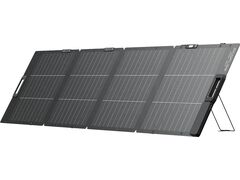
EcoFlow's previous 220W bifacial panel had no built-in stand at all: its carry case doubled as a makeshift kickstand, held by carabiners. This panel fixes that with a built-in kickstand adjustable from 30 to 60°, paired with a solar angle guide that helps aim for the best sunlight without guesswork.
That change comes with a radical weight cut: at 11.2 lb (5.1 kg), the panel weighs 46% less than that previous bifacial model, which came in at around 21 lb (9.6 kg), without losing any rated output (220W in both cases).
The kickstand doesn't remove all the handling this panel format demands, though. Once unfolded across its 89.4 in (2.27 m) length, the stand still needs stabilizing on sometimes uneven ground, then the whole panel needs aiming at the sun, a longer operation than with a monofacial panel simply laid flat. On sloped or rocky ground, this step takes longer than expected for a product meant to be nomadic.
A price that shifts once you look per watt
Priced at $549 at the time of writing, the EcoFlow 220W panel is actually the priciest of the four panels compared here by sticker price, just ahead of the Jackery SolarSaga 200W ($540) and the Anker Solix PS200 ($500), and well above the Allpowers Solax SE200 ($139).
Per rated watt, though, the picture shifts: at roughly $2.50 per watt, the 220W ties with the Anker Solix PS200 and beats the Jackery SolarSaga 200W (about $2.70 per watt), since its extra 20W of rated output offsets part of the higher sticker price. The Allpowers Solax SE200 remains far ahead on pure value, at roughly $0.70 per watt. Its own smaller sibling, the EcoFlow 160W panel, keeps the same bifacial design at a lower price, with 60W less.
How long it takes to fill a station in the sun
For reference, using the output figures above, an EcoFlow River 2 (256 Wh) would fill in roughly 1h20 at the output obtained outdoors (193W), and 1h10 at the rated peak of 220W, rarely reached in practice. A larger EcoFlow Delta 2 (1024 Wh) would need roughly 5h19 at 193W and 4h40 at the rated peak. This simplified calculation ignores conversion losses and the slowdown near the end of charging, but gives a realistic order of magnitude.
Two 220W panels wired in parallel into the same station roughly halve that time, provided the station's solar input accepts a combined output of at least 400W and a voltage compatible with each panel's 21.4V open-circuit rating.
IP68: the highest rating on the market
The EcoFlow 220W panel carries an IP68 rating, the highest tier on the standard scale, above the IP67 of the Jackery SolarSaga 200W and the IP65 of the Bluetti PV200. In theory, this tier allows brief immersion, well beyond a simple downpour.
The cells are protected by an ETFE coating, now a common treatment on this type of panel, which limits scratching and UV-related yellowing over time. The built-in XT60 cable is also rated weatherproof, a point consistent with the product's overall rating since it stays connected at all times, rain included.
Built-in XT60: simple within the EcoFlow ecosystem, more limiting elsewhere
The panel's XT60 cable is permanently built in, which avoids carrying a separate adapter to plug into an EcoFlow River or Delta series station. That's a genuine convenience gain over panels shipped with a detachable cable, which is easier to misplace.
This integration has a downside, though: plugging this panel into a station from another brand means finding or buying an adapter matching that station's solar input format, an extra cost and an extra step that panels with a native MC4 output avoid more easily. Another limit common to almost every panel in this power class: no USB output is available, so charging a phone directly without an intermediate station isn't possible.
Against direct rivals of similar power
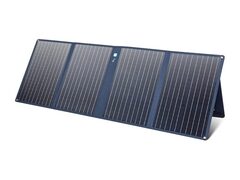
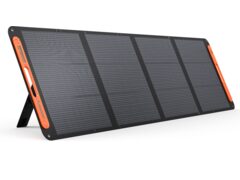
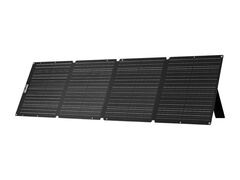
Compared with the folding panels already reviewed on this site, the EcoFlow 220W panel stands out for its higher rated output and IP68 rating, even though it carries the highest sticker price of the four.
| Criterion | EcoFlow 220W | Anker Solix PS200 | Jackery SolarSaga 200W | Allpowers Solax SE200 |
|---|---|---|---|---|
| Power | 220 W | 200 W | 200 W | 200 W |
| Weight | 11.2 lb (5.1 kg) | 10.6 lb (4.8 kg) | 13.7 lb (6.2 kg) | 15.8 lb (7.16 kg) |
| Design | Bifacial | Bifacial | Monofacial | Monofacial |
| Rating | IP68 | IP68 | IP67 | IP68 |
| Connector | Built-in XT60 | MC4 + XT60i adapter | MC4 only | MC4 + compatibility cable |
| Warranty | 5 years | 5 years | 3 years | 24 months |
| Observed price | ≈ $549 | ≈ $500 | ≈ $540 | ≈ $139 |
Against the Anker Solix PS200, also bifacial and just as weatherproof, the EcoFlow 220W costs $49 more but gains 20W of rated output and an already built-in XT60 cable, where the Anker needs an XT60i adapter to plug into the same stations, which keeps the two roughly tied on price per watt. Against the Jackery SolarSaga 200W, it costs slightly more up front but works out cheaper per rated watt and offers better waterproofing. Against the Allpowers Solax SE200, the most affordable of the four by a wide margin, it costs nearly four times as much but offers a longer warranty and direct integration with the EcoFlow ecosystem.
Manufacturing, an established brand and a 5 year warranty
EcoFlow was founded in 2017 in Shenzhen, China, and has since become one of the reference players in the portable power station market, with a broad ecosystem of panels, batteries and accessories that work together. That track record matters when choosing a solar panel: direct compatibility with the River and Delta series isn't just a marketing line, it reflects an ecosystem genuinely built up across product generations.
The manufacturer's warranty runs for 5 years, matching the Anker Solix PS200 and well ahead of the Jackery SolarSaga 200W's 3 years or the Allpowers Solax SE200's 24 months. No recall has been identified for this panel to date.
The move from the previous bifacial model (around 21 lb / 9.6 kg, no built-in stand) to this 11.2 lb (5.1 kg) panel with an adjustable kickstand amounts to a thorough design overhaul rather than a cosmetic change, spanning several years of production between the two versions.
Who this panel suits, and who it doesn't
The EcoFlow 220W panel suits first and foremost anyone who already owns an EcoFlow River or Delta series power station and wants a capable, weatherproof panel that connects directly without an adapter. Its bifacial gain, variable as it is, remains a genuine plus for anyone who regularly camps on light-colored ground (sand, gravel, a slab).
Conversely, anyone with a station from another brand will need to budget for an extra adapter, or look at a panel with a native MC4 output such as the Anker Solix PS200 or the Allpowers Solax SE200. Anyone after the lightest panel in this segment will find a slightly better compromise with the Anker Solix PS200 (10.6 lb / 4.8 kg). And anyone wanting to charge a phone directly, without going through a station, should choose a smaller panel fitted with a USB port, something none of the panels in this power class offer.