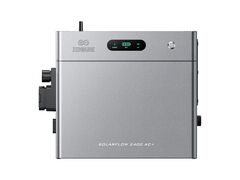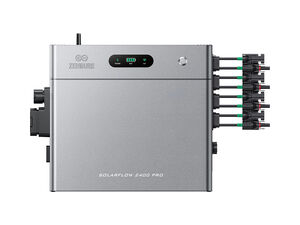
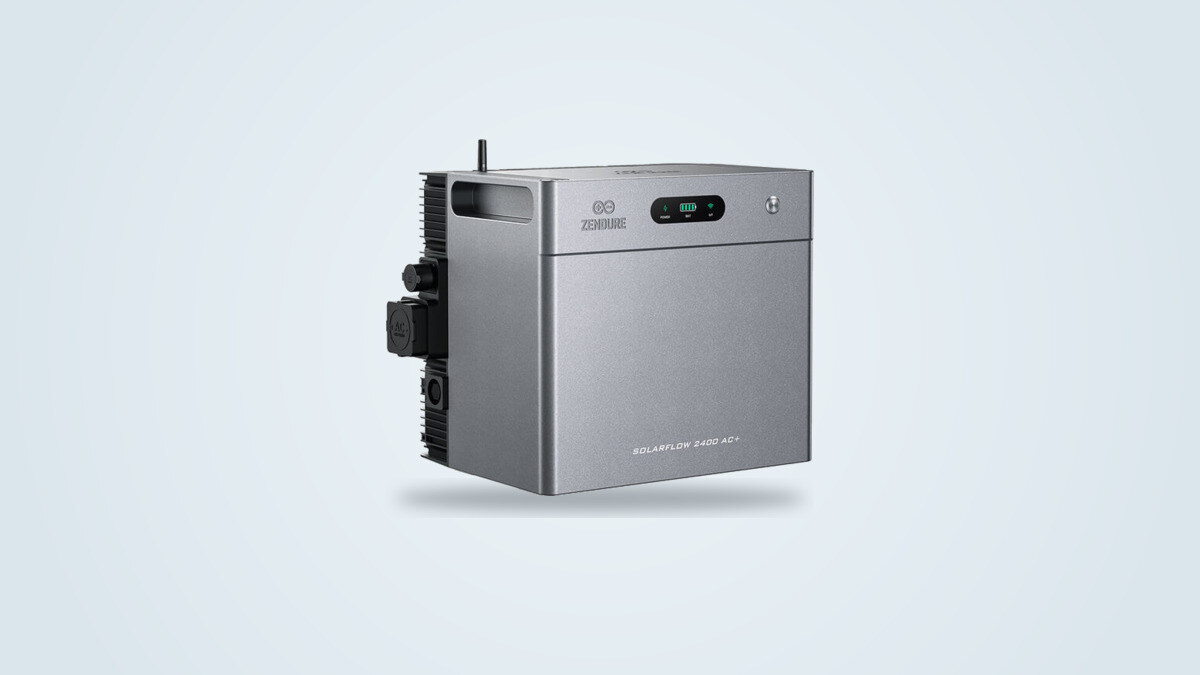
An AC+ that is neither the AC nor the Pro: three devices not to be confused
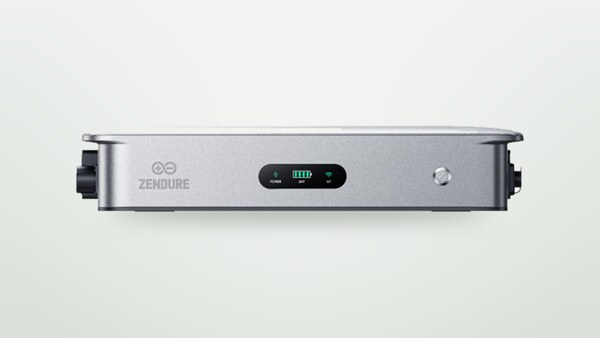
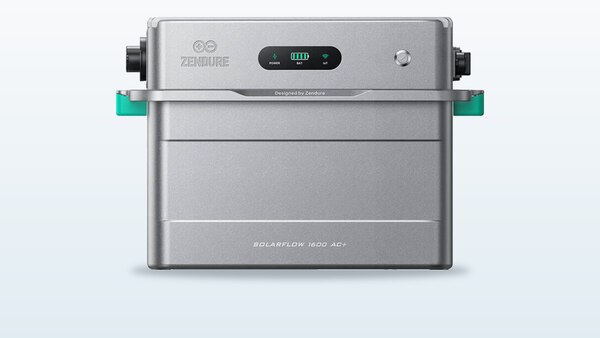
The name invites confusion, and confusion is expensive when you buy. The SolarFlow 2400 AC+ (model ZDSF2400AC+, introduced in February 2026) is a single block: a 2400 W bidirectional inverter and a 2400 Wh LiFePO4 battery (50 Ah at 48 V) in a 12.8 x 11.6 x 9.9 in (326 x 294 x 251 mm) case weighing 61.3 lb (27.8 kg). It plugs into an outlet and has no input for solar panels: it only stores alternating current, either the surplus from a solar array that is already installed or utility power when it is cheap.
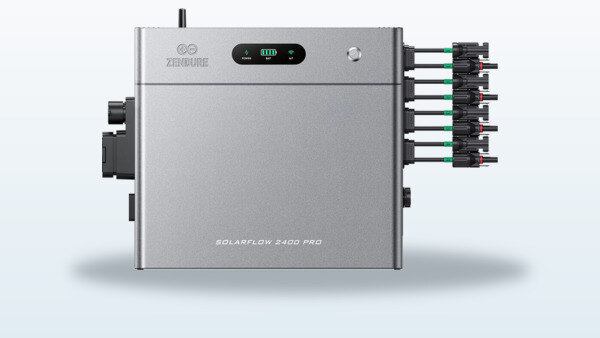
The SolarFlow 2400 AC that came before it is a different product: an inverter sold without storage, paired with AB3000X modules that do not fit under the AC+. The SolarFlow 2400 Pro shares the AC+ case and electronics but adds four MPPT solar inputs. The figures in this review apply to the AC+ only.
One point matters more for US readers than any spec: this is a European-market unit rated 230 V at 50 Hz, and Zendure's US store does not list it. This review is a benchmark for comparing plug-in storage, not a purchasing guide for an American home.
| Criterion | 2400 AC+ (this product) | 2400 AC | 2400 Pro |
|---|---|---|---|
| Base battery | 2400 Wh built in | None, AB3000X modules sold separately | 2400 Wh built in |
| Direct solar input | None (AC coupling) | None (AC coupling) | 4 MPPT, 3000 W |
| Expansion modules | AB3000L (AB1000 and AB2000 per the manual) | AB3000X | AB3000L |
| Maximum capacity | 16.8 kWh (5 modules) | 17.28 kWh (6 modules) | 16.8 kWh (5 modules) |
Efficiency: about 88% at 800 W, well short of the claimed 93%
Zendure claims up to 93% round-trip efficiency on the AC side, thanks to silicon carbide semiconductors. Over full cycles from 10 to 100% with 800 W on both charge and discharge, the figure comes out at 87.3, 88.2, 88.7 and then 88.4%, or about 88%. The five-point gap with the spec sheet amounts to roughly fifty watt-hours lost for every kWh stored.
That figure does not tell the whole story, because the inverter draws an almost fixed amount of power: the lower the load, the more that draw weighs. In zero-export regulation, when the battery delivers only 100 to 200 W, efficiency drops to between 78 and 82%. That is a common regime overnight, and therefore the one that counts for real savings. The unit works best when it is made to work hard, for instance by emptying it over a few hours at peak rates or by taking advantage of negative prices.
On standby the unit draws about 3 W when it runs on its own battery, and under 1 W when the grid supplies it: at 3 W continuously, that amounts to around 25 kWh a year. Switching it fully off removes the draw, and enabling the backup outlet increases it. As a point of reference, the earlier SolarFlow 2400 AC, with a separate inverter, sits a little lower, between 86 and 87%.
2400 W on the spec sheet, 800 W at the outlet
The 2400 W that features in the marketing is not available out of the box. The unit ships with grid export limited to 800 W, and the manual lists ceilings by country to stay within the rules for plug-in kits: 800 W in Germany, Belgium, the Netherlands and Austria, 900 W in France, 600 W in Switzerland and 350 W in Italy. The United States is not on that list. Going above the ceiling requires a dedicated circuit checked by an electrician, followed by a signed declaration in the app confirming that the check took place. The manufacturer accepts liability only for the quality and safety of the unit, not for the installation.
Three other figures frame these values: the battery accepts 2400 W on both charge and discharge, the AC input handles up to 3200 W, and the backup outlet delivers 3200 W as long as the grid is present, with 2400 W coming from the battery and the rest from the utility. That last step has nothing to do with export: it exists to power a demanding appliance directly from the unit.
The 800 W ceiling changes how the spec sheet should be read: in the evening, an oven, a cooktop and a washer together far exceed that threshold, and the shortfall is then drawn from the grid. The full 2400 W is for those prepared to have a dedicated circuit installed, with an electrician's bill on top of the price of the unit.
Control: a smart meter is essential, ZENKI still uneven
Without a smart meter, the AC+ follows a fixed charge and discharge plan, 200 W by default. To match discharge to the household's consumption, it needs a compatible meter: the maker's Smart Meter 3CT-S or 1CT-S (connected to the RJ45 port, which is an RS485 port and not a network jack), a Shelly Pro 3EM or an EverHome EcoTracker. The supplier database behind ZENKI covers European providers.
| Mode | How it works | Requirements |
|---|---|---|
| Auto | Priority to the meter, then to the smart plug, then to the base plan; follows prices if a dynamic rate is entered | Meter recommended |
| ZENKI | Weather forecasts, consumption history and electricity prices (more than 840 European suppliers) | Internet connection, meter, about a week of learning |
| Expert | Four sub-modes: meter, smart plug, base load (10 time slots), electricity price with thresholds | Manual settings |
ZENKI's decisions are sometimes hard to justify: charging from the grid when the next day's solar surplus has been forecast, discharging at a rate that is not particularly high, or charging overnight at off-peak rates so that there is no room left for the morning sun. Auto mode, which is more predictable, is the safest choice for anyone without a dynamic rate.
Regulation is fast, within a few seconds, but it deliberately keeps a margin of about 50 W around zero to spare the relay. A small residual export therefore remains, most visible in winter. Over a six-hour night, cumulative import stays at around 20 to 40 Wh with a Shelly meter or the maker's D0 reader, for an export below 15 Wh. This margin belongs to the manufacturer's own energy manager: it can be avoided by controlling the unit through the local API or MQTT, with Home Assistant for example.
That leaves cloud dependence: the app goes through the manufacturer's servers, ZENKI needs a connection to retrieve prices and weather, and the unit accepts only 2.4 GHz Wi-Fi. Without a connection it falls back on less refined local rules. A local API (HTTP) and an official Home Assistant integration that can be pointed at a local MQTT broker allow a way around this for those who can configure them. The manufacturer publishes no subscription price for HEMS or ZENKI, and promised in 2025 that its functions would remain free for the warranty period of each unit, which is ten years for the AC+.
From 2.4 to 16.8 kWh: what expansion means
The 2.4 kWh base capacity is tight for a full evening: it covers a frugal household, not a family that cooks on electricity. Expansion is by 2.88 kWh AB3000L modules that stack under the unit, are recognized automatically and go up to five, or 16.8 kWh in total. Power stays at 2400 W whatever the number of modules: 16.8 kWh empties in about seven hours at full power, against under an hour for the unit alone.
| Configuration | Capacity | Time at 2400 W |
|---|---|---|
| Unit alone | 2.4 kWh | 1 h |
| Unit + 1 module | 5.28 kWh | 2.2 h |
| Unit + 2 modules | 8.16 kWh | 3.4 h |
| Unit + 3 modules | 11.04 kWh | 4.6 h |
| Unit + 4 modules | 13.92 kWh | 5.8 h |
| Unit + 5 modules | 16.8 kWh | 7 h |
On compatibility, the manufacturer also declares the AB1000 and AB2000 modules compatible but recommends only the AB3000L: the other models do not fit the unit's dimensions, and after-sales support may be limited for a non-recommended configuration. The AB3000X from the earlier 2400 AC does not fit.
On cost, each added module is priced at roughly four fifths of the unit's own price on Zendure's European store, which is why the price per kWh of the full stack ends up about 30% below that of the unit alone. No US retail price applies to this product: it is not sold in the United States.
The backup outlet: powerful, but not an uninterruptible supply
The side outlet is a European Schuko socket, disabled by default and switched on from the app. It delivers 2400 W continuously and up to 3600 W for 200 ms when an appliance starts; with the grid present, it rises to 3200 W, the top-up coming from the utility. It also accepts, as an input, a micro-inverter of 2400 W at most to charge the battery, but only while the unit is connected to the grid. A gasoline or diesel generator must never be connected to it. When the grid disappears, it switches over to the battery.
There are three limits to know about. First, no switchover time is guaranteed: the manual gives none, and the manufacturer does not present the unit as an uninterruptible power supply (UPS). A desktop computer or a server needs its own protection. Second, only the appliances plugged into this outlet are backed up, not the rest of the home. Finally, runtime melts away: at 2400 W, the unit's 2.4 kWh last under an hour.
Normal mode keeps the outlet live permanently and nibbles at the battery; Eco mode puts it to sleep after two hours without a load. Enabling the outlet raises the standby draw, and the battery may then drop below the reserve that has been set. A refrigerator, a router, lighting and a laptop are fine; an induction cooktop or a water heater empties the battery very quickly.
Installation and compliance: why this unit is not for a US panel
This is the section where the US market parts ways with the rest of the review. The manual specifies 230 V a.c. at 50 Hz, whereas US homes run on 120/240 V at 60 Hz, and Zendure's US store does not list the AC+. The manual cites only European directives (RED and RoHS) for conformity and mentions no US certification. As supplied, it is not a product to connect to a US electrical panel, and the manufacturer's warranty policy excludes units used outside the region where they were bought.
For readers elsewhere, the physical installation takes about ten minutes: set down the 61.3 lb (27.8 kg) unit (two side handles), plug its 9.8 ft (3 m) cord into a grounded wall outlet, pair it with the app and let the firmware update. The meter, whose clamps go into the breaker panel, takes half an hour to an hour on its own. The unit can sit indoors or outdoors (IP65), out of direct sun and rain, with at least 5.9 in (15 cm) between the antenna and the wall and the clearances in the manual around the rear fins. The manual states that the system is grid-tied and that it is up to the user to check what is allowed locally.
For stacking, the manual recommends fixing the unit and its modules together with the brackets and screws supplied. In May 2026 the manufacturer published a safety notice about the earlier 2400 AC, whose terminals can overheat when the stack is not sitting flat; the AC+ is not named, but checking that the stack is level and tightening the fixings applies here too.
Silence, heat, safety and warranty
The metal case with its fins doubles as a heatsink: there is no fan, so no noise apart from the click of the relay each time charging starts or stops. After two hours of charging at 800 W, the hottest point (the rear face) reaches 91 °F (33 °C), with the other points staying between 77 and 88 °F (25 and 31 °C). The IP65 rating applies to the case; the backup outlet is not watertight in use or with its cover open.
ZenGuard combines three levels of protection: a dual BMS (local, with cell health monitoring in the cloud), a mechanical pressure-relief valve and an aerosol extinguishing module that triggers at around 338 °F (170 °C). The battery heats itself in cold weather (discharge from -4 °F to 131 °F, or -20 °C to 55 °C; charging from 32 °F, or 0 °C) and discharge stops at 5% charge.
The warranty is ten years for the unit and for the AB3000L modules, with 6000 cycles claimed and a service life of up to fifteen years. The cell clause deserves a read: it lapses if the battery is not fully charged within 30 days of delivery and then recharged at least once every three months. A no-fault return remains possible within 30 days, but the return shipping costs of an appliance this heavy are charged to the buyer.
The track record is eight months, and the firmware still has teething troubles. The reserve set by the user is not always respected during the first cycles: the battery can end up at 2 or 5% when the reserve is 15 or 10%, so the first few days need watching. In one isolated case it stays stuck at 8%, with an update that needs 10% charge to install. Error 52 (“grid voltage too low”, shown while the voltage is normal) led in one isolated case to the manufacturer replacing the units. No recall of this model has been announced to date. The manufacturer has, however, had a fire on the AiO 2400 in 2025, from which it rules out the cells, and issued the May 2026 safety notice on the earlier 2400 AC: those two products are distinct from the AC+, but they weigh on confidence in the brand.
Against the other home batteries
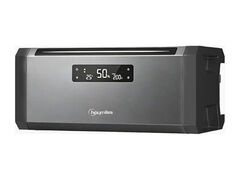
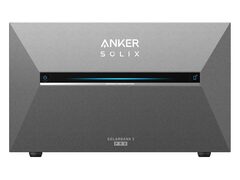
Against the other home batteries, the AC+ stands out first for its AC power: 2400 W, against 1000 to 1200 W for the Hoymiles and the two MPPT models, with only the Marstek edging past it (2500 W). The Anker and the EcoFlow regain the advantage as soon as panels have to be connected without a micro-inverter, thanks to their solar inputs.
| Criterion | Zendure SolarFlow 2400 AC+ | Hoymiles HiBattery 1920 AC | Marstek Venus E 3.0 | Anker Solix Solarbank 3 E2700 Pro | EcoFlow Stream Ultra X |
|---|---|---|---|---|---|
| Starting capacity | 2.4 kWh | 1.92 kWh | 5.12 kWh | 2.69 kWh | 3.84 kWh |
| Maximum capacity | 16.8 kWh | 11.52 kWh | Not expandable | 16.13 kWh | 23.04 kWh |
| Maximum AC power | 2400 W | 1000 W | 2500 W | 1200 W | 1200 W |
| Direct solar input | None | None | None | 4 MPPT, 3600 W | 4 MPPT, 2000 W |
| Weight | 61.3 lb (27.8 kg) | 52.9 lb (24 kg) | 132.3 lb (60 kg) | 64.4 lb (29.2 kg) | 86 lb (39 kg) |
The Hoymiles is the least powerful, and its expansion stops at 11.52 kWh. The Marstek has a fixed capacity and its 132.3 lb (60 kg) makes it hard to move. Against the only AC-coupled rival of comparable power, the Marstek, the AC+ gains in expandability and weighs half as much (61.3 lb against 132.3 lb), but offers half the capacity to start with.
Who the AC+ suits, and what to take from it
In its home market, the AC+ is aimed first at people who already have panels and an inverter or micro-inverters, want to store the surplus without touching the solar wiring and have a communicating meter within reach. It also suits a home without panels but with a dynamic rate, since charging can come from the grid.
It suits less well anyone who wants to connect panels directly (the SolarFlow 2400 Pro is designed for that), anyone expecting uninterrupted backup for sensitive equipment, or anyone who demands zero export to the watt without going through the local API. It also suits badly anyone hoping to use the full 2400 W without an electrician, and it is neither sold in the United States nor documented as certified for a US grid.
For a US reader, the practical takeaway is what to ask of any plug-in battery: a measured round-trip efficiency at your real load (the 800 W figure flatters the 100 to 200 W overnight regime), a guaranteed backup switchover time if you need one, and local control that does not depend on a cloud account.