Car, motorcycle & motorhome

Starting, backup and power on board: our selection of equipment for your car, motorcycle and motorhome.

How well your vehicle runs depends largely on its battery, and a no-start always happens at the worst time. A jump starter (or battery booster) gets you going again in seconds, without relying on another driver, while a tester tells you about your battery's state of health before it is too late.
Whether you are in a car, on a motorcycle or in a motorhome, power on board matters too: a 12V to 220V converter lets you run a mains appliance from the cigarette lighter, and a good set of jump leads remains essential in the boot. Here is our selection of the best starting and power equipment for your travels. To charge your devices or maintain the vehicle battery, head to our Chargers section. · 25 products

I - Jump Starters / Battery boosters

Who hasn't struggled to start their car on a winter morning, battery too weak? Rather than asking for help, the simplest solution is the jump starter (or battery booster): a compact, very powerful lithium battery that restarts your engine in seconds. Essential in a car as in a motorhome, discover the very best.

Noco GB20 Boost Sport

See price and availability (53)

The smallest Noco, the one that genuinely fits in a motorcycle's underseat storage: 500 amps, a kilo, and the same UltraSafe protection as its big brothers.

  • Output: 500 peak amps (petrol up to 4.0 L)
  • Endurance: Up to 20 jump starts per charge
  • Safety: UltraSafe, spark-proof and reverse-polarity proof
  • Format: 196 x 80 x 43 mm, around 1 kg, IP65
  • Pocket format, for bikes and small petrol cars
The GB20 Boost Sport opens Noco's lithium jump starter range and targets a specific audience: riders, owners of small petrol cars, quad bikes, ride-on mowers and leisure boats. Its 500 peak amps restart a petrol engine of up to 4.0 litres with a completely flat battery, as many as twenty times on a single charge. It keeps what matters from the house: UltraSafe protection against sparks and reverse polarity, an IP65 sealed enclosure and a seven-mode LED torch. A USB port also turns it into a backup battery for your phone.
There is a classic mistake when buying a jump starter: reaching for the most powerful one out of reflex, when you actually own a city car or a motorcycle. The GB20 exists for those cases, and it covers them very well. Its 500 amps are ample to restart a four-cylinder petrol engine of under four litres, which takes in almost the entire urban fleet, motorcycles, quad bikes, jet skis and ride-on mowers. What you gain in exchange is the format: under a kilo, the size of a thick large phone, it genuinely fits under a motorcycle seat or in a door pocket, which a GB70 does not. And a jump starter you actually carry beats one left in the garage. Safety has not been trimmed for all that. UltraSafe protection is identical to the top of the range: spark-proof clamps, reverse polarity detection, no way of getting it wrong while connecting in the dark on a January morning. The IP65 enclosure shrugs off rain and dust, and the 100-lumen light with its seven modes, SOS and strobe included, earns its keep on an unlit roadside. Two limits to know before buying. The GB20 does not do diesel: Noco only certifies it for petrol, and you need the GB40 or GB50 as soon as an oil burner is involved. Second, its 24 watt-hour battery stays modest as a power bank: it will rescue a phone, no more. At under eighty pounds it is the most honest entry ticket to Noco reliability.
View product page

Noco GB50 Boost XL

See price and availability (59)

The missing link between the GB40 and the GB70: 1500 amps, diesel up to 4.5 litres, thirty jump starts per charge, for barely more than the model below.

  • Output: 1500 peak amps (petrol 7 L, diesel 4.5 L)
  • Endurance: Up to 30 jump starts per charge
  • Safety: UltraSafe, spark-proof and reverse-polarity proof
  • Lighting: 200-lumen LED torch, 7 modes
  • 4.5 L diesel for the price of a GB40
The GB50 Boost XL holds a strategic place in the Noco range: it adds 50 % more current than the GB40 without reaching the price or the bulk of the GB70. Its 1500 amps restart a petrol engine up to 7.0 litres and, more to the point, a diesel up to 4.5 litres, which covers the family saloon, the SUV and the small van. Noco quotes up to thirty jump starts on a single charge. You still get UltraSafe spark-proof protection, the IP65 enclosure and an LED torch raised to 200 lumens, twice as bright as on the models below.
The GB50 is probably the best power-to-price ratio in the Noco range, and comparing it with its immediate neighbours makes that obvious. The GB40 below stops at 1000 amps and, crucially, at 3.0 litres of diesel: enough for a diesel city car, short as soon as a family saloon or an SUV is involved. The GB70 above climbs to 2000 amps but costs some forty pounds more and weighs nearly twice as much. The GB50 slots between the two with 1500 amps, diesel certified to 4.5 litres, and a price that stays within touching distance of the GB40. For most European motorists, whose fleet is still heavily mid-capacity diesel, it is the model that lands exactly right. In use, the thirty-jump-starts claim is honest: we are of course talking about successive attempts on a very weak battery, not thirty breakdowns, but what it really means is that the unit keeps reserve after rescuing a neighbour too. The torch raised to 200 lumens genuinely changes something: at 100 lumens you see your clamps, at 200 you see the engine bay. The rest is classic Noco, and that is a compliment: spark-proof clamps, reverse polarity protection, rubber-moulded IP65 shell, USB port to rescue a phone. Two reservations. Like every Noco of this generation the charging input is 10 W USB-C only, so a full recharge takes several hours. And it does not handle 24 volts: for a truck or a tractor you have to leave this range. For everything else, there is very little to hold against it.
View product page

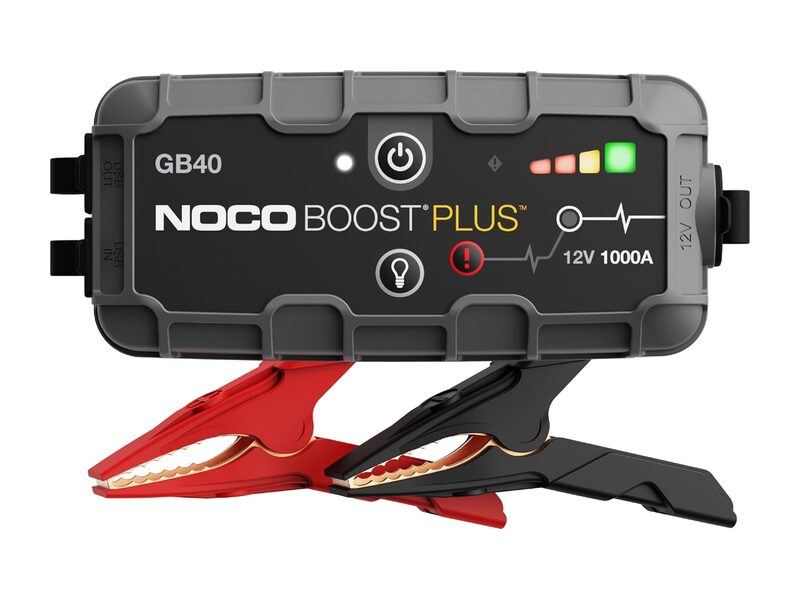
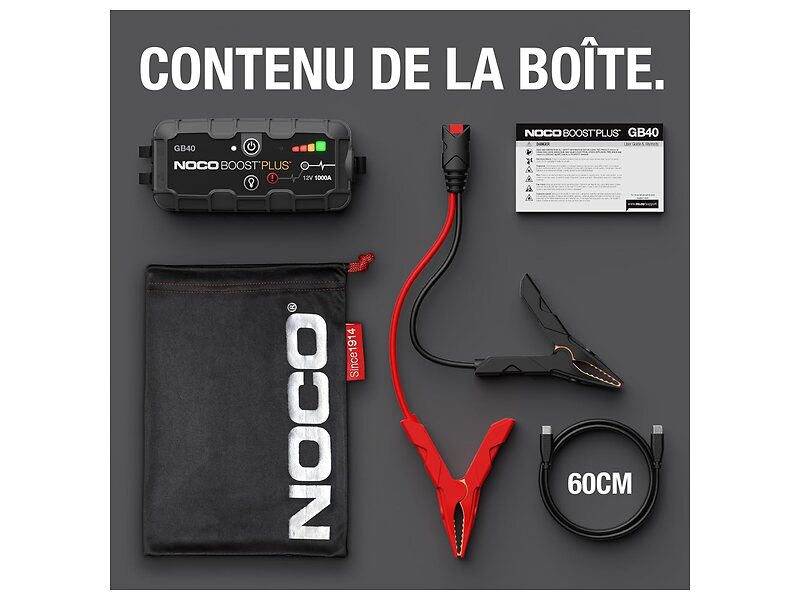
Noco GB40 Boost

See price and availability (140)

1000 amps in your glovebox to restart a dead battery: the UltraSafe NOCO GB40 forgives wiring mistakes and doubles as a power bank and a flashlight.

  • Power: 1000A (gas 6L, diesel 3L)
  • Safety: UltraSafe, spark-proof
  • Functions: USB power bank, 100 lm LED light
  • Protection: IP65, compact
  • 1000A, UltraSafe, power bank + light
The NOCO Boost GB40 is a 1000 amp portable lithium jump starter that restarts a gas engine up to 6.0L or a diesel up to 3.0L, even with a completely dead battery. Its UltraSafe technology guards against sparks and reverse polarity, so you can connect it with confidence even if you have never jumped a car before. Compact and rugged (IP65 rated), it doubles as a USB power bank for your phone and a 100 lumen LED flashlight with several modes, including SOS. The go to rescue tool for the glovebox, the garage, or the trunk.
In-depth reviewRead our full review → 4.2/5 The GB40 is one of those small gadgets that save your whole day. Dead battery on a cold morning, you grab it from the glovebox, clip on the clamps, and the car starts on the first try, no need to track down another driver for a jump. What we like most is the peace of mind: UltraSafe spark-proof and reverse-polarity protection means you can connect it without stress, even if you are not exactly a shade-tree mechanic. Its compact size makes it easy to stash anywhere, and the bonus features are genuinely useful: it can charge a phone in a pinch over USB, and the 100 lumen LED with SOS mode helps out on the shoulder of the highway at night. Two honest caveats: 1000 amps is plenty for a commuter car or a compact sedan, but a bit tight for a big diesel pickup (look at the GBX75 for that), and you need to keep it charged so it is ready when you need it. For the vast majority of drivers, it is a smart, reassuring buy.
View product page

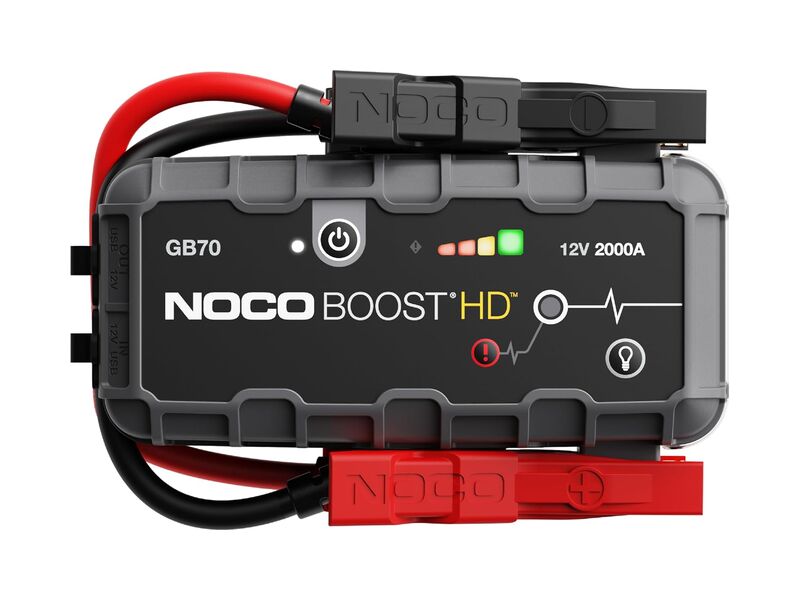
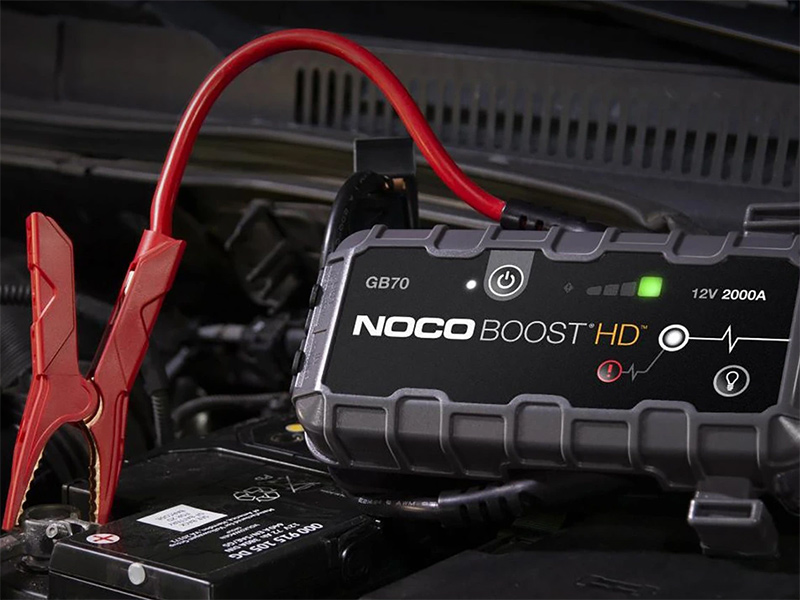
Noco Boost GB70

See price and availability (77)

The jump starter that shrugs off big engines: the NOCO GB70 delivers 2000 amps to restart a gas engine up to 8.0L or a diesel up to 6.0L, safely.

  • Peak current: 2000A
  • Engines: Gas 8.0L / Diesel 6.0L
  • Battery: 56 Wh lithium, ~40 starts
  • Extras: 400 lm light, USB power bank, IP65
  • 2000A for big engines with UltraSafe safety
The NOCO Boost GB70 is a 12V lithium jump starter rated at 2000 amps, built for big engines: gas up to 8.0L and diesel up to 6.0L. Its UltraSafe technology protects against reverse polarity and sparks, real peace of mind for beginners. Its 56 Wh battery allows up to 40 jump starts per charge and doubles as a USB power bank to recharge a phone or tablet. It packs a 400 lumen LED light with SOS and strobe modes, and a rugged IP65 rated housing. A versatile standalone jump starter for cars, SUVs, trucks, or boats.
In-depth reviewRead our full review → 4.1/5 The NOCO GB70 is the kind of accessory you toss in the trunk hoping you never need it, and that becomes a lifesaver the day the battery finally gives out. We tested it on a 2.2L diesel in cold weather with a fully dead battery: clamps connected the right colors to the right terminals, green light, and the engine fired on the first crank. The 2000 amp margin is reassuring, you can tell it has headroom to spare even on a big block. What we appreciate most is the UltraSafe protection: reverse-polarity and spark protection takes all the stress out of connecting, even for someone who does not do this often. The build is tough, the IP65 housing shrugs off garage dust and damp, and the 400 lumen light genuinely helps at night on the shoulder of the road. As a nice bonus, it works as a USB power bank to top off a phone. The only downsides: it is a bit heavy at around 2.3 kg, and a full recharge over USB-C is not exactly fast. But for the peace of mind it buys, it is an investment we recommend without hesitation.
View product page

View all 8 Jump Starters / Battery boosters →

II - 12V → 220V converters

Need to run a mains appliance from the cigarette lighter of your vehicle or motorhome? A voltage converter (or inverter) turns 12V into 220V and makes it possible. Be sure to size the power correctly for the appliance you want to run. Here is our selection of the best converters.
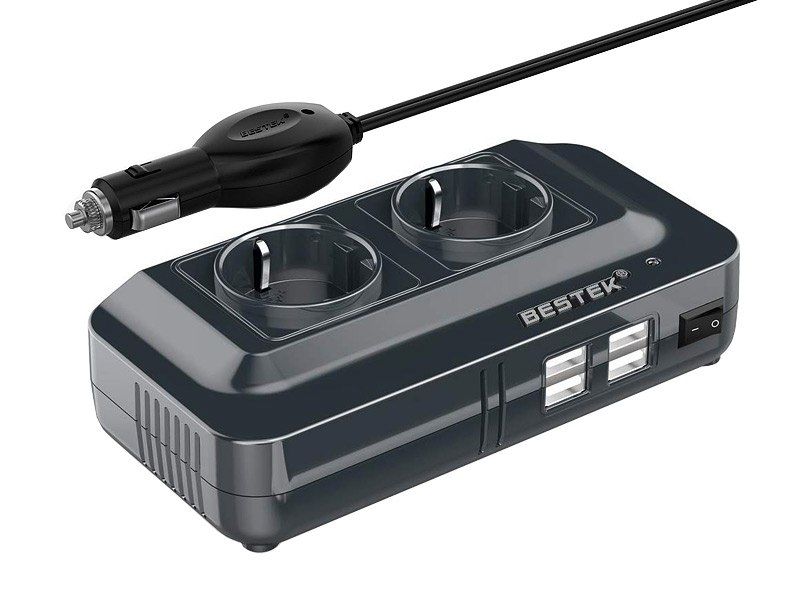
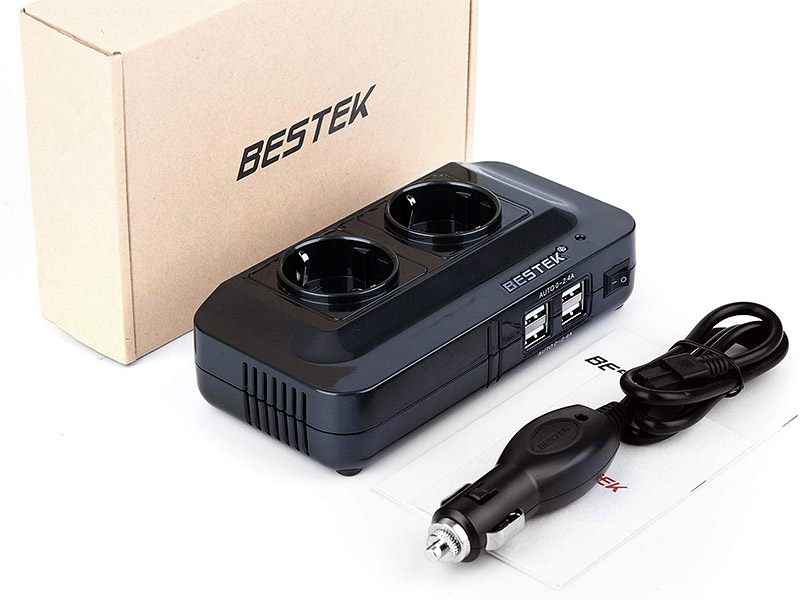
Bestek 200W Power Inverter

See price and availability (30)

Plugs into any 12V outlet and puts out true 120V household power, with fast USB-C and USB-A charging built right into the same compact unit.

  • Power: 200W continuous, 500W peak
  • Outlets: 2x 120V AC outlets
  • USB: 30W USB-C, 18W USB-A
  • Certification: ETL listed
  • Fast USB-C and USB-A charging built in
This compact Bestek power inverter plugs straight into a car, truck, or RV 12V outlet and converts it into 120V AC household power, enough to run a laptop charger, small electronics, or basic tools rated up to 200 watts continuous (500W peak). Alongside its two AC outlets, it packs a 30W USB-C port and an 18W USB-A port for fast device charging without needing the AC side at all. ETL listed for safety, it is a favorite pick-up for road trips, tailgating, storm prep, and anyone who wants a wall outlet on the go.
We kept this Bestek inverter clipped into a truck's 12V outlet for a month of errands and one genuine road trip, and it earns its keep as the small backup that quietly does its job. Plugging in a laptop charger and a portable fan at the same time never tripped the 200-watt rating, and the USB-C port pulled a real 30 watts into a phone, fast enough to matter on a long drive. The dual AC outlets are a nice touch over the single-outlet inverters we have tried, letting two low-draw devices run at once. Build quality feels solid for the price, and the ETL listing is reassuring given how many uncertified inverters show up online. Our one real complaint: the 500-watt peak is brief, so anything with a real motor, like a small blender, trips the overload protection almost immediately. It also gets warm under sustained load, so airflow around it matters. For phones, laptops, and small electronics on the road, in a car, or during a power outage, it is a dependable, inexpensive piece of kit worth keeping in the glovebox.
View product page

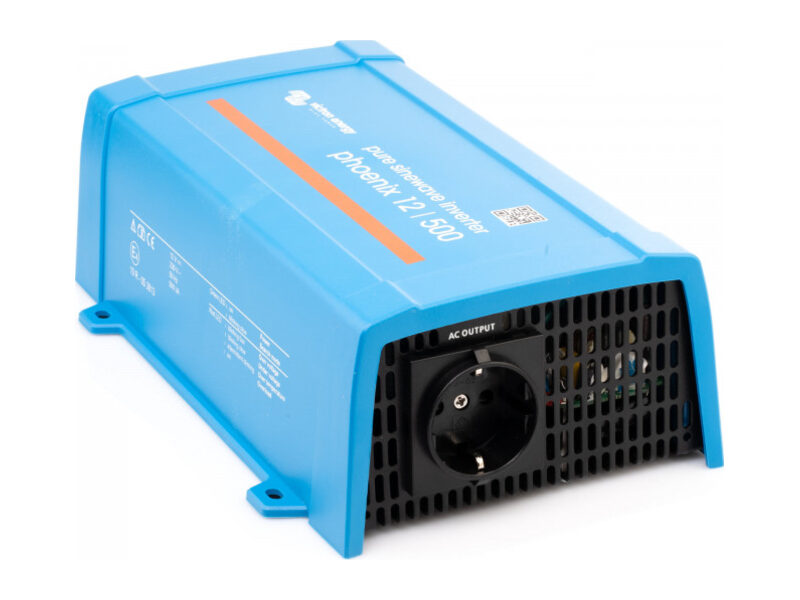
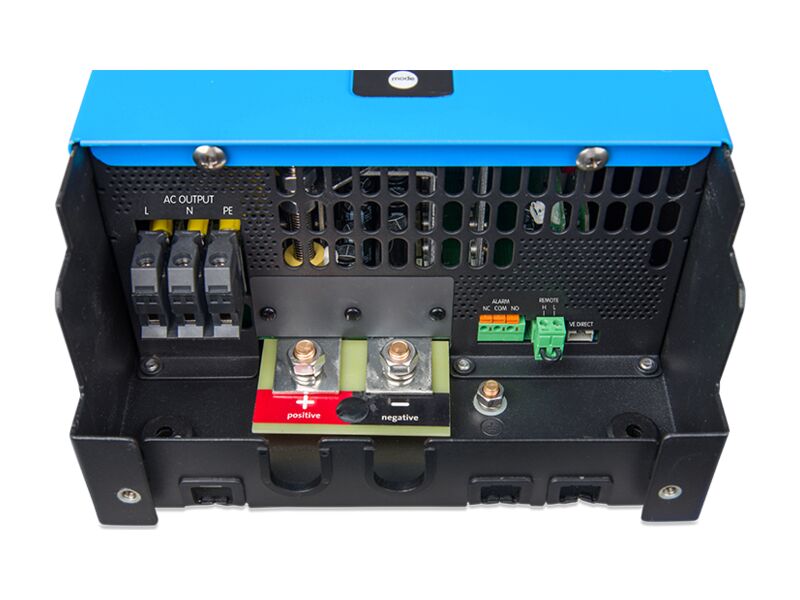
Victron Energy Phoenix 12/500

See price and availability (4)

The inverter you fit once for a decade: true pure sine wave, an ECO mode that draws a single watt on standby, and five years of manufacturer warranty.

  • Output: 400 W continuous at 77°F (25°C), 900 W peak
  • Waveform: True pure sine wave, adjustable 230 V
  • Standby: ECO mode, 1 W draw
  • Monitoring: VE.Direct port, remote on/off
  • True pure sine wave and a 5-year warranty
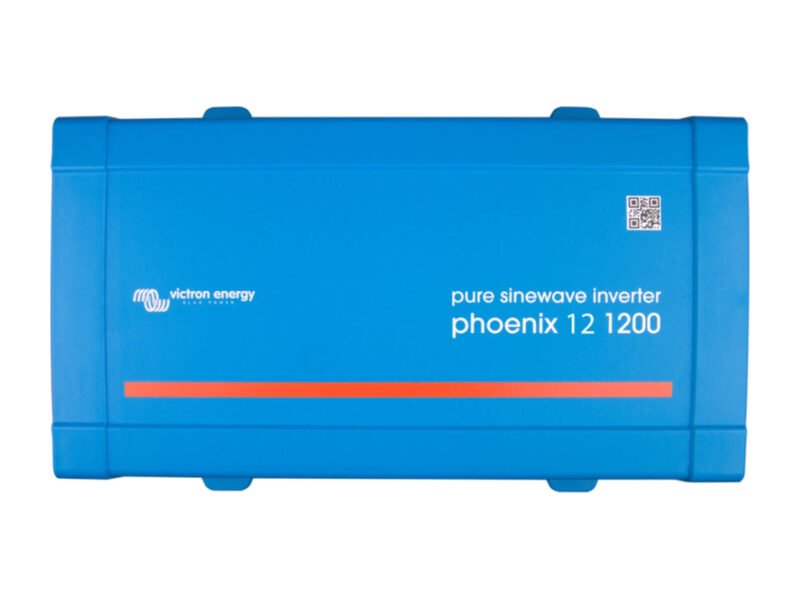
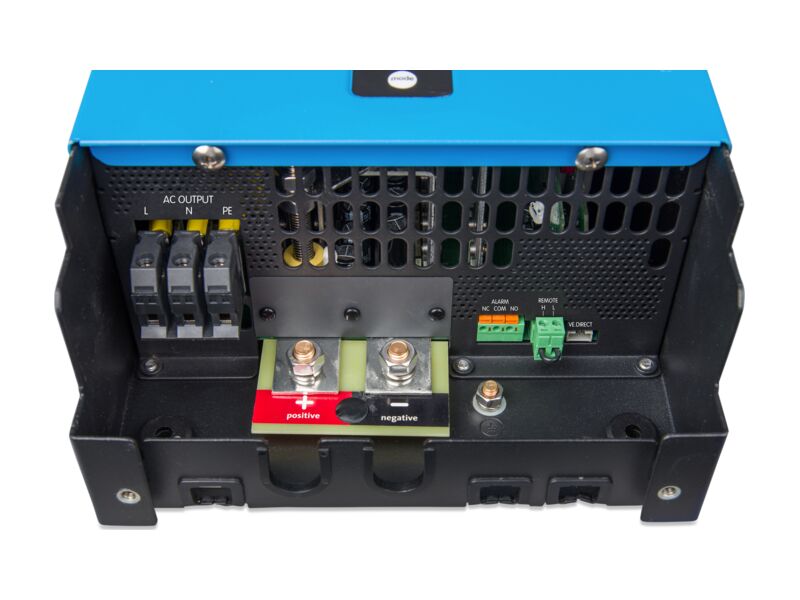
The Phoenix 12/500 VE.Direct is the entry model in Victron Energy's inverter range, from a Dutch manufacturer whose equipment is found on boats, motorhomes and off-grid installations alike. It delivers 400 watts continuous at 77°F (25°C) and absorbs 900 watt peaks, in genuine pure sine wave. Its ECO mode drops it to standby at a single watt when nothing is plugged in, and its VE.Direct port lets you configure and monitor it from a phone.
There are two families of 12 volt inverter, and the difference is not obvious in a shop. Modified sine wave models, the vast majority below a hundred pounds, produce a stepped approximation of mains current. That is fine for a lamp or a drill, but it makes transformers hum, motors run hotter and upsets some switched-mode power supplies. The Phoenix 12/500 belongs to the other family: it produces a genuine sine wave, indistinguishable from a wall socket, so it can run a medical device, a sewing machine, a tool charger or a computer power supply without reservation. The second thing that sets it apart is ECO mode. A conventional inverter draws current permanently, often five to ten watts, even with nothing plugged in: on a motorhome battery that empties a hundred amp-hours in a few weeks. The Phoenix instead drops to one watt on standby and wakes as soon as a load above fifteen watts appears. On an installation left permanently connected, that detail is the difference between a battery still charged in spring and a dead one. The VE.Direct port completes the picture: with a Bluetooth dongle you set the low-voltage cut-off thresholds, the output voltage and ECO mode from a phone. Two honest limits. The 400 continuous watts are reached quickly: enough for a laptop, a television, a charging station or a small fridge, but not a kettle or a microwave. And the price stays three to four times that of a modified sine unit of equivalent rating. What you pay for is signal quality, standby draw and a five-year warranty.
View product page

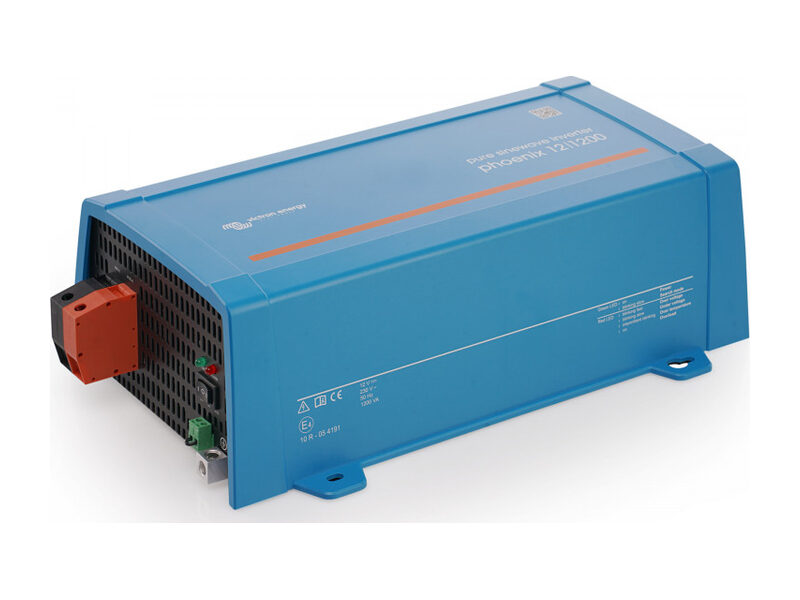
Victron Energy Phoenix 12/1200

See price and availability (5)

A thousand watts of true pure sine power from a 12-volt battery: the go-to inverter for RV owners and boaters, backed by a 5-year warranty.

  • Output: 1000W continuous, 2200W peak
  • Waveform: True pure sine wave, 120V/60Hz
  • Standby: ECO mode, 1W draw
  • Format: 7.4 kg (16.3 lbs), NEMA GFCI outlet
  • The pure sine wave that runs nearly anything
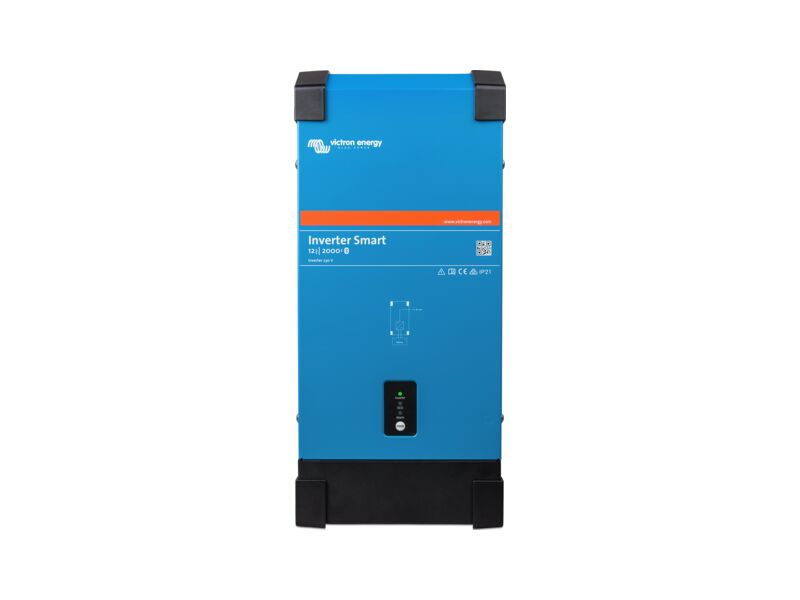
The Phoenix 12/1200 VE.Direct is the inverter that upgrades a 12-volt system to real household comfort: 1000 watts continuous at 77 degrees F, 850 watts at 104 degrees F, and up to 2200 watts of peak power to absorb a motor or compressor starting up. The output is a genuine pure sine wave from a toroidal transformer, and ECO mode drops standby draw to a single watt. A NEMA outlet with built-in GFCI protection and the VE.Direct port for phone-based monitoring round out a unit built for a permanent RV or marine installation.
A thousand continuous watts is where an inverter stops being a stopgap and becomes a real onboard power supply. Below that you charge gadgets; here you run a coffee maker, an entry-level microwave, a power tool, or a compressor fridge without a second thought. The 2200-watt peak matters just as much: it absorbs the surge of a motor starting, the exact moment cheaper inverters trip their own protection. The Phoenix produces a true pure sine wave through a toroidal transformer, an older but proven design Victron has stuck with over lighter electronics. That explains the 7.4-kilo weight, and the reputation these units have for surviving the heat and vibration of a boat engine room for years. ECO mode is the feature buyers underrate at first and rely on afterward: one watt of standby instead of ten adds up over a season. The built-in GFCI protection is a genuine plus near water. Two honest notes: the price is real money next to a cheap modified-sine box, and battery sizing matters, since 1000 watts out draws close to 90 amps at 12 volts.
View product page

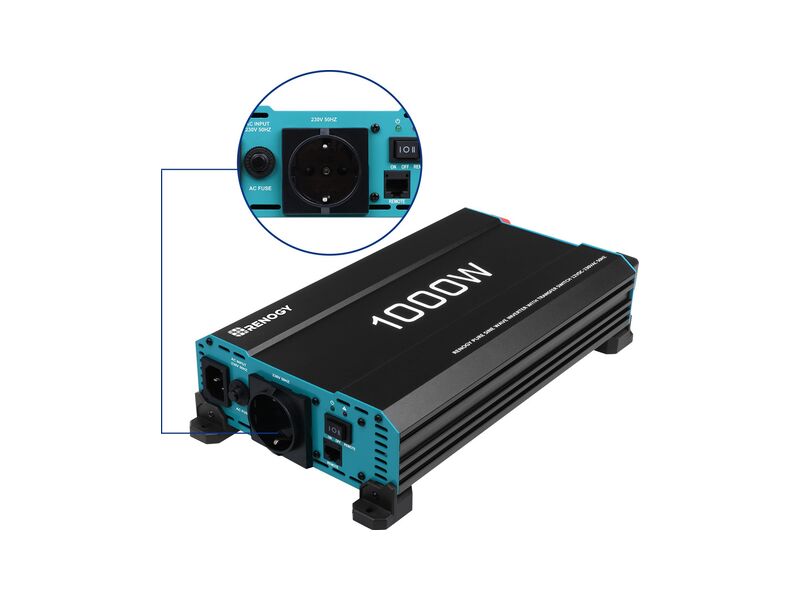
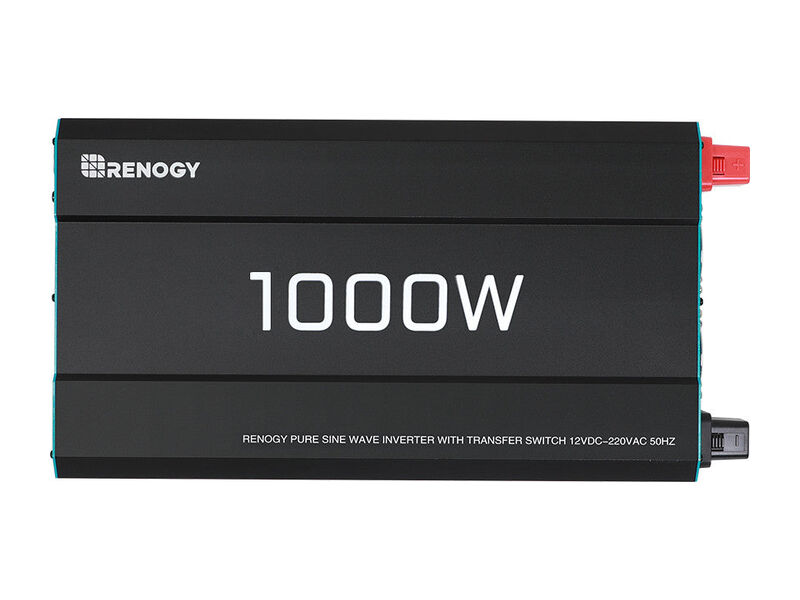
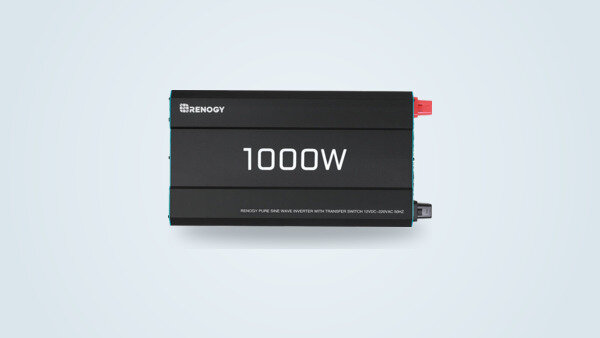
Renogy 1000W/2000W power inverter

$230.17 $148.93 (6)

From cigarette lighter to a real mains socket: the Renogy inverter keeps sensitive electronics powered, with an automatic mains transfer switch in 50ms.

  • Power: 1000W continuous, 2000W surge
  • Waveform: Pure sine wave, 220-240V
  • UPS function: Mains/battery switch in 50ms
  • Format: 2.6kg, wired remote included
  • True pure sine wave with automatic mains switch
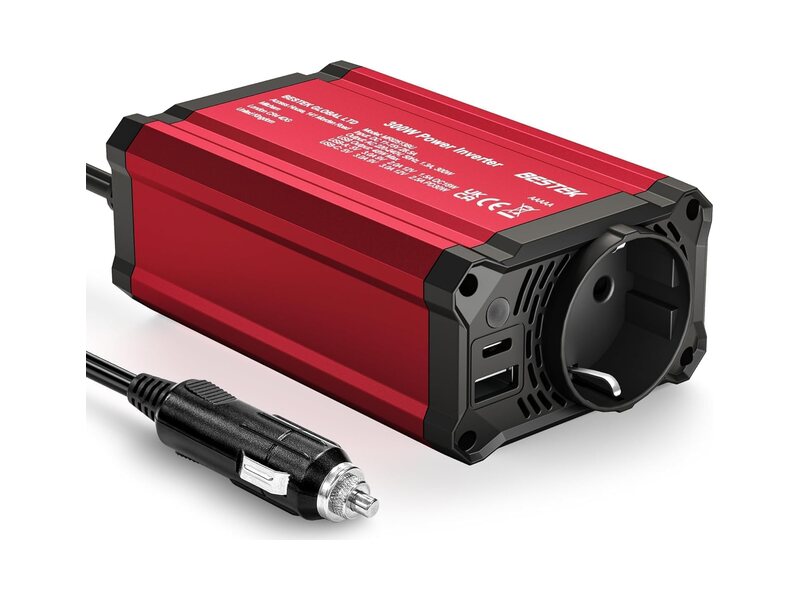
The Renogy 1000W/2000W inverter turns a battery's 12V into 230V pure sine wave AC, clean enough for sensitive electronics such as laptops, medical devices or small appliances. Its UPS function automatically switches between mains and battery power in under 50 milliseconds, a genuine asset in a motorhome, on a boat, or as home backup power. Compact at 2.6kg, protected against overload and overheating, it also comes with a wired remote control.
You would expect a lot from an inverter priced around $148.94 and this one mostly delivers. The genuine pure sine wave causes no issues with a laptop, a power tool charger or a small kettle, unlike modified sine models that make some appliances hum. The UPS function is the real selling point: wire the AC input to your motorhome's shore power and let the unit switch itself over on a power cut, no scrambling to swap plugs. A couple of honest caveats. The rated idle draw (about 1A, or 12W) is higher than a Victron in ECO mode, which matters on a setup left plugged in for weeks. The supplied battery cable is decent but no more: consider upgrading it if you plan to draw the full 1000W continuously. For the price, well below an equivalent pure sine inverter with a built-in transfer switch, it is a genuinely good compromise for a reliable 230V socket without breaking the bank.
View product page

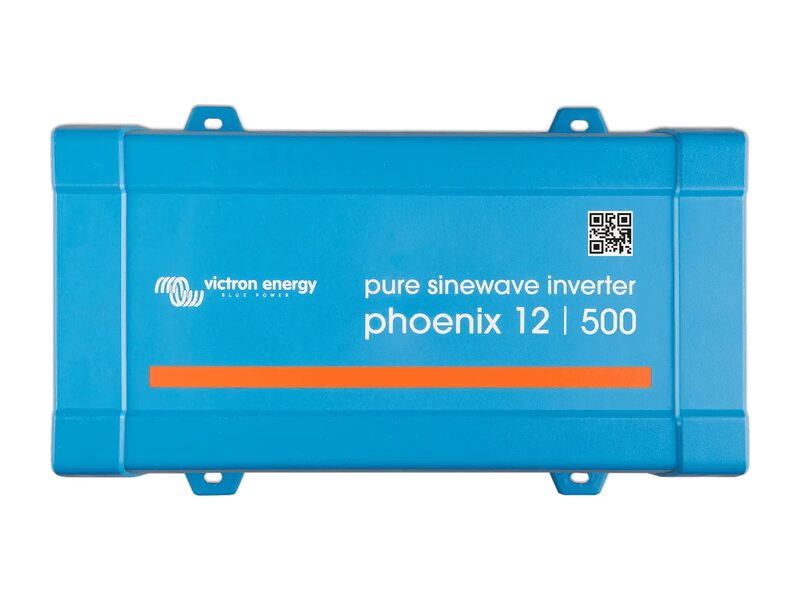
Bestek 500W power inverter

See price and availability

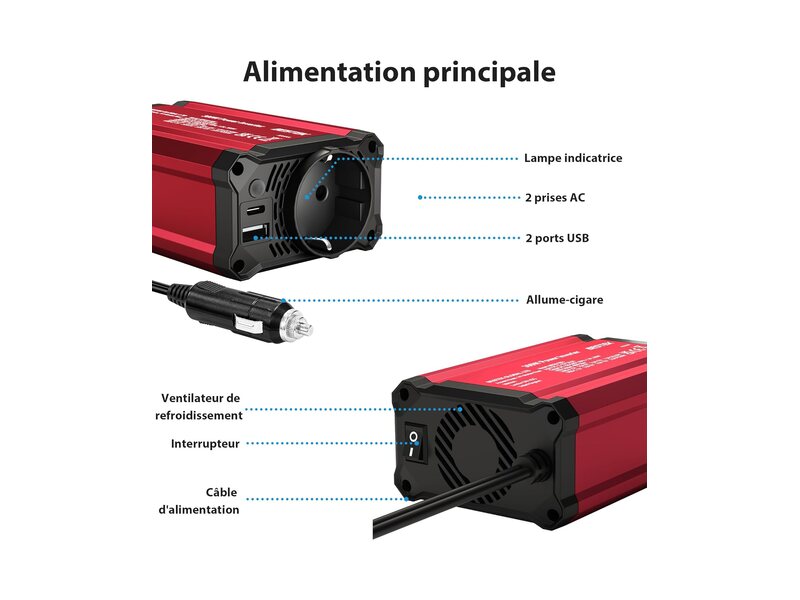
500W of 220V in the car: the Bestek inverter turns your cigarette lighter or 12V battery into a mains socket to power small devices and charge on the road.

  • Power: 500W continuous (higher peak)
  • Conversion: 12V DC to 220-240V AC
  • Outputs: Mains socket(s) + USB ports
  • Safety: Cooling fan, electronic protections
  • 500W, mains sockets + USB, portable
The Bestek 500W inverter turns the 12V direct current of your car, motorhome or boat into 220-240V alternating current, like a household mains socket. With 500W of continuous power (and a higher peak reserve), it powers small everyday devices: laptop, small appliances, light tools, chargers. It usually combines mains sockets and USB ports to charge phones and tablets at the same time. Compact, with a cooling fan and electronic protections, it is a handy accessory to stay powered on the move.
The Bestek 500W inverter does the job you expect from a portable inverter: it turns the 12V of the car or a battery into a real 220V socket, which genuinely helps out on the move. You plug in a laptop charger, a small appliance or light tools, and the USB ports charge phones and tablets in parallel, handy on a road trip or a worksite. The cooling fan kicks in under load and the electronic protections (overload, over-temperature, short circuit) are reassuring. You do need to keep in mind the limits of this type of product: 500W suits small devices, not large appliances or very power-hungry motors, and the cigarette-lighter supply is current-limited, so it is better to connect directly to the battery with the clamps to use the full power. Also take care not to drain the vehicle battery with the engine off. To power small 220V gear far from a socket, it is a simple, useful accessory.
View product page

III - Jump leads

As basic as this item may seem, it is very important to choose your jump leads well: poor quality or undersized, they can be ineffective or even dangerous. Cross-section (in mm²), length and clamp quality make all the difference. Choose wisely, with the help of this selection.

Imdifa 625 Jump Leads 35mm²

$37.44 $24.59 (5)

With a solid cross-section, these jump leads and their alligator clips can handle up to 400A to start your vehicle.

  • Cross-section: 35mm²
  • Dimensions: Length 4.5m
  • Compatibility: Gasoline engines up to 7L, diesel up to 4L
  • Reliable, solid construction, good length
Their substantial 35mm² cross-section and the quality of their alligator clips are enough for this cable to handle up to 400 amps to start your car. The Imdifa 625 jump leads are designed to connect to the electrical battery of vehicles with an engine displacement of no more than 7 liters for gasoline, or 4 liters for diesel. Built to DIN 72555 standard and 4.5m long, they will get you out of any bad situation!
View product page

Sakura SS3625 200A

$15.33 (8)

Very affordable, these jump leads are designed to help start medium-sized engines, up to 2 liters (200A max).

  • Cross-section: 25mm²
  • Dimensions: Length 3m
  • Compatibility: Mid-size cars with engines up to 2L
  • Inexpensive, very sturdy clamps
These insulated cables, 3m long, have a 25mm² cross-section, allowing them to handle up to 200A maximum. They will let you jump-start batteries on engines up to 2 liters in displacement. The alligator clips are sturdy and grip battery terminals well (but can be a bit large for small batteries like those on some motorcycles, especially if they're not very accessible). Good cables for a tight budget.
View product page

IV - Battery testers

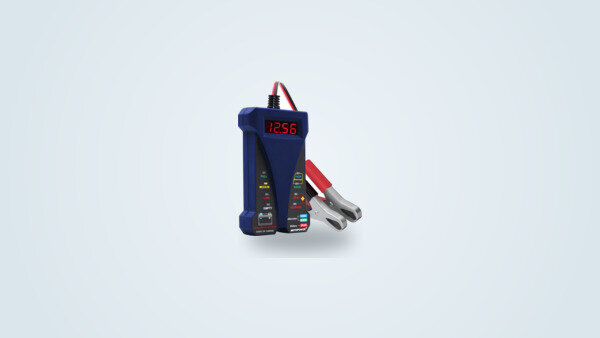
Need to know more about the state of health of your vehicle battery (or your solar kit battery)? A good battery tester gives you valuable information in seconds: charge level, voltage, state of health. Enough to anticipate a breakdown rather than suffer it. Here is our selection of testers.
Motopower MP0514B

See price and availability (6)

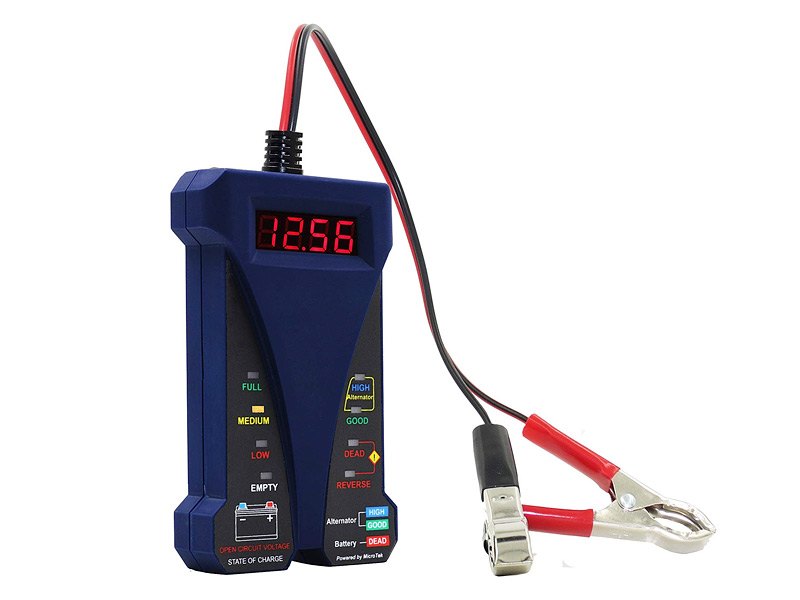
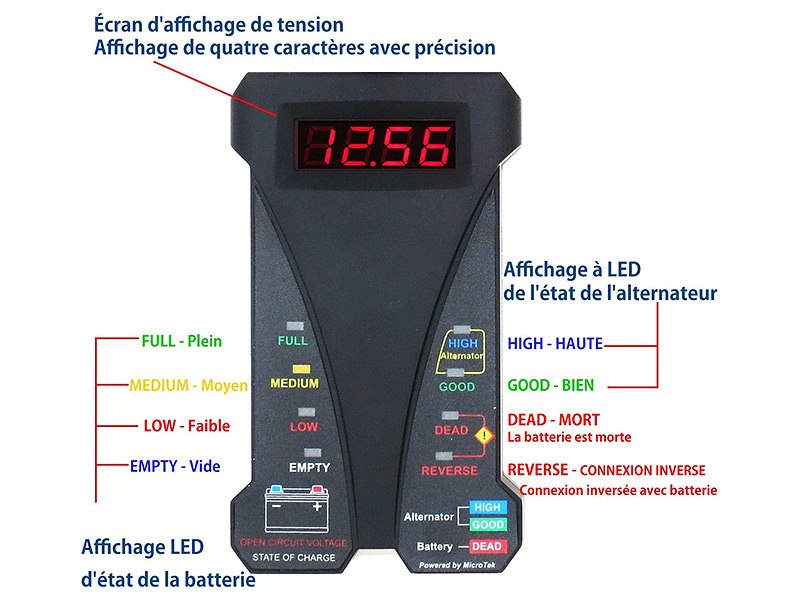
Discover the Motopower MP0514B, a digital 12V battery tester and analyzer, very complete, with a 4-digit numeric display.

  • Type: Digital battery tester
  • Dimensions: 117 x 91 x 51 mm
  • Weight: 150g
  • Voltage range: 4-20V
  • Multifunction, accurate and easy to use
The MP0514B is a digital 12V battery tester and charging system analyzer, offered by manufacturer Motopower. Equipped with an LCD screen, it gives you the information you need about your 6V and 12V car battery (voltmeter accepted range: 4V to 20V). Protected against polarity reversal and overvoltage, this tester will show you your battery's level and whether it is dead or not. Very practical!
View product page

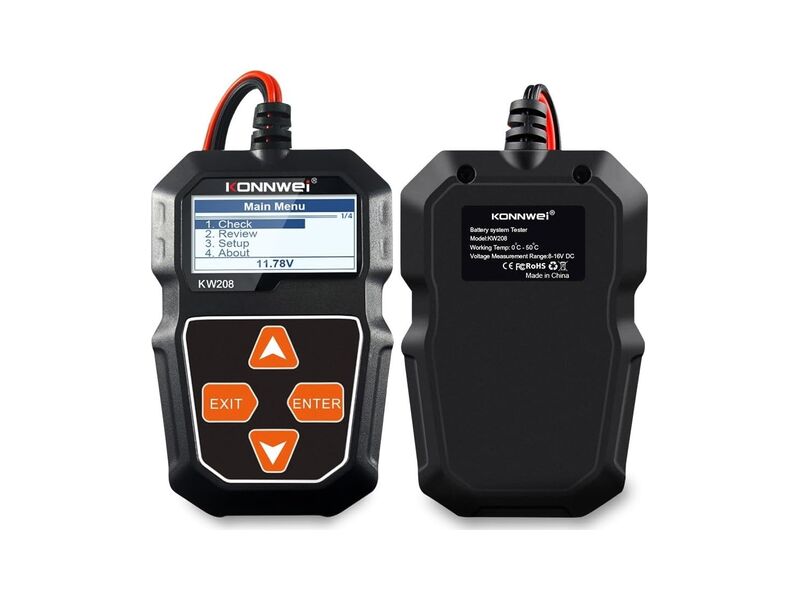
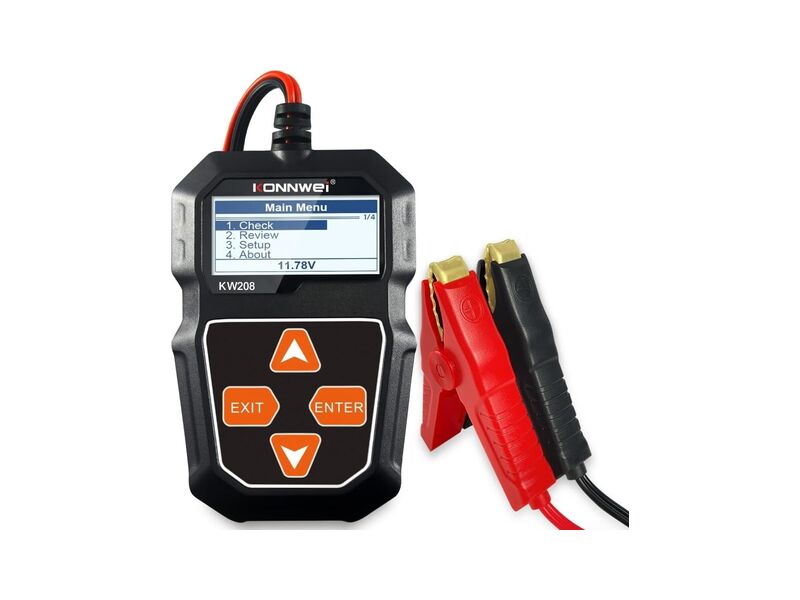
Konnwei KW208

See price and availability (44)

A complete, affordable car battery tester: it checks battery health, the cranking circuit, and alternator charging, from 100 to 2000 CCA.

  • Compatibility: 6V / 12V batteries (flooded, AGM, EFB, gel)
  • Test range: 100 to 2000 CCA
  • Functions: Battery health, cranking, alternator charging
  • Complete 3-in-1 diagnosis, LCD screen, budget friendly
The KONNWEI KW208 is a car battery tester that does a lot for the money. Clipped onto a 6V or 12V battery with its clamps, it reads the battery's state of health (remaining capacity, internal resistance, voltage) across a 100 to 2000 CCA range, plus the cranking circuit and alternator charging. Results show clearly on its backlit LCD screen. Compatible with standard flooded, AGM, EFB, and gel lead-acid batteries, it is a simple, reliable diagnostic tool for drivers and shops alike.
For a tester at this price, the KW208 earns its keep. We used it on several vehicles before winter, and it gives a clear reading in a few seconds: battery health as a percentage, voltage, and a CCA estimate to compare against the number printed on the battery. The real advantage over a plain voltmeter is that it also tests the starter draw and the alternator's charging output: you can immediately tell whether the battery is worn out or the alternator is not charging enough. Hooking up to the terminals is straightforward with the clamps, and the backlit screen stays readable under the hood. We like being able to select the battery type (standard flooded, AGM, EFB, gel) for a consistent result. It is not a high-end shop tool, the interface is basic and the translated text is occasionally rough around the edges, but for diagnosing a weakening battery yourself before replacing it blindly, it is remarkably useful and pays for itself fast.
View product page

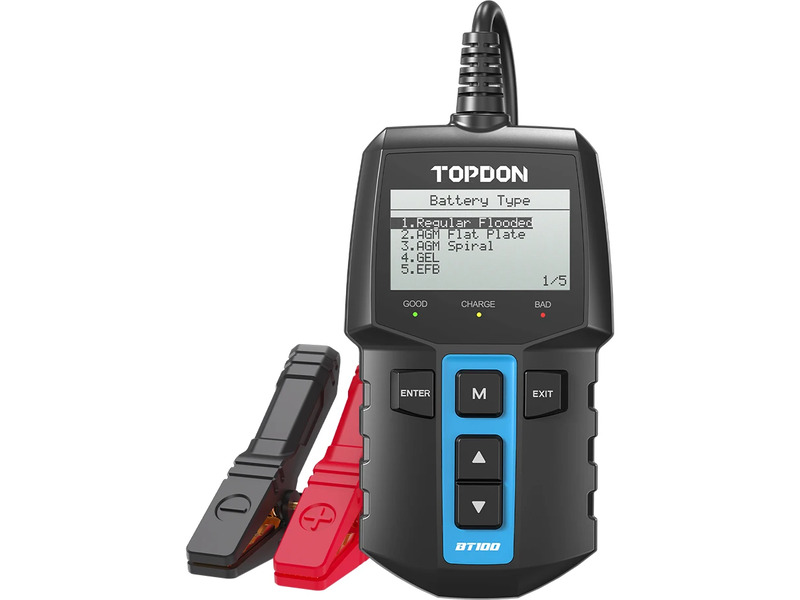
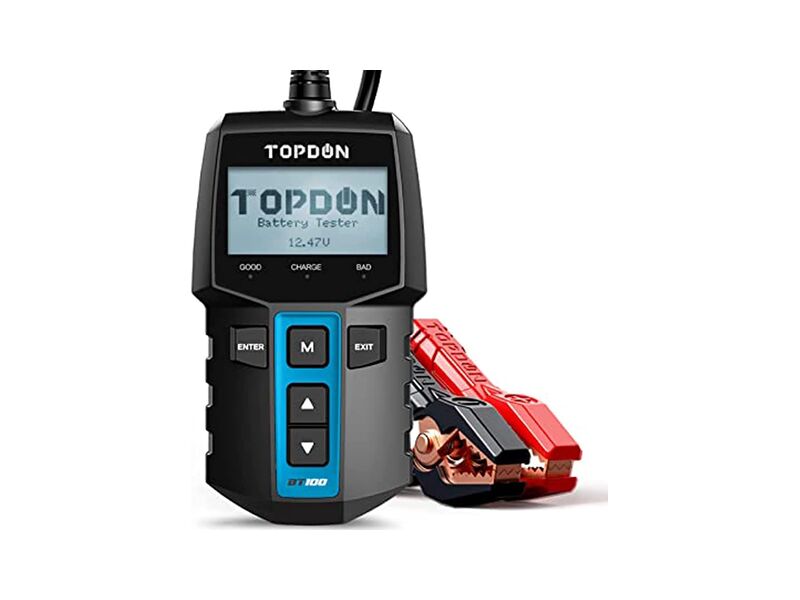
Topdon BT100

See price and availability (38)

Know in 3 seconds if your battery needs replacing: the TOPDON BT100 tests health, charge, cranking, and alternator with a single click, from 100 to 2000 CCA.

  • Compatibility: 12V batteries (flooded, AGM, EFB, gel)
  • Test range: 100 to 2000 CCA
  • Tests: Battery, cranking, charging system
  • Display: 128x64 LCD screen
  • 3 tests in one, clear results from 100 to 2000 CCA
The TOPDON BT100 is a compact 12V battery tester that reads battery health (SOH), state of charge (SOC), voltage, and internal resistance. Thanks to conductance technology, it also tests the cranking system and the charging system (alternator), across a 100 to 2000 CCA range. Compatible with every 12V battery type (flooded, AGM flat plate and spiral, EFB, gel), it shows clear results on its LCD screen and includes reverse polarity protection.
The TOPDON BT100 is one of those small tools that save a lot of hassle. We used it on a car that struggled to start in the morning: within seconds, it confirmed the battery was at the end of its life, health collapsed, before we even pulled it to replace it. What we like is that it does not just show a voltage: it gives a real health percentage, tests cranking capacity, and checks the alternator too, so you know right away whether the problem is the battery or the charging system. The LCD screen is easy to read, the clamps are solid, and the unit runs without its own batteries since it draws power from the battery under test. You just need to enter the right standard and CCA rating for an accurate result. At this price, it is an excellent diagnostic tool to keep in the glovebox, as useful for the careful DIYer as for the weekend mechanic.
View product page

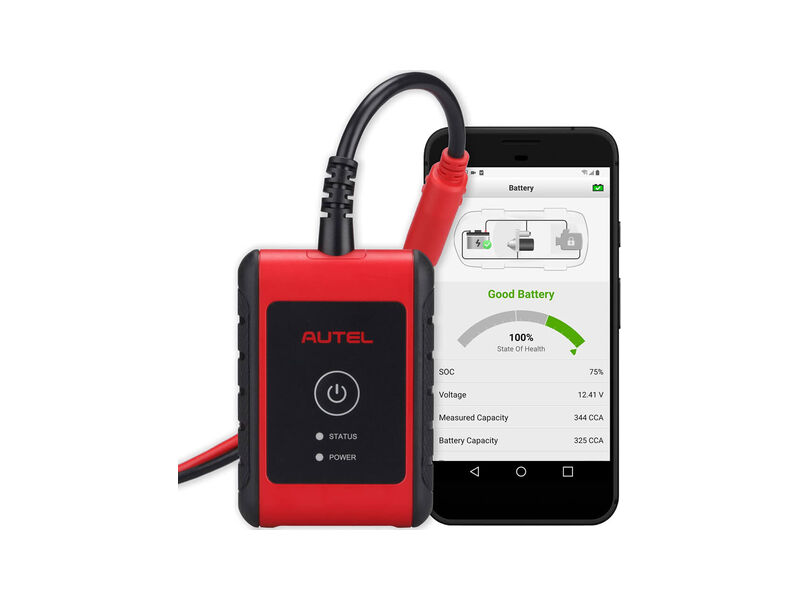
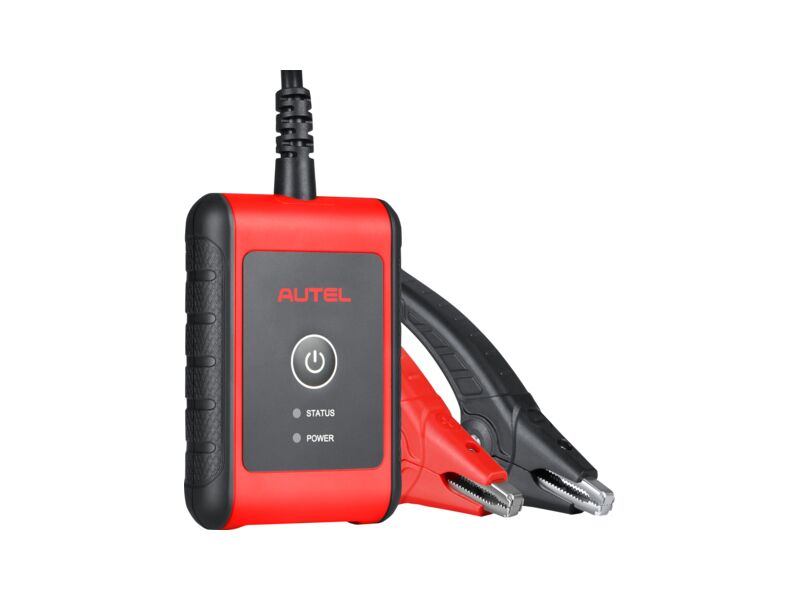
Autel MaxiBAS BT506

See price and availability (5)

The battery tester that thinks like a pro: the Autel MaxiBAS BT506 diagnoses battery, cranking and alternator with workshop accuracy, driven from your smartphone.

  • Compatibility: 6V / 12V (flooded, AGM, EFB, Gel)
  • Test range: 100 to 2000 CCA
  • Tests: Battery, cranking, alternator
  • Interface: Free iOS/Android app (Bluetooth)
  • Adaptive conductance, workshop accuracy via smartphone
The Autel MaxiBAS BT506 is a 6V and 12V battery and electrical system analyser, using adaptive conductance technology for highly accurate diagnostics. It tests the battery (health, charge), the starter and the alternator, in and out of the vehicle, over a 100 to 2000 CCA range. Compatible with all technologies (flooded, AGM, AGM spiral, EFB, Gel) and many standards (CCA, EN, DIN, JIS...), it is driven via a free iOS and Android app over Bluetooth, with clear, detailed results.
The Autel MaxiBAS BT506 plays a level above small garage testers. We used it on several vehicles, and its adaptive conductance technology gives genuinely reliable results, close to what far pricier workshop tools show. What we like is the comfort of the app: the unit connects to the smartphone over Bluetooth, and you get a clear, colourful report with health status, cranking capacity and alternator check, all in under a minute and with no subscription. Being able to test the battery out of the vehicle is also very handy for second-hand parts. The unit is well finished, the clamps sturdy. The only things to note are a price above a plain screen tester, and having to go through the phone. But for a demanding home mechanic or a small workshop, it is a remarkably accurate and complete analyser.
View product page

V - Motorcycle batteries

Leave a motorcycle in the garage all winter and it is the battery that picks up the bill in spring. Unlike a car, a two-wheeler is ridden little, recharges poorly and suffers in the cold: its battery typically needs replacing every three to four years. Picking the right reference (YTX, YTZ, size, polarity, cranking amps) is essential, and brand quality genuinely shows in service life.
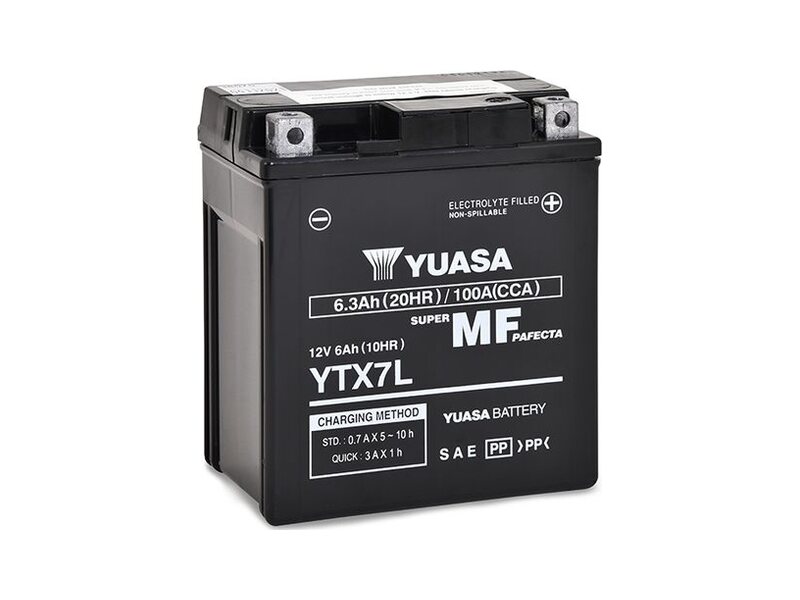
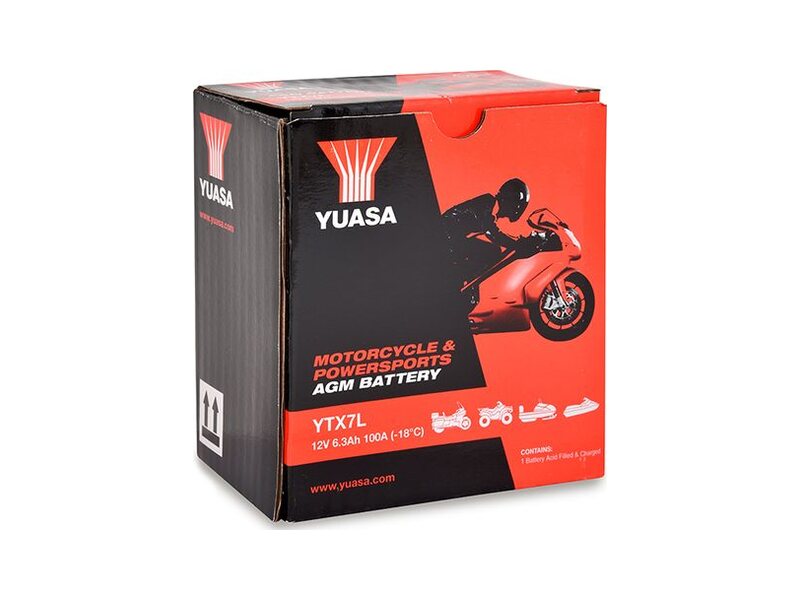
Yuasa YTX7L-BS 12V 6 Ah

See price and availability (4)

The small battery fitted to half the 125s and scooters on European roads: tall and narrow, 100 cranking amps, and the seriousness of an original-equipment maker.

  • Capacity: 12 V, 6 Ah (100 cranking amps)
  • Technology: Sealed AGM, pre-activated, maintenance free
  • Format: 115 x 72 x 132 mm, 2.5 kg
  • Polarity: Positive terminal on the right
  • The reference for 125s and city scooters
The YTX7L-BS is the reference for small capacities: 125 cc road and trail bikes, city scooters, entry-level quads and compact jet skis. Its tall, narrow 115 x 72 x 132 mm format sets it apart from the wider YTX references and rules out any mix-up at fitting. It delivers 12 volts, 6 amp-hours and 100 cranking amps in sealed maintenance-free AGM technology. Supplied factory-activated, it fits straight out of the box, which is not true of the whole range.
On a 125 or a scooter, the battery sits in a compartment sized to the millimetre, often under the seat or behind a side panel. The YTX7L-BS answers that exact format: it is tall and narrow where the YTX9-BS is low and wide, and the two are not interchangeable despite similar capacities. That is the first thing to check before ordering, and the reason this standardised reference exists at all. On substance you get the qualities that made Yuasa's name: it is the maker supplying a good share of Japanese manufacturers as original equipment, and its plates go the distance where compatibles sold at twenty-five pounds lose capacity by their second season. The 100 cranking amps are ample for a 125 cc single, cold mornings included, provided the battery is charged. One practical detail sets it apart from the rest of the range: in the version we selected it ships factory-activated, with no acid bottle to pour. Out of the box, connected, ridden. That is welcome on a two-wheeler where reaching the battery often means removing bodywork. Two reservations that are barely reservations. Six amp-hours is little: on a scooter fitted with an alarm or heated grips, the reserve drains fast if journeys are short. And like every small-capacity battery, it hates being laid up unattended. A trickle charger connected from November to March costs a third of a new battery and buys it two extra years.
View product page

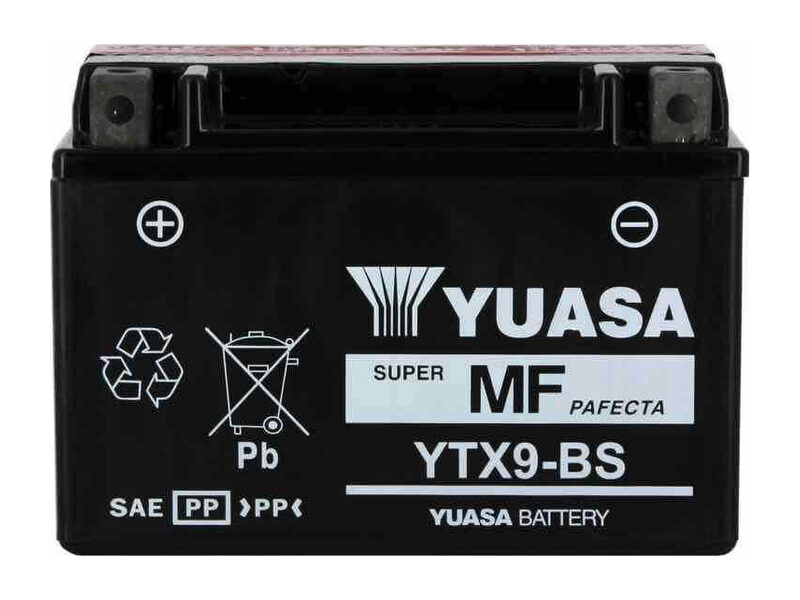
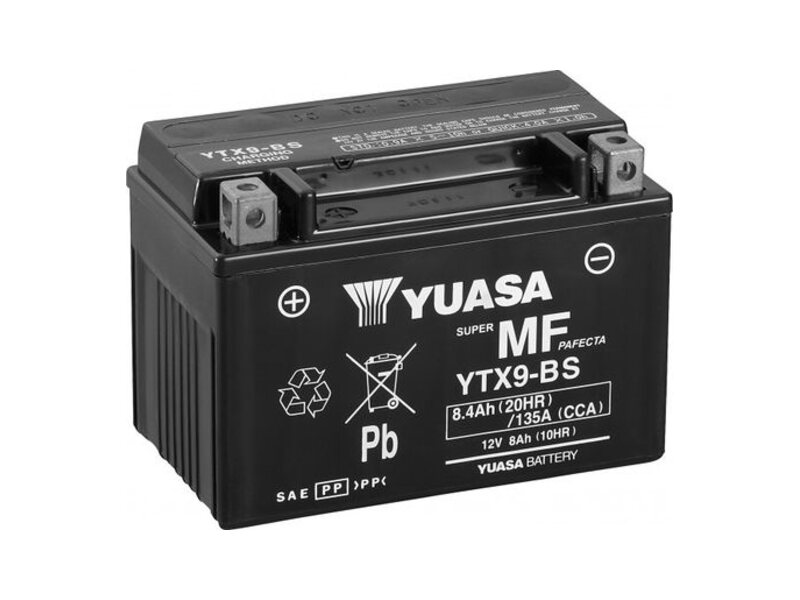
Yuasa YTX9-BS 12V 8.4 Ah

See price and availability (18)

The factory-fit reference on many mid-size motorcycles and maxi-scooters: sealed AGM, 135 cranking amps, and the reliability of a century-old maker.

  • Capacity: 12V, 8.4Ah (135 cranking amps)
  • Technology: Sealed AGM (VRLA), maintenance free
  • Size: 150 x 87 x 105 mm, 3.1 kg
  • Polarity: Positive terminal on the left
  • The original fitment on 600s and maxi-scooters
The YTX9-BS is an industry-standard battery size: it shows up on a large share of 600cc sport and standard motorcycles, on maxi-scooters, ATVs, and personal watercraft. Yuasa is its original designer, and Yuasa is the company that supplies most Japanese manufacturers as original equipment through its US operation, Yuasa Battery Inc. Sized 150 x 87 x 105 mm, 12 volts, 8.4 amp-hours, and 135 cold cranking amps, in sealed AGM technology: no maintenance, no fluid level to check, and solid resistance to vibration.
Buying a motorcycle battery is rarely fun: you replace it because the old one gave up, usually at the worst possible moment. Better to get the right one the first time, and the Yuasa YTX9-BS is hard to fault. The first argument is industrial, not technical: Yuasa is the original designer of the YTX reference, the same company that fits a large share of Japanese motorcycles from the factory through its US arm, Yuasa Battery Inc. Buying a YTX9-BS means buying exactly what the manufacturer installed, where cheaper compatible copies match the dimensions but rarely the service life. On the technical side, the 135 cold cranking amps matter most, not the amp-hour rating, since that number decides whether the starter spins convincingly on a cold morning. Sealed AGM technology removes the maintenance and handles vibration well. Two honest notes: the battery ships with a separate acid pack to fill at installation, needing a full charge first, and like any lead-acid battery it hates sitting dead, so a trickle charger during winter storage is the best investment you can make alongside it.
View product page

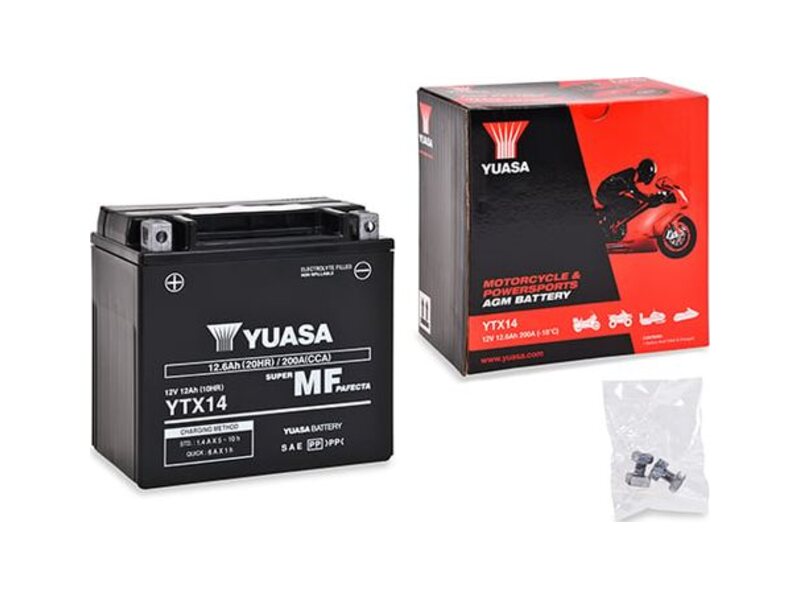
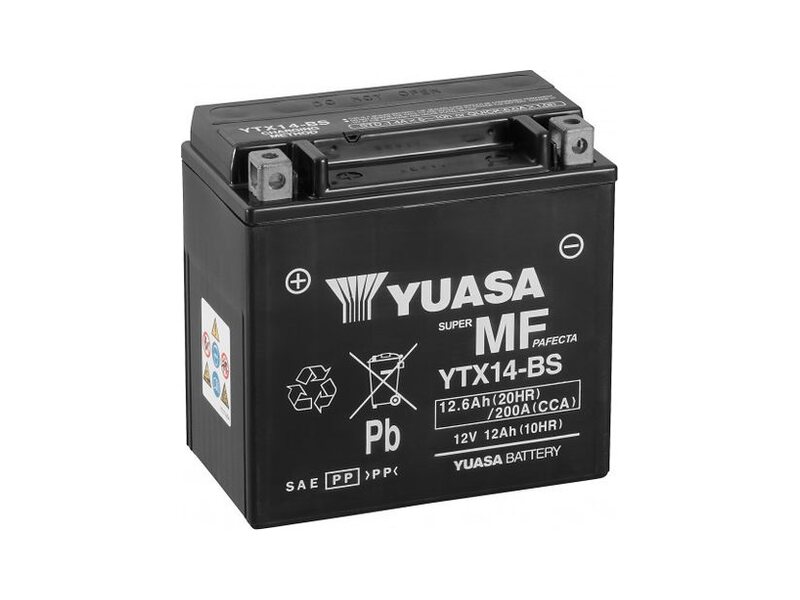
Yuasa YTX14-BS 12V 12 Ah

See price and availability (9)

Two hundred cranking amps: the reference battery that spins big twins, cruisers, and adventure bikes where a YTX9 begins to struggle.

  • Capacity: 12V, 12Ah (200 cranking amps)
  • Technology: Sealed AGM (VRLA), maintenance free
  • Size: 150 x 87 x 145 mm, 4.6 kg
  • Polarity: Positive terminal on the left
  • 200A, the reference for big-bore bikes
The YTX14-BS is the battery for big-bore machines: cruisers, adventure bikes, sport tourers, utility ATVs, and recreational boats. Its 200 cold cranking amps are half again what a YTX9-BS delivers, and its 12 amp-hours absorb the constant draws of a modern motorcycle, alarm and heated grips included. Sealed maintenance-free AGM technology, a 150 x 87 x 145 mm case weighing 4.6 kg, positive terminal on the left.
On a big-bore machine the battery works far harder than on a 125. It has to spin a twin over a liter of high compression, often after weeks parked. That is the job of the YTX14-BS, and the number that matters is not its 12 amp-hours but its 200 cold cranking amps, half again what a YTX9-BS puts out and the difference between a starter that turns over weakly and an engine that fires on the first try on a cold October morning. Sealed AGM technology suits this well: cruisers and adventure bikes vibrate, run hot, and tilt their battery inside tight housings, and electrolyte held in a glass-fiber separator does not leak and handles shaking better than a flooded battery. The 4.6 kilos simply reflect how much lead it takes to deliver those 200 amps. Two things worth knowing: the battery ships dry, so a full charge is required after activation and before first use, and the YTX14-BS is not the same as the YTX14H-BS or YTX14AHL-BS despite the similar names, since dimensions differ. On a bike that sits over winter, a trickle charger is the best way to protect the ninety dollars invested here.
View product page

VI - Alternator chargers

Driving alone is not enough to properly charge a large lithium leisure battery: the stock alternator quickly plateaus, especially on short trips. An alternator (DC-DC) charger makes full use of the current available while driving to charge a motorhome or van's leisure battery, without draining the starter battery. Here is our selection of the best alternator chargers.
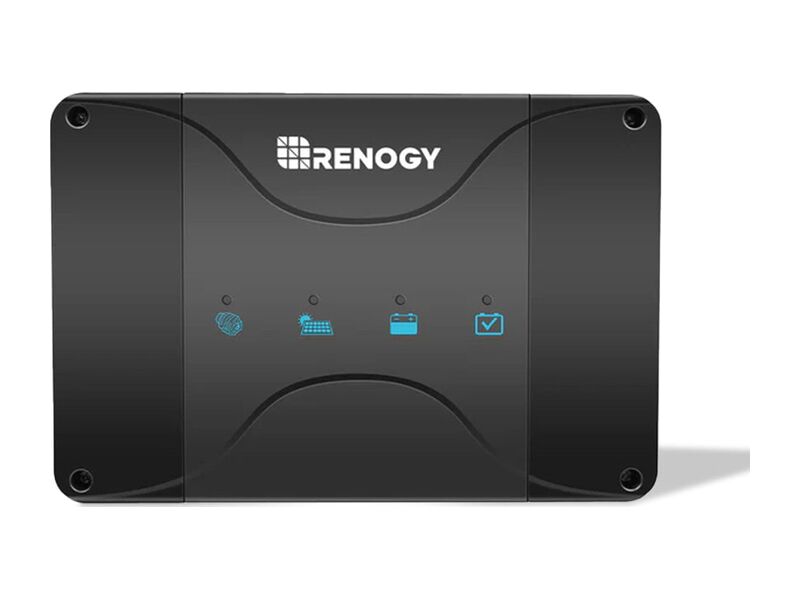
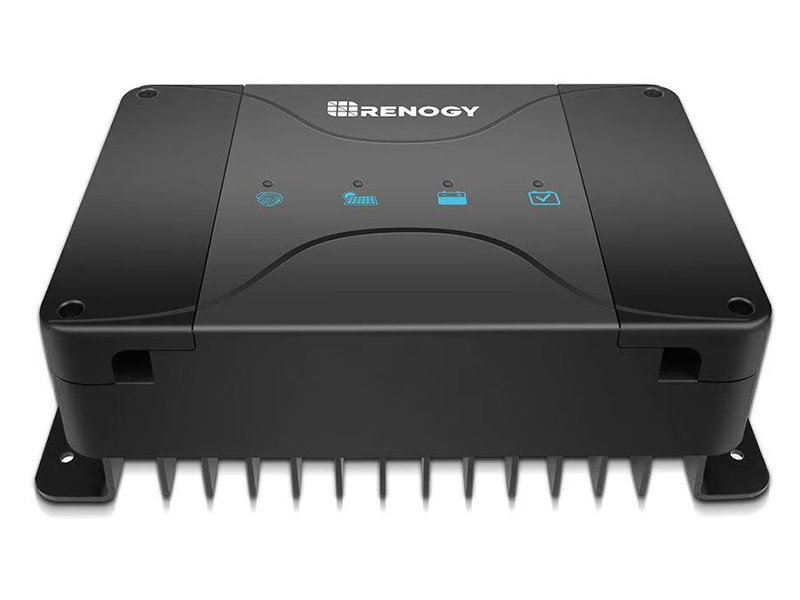
DCC50S Renogy DCC50S 50A MPPT DC-DC charger
Promo

Renogy DCC50S

See price and availability (12)

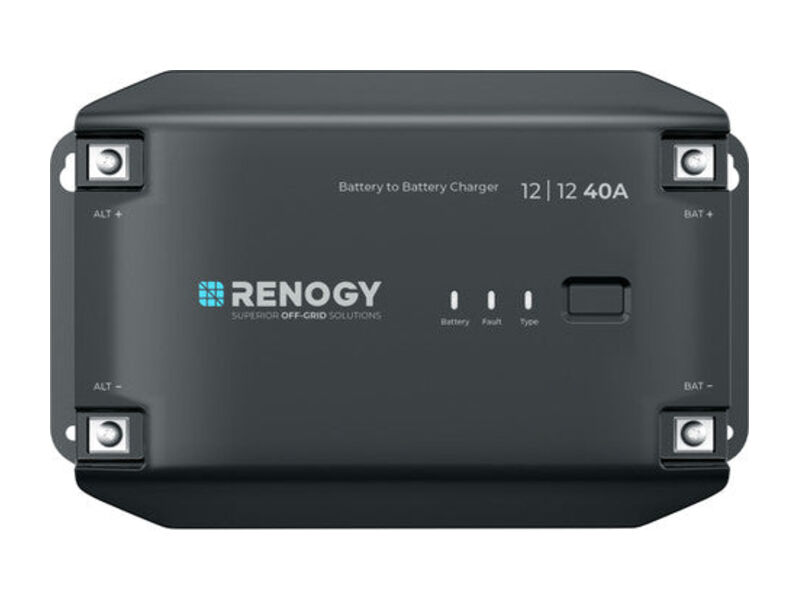
Recharge your house battery while driving AND from the sun: the Renogy DCC50S packs a 50A DC-DC charger and MPPT solar controller in one unit, built for vans.

  • Charge current: 50A (12V)
  • Inputs: Alternator + solar (built-in MPPT)
  • Power / efficiency: 660W, up to 94%
  • Compatibility: Lead-acid (flooded, gel, AGM), lithium LiFePO4
  • 50A DC-DC charger and solar MPPT in a single unit
The Renogy DCC50S is a 12V dual-input on-board battery charger delivering 50A. It recharges the auxiliary (house) battery of a van or camper from the vehicle's alternator and/or from solar panels, thanks to a built-in MPPT controller. With 660W of power and 94% efficiency, it works with lead-acid (flooded, gel, AGM) and lithium LiFePO4 batteries. Its voltage-sensitive relay (VSR) isolates the two batteries, and an optional Bluetooth module allows monitoring through the app.
The Renogy DCC50S is one of the key pieces of gear in a converted van, and in use it delivers on its promises. We installed it to recharge an auxiliary lithium battery, with one input from the alternator and another from roof-mounted solar panels. The result is impressive: while driving, the house battery recharges at 50A, far faster than with a simple battery isolator, and once parked, the MPPT controller takes over with solar. Having both functions in a single unit greatly simplifies the install and the wiring. The voltage-sensitive relay cleanly isolates the starting battery, so you are not staring at a dead battery the next morning. Adding the optional Bluetooth module lets you monitor charging from the app, which is genuinely handy. Points to plan for: you need to size the cables properly, since 50A is a lot of current, and set the correct battery profile, and on a smart alternator an ignition wire is required. But for a serious van or 4x4 build, this is a safe bet.
View product page

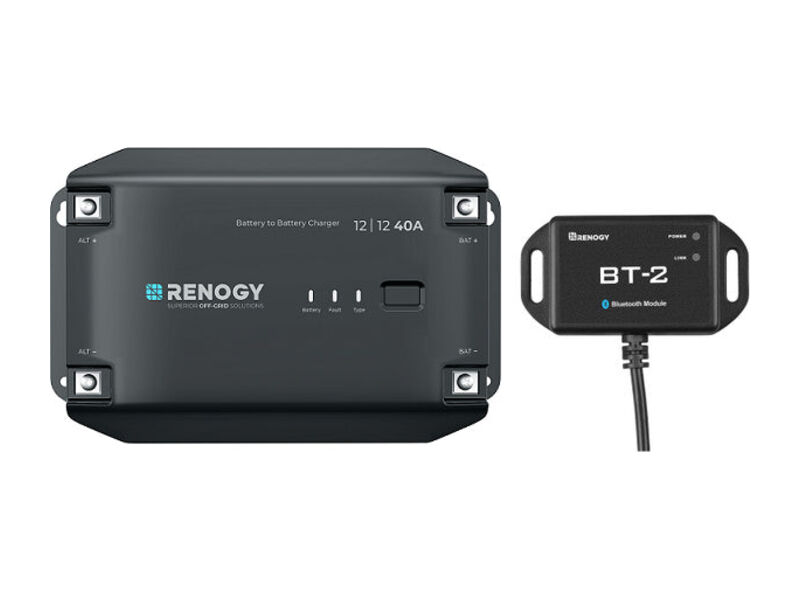
EcoFlow Alternator Charger Plus 1000

$445.47 (4)

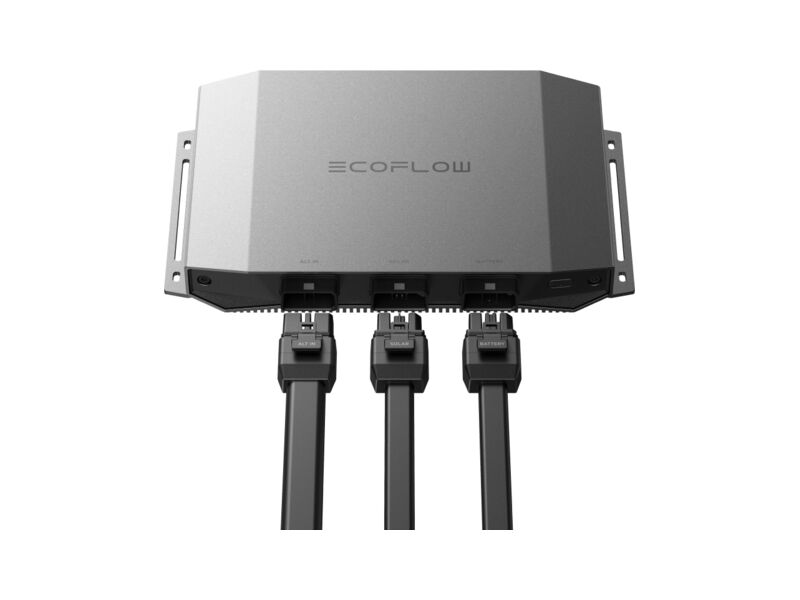
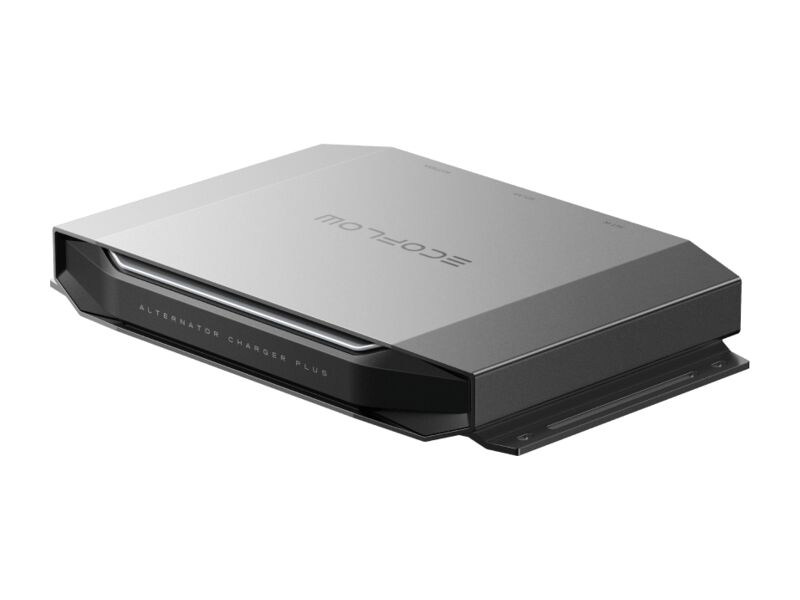
Up to 1000 W from the alternator while driving: the DC-DC charger with a dedicated solar port and reverse charging, that never drains the starter battery.

  • Alternator charging: 1000 W max, up to 75 A (12V/24V input)
  • Starter battery maintenance: 100 W, protects the starter battery
  • Reverse charging: Up to 75 A, tops up the starter battery if needed
  • Connectivity: Wi-Fi and Bluetooth, EcoFlow app
  • Simultaneous alternator + solar charging, up to 1000 W
The EcoFlow Alternator Charger Plus 1000 is a DC-DC charger that taps the alternator's current while driving to charge a motorhome or van's leisure battery at up to 1000 W, roughly 10 times faster than a cigarette lighter socket. A dedicated solar port lets you combine alternator and solar charging at the same time without tying up the power station's XT60 port. A maintenance mode protects the starter battery, and a reverse-charging mode can even top it up from the station if needed. Compact (1.7 kg) and controlled over Wi-Fi and Bluetooth via the EcoFlow app, it includes a 125A fuse and comprehensive protection.
The Alternator Charger Plus 1000 genuinely changes the game for anyone who drives a lot in a motorhome or van: no more waiting hours to charge a large leisure battery, up to 1000 W flows straight from the alternator while driving. The real highlight is the dedicated solar port: you can plug in panels in parallel without tying up the station's XT60 port, combining both sources even while parked. Reverse charging is a welcome safety net, able to top up the starter battery from the station if needed, without ever draining it by mistake. Full Wi-Fi and Bluetooth control through the EcoFlow app lets you check the active mode without popping the bonnet. Compact and light (1.7 kg), it installs easily near the battery. Our one reservation: you need a compatible EcoFlow power station to get the full benefit.
View product page
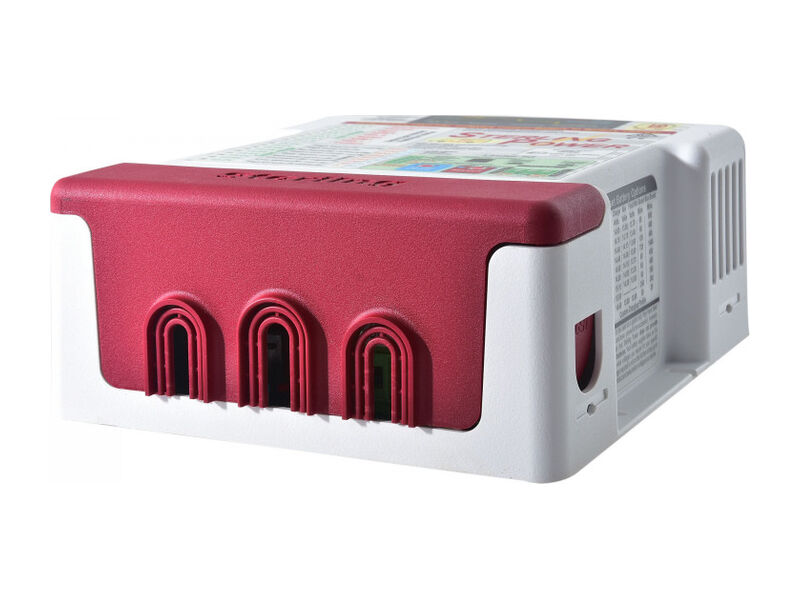
FAC580 Fossibot FAC580 alternator charger
Promo

Fossibot FAC580

$299.00 $199.00

Up to 580W from the alternator while driving, about 6 times faster than a 12V outlet, compatible with most third-party power stations.

  • Power: 580W max, up to 45A (12V/24V input)
  • Charging speed: About 6 times faster than a 12V outlet
  • Compatibility: Whole Fossibot lineup and most third-party stations
  • Weight: 0.8 kg, wall mounted
  • 580W while driving, broad third-party compatibility
The Fossibot FAC580 alternator charger is a DC-DC charger that taps the alternator's current while driving to charge a power station at up to 580W, roughly 6 times faster than a standard 12V outlet. Built for the whole Fossibot lineup and stated to work with most third-party power stations (45 to 48V input), it offers two charging modes, engine running or off, a 92% efficiency rating, and thorough electrical protection. Compact at 0.8 kg, it mounts straight onto the vehicle body.
On the road, the FAC580 genuinely lives up to its promise: wired to the starting battery, it charged our station at around 200W with the engine just idling, and considerably more once actually driving. Installation is straightforward, though the 16-foot input cable is a bit bulky to route neatly through the engine bay. The real strong point is the stated compatibility with almost every third-party power station, not just the Fossibot lineup, which is handy if you already own a station from another brand. The cooling does its job well, with no overheating noticed even on a long summer drive. One gripe raised by several buyers: the unit has no built-in fuse on the input cable, so you really do need to add one near the battery yourself, as the manual itself recommends. For its very reasonable price against the competition, the FAC580 remains an excellent deal for anyone who drives a lot.
View product page

VII - Related questions

Your battery recharges as you drive, thanks to the alternator. If that is not enough (short trips, winter, an idle vehicle), the simplest way is to connect it to the mains with a charger-maintainer, which recharges it and then keeps its charge at the right level. You will find a selection in our Car & motorcycle battery chargers section.

It is not always easy to know the state of health of your vehicle battery. Battery testers let you find out in seconds whether your battery needs replacing, along with its charge level and other useful information. You will find a selection on this page.

Every driver knows the method of connecting crocodile clips to another vehicle's battery. Effective, but painful when you are alone in the middle of nowhere. The jump starter (or battery booster), a kind of very powerful lithium battery, gives your battery the boost it needs to start your engine, with no outside help.
Need help choosing?

Further reading on the blog