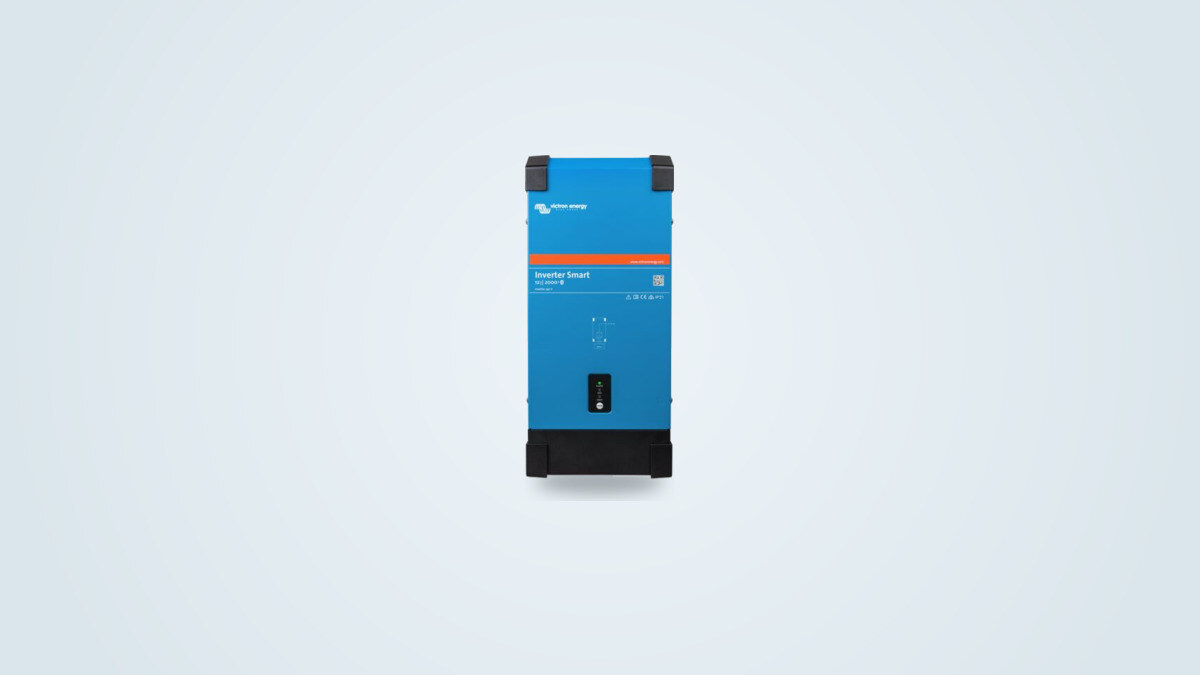
2000VA at 230V: the top of the 12-volt Phoenix range, built for a different grid
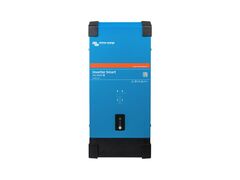
The Phoenix 12/2000 VE.Direct Smart converts a 12-volt battery bank's DC into AC power. It sits at the top of Victron's compact pure sine wave inverter range, above the Phoenix 12/1200, rated at 2000VA, which works out to 1600 watts continuous at 77 °F (25 °C), dropping to 1450 watts at 104 °F (40 °C), with an admissible peak of 4000 watts for a few seconds to absorb the startup surge of a compressor or a large motor.
So who is this review actually for? Mostly boat owners and overlanders running a genuinely dual-voltage system, or anyone who has imported 230V equipment, some European appliances, certain welding gear, some marine electronics, and needs a clean, high-power 230V source for it specifically. If that is not your situation, the rest of this review still explains what the unit is worth on its own terms, since the engineering underneath is the same as the European flagship Phoenix that has built Victron's reputation.
Built-in Bluetooth: a newer generation than its own smaller sibling
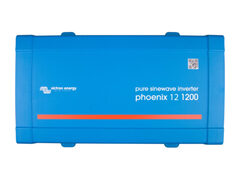
A point often missed when comparing the two units purely on power: the 12/2000 and the 12/1200 in this catalog do not belong to the same electronic generation. The 12/1200 is a classic Phoenix VE.Direct model, which needs a separately sold cable or Bluetooth dongle to pair with a phone. The 12/2000 belongs to the newer Phoenix Smart range, which builds Bluetooth in as standard. Victron's current Smart lineup starts precisely at this power level: that is the technical reason no "Smart" version of the 1200VA model exists in the manufacturer's own catalog, not an arbitrary choice on this site.
This generational difference also explains a result that looks counter-intuitive at first: the 12/2000, despite being 60% more powerful, draws less at idle than the 12/1200, the exact figures are in the next section. Newer, better-optimized control electronics matter more than transformer size for this particular figure, a useful fact to know regardless of which side of the 120V/230V divide you are shopping on.
A pure sine wave that never has to apologize to a sensitive appliance
A modified sine wave approximates AC current in steps: a lamp or a drill copes fine, but a motor runs hotter, a transformer hums, and some switch-mode power supplies simply refuse to start. The Phoenix 12/2000 produces a genuine sine wave, generated by a full-bridge topology paired with a toroidal transformer, the same architecture as the rest of the Phoenix range. The manufacturer's manual states, for this family of inverters, a total harmonic distortion below 5% at rated power: a figure rarely published by generalist competitors, and one that objectively places the cleanliness of the output rather than relying on a marketing adjective.
The stated peak efficiency reaches 92%, a figure that mostly holds true at medium to high load, the zone where an inverter of this power spends most of its useful life. The 4000-watt peak margin matters at least as much as the rated power for real-world compatibility: a compressor fridge or a power tool draws several times its rated power for a few tenths of a second at startup, and it is this peak, not the wattage printed on the appliance, that decides whether the overload protection trips.
0.6 watts in ECO mode: less than its own smaller sibling, despite 60% more power
An inverter left permanently connected to a house battery draws current even with nothing plugged in: that is what empties an energy reserve within a few weeks of inactivity over winter, at a marina or in storage. The Phoenix 12/2000 draws 8 watts at zero load in normal operation, a figure that is actually lower than the 12/1200's 10 watts, despite 60% more available power.
ECO mode widens the gap further: it brings zero-load draw down to 0.6 watts, against 1 watt on the 12/1200. The unit goes to sleep once load drops below an adjustable threshold, then briefly wakes to check whether a load has appeared; below the wake threshold, a very light load, a single phone charger for instance, may go undetected and stay unpowered. That threshold remains adjustable through the VictronConnect app, and ECO mode can also be switched off entirely if it causes trouble with a particular appliance.
On a system left connected for a whole month at a marina or in winter storage, the gap between 8 watts and 0.6 watts adds up to tens of amp-hours saved, a figure that genuinely matters for the energy budget of a limited battery bank.
1600 watts delivered, but close to 145 amps to supply at 12 volts
The continuous rating of 1600 watts at 77 °F (25 °C) and 1450 watts at 104 °F (40 °C) is not just an isolated pair of figures: Victron applies the same progressive thermal derating across the whole Phoenix range rather than a hard cutoff past a single threshold. The 4000-watt peak, meanwhile, is not measured on the same time basis: it is a short-duration capacity meant to absorb a current surge, not power available continuously.
The trade-off for this power plays out on the battery side. With efficiency close to 92% at full load, the unit draws close to 145 amps at 12 volts on the input side to deliver its 1600 watts of output.
A standard lead-acid battery cannot sustain this kind of draw over time: plan on a large-capacity lithium battery or a several-hundred-amp-hour bank, with very heavy-gauge cable up to the unit's M8 terminals, visible at the back next to the AC output terminals and the VE.Direct port. The low-voltage cutoff remains configurable through VictronConnect, as does a load-dependent dynamic cutoff, to avoid a premature shutdown under heavy demand. Without this fine-tuning, the unit simply relies on its already cautious factory thresholds.
Steel chassis, toroidal transformer: robustness comes with weight
The Phoenix 12/2000 weighs 28.7 lb (13 kg) with dimensions of 19.1 x 8.6 x 4.9 in (485 x 219 x 125 mm), nearly double the 12/1200's 16.3 lb (7.4 kg). That weight comes mainly from the toroidal transformer, a heavier and more costly technology than high-frequency electronics, but recognized for staying stable and keeping the sine wave clean even under full load. The unit withstands an output short circuit, an overload, a battery voltage that is too high or too low, excessive temperature and excessive input ripple. The steel enclosure is rated IP21 and operates from -40 °F to 149 °F (-40 °C to 65 °C), with a fan that ramps up with load to provide cooling.
One point comes up regularly across the Phoenix range in real-world use, at every power level: a noticeable transformer hum and a fan that becomes audible once a load above a few hundred watts is connected. This is not unique to the 12/2000, but its higher power makes it more likely to cross that threshold than a smaller model run well within its capacity. It is not really a build defect, more the normal consequence of active cooling sized to last rather than to stay silent.
Victron has built a reputation for reliability that extends well beyond this one model, backed by a 5-year manufacturer warranty. Installations on boats that vibrate constantly or overland rigs that bake in summer heat run for years without a documented incident, a far more demanding environment than a stationary domestic setup, and one where this unit's genuinely global reputation was earned, even though it rarely gets fitted stateside.
What the Phoenix 12/2000 does not do on its own
Beyond the voltage mismatch already covered, the unit does not switch automatically to another AC source: to take over from shore power or a generator without manual intervention, you need to add the Filax accessory, a separately sold transfer switch, or step up directly to a MultiPlus, which bundles that function with a battery charger. Without that addition, the Phoenix remains an inverter in the strict sense, not an automatic backup UPS. The far cheaper and less powerful Renogy 1000W/2000W, by contrast, builds in exactly this switchover as standard, in 50 milliseconds, and like most entry-level American inverters of this type is commonly sold in the US wired for 120V straight into standard outlets and appliances, unlike this 230V Victron.
No USB port equips the unit, on this model as on the rest of the Phoenix VE.Direct range: only wired AC output terminals and a VE.Direct port for configuration. An entry-level 120V inverter such as the Bestek 200W typically bundles USB ports, a convenience missing here.
The IP21 enclosure is also worth putting in context: this class protects against solid objects larger than 12.5mm and vertically falling drops, not against water splashes or spray. Despite the range's popularity on boats worldwide, the unit needs to be installed in a dry, ventilated space, never directly exposed to spray at an open helm.
Who actually wants a 230V inverter in the US
Once the voltage mismatch is accounted for, three groups make up nearly the entire realistic US audience for this unit. Boat owners and overlanders who have deliberately wired part of their electrical system for 230V, often because they cruise or travel between the US and Europe, or because they run 230V-rated equipment for a specific reason. Owners of imported European gear, certain welding equipment, specialty marine electronics, some lab or shop tools, that has no 120V equivalent worth buying separately. And installers building a dual-voltage system from scratch who have already decided, for reasons outside the scope of this review, that a 230V branch makes sense alongside a standard 120V one.
For everyone else, a standard US camper, boat, or home backup setup that just needs to run American 120V appliances, this is the wrong product: look at Victron's own 120V Phoenix lineup, sized up to 1600VA, or step up to a MultiPlus inverter/charger for more power at 120V. For a genuinely dual-voltage build, sizing the battery bank matters as much as the inverter choice: our solar section lists batteries suited to a 145-amp surge.
Against the 12/1200, the Renogy and entry-level units
The table sets the 12/2000 against three very different profiles from the same 12V-to-AC inverter category, on the specs that do not depend on which grid voltage a given regional version outputs.
| Criterion | Victron 12/2000 (230V) | Victron 12/1200 (120V) | Renogy 1000W/2000W (120V) | Bestek 200W (120V) |
|---|---|---|---|---|
| Continuous / peak power | 1600 W / 4000 W | 1000 W / 2200 W | 1000 W / 2000 W | 200 W / 500 W |
| Waveform | Pure sine | Pure sine | Pure sine | Modified sine |
| Automatic transfer switch | No (Filax accessory) | No (Filax accessory) | Yes, built in, 50 ms | No |
| Zero-load draw | 8 W (0.6 W in ECO) | 10 W (1 W in ECO) | < 12 W, no ECO mode | No ECO mode |
| Bluetooth | Built in as standard | Separate dongle | No | No |
| Weight | 28.7 lb (13 kg) | 16.3 lb (7.4 kg) | 5.7 lb (2.6 kg) | ~0.9 lb (0.4 kg) |
| Warranty | 5 years | 5 years | 2 years | 18 months |
| Observed price | ≈ $727 | ≈ $318 to $375 depending on market | ≈ $150 to $160 | ≈ $35 |
Against its own smaller sibling, the 12/2000 matches the 12/1200 on signal quality, safety and build, same architecture, same 5-year warranty, and pulls ahead on real available power and, thanks to its Smart generation, on standby draw, but the 12/1200 sold in the US ships as a genuine 120V unit with a NEMA outlet that plugs straight into American gear, which this 230V 12/2000 does not. Against the Renogy 1000W/2000W, sold in the US at 120V and at less than a quarter of the price, the Victron's advantages in real power, standby draw and toroidal-transformer robustness only matter to a buyer who specifically needs 230V; for a standard 120V setup, the Renogy's built-in automatic transfer switch and native US compatibility make it the more sensible choice for nearly everyone. The Bestek 200W barely belongs in the same comparison once a sensitive appliance or sustained power is involved: a different category of product entirely.
Who it suits, and who it does not
It suits a narrow but real slice of the US market: boat owners and overlanders running a genuinely dual-voltage 230V system, owners of imported European or other 230V-rated equipment with no 120V equivalent, and installers deliberately building a 230V branch for a specific reason already decided elsewhere. For that audience, the 12/2000 delivers the same toroidal-transformer robustness, Smart-generation efficiency, and 5-year warranty that make the Phoenix range Victron's flagship in Europe.
It does not suit a standard American RV, van, or home backup setup that simply needs to run US 120V appliances; Victron's own 120V Phoenix lineup, up to 1600VA, or a MultiPlus inverter/charger for more power, is the right product for that instead. It also does not suit anyone after a built-in automatic transfer switch without an extra accessory, where the 120V Renogy 1000W/2000W does better for a fraction of the price, or anyone unable or unwilling to invest in a battery bank capable of supplying 145 amps without sagging. For the specific buyer who genuinely needs 1600 watts continuous of pure sine wave at 230V on a 12-volt system, the 12/2000 earns its place as the premium reference it already is in Europe.