Conductance rather than current: what the BT100 actually measures
The BT100 is neither a charger nor a jump starter: it delivers no current at all, it measures one. Its conductance technology sends a low-intensity signal into the battery and works out state of health (SOH), state of charge (SOC), internal resistance, and an estimated cold cranking amp (CCA) rating from the electrical response. That is why the "current actually delivered" axis, originally designed for a jump starter, is read differently here: what matters is no longer an amperage supplied, but the reliability of the reading shown on screen.
One concrete example illustrates the gap with a plain voltmeter: a battery reading 13.07V, a figure that looks reassuring at first glance, came with a reading of only 24% state of health and a cranking ability rated badly degraded. A correct voltage says nothing about the real ability to turn an engine over, which is exactly what a plain voltmeter cannot see and what a conductance measurement is built to reveal.
The manufacturer's manual makes a useful point that rarely gets highlighted: picking the wrong battery type at setup can skew the reading by up to 10%. The result therefore depends directly on the care taken at setup (CCA, EN, DIN, or another standard, the value printed on the label), not only on the internal electronics.
Like any instrument built on conductance, its reading also depends on the state of charge at the time of the measurement: a heavily discharged battery can come out with an artificially low health score, while a fully charged one can mask early plate degradation. Measuring after a full charge is therefore the safer approach for a representative result, a precaution that applies to this whole family of instruments, not something specific to the BT100.
No independent comparison against a professional reference instrument was found to cross-check the stated precision on this specific model. The BT100 shares the same underlying physics as tools used in repair shops, though how it stacks up in precision against those pricier references could not be verified here.
Cold weather: a wide range, but a different role than on a jump starter
On a jump starter, cold-weather performance comes down to its own internal battery, which loses available current as the temperature drops. The BT100 does not have that problem: it carries no battery of its own and draws power directly from the battery it is testing. So the axis reads differently here: the question is not "does the unit hold its charge in severe cold?" but "does it stay usable and trustworthy in the conditions where it is needed most, a winter morning under the hood?".
| Situation | Stated range |
|---|---|
| Operating | -4 °F to 149 °F (-20 °C to 65 °C) |
| Storage | -4 °F to 158 °F (-20 °C to 70 °C) |
This range, confirmed by the manufacturer across several markets, is at least as wide as that of the jump starters covered in the same section. It is consistent with what CCA is for in the first place: a cold cranking amp figure is by design the metric most tied to winter, the one that determines whether a battery will still turn the engine over on a freezing night. On this specific point, the BT100 is well suited to its real job: catching a failure before it happens rather than being caught out by it.
One honest reservation should be raised, though: none of the documentation reviewed details an explicit mechanism for compensating the reading according to the temperature of the battery under test, even though the internal resistance of a lead-acid battery varies sharply with cold. This remains an open question rather than a confirmed shortcoming, for lack of technical sources detailed enough to settle it.
100 to 2000 CCA, five chemistries, ten standards: the real scope of compatibility
This is the axis where the BT100 is most complete. Its test range covers 100 to 2000 CCA, recognized under ten different standards (CCA, CA, BCI, MCA, DIN, IEC, EN, SAE, JIS, GB), which is roughly everything a DIYer or a small shop is likely to come across on a battery label across North America, Europe, or Asia.
The five chemistries covered (flooded lead-acid, AGM flat plate, AGM spiral, EFB, and gel) account for the vast majority of lead-acid batteries on the road. The manufacturer states broad vehicle compatibility: cars, motorcycles, light trucks, RVs, ATVs, boats, yachts, lawnmowers, and golf carts, all fitted with a 12V circuit. The documentation also expresses the same range in amp-hours under the Chinese GB standard, 30 to 220Ah, a useful reference for anyone used to thinking in battery capacity rather than CCA.
Two limits bound this scope, though. First, the BT100 stays 12V only: the step up to the 24V systems used in trucks and some farm equipment is reserved for the brand's BT200. Second, and this is the most important reservation to know before buying, no compatibility with lithium batteries is claimed on this model, even as LiFePO4 chemistry gains ground on the starter batteries of some motorcycles and a handful of newer vehicles. Running a lead-acid-calibrated algorithm on a different chemistry risks an unrepresentative reading, not just a simple inconvenience.
Spark-free and reverse-polarity protected: safety built for a low-risk connection
The electrical risk of a tester has nothing to do with that of a jump starter: the BT100 delivers no cranking current, it simply reads a battery that is already in place. The stated protections remain real and useful for anyone without particular experience, though: reverse-polarity protection and a spark-free connection at the clamps, in line with what is expected of this kind of tool.
A simple safeguard rounds things off: if the battery under test is below 6V, the unit will not power on at all, rather than showing an unreliable reading on a battery that is far too deeply discharged. That is a real usage limit (see above), but also a sensible design choice: no shaky diagnosis on a case outside the intended range.
The restriction to lead-acid chemistries also has a safety dimension, not just a compatibility one: trusting a health percentage calculated for a different chemistry than the one actually under test risks a false sense of reliability on a battery that could carry an entirely different risk profile. No incident or recall has been identified for this model to date, and the manufacturer, an automotive diagnostics company established since 2017, shows no recurring negative reliability signal at this stage.
Sturdy clamps, short cable: what the finish actually looks like
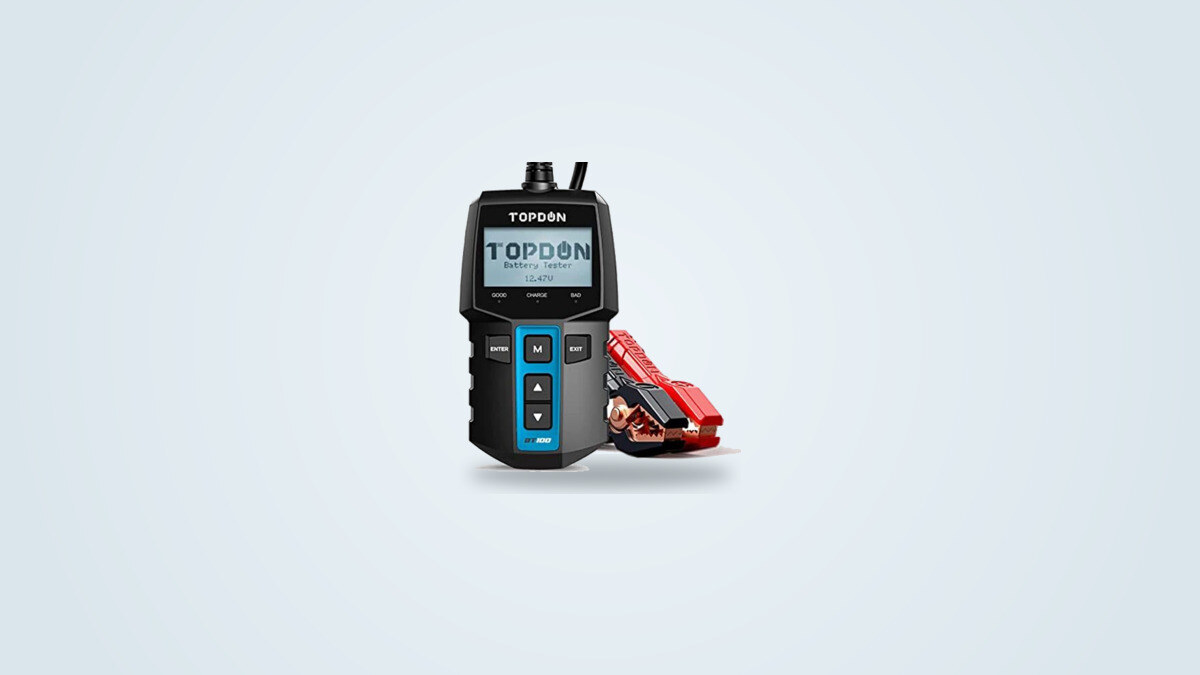
On finish, two things stand out clearly, in opposite directions. The clamps, with copper teeth for a better grip on the terminals, are sturdy and well designed, clearly ahead of a cheaper entry-level model in the same product family. That is the most heavily used contact point on the unit, and it is the one that inspires the most confidence.
By contrast, the cable linking the body to the clamps is short and fairly stiff: it does not let you bring the unit into the vehicle to read the screen during the cranking or charging test. You have to stay bent over the engine bay to follow the display, a minor but real and recurring niggle. No rigid carrying case is included, only a manual comes in the box.
This 24-month warranty, found consistently across several official regional pages and in the manual itself, is a genuine plus for a tool at this price. It contrasts with the one-year standard policy TOPDON applies by default to part of its diagnostic tool catalog, which suggests particular confidence from the manufacturer in the durability of this line of testers.
Battery, cranking, charging: what the three tests actually check
The BT100 does not take a single measurement, it runs three in sequence, which is what sets it apart from a plain voltmeter and lets it pin down the source of a fault rather than guess at it.
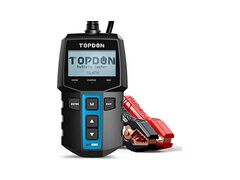
The battery test shows state of health (SOH), state of charge (SOC), voltage, current, and internal resistance, then sums it all up with a visual verdict: the screen splits its reading across three clearly labeled zones, GOOD, CHARGE, and BAD, a code simple enough to grasp without a manual for anyone who just wants to know whether to worry. The cranking test measures the voltage and the length of time the circuit holds up under the starter motor's current draw: in the automotive diagnostics trade, a commonly used threshold puts the acceptable lower limit at around 9.6V while the engine is turning over, below which a problem is suspected. The charging test, finally, is run with the engine on: you need to press the accelerator to reach around 2500 rpm and hold that speed for 5 seconds, while the unit assesses the output voltage of the alternator and rectifier.
Together, these three tests answer the question that actually matters to a driver: is the fault in the battery itself, or in the system that is supposed to recharge it once the engine is running? A plain voltmeter cannot make that distinction, a three-function tester can. Moving between the three modes only takes five buttons (ENTER, EXIT, a center menu key, and two up/down arrows), a deliberately minimal interface that limits what can go wrong mid-reading.
BT100, BT100W, BT200: where this model really sits in the lineup
The name "BT100" actually covers several fairly similar units, and it is easy to mix up their listings online. Here is exactly where this model sits within its own lineup.
| Criterion | BT100 | BT100W | BT200 | BT300P |
|---|---|---|---|---|
| Voltage | 12V | 12V | 12V / 24V | 12V / 24V |
| Screen | Monochrome LCD | Monochrome LCD | Color LCD | Color LCD |
| Bluetooth and app | No | Yes | No | No |
| Result history | Last result only | Reports in the app | Stored on the unit | Stored on the unit |
| Printing | No | No | No | Thermal printer |
The BT100W adds Bluetooth and a mobile app to save and share detailed reports, without changing the underlying measurement principle. The BT200 goes a step further: 24V compatibility, a color screen, and a result history kept directly on the unit, which makes it better suited to regular or semi-professional use. The BT300P builds on the same base with a built-in thermal printer, handy for handing a customer a printed diagnostic slip.
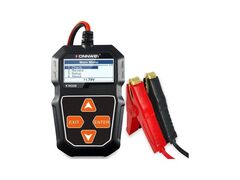
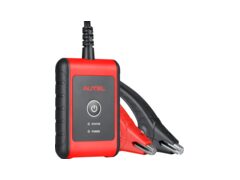
The BT100 therefore takes a deliberate entry-level position within its own family: the bare essentials for a one-off diagnosis, without the tracking features that justify a higher price on its variants. Against direct rivals in the same price range such as the Konnwei KW208, it stands out through TOPDON's established reputation as an automotive diagnostics specialist rather than through an exclusive feature. Against higher-end tools such as the Autel MaxiBAS BT506, controlled from a smartphone, the BT100 stays deliberately simpler and more affordable, with no app and no subscription.
What to know before clipping on the clamps
The BT100 does not guess anything: you need to tell it the standard (CCA, EN, DIN...) and the exact value printed on the label of the battery under test before starting the measurement. That step, presented as straightforward in the documentation, is less so in practice on some vehicles: the label can be partly hidden behind a plastic cover, turned to face a wall of the engine bay, or worn away with age. It is worth finding that information before pulling the unit out, rather than discovering the problem with the clamps already in hand.
The unit offers its interface in six languages (English, French, Spanish, Italian, German, Russian), a genuine convenience for a product sold across such different markets. In exchange, it is a deliberately basic tool: no firmware updates, only one result kept in memory at a time, no export function. For a one-off check before winter or before buying a used vehicle, that simplicity is not a shortcoming; for repeated tracking over time, it runs out of road quickly.
Who the BT100 is for, and who it is not
The BT100 is a good fit for a driver who wants a quick answer to a simple question: is my battery still good, or is it the alternator that has stopped charging properly? It also suits the home mechanic checking a battery before winter, before a long road trip, or before buying a used vehicle, and the small shop that has no need to archive its readings. Its broad standards compatibility and modest price make it a sensible first diagnostic tool for anyone who does not already own one.
It is a poorer fit for anyone running a lithium starter battery, which the unit does not cover, or a 24V system, reserved for the BT200. It is also a poor fit for anyone who needs to keep a history of readings over time, share a report with a customer, or print a slip: the BT100W, the BT200, or the BT300P from the same brand serve those needs better, at a higher price. Finally, anyone after the best possible precision and willing to go through a smartphone will find the Autel MaxiBAS BT506, covered above, a more complete but also pricier alternative.
What matters in the end: for its price, the BT100 honestly does what it says on the box, with a broad scope of compatibility and two simple limits worth remembering before buying, no lithium support and a rather short cable.