100 cranking amps at 0 °F: a standardized figure, not a marketing claim
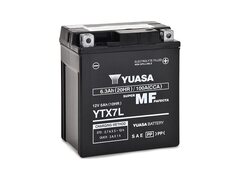
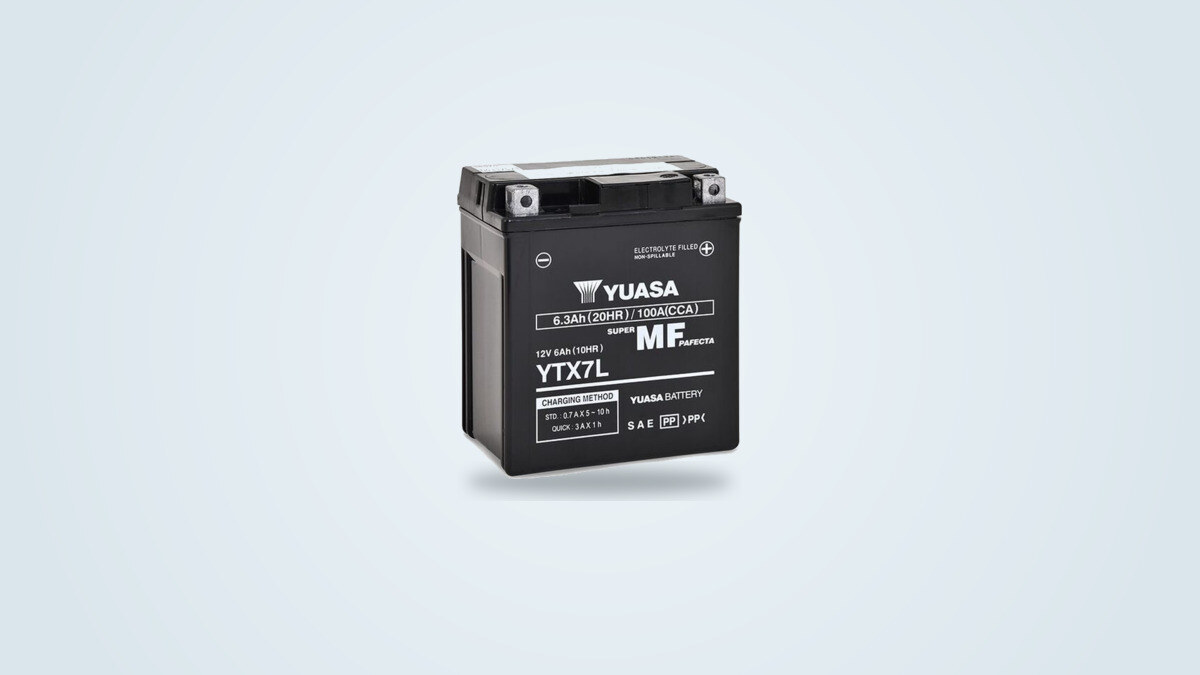
The YTX7L-BS is rated at 100 cranking amps at 0 °F (-18 °C), the industry-standard cold-cranking test point set by the manufacturer. This number appears identically on the original overseas spec sheet and on that of at least one direct competitor selling a strictly comparable format and chemistry: a value reproduced without variation from one spec sheet to another is a far better sign than a spectacular figure found nowhere else.
On a 125 cc single or a small city-scooter twin, 100 cranking amps is ample to turn the engine over, cold mornings included, provided the battery starts from a correct charge: a high cranking figure never compensates for a battery already half flat. The chart places this number within the manufacturer's own lineup: it remains the most modest of the four references shown, which matches exactly the engine size it serves rather than any design shortfall. Spec sheets issued separately for the US and European markets give the same dimensions within the stated 0.08 in (2 mm) tolerance, a sign of consistency not always found among generic compatibles.
Format above all: why it replaces neither the YTX9-BS nor the YTX7A-BS
The case measures 4.5 x 2.8 x 5.2 in (115 x 72 x 132 mm) at 5.5 lb (2.5 kg), with the positive terminal on the right and nut-and-bolt terminals (listed by the manufacturer as "Terminal Type 5"). This tall, narrow format defines the reference even before its capacity: it fills a precisely sized compartment, often under the seat or behind a side panel, and cannot be transposed onto a different case.
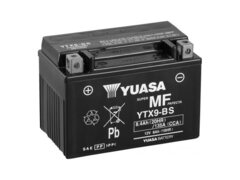
Two mix-ups come up regularly. The first involves the YTX9-BS, wider and lower (5.9 x 3.4 x 4.1 in / 150 x 87 x 105 mm): a close capacity (8.4 Ah) but a completely different volume, it simply does not fit a compartment designed for the YTX7L-BS, and the reverse holds too. The second involves the YTX7A-BS, whose name differs by a single letter: its case is noticeably more horizontal, the terminals sit on a different side, and despite close capacity and cranking figures the two references are not interchangeable. On sites that do not clearly display the dimensions, name resemblance alone is enough to get the wrong reference ordered.
The only genuinely reliable check remains the marking on the original battery being replaced, or failing that the bike's owner's manual, never the mere resemblance of a name shown on a retailer's listing.
Dry with an acid pack here, factory-activated overseas
The common US package (Yuasa part number YUAM327BS) ships dry, with its own separate acid pack to be activated by the buyer before first use. The process is not complicated: pour in the electrolyte, let it settle for a few minutes, seal permanently, then finish with a charge on a charger before riding. It still involves handling a corrosive acid and calls for gloves and eye protection, a genuine step to plan for rather than a simple unboxing formality.
That is not how the same reference reaches every market. On the European market, the version distributed is factory-activated: the battery leaves the box already filled with electrolyte and charged, ready to fit, with no acid pack involved at all. It is a real convenience advantage of that version, and one worth knowing about for anyone comparing overseas listings or importing a unit.
Either way, sealed AGM technology limits the risk once the battery is in service: the electrolyte is held in a glass-fiber separator, the battery will not leak if tilted, and a safety relief valve vents any overpressure without the user needing to step in.
Six amp-hours: the real limit once a scooter is kitted out
The 6 Ah at the 10-hour rate (6.3 Ah at the 20-hour rate) is almost never what turns the starter motor over: that is the cranking amps' job. It powers everything that stays live with the engine off and the first seconds of starting: position lights, an alarm, a GPS tracker, and on some scooters heated grips that alone can draw several dozen watts at full setting.
For a stock bike or scooter with no accessories added, this reserve is enough. It narrows noticeably as soon as a permanent aftermarket alarm or heated grips used continuously are added, particularly on short trips where the alternator does not have time to make up the draw. That is exactly the kind of use which, combined with extended parking, pushes the battery closer to the sulfation threshold detailed below: on only 6 Ah of reserve, the margin is structurally tighter than on a battery with twice the capacity.
The case format follows directly from this modest capacity: there is no way to fit more plates without changing the outer dimensions, which explains why Yuasa reserves higher capacities for references with a different case rather than a simple internal variant of the same format.
The real weak point: sulfation from sitting idle, not active cold
Sealed AGM technology copes very well with active cold: starting stays crisp even after several weeks parked at temperatures near 32 °F (0 °C), as long as the battery holds a correct charge. The real weak point lies elsewhere, in a less intuitive mechanism: self-discharge.
An AGM battery typically loses between 1 and 3 % of its charge per month at room temperature, a loss that accelerates sharply above 86 °F (30 °C). Left flat for several months, it sulfates: crystals form on the plates and permanently reduce capacity, in a way no later charge can fully reverse. On a capacity of only 6 Ah, this mechanism bites proportionally faster than on a 12 or 14 Ah battery in the same lineup: the same monthly percentage loss represents a far thinner absolute reserve to work back up from.
In other words, the YTX7L-BS does not fear cold when charged: it fears being forgotten, and even more so on this smaller format than on the higher-capacity references in the lineup.
Against an equivalent Varta: same spec sheet, a real price gap
The reference is not unique to Yuasa. A strictly equivalent Varta Powersports AGM circulates under several trade names in Europe (Varta TX7L-BS, YTX7L-4, part number 50614) with an almost identical spec sheet: 12 V, 6 Ah, 100 cranking amps, a format in the region of 4.5 x 2.8 x 5.2 in (114 x 71 x 131 mm). Part of the replacement and maintenance market there sells this reference at a noticeably lower price than the one observed for the Yuasa equivalent.
| Criterion | Yuasa YTX7L-BS | Equivalent Varta (TX7L-BS / YTX7L-4) |
|---|---|---|
| Capacity | 6 / 6.3 Ah | 6 Ah |
| Cold cranking | 100 A | 100 A |
| Dimensions | 4.5 x 2.8 x 5.2 in (115 x 72 x 132 mm) | ≈ 4.5 x 2.8 x 5.2 in (114 x 71 x 131 mm) |
| Technology | Sealed AGM | Sealed AGM |
| Observed price (Germany) | Varies by retailer | ≈ €30 to €43 |
The honest question is not which of the two is "better" on paper, the two spec sheets largely overlap, but what the Yuasa name actually buys for the observed price gap: an original-equipment reputation built over decades, manufacturing consistency at very large scale, and instant recognition in repair shops. No reliable data was found comparing the long-term durability of the two brands in this exact format: the choice remains largely a question of brand trust rather than spec sheet.
Within Yuasa's own lineup: the YTZ7S makes a different trade-off
Yuasa offers, within its own lineup, another answer for the same capacity class: the YTZ7S, aimed at compact modern sportbikes. Same nominal capacity of 6 Ah, but a noticeably lower case (4.4 x 2.8 x 4.1 in / 113 x 70 x 105 mm against 5.2 in / 132 mm of height for the YTX7L-BS), roughly 0.9 lb (400 g) lighter, and cranking amps about 30 % higher.
| Criterion | Yuasa YTX7L-BS | Yuasa YTZ7S |
|---|---|---|
| Capacity | 6.3 Ah | 6 Ah |
| Cold cranking | 100 A | 130 A |
| Dimensions | 4.5 x 2.8 x 5.2 in (115 x 72 x 132 mm) | 4.4 x 2.8 x 4.1 in (113 x 70 x 105 mm) |
| Weight | 5.5 lb (2.5 kg) | ≈ 4.6 lb (2.1 kg) |
| Target segment | Classic small-displacement bikes | Modern compact sportbikes |
This is not a direct swap: the YTZ7S will not fit a compartment designed for the YTX7L-BS, nor the other way round, for exactly the reason set out above on non-interchangeable formats. But for anyone buying a new bike or comparing two engine options before purchase, this variant existing within the same manufacturer shows that 100 cranking amps is not a technological ceiling: it is a design choice specific to this exact format, not the upper limit of what Yuasa can build in this capacity class.
AGM or lithium-ion: the trade-off for a replacement
The replacement market now offers lithium-ion (LiFePO4) equivalents, noticeably lighter. On this exact format, the gap is even sharper than on the higher-capacity references in the lineup: several lithium replacements are rated between 0.9 and 1.3 lb (0.4 to 0.6 kg), against 5.5 lb (2.5 kg) for the original AGM block.
The trade-off does not stop at weight. Lithium specialists generally offer a longer warranty than the Yuasa's 12 months, and on some models a built-in charge indicator, absent from any lead-acid battery. Against that, lithium-ion chemistry copes worse with severe cold without dedicated electronic protection: a point worth checking precisely on the specific lithium model's spec sheet rather than assuming it is sorted by default. Purchase price generally favors lead-AGM, with the Yuasa remaining a solution proven over decades in this format.
The choice comes down to a simple trade-off: weight and warranty for lithium-ion, the maturity of the technology and often the price for AGM. On a bike where every ounce genuinely matters (racing, sporting use), the gap can justify the outlay. On a 125 or a city scooter where a few pounds either way changes nothing in handling, the Yuasa remains the rational default.
Real-world reliability, warranty and cost over time
The standard manufacturer warranty is 12 months from purchase, a policy applied across the whole Yuasa motorcycle and powersports lineup, with no special treatment for this smaller format. An extension beyond that base remains possible at the retailer's discretion: better to have it confirmed at the point of sale than to assume it is included.
The manufacturer states three to four years of service life in regular use, as a cautious estimate. For anyone applying a rigorous maintainer from the first weeks of extended storage, particularly each winter, this duration is fairly often exceeded, without systematically reaching the six years sometimes seen on the higher-capacity references in the same lineup: the narrower charge margin described above works mechanically against the smaller capacity as soon as care lapses.
| Criterion | Yuasa YTX7L-BS | Generic compatible |
|---|---|---|
| Observed price | ≈ $60 to $75 | ≈ $20 to $30 |
| Cautious stated lifespan | 3 to 4 years | No reliable data available |
| Approximate annualized cost | ≈ $15 to $25/year | Impossible to calculate without a reliable lifespan |
| Manufacturer warranty | 12 months | Highly variable, often shorter |
That very impossibility of putting an annualized cost on the generic compatible is itself telling: no solid longevity data was found for that category of product in this exact format, unlike the Yuasa reference and its Varta equivalent identified above. On a battery that is rarely replaced and whose failure strands the vehicle, that lack of visibility matters more than on an accessory with no consequences if it fails.
Who it suits, and its real limits
The YTX7L-BS suits above all anyone with a 125, a city scooter, an entry-level ATV or a compact personal watercraft whose battery compartment dictates this exact format. Against the portable jump starters already reviewed on this site, it plays a different role: a Noco GB150 rescues a weak battery on an ad hoc basis, the YTX7L-BS is the battery itself, permanently fitted.
Compared with the Noco GB40 and the Noco GB150 (the car category's high anchors, both rated 4.2), the YTX7L-BS does better on the reliability of the cranking amps actually available: a standardized figure, identical at at least one direct competitor, whereas a jump starter loses power quickly in severe cold since it is not itself warmed by the engine. It also does better on everyday simplicity, since there is nothing separate to charge or carry. It falls behind on versatility: a jump starter also works as a USB power bank and flashlight, whereas a fitted battery performs a single function. Against the Noco GB70 (the low anchor at 4.1), Yuasa's edge lies in build and original-equipment status: a widespread first-fit position on small-displacement bikes, whereas the GB70, designed for occasional use, does not have to manage the same continuous charge-holding demand.
It does not suit anyone looking to cut carried weight at any cost: a lithium-ion replacement will do noticeably better on that exact point, for a higher budget and closer attention in severe cold. Nor does it suit anyone who neglects winter care or fits their scooter with accessories that draw current continuously: on only 6 amp-hours, it is sulfation from lack of charge, not frost, that will get the better of it early.