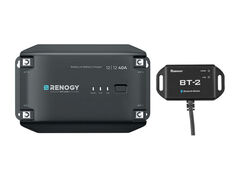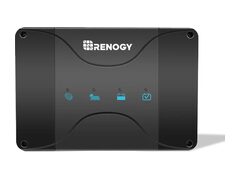
A 40A DC-DC charger, without the DCC50S's solar input
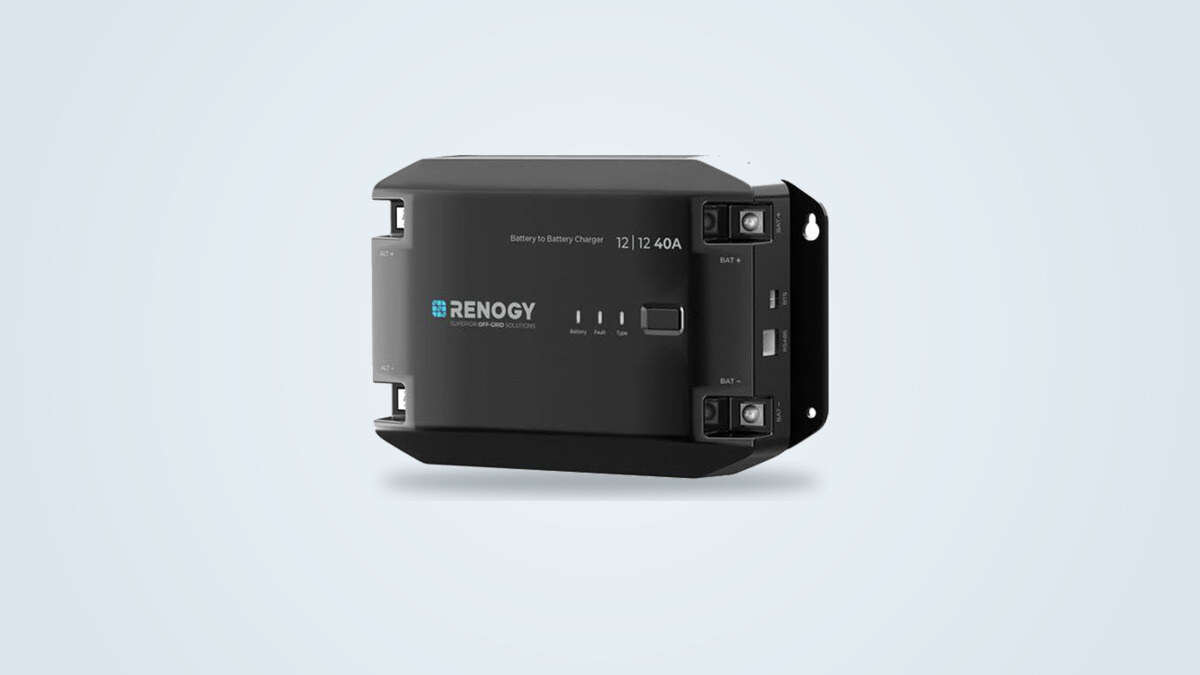
The Renogy RBC40D1U-BT2 is a 12V onboard DC-DC charger, designed to charge the auxiliary (house) battery of a converted van, RV or 4x4 from the vehicle's alternator. The BT2 suffix refers to the 2nd-generation Bluetooth module this reference is built around, not to a current rating: this model delivers up to 40A, adjustable across 4 levels (40, 30, 20 or 10A) to match the cabling and fuse already installed.
One thing not to confuse: unlike the Renogy DCC50S from the same range, which combines a 50A DC-DC charger and a built-in solar MPPT controller in a single unit, the RBC40D1U-BT2 has no solar panel input whatsoever. It's a pure alternator charger: to combine both sources, a separate MPPT controller has to be added.
The converter runs in buck-boost mode across an 8 to 16V input and output range, which lets it keep charging even when the voltage on the starter battery side drops below the targeted output voltage. Compact at 9.3 x 6.0 x 2.3 in (236.5 x 152.5 x 58mm), it mounts with screws on any flat surface, vertically or horizontally.
39 to 40A genuinely delivered at the 40A setting
A 40A setting delivers 39 to 40A of output current, a small enough gap to confirm the advertised level isn't just a spec-sheet number. On the input side, the current draw on the starter battery can briefly approach 80A at power-up before settling well below that, which explains the 80A input fuse the manufacturer specifies, higher than the 40A output fuse sized on the charge current alone.
Charging efficiency tops out at 94% in buck mode (voltage step-down, the more frequent regime when input voltage exceeds the targeted output voltage) and above 90% in boost mode (voltage step-up). In practice, efficiency sits around 90%, consistent with the lower end of that range rather than the maximum figure featured on the product page.
Before buying, one compatibility point is worth checking on the target vehicle: the manufacturer recommends an alternator whose output current sits between 75 and 100A for a power not exceeding 720W, so as not to demand more from the alternator than it can continuously deliver.
Lead-acid, lithium, and a user mode adjustable from 7 to 17V
The RBC40D1U-BT2 handles lead-acid auxiliary batteries (AGM, Gel, flooded) and lithium LiFePO4, with a user mode that allows fine adjustment of every charging parameter (overvoltage shutdown, recovery voltage, equalization voltage, boost voltage, float voltage) across a shared 7 to 17V range. That granularity makes it possible to match a profile a battery manufacturer recommends outside the factory presets, rather than being limited to a fixed choice among a few named profiles.
On lithium, the charger includes a wake-up function: if the battery voltage drops below 6V, a sign the BMS has cut the circuit for protection, the unit automatically applies a small constant-voltage current until the battery reaches 12.6V, before resuming normal charging. An optional temperature sensor can also compensate the charging voltage for ambient temperature, but only for lead-acid batteries: the manufacturer explicitly states this sensor should not be used on a LiFePO4 battery with its own BMS.
| Battery type | Charging profile | Temperature sensor |
|---|---|---|
| Lead-acid AGM / Gel / flooded | Dedicated profile or user mode (7 to 17V) | Compatible |
| Lithium LiFePO4 | Dedicated profile with wake-up below 6V | Not compatible (battery's own BMS) |
BT-2 Bluetooth as an accessory here, DC Home app
Unlike the European package, where the BT-2 Bluetooth module ships in the box, the US listing sells it as a separate accessory. Once purchased and plugged into the charger's RS485 communication port, it unlocks the same functionality either way: live current, voltage and battery-type readings in the Renogy DC Home app, up to 365 days of logged data, and remote adjustment of every charging parameter instead of reopening the unit.
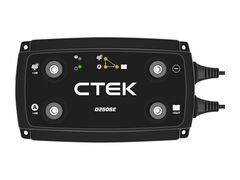
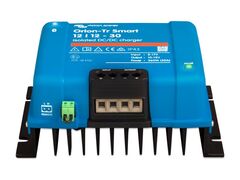
Against the two direct competitors covered in this review, the positioning shifts once the US market's own packaging is factored in: the CTEK D250SE offers neither a screen nor an app, even as an option, only two status LEDs and a three-position selector cable, so the RBC40D1U-BT2 still comes out ahead there once the BT-2 accessory is added. Against the DCC50S, which also sells its own Bluetooth module separately rather than bundling it, the two chargers land on equal footing for monitoring; the Victron Orion-Tr Smart keeps the clear edge with Bluetooth built in natively and a mature app (VictronConnect), no accessory purchase required at all.
The IGN wire and cutoff thresholds, worth knowing before buying
The charger decides whether to charge the auxiliary battery based on the vehicle's alternator type. On a traditional alternator (no IGN wire needed), charging starts once the starter battery reaches 13.5V and stops when it drops to 11.5V. On a smart alternator (IGN wire required), charging starts at 12.6V and stops at 11V.
Both cutoff thresholds run low for a lead-acid starter battery, whose cold start already gets unreliable below roughly 11.8 to 12V on many vehicles, especially in cold weather or on a battery that has already aged. An IGN wire that's missing or poorly connected on a smart alternator can therefore leave the charger active longer than needed once the engine is off, without the unit technically stepping outside its documented operating range: the 11V threshold is exactly what the manufacturer intends, not a malfunction.
To tell the two alternator types apart before buying, the manufacturer suggests a simple method: measure the voltage across the starter battery with the engine running, once major loads (headlights, air conditioning, stereo) are switched off. A steady reading around 14.4V points to a traditional alternator; a reading between 12.5 and 13.5V points to a smart alternator, which then requires connecting the supplied IGN wire to the vehicle's ignition signal.
A precise protection list, split by starter and house side
The manufacturer's official documentation splits protections by side of the circuit rather than listing them in one pile: on the auxiliary (output) battery side, the RBC40D1U-BT2 includes overvoltage, overdischarge, overtemperature and short-circuit protection; on the starter (input) battery side, it adds reverse-polarity and short-circuit protection. An input voltage above 17V also triggers a safety shutdown, a comfortable margin above the 16V ceiling expected on a 12V system.
This derating threshold compares favorably with the CTEK D250SE, whose current starts dropping at just 86 °F (30 °C), a good 27 °F (15 °C) earlier. The unit remains usable up to about 9,842 ft (3,000m) of altitude and from 0 to 95% relative humidity without condensation, with entirely natural (fanless) cooling, quieter than a fan-cooled unit and with no moving part to maintain.
IP32 and a 2-year warranty stated, where the DCC50S stays silent
The manufacturer's official documentation states an IP32 rating (protection against solid objects larger than 2.5mm and against vertically dripping water) and a 2-year manufacturer warranty, two details the DCC50S from the same brand doesn't share on its own product listing. The unit is RoHS, FCC, CE, RCM and UKCA certified, and normal operating noise stays under 40dB thanks to its natural cooling.
One minor documentation gap is worth flagging: the commercial spec sheet advertises a weight of 4.1 lb (1.88kg), while the latest official user manual (2024 edition) states 4.4 lb (2kg) for this same 40A reference. The gap is small and has no practical impact on installation, but it shows that the same manufacturer can publish two slightly different figures from one document to the next. Separately, the charging-logic section of that same manual mentions an MPPT tracking algorithm for solar panels, wording that doesn't apply to this solar-free reference and appears to be carried over from the manual of a neighboring model in the range that does have a built-in MPPT controller.
No solar MPPT: what that actually means for a van or RV
Having no solar input isn't a flaw in itself, but it fundamentally shapes who this charger is for. For a van or RV that only plans to charge its house battery on the road, from the alternator, the RBC40D1U-BT2 covers the need without paying for a solar function that would go unused. For a setup that also pairs solar panels on the roof, on the other hand, a separate MPPT controller and its wiring have to be planned for, a complexity and cost the DCC50S or the CTEK D250SE avoid by combining both sources in one unit.
This choice also has a flip side: a charger with no solar electronics to manage means fewer parameters to configure and fewer components that could fail, for a use case that was never going to touch the solar input anyway. For anyone who already knows no panel is planned, that's not a missing feature, it's an avoided one.
Against the DCC50S, the CTEK D250SE and the Victron Orion-Tr Smart
How does the Renogy RBC40D1U-BT2 stack up against other alternator chargers on the market?
| Criterion | Renogy RBC40D1U-BT2 | Renogy DCC50S | CTEK D250SE | Victron Orion-Tr Smart Isolated |
|---|---|---|---|---|
| Charge current | 40A (39 to 40A in practice) | 50A | 20A (16A from 86 °F (30 °C)) | 30A |
| Solar MPPT input | No | Yes (660W max) | Yes (300W max) | No |
| Bluetooth | Optional accessory | Optional accessory | None | Built-in |
| IP rating / Warranty | IP32 / 2 years | Not stated | IP65 / 2 years | Not stated / 5 years |
| Battery isolation | Running detection | Voltage-sensitive relay (VSR) | Running detection | Galvanic, 200V |
| Observed price | $186.99 | $247.58 | $495.89 | $243.95 |
Against the DCC50S, the RBC40D1U-BT2 gives up 10A of current and any solar input at all, and on this market both chargers sell their Bluetooth module as a separate accessory rather than one having it bundled in, so that particular edge disappears here. What remains is real: IP rating and warranty are stated where the DCC50S stays silent on both, and the observed price runs noticeably lower even after adding the optional module. Against the CTEK D250SE, the RBC40D1U-BT2 delivers twice the current, with a thermal derating threshold a full 27 °F (15 °C) more favorable, at a clearly lower price; the CTEK keeps the edge on sealing (IP65 versus IP32) and on the granularity of its lead-acid profiles. Against the Victron Orion-Tr Smart Isolated, finally, the RBC40D1U-BT2 delivers more current (40 versus 30A) at a lower price, but the Victron keeps a full galvanic isolation, Bluetooth built in with no accessory to buy, and a warranty twice as long (5 years versus 2). Overall, the RBC40D1U-BT2 sits above the CTEK D250SE (less current, no Bluetooth at all) and slightly above the DCC50S (incomplete documentation, same Bluetooth-as-accessory setup, higher price), without reaching the level of the Victron Orion-Tr Smart Isolated, which remains the most accomplished reference in this selection.
Who the Renogy RBC40D1U-BT2 is for
This charger suits anyone who wants to charge their house battery from the alternator alone, with no solar panels involved, and who doesn't mind budgeting separately for Bluetooth monitoring if they want it. For a setup that also needs to fold solar into the same unit, the Renogy DCC50S remains a direct alternative from the same brand. For full galvanic isolation and native Bluetooth with no accessory to buy, at the cost of lower current, the Victron Orion-Tr Smart Isolated is the reference in this segment.