Noco GB50 Boost XL: our full review

Under a described German protocol, the GB50 starts a diesel engine just as well as a gas engine with a weak battery. One recurring flaw is worth knowing before you buy, though: switches that stop responding after a few months for some users, often linked to storing the unit in the cabin during hot weather.

Our rating
4.1/5
Current actually delivered: 4.0 out of 5 (weighting 30%)Current4.0Cold-weather performance: 3.9 out of 5 (weighting 25%)Cold3.9Capacity and versatility: 4.3 out of 5 (weighting 20%)Capacity4.3Safety and protections: 4.4 out of 5 (weighting 15%)Safety4.4Build and endurance: 3.7 out of 5 (weighting 10%)Build3.7

How is this rating calculated?

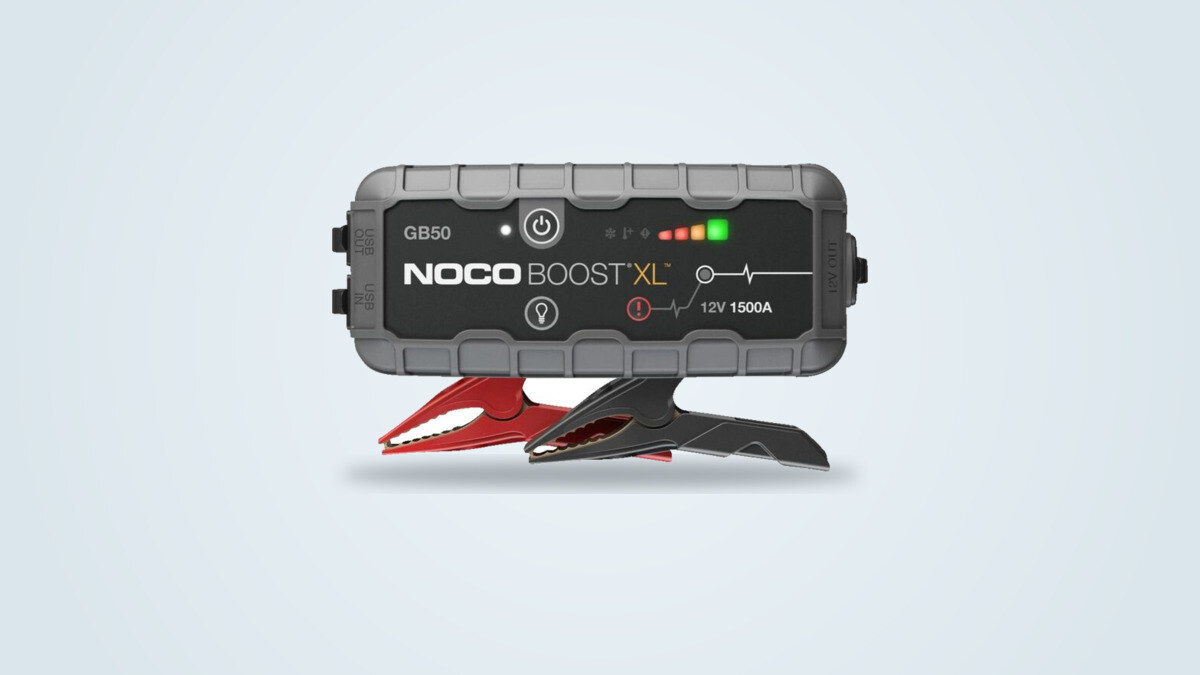
Noco GB50 Boost XL jump starter with its clamps on a light background

The essentials

The GB50 delivers on its most important promise: under a protocol published in Germany (three successful jump starts required, on a Jeep Wrangler diesel with a very weak battery and a Ford Focus gas engine with a weak battery), it earns the “recommended” rating, without standing out as the best in its category. Its position between the GB40 and the GB70 still makes sense: 1500 A, gas engines up to 7.0 L and, notably, diesel up to 4.5 L, a range that fits the diesel pickups, vans and SUVs found on US roads, even though diesel remains far less common here than in Europe. The point that weighs most heavily on the score is build quality: a switch flaw comes up across several independent teardown accounts and non-commercial forum threads, with a plausible cause identified, a sensitivity to heat when the unit is stored in the cabin for long periods. No safety recall has been found for this model to date. The 10 W USB-C charging input remains slow, and no independent cold-weather test has been found either. A good choice for anyone with a diesel sedan, pickup or SUV, provided it is stored away from heat.

Strengths

  • Successful start on a diesel with a very weak battery and on a gas engine with a weak battery, under a protocol published in Germany
  • Smart positioning between the GB40 and the GB70: diesel capacity rises from 3.0 to 4.5 L, a real jump that comes at a real premium over the GB40's price
  • Clamps rated among the best in their category in the comparison consulted: slim, with a wide jaw opening
  • UltraSafe protection (spark-proof, reverse-polarity proof), no safety recall found to date
  • Compact format despite the power on offer: 2.4 lb (1098 g) including the clamps, on the independent weighing consulted

Limitations

  • Recurring switch flaw for some users, identified across several teardown accounts and non-commercial forum threads, appearing anywhere from a few days to 2 to 3 months after purchase
  • A plausible sensitivity to heat when stored in the cabin for long periods, put forward as the likely cause of the flaw above
  • Charging input limited to 10 W USB-C, a full recharge takes several hours, and no wall charger is included in the box
  • No independent cold-weather measurement found for this specific model
  • Does not handle 24 volts, so it is not an option for a heavy-duty truck or a tractor
  • A newer model in the neighboring lineup (the GBX55) shares a similar positioning and can be confused with this one when buying
Noco GB50 Boost XL: see the full details and price →

A successful start on diesel and gas with a weak battery

Under a protocol published in Germany (three successful jump starts required, a five-second maximum cranking time per attempt, fifteen seconds of rest between each try), the GB50 successfully starts two real-world cases: a Jeep Wrangler 2.8 L diesel with a very depleted 94 Ah battery, and a Ford Focus 1.5 EcoBoost gas engine with a weak 65 Ah battery. The result: the “recommended” rating, a positive verdict that stops short of the top spot in the comparison, edged out by a lead-acid unit from the same selection.

2.4 lb
Weight with clamps, independent weighing (1098 g)
8.3 x 3.3 x 2.0 in
Measured dimensions (210 x 85 x 50 mm)

The GB50's clamps stand out as among the best in this selection, slim and with a wide jaw opening, a concrete advantage for anyone reaching awkwardly placed battery terminals. In exchange, the unit comes out as the heaviest in its category in this comparison, and the box does not include a wall charger.

No independent measurement was found, however, for the exact peak current in amps: only a pass/fail result is published under this protocol, not a measured figure for the current actually delivered.

1500 A, diesel up to 4.5 L: the range's strategic sweet spot

The GB50 occupies a deliberate spot in Noco's Boost lineup. The GB40 below it tops out at 1000 A and 3.0 L of diesel: enough for a compact diesel car, but not quite enough once a family sedan or an SUV is involved. The GB70 above climbs to 2000 A and 6.0 L of diesel, but it costs and weighs noticeably more. Between the two, the GB50 raises the approved diesel rating from 3.0 to 4.5 L, at a real premium over the GB40's price ($149.95 versus $84.69). Diesel passenger vehicles remain far less common in the US than in Europe, but that 4.5 L ceiling still lines up well with the diesel pickups, vans and SUVs that do run on American roads, without stretching into heavy-duty territory.

A recurring switch flaw, with a plausible cause identified

This is the most important point to know before buying. Several independent, non-commercial accounts, including one detailed teardown, describe switches that stop responding after only a few presses on certain units, with a plausible cause being entry-level components that leave too little clearance in the housing for their travel. The delay before it appears ranges from a few days to two or three months after purchase.

Likely cause: several users link this flaw to storing the unit in the cabin for long periods in hot weather, reporting a marked improvement in longevity once that habit was dropped. Storing it away from direct heat (a glovebox rather than the rear deck, for instance) is a reasonable precaution given this signal.

A related flaw, battery swelling that deforms the casing, also comes up for the GB70, the next model up in the range, which suggests a shared point of vigilance for this generation of products rather than a problem isolated to the GB50 alone.

UltraSafe protection, and no safety recall to date

UltraSafe technology (clamps stay inert until the connection is correct, with detection and blocking of reverse polarity) is identical to the rest of the range and remains the main safety argument over conventional jumper cables. No safety recall has been found for Noco's Boost range to date, unlike some direct competitors that have been the subject of battery failure reports to the Consumer Product Safety Commission (CPSC). This absence of a recall does not guarantee the absence of a future problem, but it remains a favorable signal about the product's track record.

10 W USB-C charging input: this generation's acknowledged weak point

Like the rest of the Boost range of this generation, the charging input is 10 W USB-C, which takes several hours for a full charge. No wall charger is included in the box. It is better to plug the unit in the night before a trip rather than at the last minute, a limitation that the newer GBX range fixes with much faster USB-C Power Delivery charging.

GB50 or GBX55: two distinct lineups, not to be confused

The GB50 belongs to the original Boost lineup (GB20/GB40/GB50/GB70/GB150), still in Noco's catalog. Noco also sells a newer lineup in parallel, Boost X (GBX45/GBX55/GBX75/GBX155), with revised thermal management and much faster USB-C Power Delivery charging. The GBX55, in particular, sits close to the GB50 in positioning (1750 A, a full recharge in about 1.5 hours versus 5 hours) at a comparable price: a shopper searching for “Noco 1500 A” or comparing reviews online can genuinely mix up the two lineups, which look similar. No evidence of an internal redesign of the GB50 itself under the same name has been found: the risk of confusion lies in choosing between two distinct lineups, not in a silent evolution of this specific model.

Observed price and availability

The price for the GB50 is $149.95. Noco, founded in 1914 in Cleveland, Ohio, under the name Nook & O'Neill, remains a family-run company with no funding round identified, originally focused on battery maintenance before expanding into electronics. The GB50 is also officially distributed in Japan, alongside the rest of the Boost range.

Against the GB40 and the GB70

The choice largely comes down to the diesel displacement of the vehicle to cover.

Technical comparison: the Noco GB50 against the GB40 and the GB70
CriterionNoco GB40Noco GB50Noco GB70
Peak current1000 A1500 A2000 A
DieselUp to 3.0 LUp to 4.5 LUp to 6.0 L
LED light100 lumens200 lumens400 lumens
Observed price≈ $84.69≈ $149.95≈ $189.95

The GB50 costs about $65 more than the GB40, and in exchange the approved diesel rating jumps from 3.0 to 4.5 L, the gap between a compact diesel car and a family sedan, SUV or light pickup: that step is worth it for drivers who actually need the extra diesel headroom, less so for a gas-only vehicle or a small diesel. The GB70 keeps the advantage beyond 4.5 L of diesel, so for a van or a large SUV, at the cost of a heavier, pricier unit.

Who it suits, and who it does not

It suits anyone with a family sedan, an SUV or a small diesel van up to 4.5 L, who can store it away from strong direct heat rather than on the rear deck in full sun.

It does not suit anyone who needs a fast recharge before an imminent departure (the 10 W USB-C input takes several hours), nor anyone with a heavy-duty truck or a diesel tractor beyond 4.5 L, for whom the GB70 or a 24 V model remains necessary.
The rating in detail

Our rating
4.1/5
Current actually delivered 4.0
Cold-weather performance 3.9
Capacity and versatility 4.3
Safety and protections 4.4
Build and endurance 3.7
Noco GB50 Boost XL: see the full details and price →

The product and its alternatives

Noco GB50 Boost XL

Noco GB50 Boost XL

See price (59)

The missing link between the GB40 and the GB70: 1500 amps, diesel up to 4.5 liters, thirty jump starts per charge, for barely more than the model below.

View product
Noco GB20 Boost Sport

Noco GB20 Boost Sport

See price (53)

The smallest Noco, the one that genuinely fits in a motorcycle's underseat storage: 500 amps, about 2.2 lb (1 kg), and the same UltraSafe protection as its big brothers.

View product
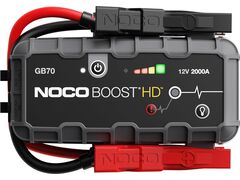
Noco Boost GB70

Noco Boost GB70

See price (77)

The jump starter that shrugs off big engines: the NOCO GB70 delivers 2000 amps to restart a gas engine up to 8.0L or a diesel up to 6.0L, safely.

View product

Frequently asked questions

Under a protocol published in Germany (three successful jump starts required), the GB50 successfully starts a Jeep Wrangler 2.8 L diesel with a very depleted 94 Ah battery, earning the overall “recommended” rating without standing out as the best in its category.

A switch flaw comes up across several independent teardown accounts and non-commercial forum threads, appearing anywhere from a few days to two or three months after purchase. A sensitivity to heat when stored in the cabin for long periods is put forward as the likely cause: storing it away from direct heat is a reasonable precaution.

The charging input is 10 W USB-C, which takes several hours for a full charge, with no wall charger included in the box. It is better to plug it in the night before a trip rather than at the last minute.

The GB50 belongs to the original Boost lineup, the GBX55 to the newer Boost X lineup with much faster USB-C Power Delivery charging (about 1.5 hours versus 5 hours). The two have a similar positioning and price: make sure which of the two lineups you are looking at before buying.

The GB50 raises the approved diesel rating from 3.0 to 4.5 L for a real premium over the GB40 ($149.95 versus $84.69), enough to cover a family sedan or an SUV where the GB40 stays limited to a compact diesel car. For a small gas engine with no diesel to worry about, the GB40 is enough.