The inverter you install once, for ten years
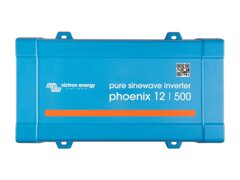
Motorhome, boat, off-grid site or home backup: the Phoenix 12/500 turns a battery's 12V DC into 230V AC, to run everyday household appliances far from a wall outlet. It belongs to the pure sine wave family of inverters, pricier than modified sine wave models but able to power the most sensitive equipment without reservation.
A true pure sine wave, no meter in hand but plenty of real-world evidence
The difference between a modified sine wave and a pure sine wave does not show up on the spec sheet, but it is felt immediately in use. A modified sine wave approximates grid current in steps: a lamp or a drill tolerates that fine, but a motor runs hotter, a transformer hums and some switch-mode power supplies simply refuse to start. The Phoenix produces a genuine sine wave, achieved through a full-bridge topology paired with a toroidal transformer, and behaves like an ordinary wall outlet: a laptop, a sewing machine or medical equipment all run without reservation. No harmonic distortion measurement is available to quantify the signal's purity precisely, for lack of an oscilloscope, but the trouble-free operation of equipment that is normally the most demanding on power quality amounts to a concrete confirmation, short of being a number.
1 watt in ECO mode, but a wake-up threshold set at 15 watts
A standard inverter draws power constantly, often several watts, even with nothing plugged in: on a motorhome or boat battery, that drains a meaningful energy reserve within a few weeks of inactivity. The Phoenix stands out with its ECO mode, which drops no-load consumption to 1 watt (actual consumption can even fall between 0.1 and 0.4 watt depending on configuration), against 6.5 watts in normal operation outside ECO. The unit wakes up as soon as a load above 15 watts appears, a factory-set threshold that suits the vast majority of uses but which, without the configuration dongle sold separately, cannot be adjusted to recognize a lighter load.
400 watts delivered, but a peak that does not guarantee every start-up
The 400 continuous watts quoted at 25 °C are well delivered in practice, with power dropping to 350 watts at 40 °C, a welcome piece of transparency about the unit's actual thermal behavior. The 900-watt peak mainly exists to absorb the inrush current of motor-driven or switch-mode appliances at start-up. On this exact point, user experiences diverge depending on the appliance connected: some users start a compressor fridge of around sixty running watts without any trouble, while others report a failure with a different unit, since a compressor's start-up inrush current can reach up to ten times its rated consumption depending on the model. There is therefore no universal guarantee of compatibility with every compressor fridge, despite the 900-watt margin available.
A toroidal transformer that tips the scales, in both senses of the phrase
The Phoenix weighs 3.9 kg, noticeably more than a high-frequency-transformer inverter of comparable power. That mass comes from the toroidal transformer used, a heavier and costlier technology but one reputed to be more stable, favoring sine wave quality even at full load. The unit runs from -40 to +65 °C in an IP21 enclosure, with a fan that only kicks in above a significant load (roughly 150 to 200 watts) rather than running continuously, which explains the near-silent operation reported on light to moderate use. The brand carries a reputation for reliability that extends well beyond this one model, with a high rate of positive reviews and repeat purchases within the same range after a first successful experience with a different power rating. Victron warrants the unit for 5 years, a rare duration at this price point.
What the Phoenix does not do
The power cable and the Bluetooth VE.Direct dongle, needed to adjust thresholds from a phone, are sold separately: budget around $45 extra for the dongle alone if fine-tuning interests you. The unit also has a soft start, which makes it unsuitable for use as an instant-transfer UPS, unlike a standard home UPS designed to take over with no perceptible break. Finally, without the configuration cable, the unit works perfectly with its factory settings, but any customization (ECO mode threshold, output voltage, low-voltage cut-off thresholds) stays out of reach.
Against the Phoenix 12/1200 and an entry-level modified sine wave unit
At equal power, the price gap between a modified sine wave unit and a true pure sine wave inverter is always surprising. The table shows what you are actually buying.
| Criterion | Phoenix 12/500 | Phoenix 12/1200 | Modified sine 500W |
|---|---|---|---|
| Continuous power | 400 W | 1000 W | 500 W |
| Peak | 900 W | 2200 W | Not stated |
| Wave type | Pure sine | Pure sine | Modified sine |
| No-load consumption | 6.5 W (1 W in ECO) | 10 W (1 W in ECO) | Not stated |
| Observed price | $169.99 | ≈ $300 | ≈ $70 |
A modified sine wave unit advertises the same power for a third of the price, but without an economical standby mode and with a real risk of malfunction on sensitive equipment: to run a drill for the length of a job, it does the work. The Victron earns its keep as soon as the equipment powered is sensitive, or as soon as the inverter stays permanently connected to the battery of a motorhome or boat. For a higher power need in the same signal quality, the Phoenix 12/1200 very nearly doubles the continuous power available.