The same principle as the 100 S, with the shunt raised to 200A
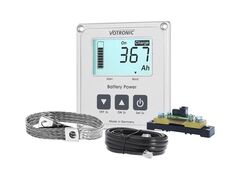
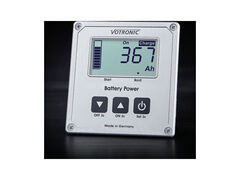
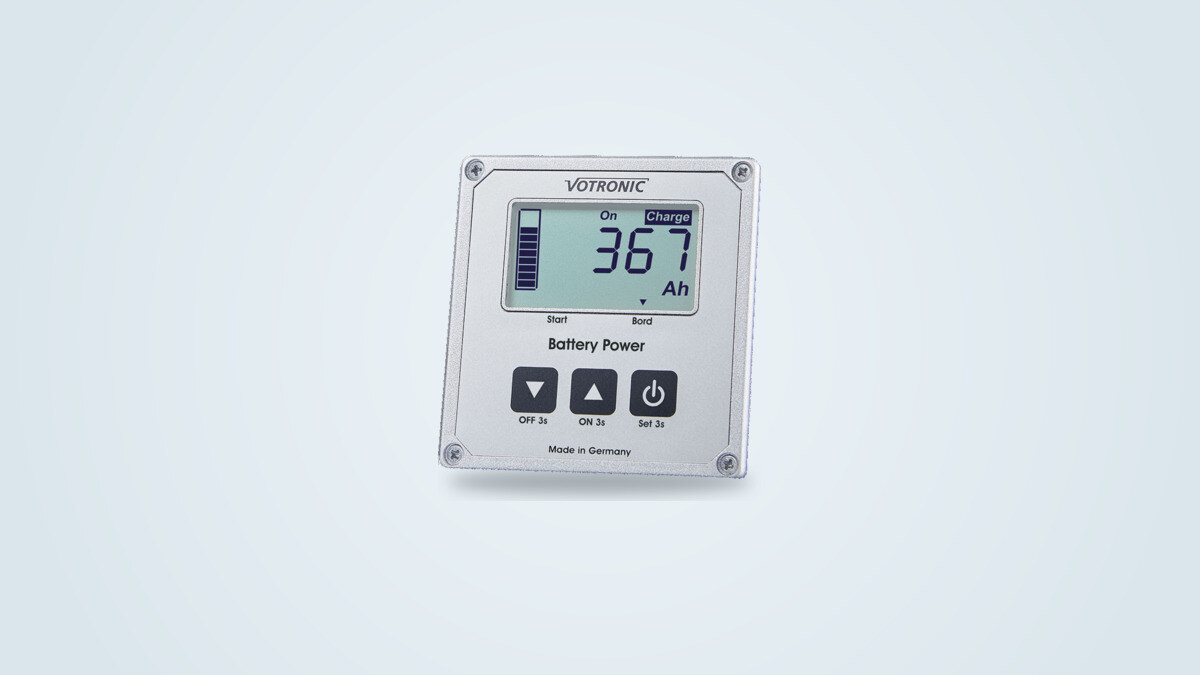
The Votronic LCD Battery Computer 200 S (manufacturer reference 1266) monitors a house battery in an RV, van or boat through a shunt fitted on the negative terminal: rather than guessing the state of charge from voltage alone, it continuously tracks current flowing in and out to display a percentage and an amp-hour value, much like a fuel gauge. It reuses the backlit LCD screen and housing of the 100 S from the same lineup, but with a Smart-Shunt rated to handle twice the continuous current.
The kit includes the display, the 200A Smart-Shunt, a ground strap and a 16.4 ft (5 m) control cable: enough to cover a complete installation with no extra accessory, aside from the optional Bluetooth module covered later in this review.
200A continuous, 400A at short peak: the headroom the 100 S lacks
The rating of the supplied shunt sets the unit's reliable measuring range: 200A continuous, with tolerated peaks of 300A for 15 minutes and then 400A for 7 minutes. Beyond that, the reading saturates, which is why the lineup comes in three variants: the choice between them depends on the maximum continuous current actually drawn by the loads, not on the amp-hour capacity of the battery being monitored.
Against the 100 S from the same lineup, rated at 100A continuous (200A only at its shortest peak), the 200 S doubles the available headroom: a powerful inverter, air conditioning or a compressor fridge regularly drawing more than 100A at peak no longer saturates the reading. The 400 S, higher up the lineup, reaches 400A continuous and 800A at short peak for even heavier setups.
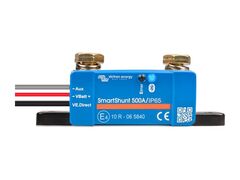
The Smart-Shunt supplied with this generation is stated by the manufacturer to be notably more accurate than its predecessor's, with a displayed resolution of 0.1A and 0.1V, identical to the 100 S. That is an adequate resolution for everyday use, but one notch below the Victron SmartShunt and BMV-712, which share the same 500A/50mV shunt and state a resolution of 0.01A and 0.01V, ten times finer on paper.
As with the 100 S, Votronic states no overall accuracy percentage for this model, where Victron quotes 99.6% for the SmartShunt and 0.4%/0.3% for the BMV-712. Those Victron figures are themselves manufacturer data with no independent confirmation, but their mere existence gives readers at least an order of magnitude, which is absent from the Votronic datasheet.
8 to 60mA depending on the backlight: a carefully managed power draw
On a house battery that has to last several days without recharging, every permanent load counts. The manufacturer states a power draw between 8mA with the backlight off and 60mA with the backlight set to maximum: the screen switches itself off after a few seconds of inactivity, and the backlight cuts out even sooner when the switching output is disabled, to limit the drain on the monitored battery.
For comparison, even at its highest draw, the unit stays far below the currents it is monitoring: on a 200Ah lithium battery, 60mA amounts to a daily drain of around 1.4Ah over 24 hours, negligible against the total capacity. The backlight can be adjusted in steps from the unit's own menu, letting owners balance nighttime readability against saving power.
Still no native Bluetooth: the S-BC module billed separately
Out of the box, the LCD Battery Computer 200 S talks to nothing but its own screen: no app, no history, no data export. To get those, the Bluetooth Connector S-BC has to be added, a separate module that relays the displayed values to the free Votronic Energy Monitor app (history, graphs, CSV export). This module has two inputs and two outputs: it can link both an LCD Solar Computer and this LCD Battery Computer through a single unit, which spreads its cost for anyone who already owns a Votronic solar controller, but remains a pure extra expense for anyone with just this monitor.
For anyone who has never needed to open an app just to check their battery, the lack of native Bluetooth is not necessarily a shortcoming: the screen works on its own, with no pairing, no account and no firmware update to track. But once charge history or a remote alert become a requirement for a high-stakes setup (a sizeable lithium bank, a powerful inverter), the real budget climbs well above the price shown for the unit alone.
From lead-acid to lithium, with a wiring direction to respect
The unit covers flooded lead-acid, gel, AGM and lithium LiFePO4 batteries, each with its own profile, and an adjustable capacity from 50 to 2000Ah, in 12V or 24V. That ceiling comfortably covers an RV, van or boat house battery bank; only the shunt rating (200A) really limits use, now sized for heavy setups rather than small banks.
| Specification | Value |
|---|---|
| Housing dimensions | 3.15 x 3.35 x 0.94 in (80 x 85 x 24 mm) |
| Cutout size | about 2.83 x 2.6 in (72 x 66 mm) |
| Weight (screen + shunt) | 10.4 oz (295 g) |
| Ground strap | 35 mm² cross-section, about 4.9 oz (140 g) separately |
| Protection rating | IP2X (no water resistance) |
As with any shunt-based monitor, the wiring must electrically isolate the monitored battery from the rest of the system: the shunt sits on the negative terminal, between the battery and the common ground bus. Every charging return (solar, AC charger, alternator) must reach that common ground bus rather than the battery's own negative terminal.
Beyond IP2X (basic protection against solid objects larger than 12.5mm, or about half an inch), the unit carries no rating against water or fine dust: the official documentation explicitly recommends mounting it away from rain, moisture and battery gases, in a ventilated space. A standard dashboard or technical-locker mount in an RV naturally meets that requirement.
A programmable cutoff output, fused at 0.3A
The unit has a programmable switching output (12V/24V, protected by a self-resetting 0.3A fuse) that can automatically cut loads once the charge drops below a set threshold, to prevent deep discharge of the battery. A long press on a button lets owners re-enable or cut this output on demand when needed. This output does not switch a large load directly: it is designed to drive an external relay, working like a dry contact; the manufacturer in fact recommends its own switching units over a standard relay, which draws more holding current.
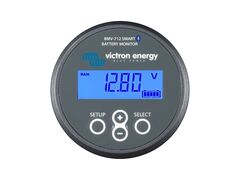
The Victron BMV-712 offers a comparable function (a 60V/1A relay) paired with an audible and visual alarm built into the unit, which the Votronic 200 S lacks. Conversely, the Victron SmartShunt has neither relay nor alarm at all, leaving all cutoff and alert logic to the app. The Votronic sits between the two: a real active protection, but with no alert signal noticeable without checking the screen.
The special case of a lithium LiFePO4 battery
Like any monitor that calculates state of charge by counting current, the Votronic needs to spot an end-of-charge threshold (high voltage paired with a low residual current) to reset its percentage to 100%. That principle was originally designed around the charge curve of lead-acid batteries, with a clearly marked absorption phase. A LiFePO4 battery shows a much flatter voltage curve near full charge: depending on the charger paired with it and its own end-of-charge threshold, the displayed percentage can settle one notch under 100% even after a full charge, a behavior already reported on the 100 S from the same lineup, which shares the same calculating electronics.
The unit's dedicated lithium profile (adjustable to the exact end-of-charge voltage of the battery in use) reduces this risk, but correctly setting both that profile and the paired charger's cutoff threshold remains decisive. At first setup, as after any disconnection of the shunt or the battery, a full charge of at least 24 hours with an automatic charger is required for the unit to recognize 100% and then calculate remaining capacity correctly.
German manufacturing, a 60-month warranty, a mature lineup
Votronic develops, manufactures and services its units from its plant in Lauterbach, Germany. Every unit is function-tested before shipping, and repair service remains available regardless of location or age of purchase. The manufacturer warranty runs for 60 months, matching the Victron SmartShunt and BMV-712, and well above the sector average.
The LCD Battery Computer S format has stayed stable in the Votronic catalog for many years (the same 1263/1266/1269 references still cover the 100/200/400A ratings), which points to a mature lineup rather than a recently revised product. One isolated report of a screen failure was found, with no recurring problem or recall otherwise surfacing for this specific model, and the unit remains stocked by a large number of specialist retailers across Europe.
Against the 100 S, the 400 S and the Victron/Renogy units
How does the Votronic LCD Battery Computer 200 S compare with the most common battery monitors for RVs, vans and boats?
| Criterion | Votronic 200 S | Votronic 100 S | Victron BMV-712 Smart | Victron SmartShunt 500A | Renogy RBM500 |
|---|---|---|---|---|---|
| Physical display | Yes (LCD) | Yes (LCD) | Yes (dedicated LCD) | No (app only) | Yes (wired LCD) |
| Shunt | 200 A | 100 A | 500 A | 500 A | 500 A |
| Short peak | 400 A (7 min) | 200 A (7 min) | Not stated | Not stated | Not stated |
| Stated current resolution | 0.1 A | 0.1 A | 0.01 A | 0.01 A (same shunt) | Not stated |
| Bluetooth | Optional, paid | Optional, paid | Built in | Built in | Optional |
| Warranty | 60 months | 60 months | 60 months | 60 months | 24 months |
| Observed price | $243.15 | $220.00 | $158.95 | $98.25 | Lower |
The 200 S is the only unit in this Votronic lineup to offer this much shunt headroom (up to 400A at short peak) while keeping a self-contained physical screen: a combination that suits a large lithium setup without ever touching an app, though it costs more than either Victron unit despite a shunt that handles less continuous current than theirs (500A). The BMV-712 remains the reference for anyone wanting screen and native Bluetooth together; the SmartShunt, with no screen, is the cheapest of the Bluetooth-equipped monitors; the Renogy RBM500 remains the most budget-friendly option, at the cost of a shorter warranty and an unstated accuracy figure. Against the 100 S from its own lineup, the 200 S changes nothing about connectivity or relative pricing against Victron: it is only justified by a genuine need for more than 100A of shunt capacity.
Who the Votronic LCD Battery Computer 200 S is for
This monitor is aimed first at anyone fitting an RV, van or boat with a large lithium, lead-acid, gel or AGM battery bank (beyond what a 100A shunt can measure without saturating), paired with a powerful inverter, air conditioning or a compressor fridge likely to regularly draw more than 100A at peak. For those setups, the 200 S brings exactly the headroom the 100 S lacks, without changing anything about connectivity or price.
For a more modest setup, where the largest current draws stay under 100A, the 100 S from the same lineup is enough, at a similar price. On a tighter budget and with no need for a physical screen, Victron's SmartShunt costs less for a wider shunt. For a screen and native Bluetooth together, the BMV-712 Smart remains the reference in this segment. Beyond 400A of regular current draw, only the 400 S from the same Votronic lineup, rated at 400A continuous, avoids saturating the reading.