The 200 A that changes everything
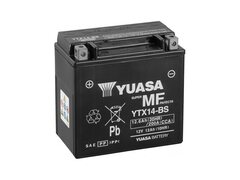
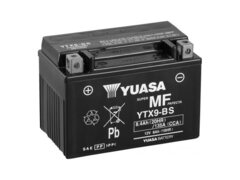
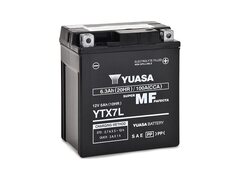
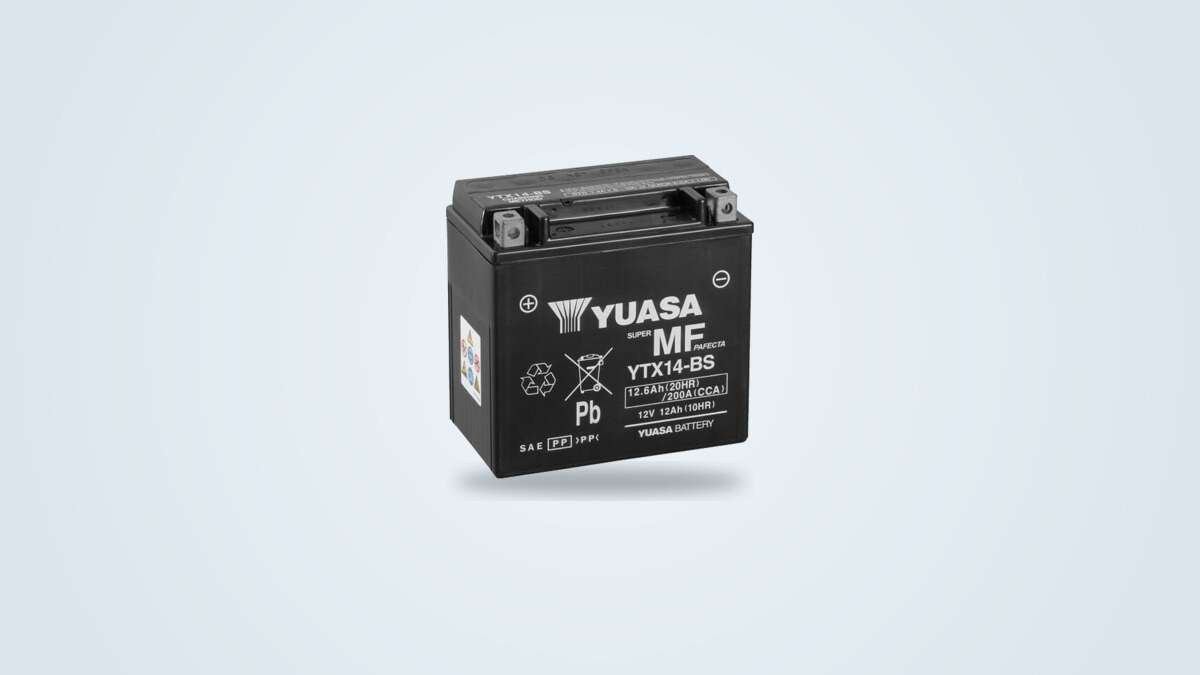
The number that defines the YTX14-BS isn't its amp-hours but its cold cranking amps: 200 A under the EN1 standard, a standardized rating rather than a marketing estimate. That's half again what a YTX9-BS (135 A) puts out, and double a YTX7L-BS (100 A). On a big twin or triple with high compression, it's this current peak, not the amp-hour capacity, that decides whether the engine fires on the first crank or the starter just struggles.
The manufacturer's official spec sheets, issued separately for the European and Japanese markets, show the same dimensions to a fraction of an inch: a rare sign of consistency in a market where generic compatibles often round their numbers upward.
The real risk isn't cold, it's sitting unused
Sealed AGM technology handles active cold very well: starting stays crisp even after several weeks parked at temperatures near 32 °F (0 °C). The YTX14-BS's real weak point lies elsewhere, in a less intuitive mechanism: self-discharge.
An AGM battery typically loses between 1 and 3% of its charge per month at room temperature, and that loss accelerates sharply above 86 °F (30 °C). Left discharged for months, it sulfates: crystals form on the plates and permanently reduce capacity, in a way no later charge can fully reverse. The most insidious case isn't outright failure but irregular use: a motorcycle left standing for weeks at partial charge, never running flat but never topped back up to 100% either, is exactly what feeds this kind of creeping sulfation.
In other words, the YTX14-BS doesn't fear cold when charged: it fears being forgotten. That's a nuance no spec sheet mentions, and it changes the buying advice directly for anyone who parks their bike for months at a time.
Twelve amp-hours: enough for modern accessories?
The 12 Ah at the 10-hour rate (12.6 Ah at the 20-hour rate) is almost never what spins the starter motor, that's the job of the 200 A. It powers everything that stays live with the engine off and through the first seconds of starting: alarm, GPS tracker, digital dashboard, and on some tourers, heated grips that alone can draw several dozen watts at full setting.
For a recent stock motorcycle with no added accessories, that reserve is comfortable. It tightens noticeably once a permanent aftermarket alarm and heated grips used continuously are added: exactly the kind of use that, combined with long periods parked, speeds up discharge and brings the battery closer to the sulfation threshold described above.
The case size, 5.9 x 3.4 x 5.7 in (150 x 87 x 145 mm), is dictated directly by that capacity and by the plates needed for 200 A: on a bike designed around a more modest reference such as the YTX9-BS, the extra height simply doesn't fit the stock battery box. Choosing the YTX14-BS isn't optional, it's a constraint set by the vehicle itself.
First-fit equipment with nearly every manufacturer: what that's really worth
Yuasa supplies first-fit batteries to nearly every major motorcycle manufacturer: Honda since 1975 on the Gold Wing, and more broadly Yamaha, BMW, Triumph, Aprilia, Ducati, Harley-Davidson, Kawasaki, KTM, Moto Guzzi, Suzuki, and Vespa. That isn't an isolated marketing claim, it's a position built over decades as an original-equipment supplier, and it explains why the YTX14-BS remains the most common replacement size for big-bore motorcycles, well beyond bikes that originally shipped with a Yuasa battery.
With regular use, real-world service life runs closer to six years, beyond the three to four years claimed out of caution. A twelve-month contractual warranty then looks short against what well-maintained AGM chemistry can actually deliver: a gap between the caution on paper and the robustness of the technology itself.
Activation at fitting: what to know before you buy
Whether the YTX14-BS you order on this market ships dry or already factory-activated depends on the specific listing: both are sold under the same reference. Three points are worth knowing either way, since the wrong assumption at delivery causes real confusion.
- On a dry-shipped unit, activation happens once, at fitting. Pour in the electrolyte, let it settle for a few minutes, then seal permanently: the process involves a corrosive acid and calls for gloves and eye protection.
- A full charge is mandatory before first use on any dry-shipped unit. Filling alone isn't enough to reach rated capacity: without that initial charge on a charger, the battery will never deliver its claimed 200 A.
- Check whether your specific listing ships dry or factory-activated before buying. A factory-activated unit skips the acid-handling step entirely, while a dry-shipped one requires it: knowing which one is on its way avoids an unwelcome surprise at delivery.
None of this is complicated or lengthy, but it is a real step to plan for on a dry-shipped unit, not just a matter of unboxing.
AGM or lithium-ion: the trade-off for a replacement
The replacement market now offers lithium-ion (LiFePO4) alternatives that are markedly lighter. That's the central selling point of this chemistry: the same starting function for a fraction of the weight.
The trade-off doesn't stop at weight. Lithium specialists generally offer a three-year warranty, against twelve months for the Yuasa, and on some models a smartphone app to track state of charge, something no lead-acid battery offers. On the other side, lithium-ion chemistry copes less well with severe cold without dedicated electronic protection: worth checking precisely on the specific lithium model in question rather than assuming it's handled by default. Purchase price also swings clearly in favor of lead-acid AGM, the Yuasa remaining the cheaper option upfront for reliability proven over decades.
The choice comes down to a simple trade-off: weight and warranty for lithium-ion, price and the maturity of the technology for AGM. On a machine where every ounce genuinely matters (racing, off-road), the difference justifies the expense. On a tourer or cruiser where 7.3 lb (3.3 kg) makes no difference to handling, the Yuasa remains the more rational default choice.
Don't mix them up: neighboring references in the YTX14 range
The YTX14-BS designation comes in several closely related references with different performance. The YTX14H-BS offers higher capacity and cranking current than the YTX14-BS, at a noticeably higher price; the YTX14AHL-BS also differs in its dimensions. All three look similar enough that some plate-based fitment lookup tools used by online retailers occasionally point to the wrong reference, including an entirely different YTX16-BS.
| Reference | YTX14-BS | YTX14H-BS | YTX9-BS |
|---|---|---|---|
| Positioning | Standard, big-bore machines | Higher tier, same segment | Mid-size machines |
| Relative price | Reference | Noticeably higher | Lower |
The only genuinely reliable check remains the marking on the original battery being replaced, never how closely a name on a retailer page resembles it, or what an automatic compatibility tool returns.
The real cost over time: Yuasa against a generic compatible
Against the Yuasa, the market offers noticeably cheaper generic compatibles, generally listed around $35 to $50 against an observed price closer to $85 to $95 for the original reference. Comparing raw purchase price alone is misleading: it ignores the most important variable, real-world service life.
| Criterion | Yuasa YTX14-BS | Generic compatible |
|---|---|---|
| Observed price | ≈ $85 to $95 | ≈ $35 to $50 |
| Real-world service life | Around 6 years with regular use | Not reliably documented |
| Approximate annualized cost | ≈ $14 to $16/year | Impossible to calculate without a reliable lifespan |
| Manufacturer warranty | 12 months | Highly variable, often shorter |
That very impossibility of putting an annualized cost on the generic compatible is itself telling: no solid longevity data was found for that category of product, unlike the Yuasa reference. Excessive gassing once sealed affects some entry-level AGM batteries at the cheaper end, a classic symptom of shortened service life.
On a big machine where reaching the battery takes real effort, replacing a generic compatible twice over is likely to cost more, and be far less predictable, than fitting the original reference once.
Who it's for, and its real limits
The YTX14-BS is aimed first at owners of big-bore machines whose battery box dictates this size: cruisers, sport tourers, adventure bikes, utility ATVs, or recreational boats. Compared with the portable jump starters already reviewed on this site, it plays an entirely different role: a Noco GB150 rescues a dead battery on an ad hoc basis, while the YTX14-BS is the battery itself, permanently fitted.
Against the Noco GB150 and Noco GB40 (the category's high anchors, both rated 4.2), the YTX14-BS does better on the reliability of the cranking current actually available (a standardized EN1 rating, identical across several markets, where a jump starter loses power quickly in severe cold since it isn't itself warmed by a running engine) and on everyday simplicity, since there's nothing separate to recharge. It trails on versatility: a jump starter also works as a USB power bank and flashlight, where an installed battery serves only one function. Against the Noco GB70 (the category's low anchor at 4.1), the Yuasa's advantage lies in build quality and reliability history: first-fit status with nearly every motorcycle manufacturer and real-world longevity beyond the manufacturer's cautious estimate, where the GB70, designed for occasional use, doesn't face the same demand to hold a charge continuously.
It isn't the right choice for anyone chasing minimum weight at any cost: a lithium-ion replacement will do markedly better on that specific point, for a higher budget. Nor is it right for anyone who neglects winter care: without a maintainer, sulfation, not frost, will be what finishes it early.