The shunt, not just another voltmeter
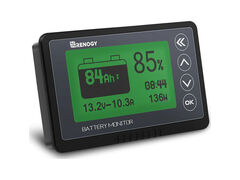
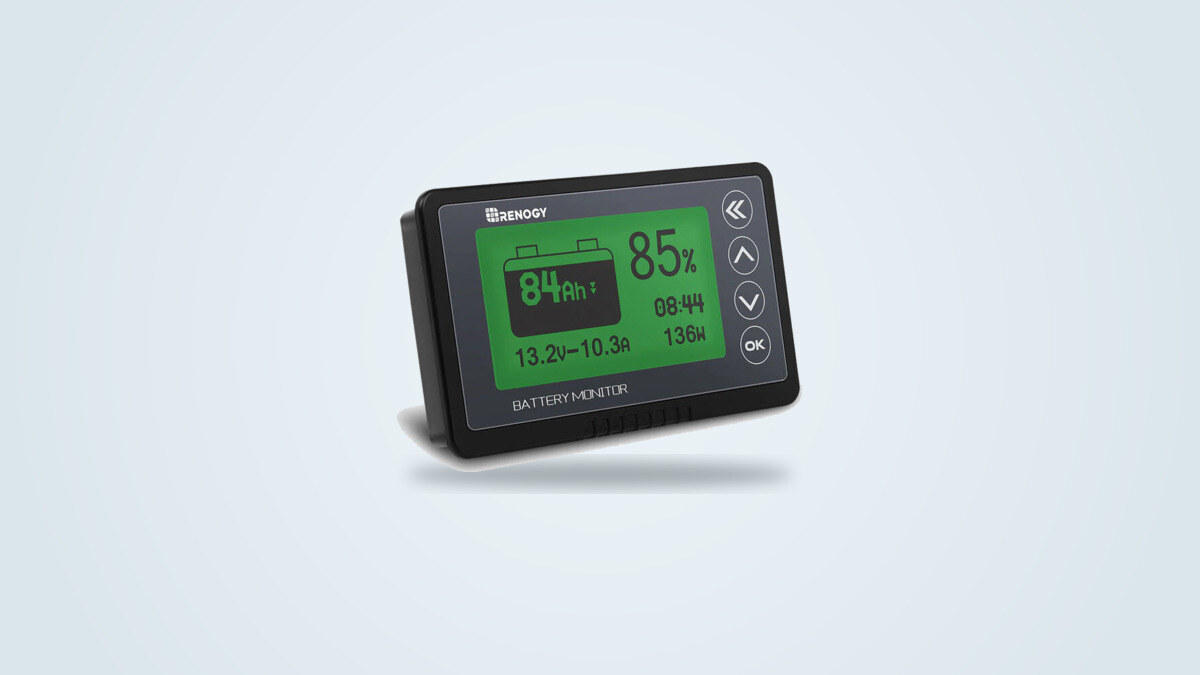
An ordinary voltmeter only gives a rough indication of a battery's state: voltage alone says very little about the capacity actually available, especially on a lithium battery whose discharge curve stays flat right up until a sudden collapse. The Renogy RBM500 takes a different approach: its 500A shunt wires in series on the battery's negative terminal and directly measures the current flowing in and out, to calculate a genuine state of charge rather than a simple voltage estimate.
That ±1% figure appears in the technical documentation supplied with the unit, not just on the packaging: the specification sheet gives the same value for voltage, current and displayed capacity. The manufacturer does flag a real limitation of its own: current that changes very frequently can throw off the data acquisition and therefore the displayed accuracy, a logical quirk for any meter that integrates a current over time rather than reading a fixed value.
No comparison against an independent reference instrument has been found for this particular model, which remains a fair reservation rather than a proven flaw: the ±1% figure stays a manufacturer specification, consistent across all the available documentation, but not cross-checked by a third party.
Initial calibration, the step behind most complaints
The RBM500 has no idea of the real capacity of the battery it is fitted to until it has been calibrated. According to the manufacturer's documentation, one operation is needed on first use or after replacing the battery: fully discharge it and hold down a button to reset the counter to 0%, or fully charge it and hold down the other button to set it to 100%. Without this step, the displayed percentage does not reflect the battery's actual state.
This requirement explains a good share of the inconsistent readings seen online: a percentage that stays stuck near 100% early in a discharge, or one that suddenly jumps to 0% after a brief but heavy draw, typically points to a calibration that was never done, or wiring that is incomplete. The manufacturer is explicit on this second point: every amp, from both loads and charging sources, must physically pass through the shunt's P- terminal. A device whose negative return is wired elsewhere, straight to the chassis for instance, escapes the measurement entirely and throws off the percentage calculation.
On an installation with several circuits (a solar panel, a shore power charger, several loads), this usually means gathering every negative return onto a single common bus bar wired to the shunt's P- terminal, rather than spreading them across several separate ground points.
A 10 to 120V range, an unusual reach for its class
The RBM500 accepts a 10 to 120V range, covering 12V, 24V and 48V systems in a single unit, with no need to switch model or hardware setting. That is noticeably wider than the direct rivals in the same category.
Compatible with lead-acid batteries (AGM, Gel), lithium (LiFePO4, Li-ion) and nickel-metal hydride, the RBM500 works as a universal amp-hour counter: it measures a current and integrates it over time, without talking to a modern lithium battery's own battery management system (BMS). That is an important difference from the dedicated monitoring screen Renogy also sells for its own smart lithium battery lineup, which reads BMS data directly through a dedicated port for a finer state of charge, but only on batteries from that brand. The RBM500 trades away that extra precision for universality: it works identically regardless of which brand of battery is fitted.
Another consequence of this generic approach: there is no pre-programmed chemistry profile, such as a dedicated LiFePO4 curve. Full-charge and low-voltage thresholds have to be worked out and entered manually in the settings, based on the specific battery installed.
A narrower cold-weather threshold than the headline suggests
The RBM500 has no internal battery of its own: it draws its operating power directly from the battery it monitors. The cold-weather question, then, is not about any runtime of the unit's own, but about whether its LCD screen stays readable and reliable in exactly the conditions where it matters most, a winter morning in an unheated technical compartment.
The manufacturer's documentation states that prolonged exposure below 14 °F (-10 °C) or above 140 °F (60 °C), much like prolonged exposure to sunlight or UV, risks shortening the LCD screen's lifespan. That is a narrower range, on the cold side, than some direct rivals in the same category: the Victron BMV-712, for instance, states an operating range down to -40 °F (-40 °C) on its own listing.
In practice, the RBM500's screen is most often mounted inside the cab (a dashboard, a partition near a door), sheltered from direct frost while the vehicle is in use. The point to watch is prolonged winter storage of an unheated vehicle, where the interior temperature can sit below that 14 °F (-10 °C) threshold for weeks at a time.
Bluetooth: what the BT-2 actually connects to
The RBM500's screen connects to the shunt exclusively through the supplied shielded cable: no wireless port, no RJ45 socket appears anywhere on the unit itself, in its wiring diagram, or in its specification table. It is a wired device from end to end.
Renogy separately sells two Bluetooth modules, BT-1 and BT-2, marketed as generic accessories across its lineup. Their official documentation lists the compatible products: Rover and Elite charge controllers, the brand's own smart lithium batteries, inverters and dual-input DC-DC chargers, all fitted with an RS232 or RS485 communication port. The RBM500 does not appear on either compatibility list, and its own support page does not mention BT-1 or BT-2 among its accessories.
The manufacturer's own documentation treats the two products as two different answers to the same need, rather than as a matched pair: the wired screen for anyone who stays near their installation, the Bluetooth module for anyone who wants to go wireless, but attached to a charge controller or a Renogy smart battery, not to the RBM500's shunt. A useful distinction to know before adding a Bluetooth module to the cart in the hope of extending this particular unit.
Passive safety, but real all the same
The RBM500 delivers no power of its own: it only measures its passage. The electrical risk inherent to the unit is therefore structurally lower than that of a charger or a jump starter. The protections it does carry remain real and useful.
A reversed shunt connection (the B- and P- terminals swapped) triggers a flashing backlight, a simple visual cue to catch a wiring mistake before it permanently skews the readings. Two configurable thresholds round things out: a low-voltage threshold triggers a buzzer every 10 seconds and flashes the display, and a second, lower threshold simply switches off the screen and its backlight altogether.
The manufacturer's documentation also repeats the general precautions expected on this type of installation: adequate ventilation while charging a lead-acid battery, eye protection when handling a large lead-acid battery, and a fuse or circuit breaker on every load connected. These are common-sense reminders rather than a feature specific to the RBM500, but their presence in a technical document aimed at a sometimes novice audience is still worth having.
Build quality, warranty and long-term reliability
The screen's plastic housing clips into a panel cutout (3.7 x 2.2in / 94 x 57mm): a straightforward flush-mount installation, but no water resistance rating is stated on the specification sheet. It is best kept somewhere sheltered (a dashboard, an interior partition) rather than in a compartment exposed to splashing.
The RBM500 has gone through several hardware revisions over the years (successive versions carry the G1 then G3 suffix depending on the market), the latest adding a battery attenuation-rate setting and an adjustable backlight on top of the parameters already present. That kind of gradual evolution points to a product still being actively maintained by its manufacturer, rather than one left unchanged since launch.
Over time, the friction point most often encountered around this type of shunt monitor is the initial setup: a manual that covers the essentials only, a calibration step that is easy to miss (see above), wiring that needs revisiting when a reading does not match reality. None of this points to a recurring hardware fault or build defect, but rather to room for improvement in how the first connection is explained.
Installation in practice: shunt, cable and a common bus bar
The shunt wires only into the negative circuit, never the positive: its B- terminal joins the battery's negative, its P- terminal takes the negative return from every load and every charging source. Both shunt terminals accept large-diameter lugs (M10 studs), to be sized according to the cable gauge used on the installation.
| Item | Detail |
|---|---|
| LCD display | 3.9 x 2.4 x 0.7in (99 x 61 x 18mm), 2.6oz (75g), adjustable green backlight |
| Shunt | 500A, M10 stud terminals |
| Shielded display-to-shunt cable | 20ft (6m) |
| B+ sense wire | 3ft (1m), 20AWG |
| Shunt bracket | Clear plastic bracket supplied |
The 20ft (6m) shielded cable linking the screen to the shunt lets the display sit well away from the technical compartment, on a dashboard or near an RV door for instance, with no need to extend anything in most setups. The screen shows voltage, current, power, estimated remaining runtime and charge percentage all at once on a single dial, with no need to page through several screens to gather that information.
On an installation that already includes a solar panel, a shore power charger and several loads, the point to plan for remains the one flagged above: gather every negative return onto a single common bus bar wired to the shunt's P- terminal, rather than spreading them across several independent ground points.
Against the direct competition
The shunt battery monitor shelf holds several directly comparable options, at very different prices and with very different design choices.
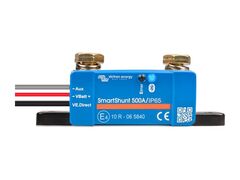
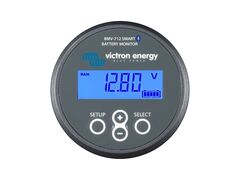
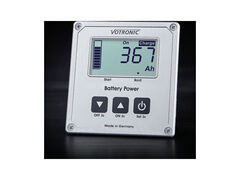
| Criterion | Renogy RBM500 | Victron SmartShunt 500A | Victron BMV-712 | Votronic LCD 100 S |
|---|---|---|---|---|
| Shunt | 500A | 500A | 500A | 100A |
| Voltage range | 10 to 120V | 6.5 to 70V | 6.5 to 95V | 7 to 32V |
| Physical screen | Wired LCD included | None (app only) | Color LCD included | LCD included |
| Bluetooth | Not confirmed | Built-in | Built-in | Optional |
| Stated water resistance | No | IP65 | Not stated | Not stated |
| Warranty | 1 year | 5 years | 5 years | Not stated |
| Catalog price | ≈ $87 | ≈ $98 | ≈ $159 | ≈ $220 |
Against the SmartShunt, Victron bets everything on built-in Bluetooth and an IP65-rated housing, at the cost of a physical screen: everything runs through a nearby smartphone. The BMV-712 adds that dedicated physical screen on top of the same built-in Bluetooth, with a warranty twice as long, but for nearly double the RBM500's catalog price. Against the Votronic LCD 100 S, the RBM500 benefits from a shunt five times larger and a far wider voltage range, at a lower price, but without its rival's pre-programmed chemistry profile. The RBM500 remains the most affordable option in this lineup to include a physical screen in the price, at the cost of the reservations already detailed above: no confirmed Bluetooth, a shorter warranty, a narrower cold-weather range.
Who the RBM500 suits, and who it does not
The RBM500 suits anyone who wants a permanent physical readout, legible without reaching for a phone, on a 12V, 24V or 48V system, on a tight budget. Its unusually wide voltage range also makes it a sensible choice for anyone wiring up an unconventional installation (48V in particular), where most direct rivals cap out considerably lower.
It suits less well anyone after smartphone-based remote monitoring straight out of the box: without confirmed Bluetooth compatibility, that need is better served by a Victron SmartShunt or BMV-712. It is also a poor fit for anyone mounting the unit in a compartment exposed to moisture (no stated water resistance) or in a vehicle stored all winter without heat (a stated cold-weather range down to 14 °F/-10 °C only). Lastly, anyone who already owns one of Renogy's own smart lithium batteries will find a finer reading, taken straight from the BMS, on the dedicated monitoring screen for that lineup, at the cost of losing the universal compatibility that is the RBM500's strength.
The bottom line: for a modest price, the RBM500 usefully replaces a simple voltmeter over a voltage range rarely matched elsewhere, provided buyers accept a proper initial calibration and two clear trade-offs, no confirmed Bluetooth and a standard one-year warranty.