Cell efficiency versus real-world power output
The PV60's spec sheet rates its monocrystalline cells at up to 24.7% conversion efficiency, a high figure for a panel this size: it sits near the top of the portable-panel segment, on par with the catalog's best references. That number describes the efficiency of the cells themselves, not the power that actually comes out of the panel once it is out in the sun.
As with any solar panel, the rated 60 W corresponds to a standardized peak-power figure (1000 W/m² of irradiance, 77 °F / 25 °C cell temperature), a lab convention that is almost never matched outdoors. On this panel specifically, available power in full sun, even on a hot day with no shadow at all, most often caps well below the rated figure: values in the 30 to 35 W range come up repeatedly, roughly half the rated 60 W.
A second point is worth knowing before buying: because the cells are wired in series by panel group, even partial shade on one section can cut the whole panel's output far more than the shaded area alone would suggest, a classic electrical behavior of this type of wiring. This is not unique to the PV60, almost every foldable panel at this format and price point works the same way, but it changes how it should be positioned outdoors in practice: avoid any shadow at all, even a small partial one, rather than assuming partial shade only costs a proportional amount of power.
Weight and folded size: the PV60's real strength
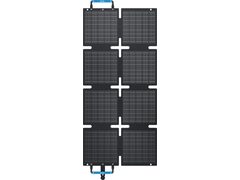
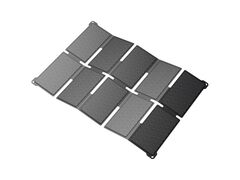
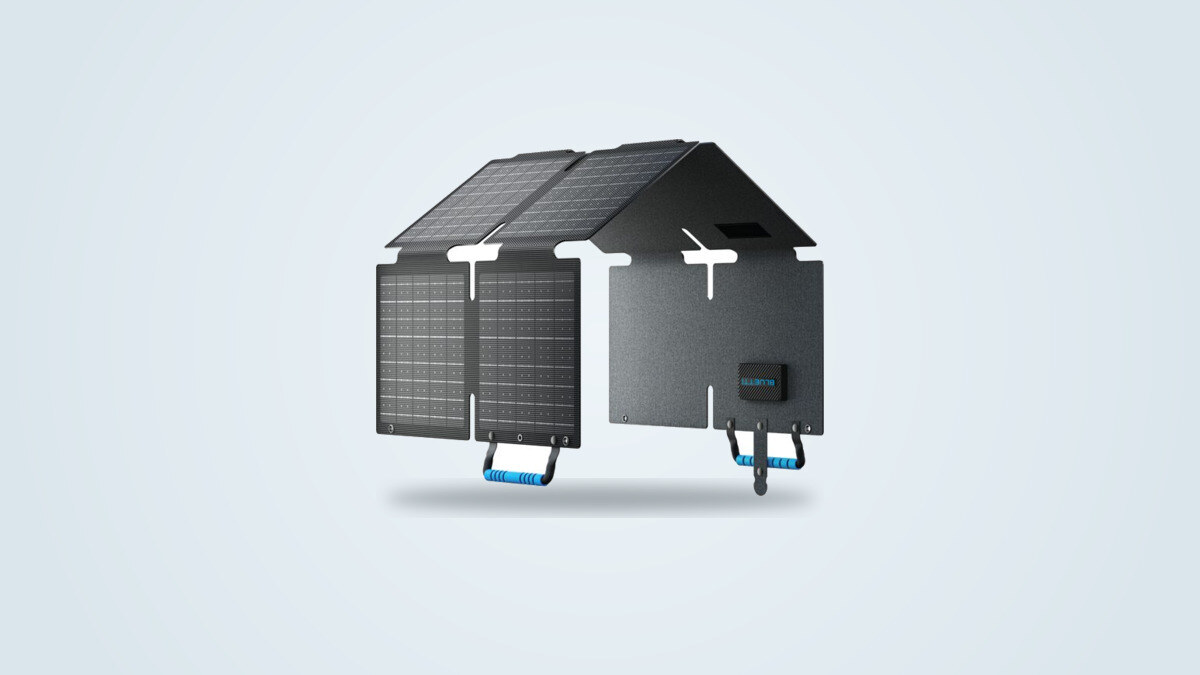
The PV60 weighs 3.1 lb (1.4 kg) on the scale, folding down to a compact 8.9 x 8.3 x 2.8 in (226 x 210 x 70 mm), roughly the size of a thick binder. Unfolded, it measures 35.4 x 16.7 in (900 x 424 mm) spread across 8 hinged panels that fold accordion-style. That makes it, as of writing, the most compact folded size of any portable panel already compared on this site, across every power class.
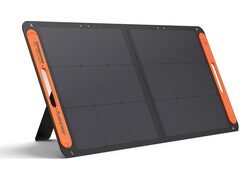
The right way to judge a portable panel is not weight alone but power carried per kilogram. On that measure, the PV60 scores very well: at around 42.9 W per kilogram, it comfortably beats the catalog's 100 W panels (27.8 W/kg for the Jackery SolarSaga 100W) and matches the Anker Solix PS200, a bifacial 200 W panel itself prized for being light (41.7 W/kg). Only the BigBlue P35, a simple 35 W USB charger with no DC output at all, does slightly better (50.0 W/kg).
In absolute terms, the PV60 is still heavier than BigBlue's tiny USB chargers (1.5 lb / 0.68 to 0.7 kg), but those deliver less than half its power and have no output compatible with a power station. Against panels that make sense for charging a small station (Jackery SolarSaga 100W at 7.9 lb / 3.6 kg, Goal Zero Nomad 100 at 10.1 lb / 4.6 kg), the weight gap is significant and shows up immediately on a hike or a bike ride.
Three output ports: more complete connectivity than it first appears
The PV60 has three real output ports: a DC5521 connector rated up to 23.1 V and 60 W, designed to charge a compatible small Bluetti station (AC50P, AC180P, Premium 30 V2) directly, a USB-A port rated up to 18 W and a USB-C port rated up to 30 W. That combination is more complete than it first appears: several portable panels in the catalog are limited to a single output type, DC/MC4 only on the Anker Solix PS200, the Fossibot SP200 and the Bluetti MP200, a proprietary 8mm connector only and no USB at all on the Goal Zero Nomad 100.
In practice, that means you can charge a phone, tablet or power bank directly over USB without carrying a power station at all, while still being able to plug in a compatible small station over DC5521 for longer sessions. That is a genuinely useful flexibility for hiking or a bivouac, where a station is not always part of the load-out.
IP65 weatherproofing and the ETFE coating
The PV60 carries an IP65 rating: the first digit (6) means full protection against dust, the second (5) means protection against water jets, a step up from simple splashing. In practice, the panel handles dust, morning dew and an ordinary rain shower, but it is not designed for immersion, even briefly, unlike the IP67 (immersion up to 1 m for 30 minutes) or IP68 (sustained immersion beyond 1 m) ratings claimed by several direct rivals.
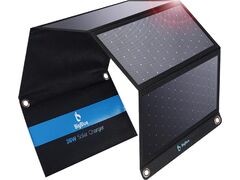
Among the portable panels already reviewed on this site, the PV60's IP65 sits between the BigBlue 28W's IP44 (simple splashing only, no protection against stronger jets) and the IP67 of the Bluetti MP200 and Fossibot SP200. The Jackery SolarSaga 100W, the BigBlue P35 and the Anker Solix PS200 go further still with an IP68 rating. The ETFE film coating over the cells, a common technical choice on foldable panels, adds protection against scratches and UV-related yellowing, a separate matter from the IP rating.
An 8-panel accordion fold: compact, but worth treating with care
The PV60's very compact folded size comes from its 8-panel accordion fold, against 2 to 4 panels on most portable panels of comparable or greater power (2 on the Anker Solix PS200, 4 on the Bluetti MP200 and the Fossibot SP200). In practice, each panel is narrower, which lets the whole unit fold down smaller across every dimension rather than just one.
That design has a logical trade-off: an 8-panel accordion fold mechanically means more fabric creases and hinges than a 2 or 4-panel design, each one a flex line repeated every time the panel opens and closes. No hinge or fastener failure has been identified on this specific panel as of writing, but use across several years and hundreds of fold cycles remains the real test for this kind of design, and the track record on that specific point is still limited. A built-in kickstand adjustable across several positions, on the other hand, makes it easy to angle the deployed panel toward the sun without any extra accessory.
Which stations and devices it works with
The PV60 is built for portable top-ups rather than quickly filling a large battery. Through its DC5521 port, it charges small Bluetti power stations fitted with the matching input directly, notably the AC50P, AC180P and Premium 30 V2, forming a lightweight solar kit with any of them. Its USB-A and USB-C ports let you charge a phone, tablet or power bank in parallel without going through a station at all, a common need on a day hike or a bike ride where carrying extra gear is not an option.
With 60 W rated and real-world output more in the 30 to 35 W range in full sun, expect several hours of direct sunlight to fully charge a small 200 to 300 Wh station, and the better part of a day for a larger one. This is not a panel meant to cover a van or motorhome's needs on its own with a large station attached: the catalog's 100 to 200 W panels remain better suited to that job.
Versus the other portable panels in the catalog
The PV60 occupies an unusual spot in the catalog: more powerful than BigBlue's simple USB chargers (28 and 35 W), yet notably lighter than the 100 W-and-up panels. The table below compares its main specifications with three portable panels already reviewed on this site.
| Criterion | Bluetti PV60 | BigBlue P35 | BigBlue 28W | Jackery SolarSaga 100W |
|---|---|---|---|---|
| Power | 60 W | 35 W | 28 W | 100 W |
| Weight | 3.1 lb (1.4 kg) | 1.5 lb (0.7 kg) | 1.5 lb (0.68 kg) | 7.9 lb (3.6 kg) |
| Power per kilogram | 42.9 W/kg | 50.0 W/kg | 41.2 W/kg | 27.8 W/kg |
| Cell efficiency | 24.7% | 25.4% | 24% | 25% |
| Weatherproofing | IP65 | IP68 | IP44 | IP68 |
| Ports | DC5521 + USB-A 18 W + USB-C 30 W | USB-A 18 W + 2 USB-C (one at 25 W) | USB-A + 2 USB-C, 5V/4.8A total | DC + USB-C 15 W + USB-A 12 W |
| Warranty | 2 years | 2 years | 2 years | 3 years |
| Price observed | around $149 | around $90 | around $60 | around $215 |
Against the BigBlue P35, the PV60 offers more than double the rated power for double the weight, plus a DC output the P35 lacks entirely (useful for a small station, something the USB-only P35 simply cannot do). Against the Jackery SolarSaga 100W, more powerful and better protected (IP68) but 2.6 times heavier, the PV60 keeps a clear edge as soon as weight becomes the priority, on a hike or a bike ride for instance. Against the Bluetti MP200, its own 200 W sibling in the catalog, the PV60 targets a completely different use case: where the MP200 suits an installation left on the ground near a station, the PV60 is built to be carried around every day.
Build quality, warranty and brand track record
Bluetti is an established name in the portable solar generator market, with a catalog that spans pocket-sized panels through to multi-kilowatt installations. The PV60 carries a 2-year manufacturer warranty, in line with the segment average but shorter than the Jackery SolarSaga 100W (3 years) and well short of the Anker Solix PS200 (5 years).
No recall or safety issue has been identified on this panel. The ETFE coating and the rigid-panel construction linked by fabric hinges is a proven approach shared by most foldable panels at this price point. The most concrete concern on this axis remains the real-world power shortfall against the rated figure, already covered above, which reflects a design choice (cells and wiring) more than a manufacturing defect as such.
Who it suits, and who should look elsewhere
The PV60 suits hiking, bivouacking or cycling trips where every ounce counts: its class-leading weight for 60 W, compact folded size and direct USB ports make it a companion worth packing without hesitation, even when a power station is not part of the plan. It also suits anyone who already owns a compatible small Bluetti station (AC50P, AC180P, Premium 30 V2) and wants a light solar top-up for everyday use.
It suits less well anyone needing to quickly recharge a large station running into the hundreds or thousands of Wh: the catalog's 100 to 200 W panels remain better suited to that job, despite their significantly greater weight. It is also not the right pick for anyone needing full immersion resistance: IP65 handles splashing and a rain shower, not a dunk underwater. Before buying, the single most important thing is to set expectations on the power actually available, in the 30 to 35 W range in full sun, rather than on the 60 W printed on the spec sheet.