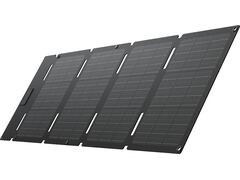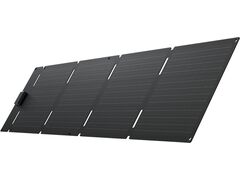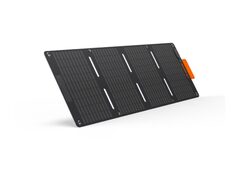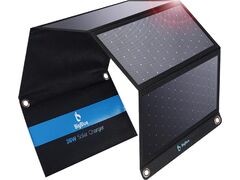
Two outputs, only one actually carries the full 45W
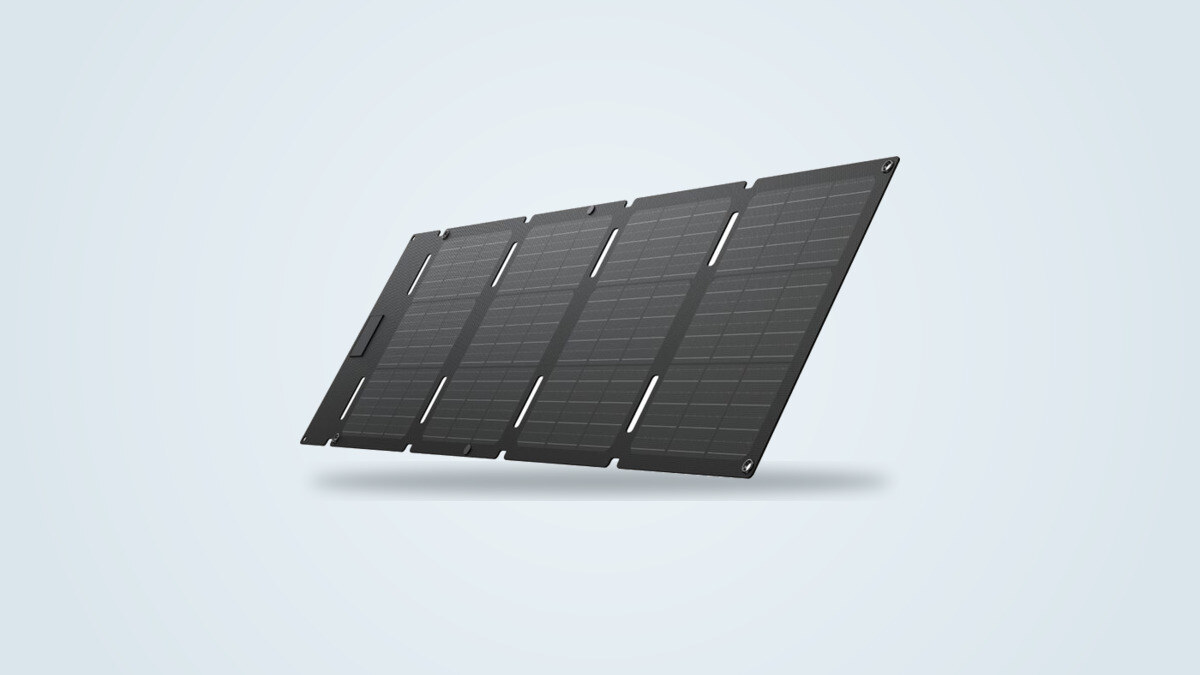
The EcoFlow 45W (USB-C) portable solar panel takes its commercial name from a built-in USB-C output port, presented as the headline feature on the product page: plug in a phone, a tablet or an electric air pump directly, with no power station in between. In practice, this USB-C port is limited to 15W (5V/3A), a figure set by the manufacturer itself.
The 45W printed on the box actually only flows through a second connector, a DC5521 type, capable of carrying the panel's full rated output (45W ±5W, or 22V/1.98A at the maximum power point). A DC5521-to-XT60i adapter cable is included in the box along with four hanging hooks and the user manual, letting you plug the panel straight into the solar input of an EcoFlow RIVER-series station (RIVER 2 and RIVER 3 are explicitly listed as compatible by the manufacturer), with no extra accessory to buy.
This dual-output design mirrors exactly the one on the bigger sibling EcoFlow 60W (USB-C) already reviewed on this site: a convenient but limited USB-C port, and a DC connector that carries the real power. It differs, however, from the Jackery SolarSaga 40W Mini, which offers two USB ports (USB-C at 15W and USB-A at 12W): there is no USB-A port here at all, this EcoFlow panel offering only a single USB access point in total. There is also no way to link several panels of this compact range together to add up their output, a limitation shared across this whole EcoFlow size class.
Real output: what the rated 25% TOPCon efficiency is worth
EcoFlow rates this panel's conversion efficiency at up to 25%, thanks to N-type monocrystalline TOPCon (Tunnel Oxide Passivated Contact) cells, already used on the bigger 60W sibling in the same range. This figure, measured under industry-standard conditions (STC: 1000 W/m² irradiance, 77 °F (25 °C) cell temperature, AM1.5 reference spectrum), remains a manufacturer figure, as is the case for nearly every portable solar panel on the market.
In the field, output measured on the DC5521 connector, in direct sun with good orientation, reaches up to 41W out of the 45W rated, roughly 91% of the nominal figure, a high proportion for such a compact panel. This figure swings hard with season and latitude: at the depth of winter, output drops below 10W for only a few hours around midday, and falls to zero as soon as partial shade covers even a single one of the four folding panels.
Over one hour, this panel gathers on the order of 2350 mAh in direct sun, and still around 1390 mAh in indirect light or overcast conditions over the same span, or 59% of the direct-sun figure: a high proportion that sets it apart from most compact panels, which are typically hit harder by an overcast sky.
As with any portable solar panel, the sun's angle of incidence strongly affects output. N-type cells generally hold up better thermally in direct sun than the P-type cells more common on entry-level panels, which in theory limits the efficiency loss on the hottest days.
3.1 lb on paper, 3.2 lb actual: weight and size in detail
Unfolded, the panel measures 38.6 x 12.2 in (98 x 30.9 cm) and 0.6 in (1.6 cm) thick. Folded into four sections, it packs down to 8.7 x 12.2 x 1.6 in (22.2 x 30.9 x 4 cm), barely thicker than a hardback book, for a rated weight of 3.1 lb (1.4 kg). A separate weighing recorded 3.2 lb (1454 g), about 4% above the rated figure, a small but real gap.
This makes it the most compact and lightest panel in the whole EcoFlow DC-connector lineup compared on this site, ahead of the 60W (4.4 lb / 2 kg) and far ahead of the brand's own 110W to 400W bifacial panels. It remains, however, heavier than its closest direct rival, the Jackery SolarSaga 40W Mini (2.6 lb / 1.18 kg, 1.2 in / 3 cm folded thickness), for just 5W of extra rated output. Set against the whole portable solar charger market, from the lightest phone-only chargers to large panels, 3.1 lb (1.4 kg) sits on the heavier side: the BigBlue 28W, for instance, weighs only about 1.4 lb (0.65 kg), nearly half as much, but for a rated output about 40% lower and far weaker weatherproofing (IPX4 versus the IP68 rating here).
| Panel | EcoFlow 45W (USB-C) | EcoFlow 60W (USB-C) | Jackery SolarSaga 40W Mini |
|---|---|---|---|
| Rated weight | 3.1 lb (1.4 kg) | 4.4 lb (2 kg) | 2.6 lb (1.18 kg) |
| Folded thickness | 1.6 in (4 cm) | 1.8 in (4.5 cm) | 1.2 in (3 cm) |
| Rated output | 45W | 60W | 40W |
The panel ships with four hanging hooks rather than a built-in kickstand: unlike larger panels, there is no dedicated way to angle it precisely on the ground toward the sun. It lies flat or hangs from a backpack, a branch or a tent guy line, a workable solution for nomadic use but one that takes more fiddling than a fold-out stand.
Rated IP68, ETFE build: weatherproofing in detail
The panel is rated IP68 by the manufacturer, the highest protection level on the standard scale against water and dust, matching the 60W and the brand's bifacial panels already reviewed on this site. Its cells are protected by an ETFE coating and fiberglass circuit boards, a construction now common on mid-range and premium portable panels.
No hinge or connector failure has been identified for this specific panel to date. Track record naturally remains more limited than for the brand's own 110W to 400W bifacial panels, which are older and more widely sold.
One name, two very different panels
Before comparing this review with other information found online, one point is worth knowing: the name "EcoFlow 45W" does not refer to a single product. A much simpler version circulates in parallel, with a fixed MC4 connector only, no USB port at all, weighing about 4.4 lb (2 kg) and rated IP67 rather than IP68. This version, built solely for charging a station through a roughly 5-foot (1.5 m) MC4 cable, allows no direct device charging at all and shares neither the weight, the connectors, nor even the ingress rating with the version covered in this review.
| Feature | MC4 version (no USB) | USB-C version (this panel) |
|---|---|---|
| USB port | None | USB-C, 15W max |
| Main connector | Fixed MC4 | DC5521 (XT60i cable included) |
| Rated weight | About 4.4 lb (2 kg) | 3.1 lb (1.4 kg) |
| Rated ingress protection | IP67 | IP68 |
The version covered in this review is recognisable by the explicit "USB-C" or "Type-C" wording in its exact name (manufacturer reference EFSOLAR45-TYPE-C), by its 3.1 lb (1.4 kg) weight and by its two outputs (USB-C and DC5521). The same kind of mix-up already exists on the EcoFlow 60W panel in the same range, already flagged on this site: checking for the "USB-C" wording before comparing this review with other information found online remains the most reliable habit for this product line.
Build and warranty: the same trade-off as the 60W
EcoFlow was founded in 2017 in Shenzhen, China, and has since become one of the reference names in the portable power station market, with a broad ecosystem of panels, batteries and accessories that work together. No recall has been identified for this panel to date.
Worth noting: this panel's manufacturer warranty is limited to 12 months, the same as the 60W USB-C panel from the same brand, but far short of the 5 years (3 base years plus 2 more with online registration) on the Jackery SolarSaga 40W Mini, its closest direct rival, and of the 5 years on EcoFlow's own 110W to 400W bifacial panels already reviewed on this site. This gap in coverage length is not trivial for an accessory left outdoors in the sun and weather, even though no recurring build defect has been identified for this version to date.
Against other small portable panels
Against other portable panels already reviewed on this site, the EcoFlow 45W holds the most compact spot in the EcoFlow DC-connector lineup, just ahead of the 60W, but stays heavier than its closest direct rival by rated output, the Jackery SolarSaga 40W Mini.
| Criterion | EcoFlow 45W (USB-C) | EcoFlow 60W (USB-C) | Jackery SolarSaga 40W Mini | BigBlue 28W |
|---|---|---|---|---|
| Rated output | 45W | 60W | 40W | 28W |
| USB outputs | 1 (USB-C, 15W max) | 1 (USB-C, 15W max) | 2 (USB-C 15W + USB-A 12W) | 1 (USB-A) |
| Rated ingress protection | IP68 | IP68 | IP68 | IPX4 |
| Warranty | 12 months | 12 months | 5 years (3+2) | Not specified |
| Observed price | ≈ $99 | ≈ $109 | ≈ $126 | ≈ $60 |
The Jackery SolarSaga 40W Mini stays lighter and thinner once folded, with a far longer warranty (5 years against 1), but its USB connectivity stacks two capped ports (15W and 12W) against a single one here. The 60W from the same EcoFlow range offers 15W of extra rated output for just 1.3 lb (600 g) more, with exactly the same output architecture. The BigBlue 28W remains the lightest and cheapest of the four, but delivers a rated output about 40% lower, with far weaker weatherproofing.
Price and positioning in the range
At the time of writing, the EcoFlow 45W (USB-C) solar panel sits around $99 on the manufacturer's own site, with no active discount observed. It is also stocked by mainstream outdoor and camping retailers, a sign of wider distribution than direct sales alone. It sits below its bigger sibling the 60W (about $109) and well below a far more powerful panel such as the Jackery SolarSaga 100W (about $215).
Before buying, checking for the "USB-C" or "Type-C" wording in the exact product name remains the best way to avoid comparing, or paying for, a version other than the one covered in this review: the MC4 version with no USB sometimes sells at a similar price despite very different features.
Who this panel suits, and who it does not
The EcoFlow 45W (USB-C) is aimed first at anyone who wants to charge USB devices directly (phone, tablet, small power bank, electric air pump) while hiking or traveling light, with no power station to carry, while keeping the option of plugging into a small compatible EcoFlow station through the included cable. Its 3.1 lb (1.4 kg) weight and book-thin folded format make it a solid nomadic companion for that exact use case.
By contrast, anyone after the lightest, thinnest possible format with a long warranty should look at the Jackery SolarSaga 40W Mini instead. Anyone wanting to charge a larger-capacity station quickly should look at a 110W or bigger bifacial panel, fitted with a native XT60 cable built for that purpose. And anyone who confuses this model with the MC4 version with no USB, sometimes found at a similar price, risks an unpleasant surprise on arrival: no direct device charging is possible on that version at all.