Bifacial efficiency and the 200 W claim against real output
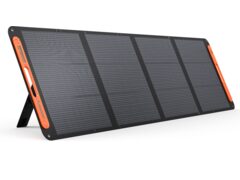
The SolarSaga 200W is built around bifacial IBC monocrystalline cells, premium technology aiming for a conversion efficiency of up to 25%, one of the highest rates on the market for this format. Outdoors, that rate settles at 24.3%, very close to the manufacturer's claim: the cell efficiency promise holds up rather well.
The total output tells a different story. Two independent protocols, each under its own conditions, place the real output well under the claimed 200 W: a first protocol, under stable and repeated conditions, establishes an average of 140 W (a range of 125 to 147 W); a second, in outdoor use against other panels, places output at 171 W, that is 86% of the claim.
These two figures are not directly comparable with each other, since sunlight conditions differ between protocols, but they converge on the same conclusion: the 200 W peak power, a laboratory-standardized figure (1000 W/m², cell at 77 °F / 25 °C), remains a theoretical ceiling rarely reached in real use, whichever protocol is used.
Against a rival panel of the same power, in a shared protocol
The second protocol allows a direct comparison against a rival panel also rated at 200 W with a close cell efficiency (23.4%, against 24.3% for the SolarSaga). Under that shared setup, the rival delivers 165 W on average (a range of 160 to 172 W), against 140 W for the SolarSaga 200W: a gap of nearly 18% in the rival's favor, even though its cell efficiency is slightly lower.
This gap suggests that cell efficiency alone does not guarantee the best output: other factors (conversion electronics, internal losses, thermal behavior of the enclosure) come into play and do not show up on the spec sheet alone.
What the bifacial rear side actually adds
The SolarSaga 200W's distinctive feature is its active rear side: it captures part of the light reflected off the ground (light sand, concrete, snow), which in theory adds output without enlarging the panel. Jackery claims a gain of up to 25% under good reflection conditions, and a drop in that gain over a dark or absorbent surface (grass, soil).
What is established, on the other hand, is that total output, bifacial gain included, stays under the claimed 200 W in both available protocols: bifacial technology alone is therefore not enough to close the usual gap between laboratory peak power and real-world conditions.
SolarSaga 200W: at least two references not to confuse
Worth knowing before comparing information found online about this product: the commercial name "SolarSaga 200W" has covered, and still covers at some retailers, at least two materially different references. An earlier reference, without an active bifacial rear side and without any USB output, lists a weight around 14.1 lb (6.4 kg) on its own spec sheet. The current version, the one this review covers (bifacial IBC cells, cell efficiency that settles at 24.3% outdoors, up to 25% claimed), lists instead a weight closer to 17.6 lb (8 kg) across several manufacturer and specialist-retailer spec sheets cross-checked independently.
| Characteristic | Earlier reference | Current version (this review) |
|---|---|---|
| Active bifacial rear side | No | Yes |
| Claimed cell efficiency | Around 24% | Up to 25% |
| USB outputs | None | None |
| Waterproofing | IP68 | IP68 |
Weight and size: the heaviest in its category already covered here
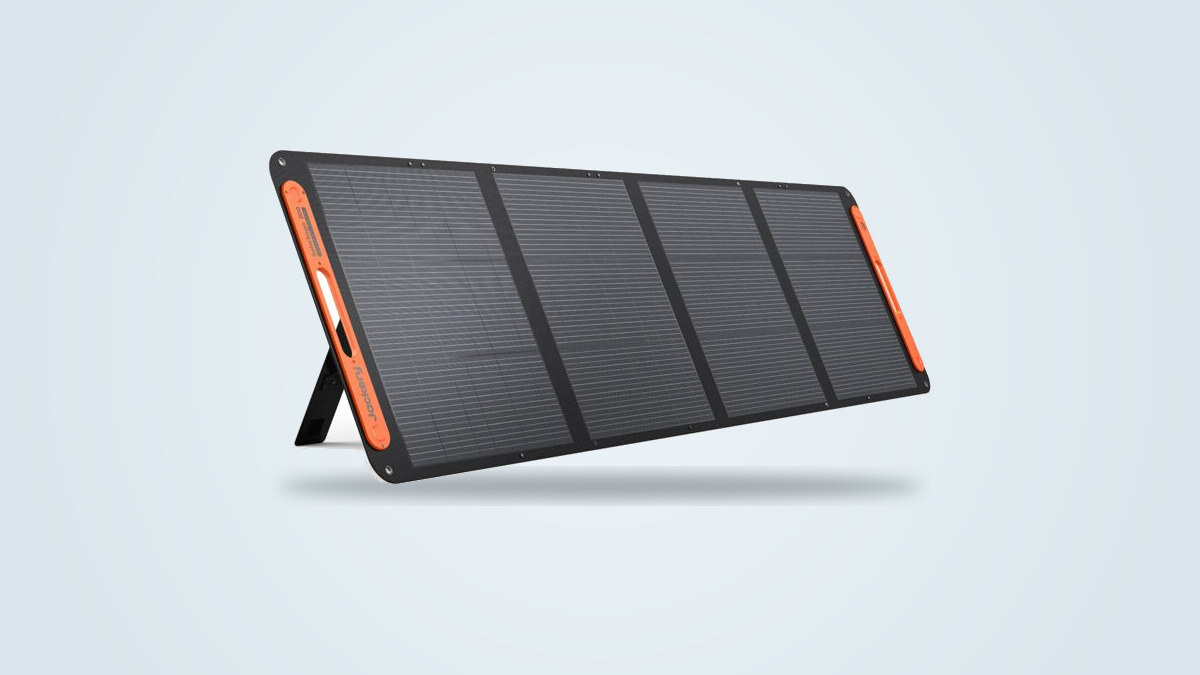
Based on cross-checked spec sheets for the bifacial version, the SolarSaga 200W weighs around 17.6 lb (8 kg). Unfolded, it measures roughly 92.1 x 21.7 in (234 x 55 cm) for 1 in (2.5 cm) of thickness. It folds accordion-style into four panels linked by hinges, down to a stored size of roughly 24.2 x 21.7 in (61.5 x 55 cm) at 1.6 in (4 cm) thick.
| Panel | Power | Weight |
|---|---|---|
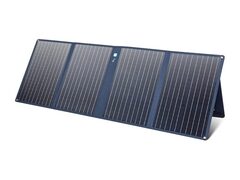
| Anker Solix PS200 | 200 W | 10.6 lb (4.8 kg) |
| Jackery SolarSaga 200W | 200 W | Around 17.6 lb (8 kg) |
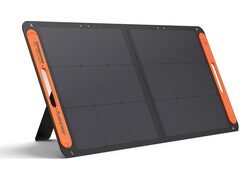
| Jackery SolarSaga 100W | 100 W | 7.9 lb (3.6 kg) |
At a similar weight to other non-bifacial 200 W panels on the market, the SolarSaga 200W stays close to double the Anker Solix PS200, the lightest reference in the segment already covered on this site at the same power. The rear kickstands, which let the panel tilt toward the sun, can also lack stability in strong wind, a point worth watching in an exposed outdoor setup.
IP68 and weather resistance
The SolarSaga 200W is IP68-rated, the best common protection against water and dust, with an ETFE coating on the front known for its resistance to UV and temperature swings. The manufacturer claims an operating range of 14 °F to 149 °F (-10 °C to 65 °C).
Metal grommets built into the frame allow it to be hung (awning, branch, fence) to angle it toward the sun independently of the kickstands. No recurring hinge or seam defect is associated with this version after repeated folding cycles; absent independent, multi-year track record, this point remains worth watching over time rather than something to take for granted.
Output connector: DC only, no USB and no MC4
The SolarSaga 200W outputs exclusively through a proprietary Jackery DC connector (the brand's DC8020), with no direct USB output at all and no native MC4 connector. Voltage at the maximum power point settles around 18 to 20 V for a current close to 10 to 11 A depending on the spec sheet consulted, with an open-circuit voltage near 23 to 25 V.
This choice closes the door to any direct connection with a station or charge controller from another brand without a separately purchased adapter, and rules out any direct charging of a phone or tablet, unlike the SolarSaga 100W, which integrates USB-A and USB-C ports. That is a real step back in connectivity compared with its own smaller sibling, for a panel that costs noticeably more.
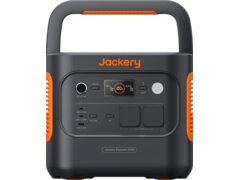
The manufacturer claims direct compatibility with most of its Explorer station lineup, from mid-range models to the largest, and several SolarSaga 200W panels can be combined to cut charging time on the most capacious stations.
Against other 200 W portable panels
Compared with three other panels of the same rated power already covered on this site, the SolarSaga 200W stands out for its bifacial rear side and a slightly higher cell efficiency, but trails on connectivity and price.
| Criterion | Jackery SolarSaga 200W | Anker Solix PS200 | Other 200 W panels in the segment |
|---|---|---|---|
| Claimed cell efficiency | Up to 25% | 25% | 23.4% |
| Bifacial rear side | Yes | Yes | No |
| Weight | Around 17.6 lb (8 kg) | 10.6 lb (4.8 kg) | Around 17.6 lb (8 kg) |
| Station output | Proprietary DC | MC4 | MC4 |
| Warranty | 3 years (5 if registered) | 5 years | 2 years |
The Anker Solix PS200 combines the same bifacial rear side and a comparable cell efficiency in a noticeably lighter format with an open MC4 connector for any third-party controller or station, plus a longer standard warranty. The two other panels in the segment, more affordable, forgo the bifacial rear side and show a lower cell efficiency, for a weight close to the SolarSaga 200W's own.
Build, warranty and reliability
Jackery claims a 3-year manufacturer warranty on this panel, extendable to 5 years with a product registration with the manufacturer. That is more than the 2 years on the two other non-bifacial 200 W panels compared above, but less than the Anker Solix PS200's 5-year standard warranty.
The ETFE coating and reinforced frame are not associated with any recurring manufacturing defect report for this version. As with the SolarSaga 100W, the Jackery lineup's DC connector can have its center pin loosen over time or with heavy use, a point well-known enough that the manufacturer maintains its own official troubleshooting guide for it. The SolarSaga 200W, a passive panel with no storage cell or complex charging electronics, is by nature unaffected by any recall involving other catalog references' onboard lithium batteries.
Who it's for, and at what price
The SolarSaga 200W is aimed first at anyone who already owns, or plans to get, a large Jackery Explorer station and wants to speed up solar charging in an RV, a converted van or a semi-fixed setup. Its weight and size make it a panel you set up and leave in place rather than an accessory unfolded and refolded several times a day while hiking.
Anyone after universal compatibility with any station or charge controller on the market should look instead at an MC4-output panel like the Anker Solix PS200, lighter to boot. Anyone who also wants to charge a phone or tablet directly, without a station, will find that use case in the SolarSaga 100W, smaller but fitted with USB ports the 200W does not offer.
This panel is listed in our catalog at $540 before tax, a price worth weighing against the frequent, sometimes steep promotions the brand runs on this reference: checking the current price always pays off before buying this kind of product.