The Rated 35W Versus What You Actually Get
Like any solar panel, the 35W rating printed on the BigBlue P35 corresponds to a standardized figure (1000 W/m² of sunlight, 77 °F (25 °C) cell temperature, standard light spectrum), a useful yardstick for comparing panels but one that is never actually met outdoors. The manufacturer's own documentation notes that the gap between rated and real output mostly comes down to heat building up in the cells under direct sun, on top of the angle of incidence and cloud cover.
Under a hazy sky or with an imperfect angle, available output typically drops to 15 to 20W, against the advertised 35W. That gap is nothing unusual for this class of panel: the BigBlue 28W, the P35's own smaller sibling in the catalogue, comes out at just 10.5W in full midday sun against its own 28W rating in the review published on this site, or 37.5% of its rated output, the weakest ratio in a four-panel comparison. The P35 starts with a real structural edge here: its cells reach 25.4% efficiency, the best figure in a direct comparison with its own predecessor (≈24%), the Jackery SolarSaga 40W Mini (≈23%) and the Choetech SC006 (≈20%), which mechanically limits how much energy gets lost as heat for the same cell area.
The panel adds a second useful mechanism: a dual parallel circuit rather than cells wired in series. In practice, if part of the panel falls into shade (a branch, a bag left on top, a stray cloud), the rest keeps producing instead of the whole panel's output collapsing, a common weakness of series-wired panels.
Weight and Folded Size
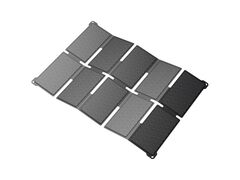
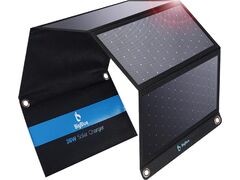
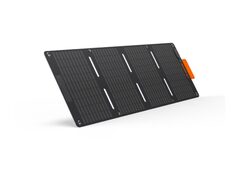
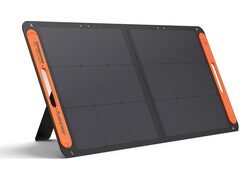
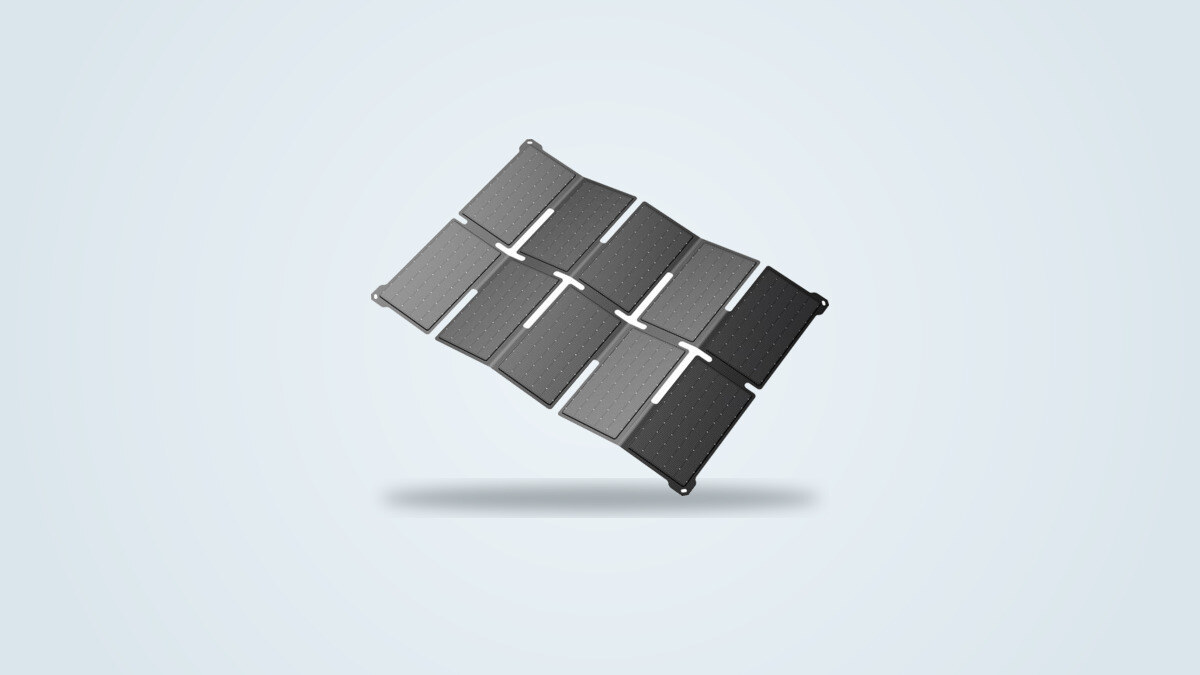
The BigBlue P35 weighs a rated 1.54 lb (0.7 kg) and folds down to 8.3 x 4.8 x 1.9 in (21 x 12.3 x 4.8 cm), barely bigger than a paperback. Unfolded, it spans 23.7 x 16.5 in (60.3 x 42 cm). A built-in carry handle, two carabiners and an elastic strap are included, letting you clip it straight onto a backpack or a tent without buying anything extra.
Within its own catalogue, the weight sits in the same ballpark as the BigBlue 28W (1.5 lb / 0.68 kg), despite that panel being less powerful and far less weatherproof: the P35's few extra grams buy 7W of extra power, an additional fast-charging port and a major jump in waterproofing (more on that below). Against panels of directly comparable power, the gap widens: the Jackery SolarSaga 40W Mini weighs about 2.6 lb (1.2 kg) and the Choetech SC006 about 3.4 lb (1.55 kg), roughly 70% and more than double the P35's weight respectively, for a similar rated output.
Three Ports, Only One Genuinely Fast
The P35 splits its output across three ports: a USB-A port with Quick Charge at 18W, a first USB-C port with 25W Power Delivery and PPS (Programmable Power Supply, which adjusts voltage and current for a faster, safer charge), and a second USB-C port capped at 5V/3A, or 15W at best, with no PD or PPS. Of the three ports, only one actually benefits from a fast-charging protocol: the second USB-C port remains a secondary output for a lower-priority device.
Worth knowing before buying, confirmed by the manufacturer itself: the first USB-C port (PD 25W) is not compatible with Apple devices. For an iPhone or iPad, you need the USB-A port or the second USB-C port, both slower.
One simple calculation, absent from the marketing material, is worth doing: the three ports add up to 58W (18+25+15), well beyond the 35W the panel actually produces at best. Plugging in three demanding devices at once necessarily means sharing less power than the sum of their individual maximums, with no priority order between the ports published by BigBlue.
IP68 on the Panel, Not on the USB Box
The P35 carries an IP68 rating, the highest in its own direct comparison set: well ahead of the IP44 on its predecessor, the BigBlue 28W, and ahead of the vague wording ("weather-resistant", "water-resistant") used by the Jackery SolarSaga 40W Mini and the Choetech SC006. The manufacturer's own documentation adds an important caveat, though: this IP68 rating covers the fabric and the cells, not the USB junction box, which needs to stay covered in the rain.
No independent corroboration of this IP68 rating in the rain has been found to date for this specific model, a common gap for a recently updated addition to the brand's lineup. The manufacturer also describes a reinforced grommet point built around a fiberglass core, designed to resist cracking and corrosion through repeated folding: a build detail claimed by the brand, but not independently verified.
Against Its Own Predecessor, the BigBlue 28W
The P35 directly succeeds the BigBlue 28W in the brand's lineup, with higher rated power and a major jump in waterproofing. The table below lists the most significant differences between the two generations.
| Criterion | BigBlue 28W | BigBlue P35 |
|---|---|---|
| Rated power | 28 W | 35 W |
| Cell efficiency | ≈24 % (SunPower) | 25.4 % |
| Fast port | None (2 USB-C + 1 USB-A, 5V/4.8A combined) | USB-C PD 25 W with PPS |
| Waterproofing | IP44 (fabric only) | IP68 (fabric and cells) |
| Rated weight | 1.5 lb (0.68 kg) | 1.54 lb (0.7 kg) |
| Warranty | 2 years | 2 years |
The review published on this site for the BigBlue 28W puts its real-world output at 10 to 14W in full sun, or 37.5% of rated power in the best of the compared cases, the weakest ratio in a four-panel comparison. The P35 does not automatically inherit a better ratio just from having more efficient cells: the same physics that degrades outdoor output (heat, angle, cloud cover) affects both products. Higher cell efficiency (25.4% against ≈24%) and a dual parallel circuit design, absent on the 28W, still work in its favor on this specific front.
Against the Direct Competition at 35 to 40W
Against two direct rivals of similar power already mentioned, the P35 stands out with the best cell efficiency and the best waterproofing of the three, while staying one of the lightest.
| Criterion | BigBlue P35 | Jackery SolarSaga 40W Mini | Choetech SC006 |
|---|---|---|---|
| Power | 35 W | 40 W | 36 W |
| Cell efficiency | 25.4 % | ≈23 % | ≈20 % |
| Ports | 2 USB-C (incl. PD 25 W) + USB-A 18 W | USB-A + USB-C | USB-C PD 20 W + USB-A 18 W |
| Waterproofing | IP68 | Weather-resistant (rating not specified) | Water-resistant (rating not specified) |
| Weight | 1.54 lb (0.7 kg) | ≈2.6 lb (1.2 kg) | ≈3.4 lb (1.55 kg) |
The SolarSaga 40W Mini narrowly wins on raw power (40W against 35W), a 5W gap that does not make up, in practice, for a weight almost 70% higher and lower cell efficiency. The Choetech SC006 offers a respectable USB-C PD 20W port, but remains the heaviest of the three and posts the lowest cell efficiency in the comparison, with no rated waterproofing figure. Neither rival publishes a formal IP rating comparable to the P35's IP68.
Build Quality, Warranty and Brand Track Record
BigBlue has sold nomad solar chargers for several years, and the 28W remains an established reference in its own lineup, with a solid track record in this site's own catalogue: the review published for that model notes no product recall, with only two isolated failure cases after roughly 3 years of heavy use. The P35 carries over the same 2-year manufacturer warranty.
No recall has been found for the P35 to date, a model that is still recent in the brand's lineup, which naturally limits the track record available compared with a product sold for longer, like the 28W. The fiberglass-reinforced grommet point (see above) is the only build upgrade the manufacturer highlights beyond waterproofing and power.
Who the P35 Is Really For
The P35 targets hiking, bikepacking and light RV travel first and foremost: a panel you can slip into a pack pocket without a second thought, capable of recharging a phone or a power bank during the day. With no built-in battery, it must be paired with a power bank to actually use that energy once the sun goes down, like any nomad panel of this format.
For anyone mainly looking to recharge an iPhone on the fastest port, the picture is more mixed: that specific port (USB-C PD 25W) is not Apple-compatible, leaving only the USB-A port or the second USB-C port, both slower. Anyone chasing raw power over weight should still consider the Jackery SolarSaga 40W Mini, at the cost of a noticeably heavier panel. And for a stationary setup in an RV or van, where total available power matters more than weight, a 100 to 200W panel is a better fit than a lightweight companion panel like the P35.
Price and Availability
In the US, the BigBlue P35 sells for around $89.99 at the time of writing, available through the partner retailer linked on the product page. That's roughly $30 more than the BigBlue 28W ($59.97), for 7W of extra rated power, an additional fast-charging port and a major jump in waterproofing.
Against the two direct rivals already mentioned, the P35's positioning stands up well: it trades a somewhat higher price than the cheapest option in its class for a clear edge in cell efficiency and waterproofing.