Real-world power, well below the rated 100W
Like any solar panel, the 100W figure printed on the Nomad 100 corresponds to a standardized rating (1000 W/m² of irradiance, 77 °F (25 °C) cell temperature, a standard light spectrum), rarely met in outdoor use. In the field, output depends on the angle of incidence, cloud cover, altitude and, above all, the panel's own temperature: above 77 °F (25 °C), a silicon cell's efficiency drops mechanically, and a dark panel sitting in full sun heats up well past that point quickly.
Real-world output for the Nomad 100 generally lands between 50 and 80W, rarely higher. One specific case gives around 78W (a little over 20V at about 3.8A), while another tops out at 55W on a fully sunny day at sea level, a figure Goal Zero itself calls normal since the rated 100W is never seen in outdoor use. At altitude and in full desert conditions, several cases settle even lower, between 50 and 62W, with ambient heat offsetting the gain that more direct sunlight would otherwise bring.
Two Nomad 100 panels chained together, to double the capture area, cap out around 80W combined, never exceeding 110W even in full sun, well short of the 200W combined rating. One case from the European market points to around 70W under conditions judged ideal for a single panel in summer, a figure consistent with the rest of the cases cited above.
This gap between the rating and reality is nothing unusual for a folding panel of this format: comparable gaps show up across most nomad panels of similar power, and this is standard practice across the industry. The peak-watt figure printed on most panels on the market follows the same standardized convention, useful for comparing two panels against each other but misleading if taken as a promise of power actually available day to day. What stands out more here is the lack of any official disclosure from Goal Zero about this expected range at the point of sale, where a direct competitor like EcoFlow now publishes its own real-world range straight in its technical documentation.
Frictionless Yeti integration
The Nomad 100's real strength shows up before you even unfold it: the charging cable is already built into the panel and ends in Goal Zero's own 8mm connector, the exact same one shared by all four stations in the Yeti X lineup (500X, 1000X, 1500X, 3000X). In practice, that means plugging the panel straight into the station out of the box, with no hunting for the right adapter or ordering a separate cable, a hassle that owners of generic MC4-connector panels know well, since they first have to check their station's compatibility.
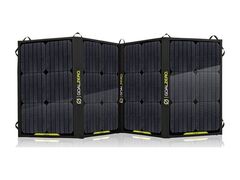
The fold-out kickstand built into the back of the panel also makes setup easier: it lets you angle the panel toward the sun without propping it against whatever is at hand. Combined with the four hanging loops at the corners of the panel, it offers several ways to set it up depending on terrain (resting flat on the ground, hanging from a vehicle or branch, leaning against a wall).
Yeti recharge time: a range to take broadly
Goal Zero states a full recharge of a Yeti 1000X in 12 to 24 hours with a Nomad 100, an already wide range that reflects how much the power actually collected varies through the day. In the field, several cases fall well short of the lower bound: one case in the European mountains needed more than a full day of sunshine for a complete recharge, and one RV use case puts a full recharge closer to two full sunny days.
This gap comes directly from the real-world power available (50 to 80W rather than 100W) and from the number of hours of direct sunlight actually usable in a day, often lower than the 8 to 10 hours an optimistic calculation might assume. Chaining two Nomad 100 panels with the dedicated combiner cable (see further down) cuts this time by adding up input power, at the cost of double the footprint.
Weight and folded size
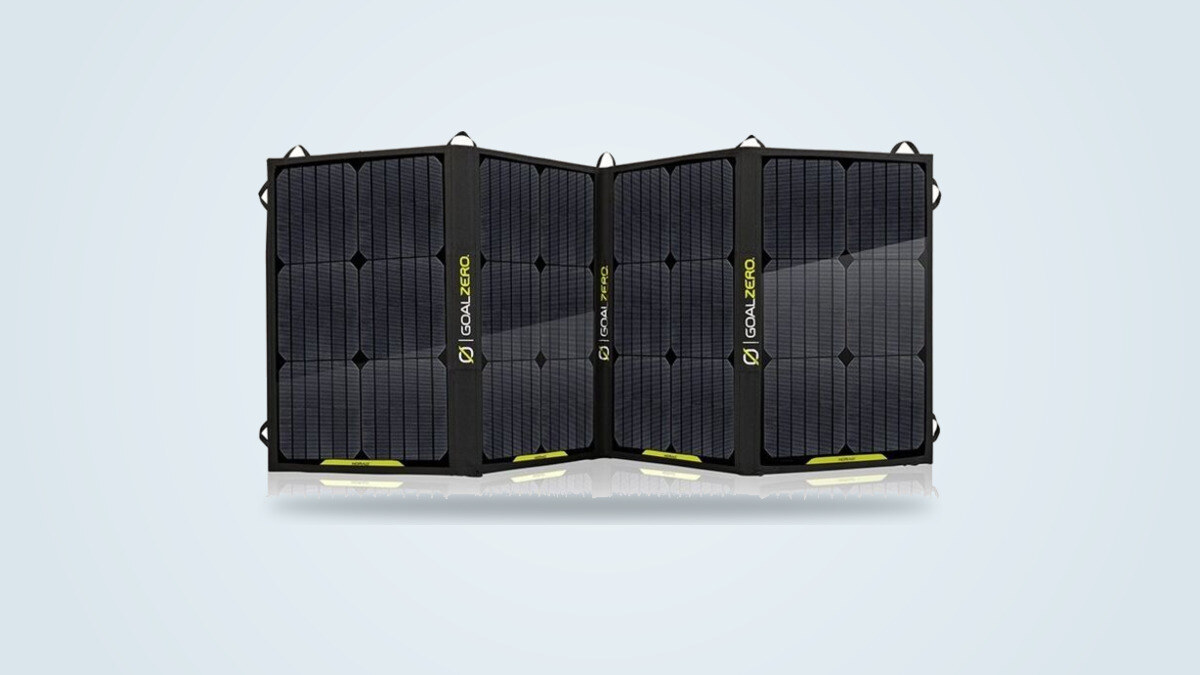
The Nomad 100 weighs 10.1 lb (4.6kg) for a folded size of 20.5 x 15.5 x 2 in (52 x 39 x 5cm), folding into four panels thanks to its built-in hinges. Unfolded, it covers 20.5 x 59.5 in (52 x 151cm) of surface area, a generous footprint that needs its own space on the ground, on a vehicle roof, or against a wall.
Against these three panels, the Nomad 100 sits on the lighter side of the group: lighter than the Jackery SolarSaga 100W, slightly heavier than the Bluetti PV120 or the EcoFlow 110W, a gap of a few ounces that does not fundamentally change the carrying experience. The folded size, with its built-in handle and hanging loops at all four corners, makes it easy to store in a van or a car trunk; it stays bulky for lightweight hiking or a multi-day backpacking trip, where every extra ounce counts more.
One output only: the proprietary 8mm connector
The Nomad 100 has exactly one output: a proprietary blue 8mm connector (14 to 22V, up to 5.56A), wired at the factory with roughly 6 ft (1.8m) of built-in cable, shorter than what some setups need when the panel and the station sit further apart. This choice is a win for anyone who already owns a Yeti X (no cable or adapter to buy), but it closes the door entirely on any other use: no USB port to charge a phone or a power bank directly, and no MC4 output that would allow a third-party solar controller, a different brand of station, or an existing fixed install to be connected.
| Criterion | Goal Zero Nomad 100 | Jackery SolarSaga 100W | Bluetti PV120 | EcoFlow 110W |
|---|---|---|---|---|
| Connector | Proprietary 8mm (Yeti) | Proprietary (Jackery) | MC4 | MC4 |
| Direct USB output | No | No | Yes | No |
| Open ecosystem (USB or MC4) | No | No | Yes | Yes |
This is the single most defining point of this review: of the four comparable folding panels, the Nomad 100 is the only one offering neither a USB port nor an MC4 output. A combiner cable lets multiple Nomad 100 panels be chained together to add up their input power into a single station, but that does nothing to fix this closed ecosystem toward the outside world.
Weatherproofing: the fuzziness behind "weatherproof"
Goal Zero describes the Nomad 100 as weatherproof, marketing language that does not correspond to any independently verifiable IP rating on the manufacturer's own spec sheet. The official documentation only states that the fabric housing protecting the cells may wear out faster if left outdoors permanently, an explicit caveat that runs against a fixed, long-term install, even under cover.
Four hanging loops at the panel's corners allow it to be suspended (from a vehicle, a branch, a rope) rather than laid on the ground, a mounting method that limits contact with moisture or sand and usefully complements the built-in kickstand on rough terrain.
One isolated case of use in a very hot tropical climate also reports the rear storage pouch coming loose, with the glue apparently affected by the heat; this case remains isolated and does not support a general rule, but it does show that the product's heat resistance has its limits in extreme climates. The hanging loops and the folding hinges, for their part, show no recurring failure reports in the cases reviewed.
Chaining panels: more power, and a recall to know about
The Nomad 100 can be chained to a second panel with an 8mm-to-HPP cable, or on a larger scale with a 4x HPP to 1x HPP+ combiner that adds up the input power of multiple Nomad panels into a single station. That is a genuine advantage for anyone wanting more power without switching ecosystems.
Anyone planning a multi-panel setup should check their combiner cable's model number before putting it into service, a simple, free precaution. Goal Zero is offering a free replacement of the recalled product to affected buyers.
Build quality, warranty and brand reputation
Goal Zero has sold nomadic power solutions since 2009 and carries an established reputation among the camping and van-life crowd, backing the Nomad 100 with a 2-year manufacturer warranty in line with the rest of the category. Overall build quality (frame, stitching, connectors) is generally described as solid and well finished in the cases reviewed, with no recurring manufacturing defect beyond isolated cases like the one mentioned above.
The most serious reliability issue tied to the ecosystem actually concerns a related accessory rather than the panel itself: the combiner cable needed to chain multiple Nomad 100 panels, recalled by the CPSC in 2025 over a fire risk (see the previous section). The panel alone is not covered by that recall, but the brand has also been the subject, on other product lines (batteries, solar power stations), of separate CPSC recalls or official notices over the years. That does not directly involve the Nomad 100, but it is worth keeping in mind before expanding a Yeti ecosystem with other brand accessories.
Against the competition, and against itself
Compared with the three other folding panels of similar power already mentioned (Jackery SolarSaga 100W, Bluetti PV120, EcoFlow 110W), the Nomad 100 occupies an odd spot: not the lightest, not the most powerful on paper (100W against 110 to 120W for two of the other three), and certainly not the cheapest, with a list price of $399.95 against $189 to $279 for the other three. Per rated watt, it comes out as the least cost-effective of the four, a gap that is only justified by the brand and by the ease of use it offers Yeti owners.
Its one structural, genuine advantage is direct, adapter-free compatibility with the whole Yeti X lineup. On every other criterion, an MC4-connector panel like the Bluetti PV120 or the EcoFlow 110W offers structurally greater flexibility: it works with pretty much any solar controller or station on the market, where the Nomad 100 stays locked into a single brand's ecosystem.
Goal Zero also sells the Boulder 100, a rigid panel of the same rated power, with its own built-in kickstand and a protective housing. The trade-off is clear: the Boulder weighs close to 26.5 lb (12kg) against 10.1 lb (4.6kg) for the Nomad, more than double, but its rigid build handles a semi-permanent install (a van roof, a fixed pad) better than the Nomad's fabric, which the manufacturer itself advises against exposing outdoors long-term. The Nomad 100 is built for occasional, nomadic use, where the Boulder 100 is built for an install that stays put longer; both share the same 8mm connector and the same Yeti X compatibility.
Who the Nomad 100 is really for
The Nomad 100 only makes sense for a specific buyer: current or future owners of a Yeti X station (500X, 1000X, 1500X, 3000X) who want a solar add-on with no adapter or extra cable to hunt down. For that buyer, the integration is real and so is the simplicity: plug in, angle toward the sun, wait.
Outside that group, the calculation flips entirely: with no USB port and no MC4 output, the panel is useless with a power bank, a third-party solar controller, or a different brand of station, and its price, the highest of the four folding 100W panels compared above, buys no matching technical advantage. Lightweight hiking is not the product's home turf either: 10.1 lb (4.6kg) and a 20.5 x 15.5 x 2 in (52 x 39 x 5cm) folded size are reasonable for a van or a set-up campsite, less so at the bottom of a backpack over several days on the trail.
Price and availability
The Nomad 100 carries a $399.95 list price and is currently available through Amazon.com at a discounted $299.89, before tax, backed by a 2-year manufacturer warranty. That list price sits well above its direct, similarly rated competitors, a gap that has nothing to do with extra power (100W is the lowest rating of the four compared) and everything to do with the brand and its Yeti ecosystem.
In Europe, the same panel runs about €399 through Goal Zero's own French distributor. Goal Zero has been an established name in the camping and van-life market since 2009, a reasonable guarantee of longevity for the Yeti ecosystem for anyone investing in several compatible accessories.