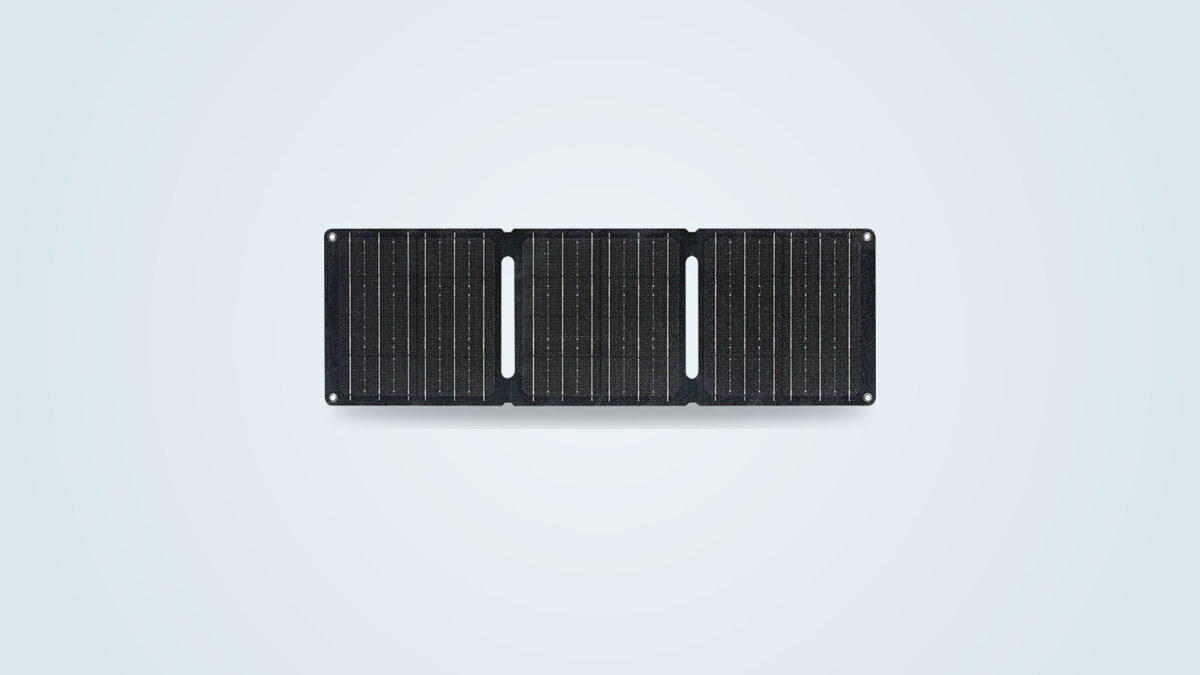
What the SP001 really is: a USB charger, not a 12V battery maintainer
On paper, the Allpowers SP001 21W has long been presented as a small panel able to maintain a 12V car, motorcycle or RV battery through clamps or a cigarette lighter plug. That is not what this product does. The manufacturer's own documentation, on its US, UK and German stores, describes a panel fitted with only two ports: a USB-A port and a USB-C port, both able to negotiate several voltage steps (5V/3A, 9V/2A, 12V/1.5A). No separate DC connector appears in the product photos or in its documentation.
The "12V" voltage step in this fast-charging profile most likely explains the confusion: a port that steps up to 12V to speed up a phone's charge has nothing to do with a DC 12V output meant to maintain a vehicle battery. It is an easy technical nuance to miss, one that was long misrepresented even in the specifications published on this site.
In practice, the SP001 charges a phone, tablet or power bank directly in the sun. It replaces neither a vehicle battery charger nor a wall outlet for heavy daily use: it is a nomadic top-up accessory, designed so you never run out of battery far from an outlet.
SP001 versus SP002: a name mix-up that Allpowers keeps alive itself
The name "SP001" sits inside an Allpowers range where two very similar references coexist. The SP001 described here is a panel on its own, with no battery at all, its two USB ports as its only connectivity. The SP002, sold alongside it, builds in a 10,000mAh battery and offers different connectivity, for a hybrid solar power bank function.
| Feature | SP001 (this product) | SP002 |
|---|---|---|
| Built-in battery | None | 10,000mAh |
| Rated weight | 1.3 lb (610g) | About 1.8 lb (800g) |
| Folded size | 8.7 x 8.2 x 0.8in (220 x 208 x 20mm) | About 12.0 x 7.1 x 0.8in (305 x 180 x 20mm) |
| Rated water resistance | IP67 (fabric) | IPX4 |
This closeness in naming creates a genuine commercial mix-up: some listings presented as SP001 units mistakenly reuse arguments that belong to the SP002 (power bank function, several USB inputs), which can lead a buyer to believe they are getting a built-in battery when that is not the case. Before buying, checking that the listing makes no mention of a "built-in battery" or "power bank" remains the simplest way to make sure it really is the panel-only unit covered in this review.
21W on paper: what to reasonably expect in the sun
Allpowers rates the SP001's cell efficiency at 22 to 25%, a monocrystalline figure in the upper range for its category. No independent measurement specific to this exact model is available to date: no lab protocol, no published figures for this panel.
On folding panels of comparable rated output (around 20W), real-world production in full sun typically stays well below the rated figure, and drops sharply as soon as the sky clouds over or the angle moves away from ideal. The physical mechanism stays the same regardless of brand: a small cell surface leaves little margin the moment conditions are not perfect.
In practice, this panel behaves like almost every small USB panel in its class: a slow and variable charge, useful as a top-up over several hours of sunlight, but no match for a wall outlet when it comes to charging a device quickly.
Two ports at 18W: the least restrictive ceiling in its category
The SP001 offers two output ports, one USB-A and one USB-C, both rated at 18W maximum (5V/3A, 9V/2A, 12V/1.5A steps) by the manufacturer's own documentation. Against the panel's rated 21W, that ceiling represents 86% of the stated output.
That is the best ratio in this whole comparison of nomadic USB-output panels already reviewed on this site. By contrast, several more powerful panels (SolarSaga 40W Mini, EcoFlow 45W and 60W) cap their single or best port at a much lower proportion, a gap that can become the real limiting factor in full sun.
The flip side of this good news: the SP001 offers no DC output and no MC4 connector at all. It cannot be plugged directly into a power station, unlike, for example, the SolarSaga 40W Mini and its DC8020 connector. That choice makes sense for a panel of this output, almost never used to feed a station, but it rules out that use entirely.
One more point worth watching: some retail listings for the SP001 state a different ceiling, limited to 15W (5V/3A) with no higher steps, where the documentation the brand itself promotes mentions steps up to 12V/1.5A. This lack of consistency in the marketing material is worth keeping in mind before counting on 18W in every circumstance.
1.3 lb (610g) and 0.8in folded: the most compact format in its category
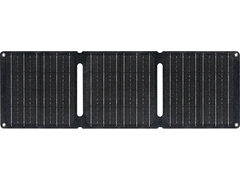
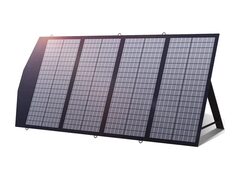
On the scale, the Allpowers SP001 shows 1.3 lb (610g), the lightest of all the nomadic USB-output panels already compared on this site. Folded into three sections, it measures 8.7 x 8.2 x 0.8in (220 x 208 x 20mm), a format that fits in a palm at just 0.8in thick.
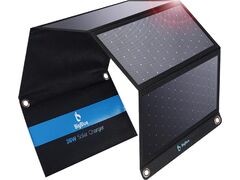
The gap is not just about weight: at 0.8in thick once folded, the SP001 is also the thinnest in this same list, ahead of the BigBlue 28W's 1.4in (35mm) and far below the Bluetti PV60's 2.8in (70mm). For on-foot use (hiking, light travel), this weight and thickness combination makes it a serious candidate whenever minimizing bulk matters, even at the cost of available power.
The fabric has built-in cut-outs between the panels, visible once the panel is unfolded, which double as carry handles. No built-in kickstand appears in the product documentation: it lies flat or leans against a support found on site rather than standing up on its own.
IP67 on paper, an honest caveat on the housing
The SP001's fabric is rated IP67 by the manufacturer's own documentation, a level that in theory allows brief immersion. But that same documentation states that the housing grouping the two USB ports is not designed to be waterproof: if it gets rained on, it is recommended to let it dry out completely before plugging it back in.
The rated operating range runs from -4 °F to 140 °F (-20 °C to 60 °C), a wide span that covers both winter use in the mountains and a summer day in full sun on the cells' black fabric.
On this point, the SP001 sits in the middle of the segment: its rated IP67 beats the IP44 and IP65 of several direct rivals compared further down, but the manufacturer's own explicit caveat about the connector housing tempers that figure. No independent feedback on hinge durability after extended use is available for this specific model, a trust caveat worth keeping in mind rather than a proven flaw.
Against other small nomadic USB-output panels
Compared with the small nomadic USB-output panels already reviewed on this site, the SP001 occupies a distinct spot: the lightest and least powerful of the group, with the best port-ceiling ratio but no output to a station at all.
| Criterion | Allpowers SP001 | BigBlue 28W | SolarSaga 40W Mini | EcoFlow 45W |
|---|---|---|---|---|
| Rated output | 21W | 28W | 40W | 45W |
| Rated weight | 1.3lb | 1.5lb | 2.6lb | 3.1lb |
| Best port / rated output | 86% | 54% | 38% | 33% |
| Output to a station | None | None | DC8020 | DC5521 |
| Warranty | 1 year | 2 years | 5 years (3+2) | 1 year |
| Note best-batteries.com | 3.8 | 3.7 | 4.0 | 4.0 |
The BigBlue 28W stays very close in weight, with a longer warranty (2 years) and a decent port ratio (54%), but real-world output well below what is advertised, as detailed in its own review on this site. The SolarSaga 40W Mini and the EcoFlow 45W both offer more rated output and, for the former, a genuine output to a station and a much longer warranty, at the cost of two to more than two times the weight. Against these three references, the SP001 stands out through a deliberate trade-off: the smallest possible format, at the cost of very limited available power and no bridge to a power station at all.
One-year warranty, budget price: who this panel suits
The SP001's warranty covers only one year, the shortest period in this whole comparison alongside the EcoFlow 45W. This model shows no particular reliability issue, but the limited independent coverage available for this entry-level product remains, in itself, a trust caveat worth keeping in mind rather than a settled verdict.
In the US, the SP001 is priced around $39, a modest sum that still makes it the cheapest in this comparison, undercutting the BigBlue 28W (around $60), the SolarSaga 40W Mini (around $126) and the EcoFlow 45W (around $99).
The SP001 suits anyone looking for the smallest, lightest possible solar top-up to never run out of battery on a phone or tablet, while hiking, traveling or at a festival, with no need to power anything else. By contrast, anyone who already owns a power station should look instead at a panel fitted with a genuine DC or MC4 output, and anyone who needs a fast, reliable daily charge should turn to a regular wall charger. The SP001 remains, above all, a discreet backup accessory to slip into a bag and forget about until the day it genuinely comes to the rescue.