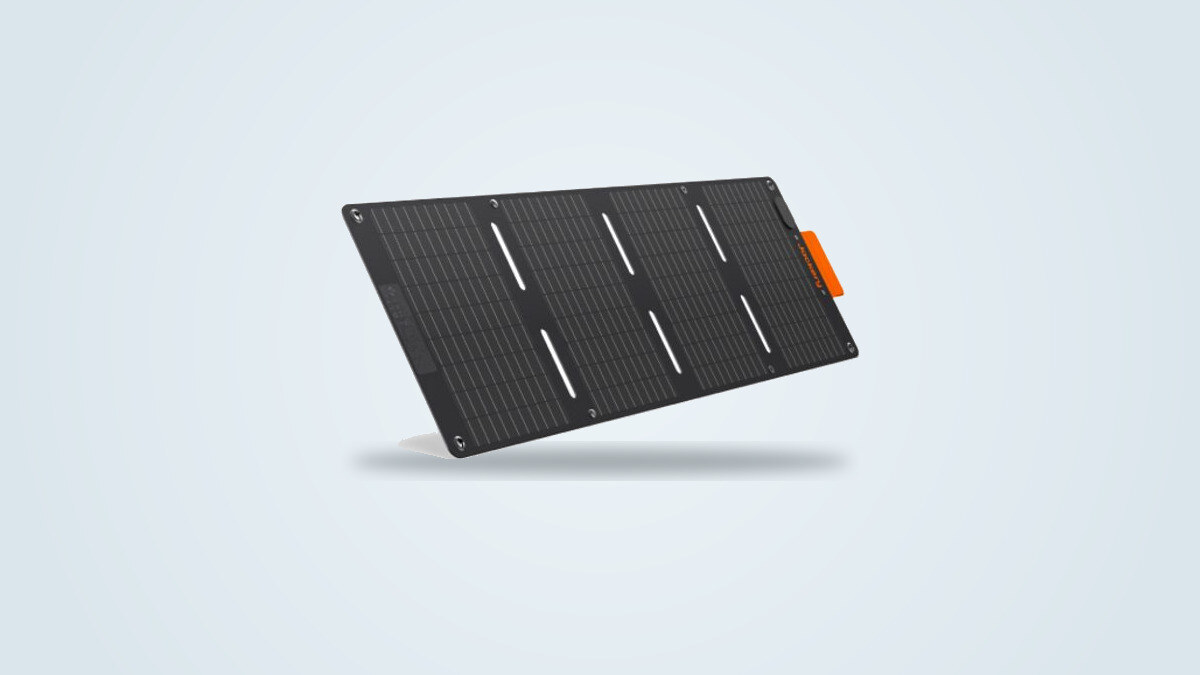
The advertised 40 W, and what you can actually get from it
The Jackery SolarSaga 40W Mini uses monocrystalline cells rated at 23% efficiency, one of the best figures in its class of compact nomad panels. Its spec sheet lists an open-circuit voltage (Voc) of 25 V and a short-circuit current (Isc) of 2.07 A, standardised values that never show up as such in real use: they mark the two extremes of the power curve, not an operating point.
In the field, the power actually fed into a station through the DC output runs to around 30 to 35 W in direct sun with good panel orientation, or 75 to 88% of the advertised 40 W, a solid share for such a compact format. Around 10am under a clear sky, it sits in the same upper range, around 28 to 30 W.
That output drops off very quickly once conditions worsen: under cloud cover it falls to around 4 W, and near the winter solstice at midday it barely exceeds 3 W. That gap, far wider than on larger panels, comes down to the physics of such a compact panel: less cell surface means less margin as soon as the angle of incidence or the sunlight moves away from ideal.
That 30 to 35 W of DC output still stays out of reach of the panel's two built-in USB ports, capped much lower by the manufacturer itself, as the next section details.
The USB-C port never exceeds 15 W: the DC output remains the only real way in
The SolarSaga 40W Mini offers three outputs: a DC8020 connector for a Jackery station, a USB-A port and a USB-C port, said by the manufacturer to power up to three devices at once. But these three outputs are far from equal. The USB-A port caps at 12 W (5V, 2.4A) and the USB-C port at 15 W (5V, 3A): limits set by the product's own documentation, not by sunlight conditions. Even in direct sun with 30 W or more available at the panel's output, no device plugged into a single USB port can receive more than that limit.
Another limit worth knowing before buying: the included cable comes with a DC8020-to-USB-C adapter, but it is explicitly reserved by the manufacturer for charging a Jackery station. It should not be used to power another device, despite the standard-looking USB-C plug on its end. This USB-C port is also not a full USB-PD port: it only offers a single fixed 5V step, without the 9V or 12V steps most recent smartphones use to trigger fast charging. A USB-PD-capable phone will therefore charge at the same rate as an older, plain USB-A port, not at a modern fast-charge rate.
When both USB ports are used at the same time, they share a single pool of available power rather than each running at its own ceiling: the second device plugged in receives less than the first, with the USB-C port generally prioritised over USB-A. No MC4 or universal connector is offered: connecting this panel to another brand's station or charge controller requires finding an adapter that matches Jackery's proprietary DC8020 connector.
2.6 lb (1.18 kg) and 1.2 in (3 cm) folded: the format that earns the Mini name
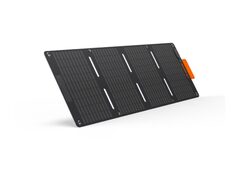
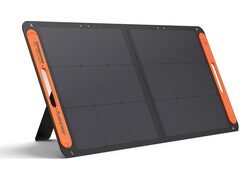
Unfolded, the panel measures 40.2 x 11.8 x 0.7 in (102 x 30 x 1.85 cm) across its four panels. Folded, it packs down to 9.9 x 11.8 x 1.2 in (25.2 x 30 x 3 cm), roughly the size of a ring binder, for a weight of 2.6 lb (1.18 kg) on the scale. That makes it one of the most compact formats in the entire segment of USB-equipped nomad solar panels compared on this site.
| Panel | SolarSaga 40W Mini | Bluetti PV60 (60 W) | EcoFlow 60W USB-C |
|---|---|---|---|
| Advertised weight | 2.6 lb (1.18 kg) | 3.1 lb (1.4 kg) | 4.4 lb (2 kg) |
| Folded thickness | 1.2 in (3 cm) | 2.8 in (7 cm) | 1.8 in (4.5 cm) |
| Rated power | 40 W | 60 W | 60 W |
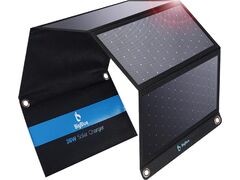
The SolarSaga 40W Mini is therefore both the lightest and the thinnest folded of these three references, despite a lower rated power. The BigBlue 28W, smaller still at around 1.5 lb (0.7 kg) advertised, remains the featherweight of the category, but for a far lower rated power (28 W) and noticeably weaker weatherproofing (IP44 against IP68 here). Lighter than a laptop, the Mini slips into a laptop bag or against the back of a backpack without noticeably shifting its balance.
No built-in kickstand: the panel lies flat or hangs
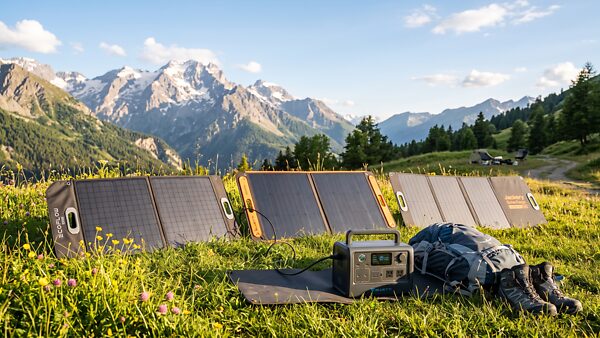
Unlike larger Jackery panels, the SolarSaga 40W Mini has no built-in kickstand to tilt it precisely toward the sun. Its only support accessories are two included carabiners and loops built into the fabric, designed for hanging the panel from a backpack, a branch or a tent line rather than for standing it upright on its own.
That absence is not a minor detail on such a small panel. Elsewhere on this site, a solar panel's orientation is shown to easily swing output by 30 to 40%: with no built-in system to lock in a precise angle, the Mini has to be laid flat, propped against whatever is on hand, or hung vertically, three solutions that take more fiddling than a fold-out kickstand and make it harder to hold the optimal angle over time, especially early morning or late afternoon when the sun sits low.
The two carabiners remain a credible solution for nomadic use, though: hung from a backpack while walking, or clipped to the outside of a tent at camp, the panel keeps producing without needing to be set down on the ground.
IP68, a documented certification, and a warranty reaching 5 years
The panel is IP68-certified, the best protection against water and dust for this type of product, verified across eight separate tests under the IEC TS 63163 standard with TUV SUD certification. That rating means the panel can be left outside through a rain shower without needing to be packed away in a hurry, even though it is not rated to stay submerged or exposed to heavy rain for long periods.
The stated operating temperature range runs from -4 °F (-20 °C) to 149 °F (65 °C), wide enough to cover both a winter camp at altitude and a summer day in direct sun on the cells' black fabric. The manufacturer's warranty reaches 5 years in total: 3 base years, plus 2 extra years by registering the product online, a span that matches the best in the bifacial panel segment and comfortably beats the 12-month warranty of a competing USB-C panel like the EcoFlow 60W.
As the SolarSaga 40W Mini has been on sale since 2024, the track record available on its long-term durability is naturally more limited than for a product sold for many years: no hinge or connector issue has been found for this product to date, an honest caveat to keep in mind rather than a proven flaw.
Compatible with small Jackery stations, closed to everything else without an adapter
The SolarSaga 40W Mini is designed to pair with Jackery's compact stations: the Explorer 100 Plus, the Explorer 240 v2 and the Explorer 300 Plus are explicitly listed by the manufacturer as compatible through the DC8020 connector. At 40 W, it will not quickly fill a large station: for a capacity in the kWh range, a 200 W or larger panel carried by vehicle remains far more suitable.
Connecting this panel to another brand's station or charge controller requires sourcing an adapter cable matching the target solar input yourself, as the DC8020 connector is proprietary to Jackery and not shared with the rest of the market.
Against other small USB-equipped nomad panels
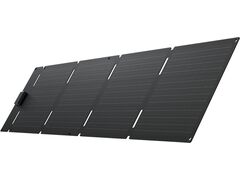
Compared with the USB-equipped nomad panels already reviewed on this site, the SolarSaga 40W Mini sits in an intermediate spot: more powerful and better sealed than the BigBlue 28W, but less versatile on connectivity than the Bluetti PV60 or the EcoFlow 60W USB-C, both of which weigh more.
| Criterion | SolarSaga 40W Mini | BigBlue 28W | Bluetti PV60 | EcoFlow 60W USB-C |
|---|---|---|---|---|
| Rated power | 40 W | 28 W | 60 W | 60 W |
| Advertised weight | 2.6 lb (1.18 kg) | ≈ 1.5 lb (0.7 kg) | 3.1 lb (1.4 kg) | 4.4 lb (2 kg) |
| Weatherproofing | IP68 | IP44 | IP65 | IP68 |
| USB-C port | 15 W max. | Not specified | Yes | 15 W max. |
| Warranty | 5 years (3+2) | Not specified | Not specified | 12 months |
| best-batteries.com rating | 4.0 | 3.7 | 3.9 | 4.1 |
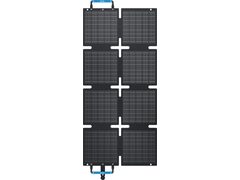
The BigBlue 28W is unbeatable on weight alone, but its far lower rated power and IP44 rating, which protects the fabric but not the USB ports, confine it to strict phone top-ups. The Bluetti PV60 offers three genuine outputs (DC5521, USB-A, USB-C) for an advertised 60 W, but its real available power in the field generally sits around 30 to 35 W, roughly what the SolarSaga 40W Mini already approaches with 20 W less on paper. The EcoFlow 60W USB-C shares the same 15 W ceiling on its USB-C port, but its mere 12-month warranty contrasts sharply with the Mini's 5 years once registered. Against these three references, the SolarSaga 40W Mini stands out mainly for its balance of weatherproofing, warranty and format, more than for a single standout advantage.
Price and positioning in the Jackery range
In the US, the SolarSaga 40W Mini is priced around $126, or about $3.16 per advertised watt. That is pricier per watt than the BigBlue 28W (around $69, or $2.47/W), but cheaper than the SolarSaga 80W (around $288, or $3.61/W) or the EcoFlow 45W (around $172, or $3.82/W), two panels that are nonetheless more powerful.
| Panel | SolarSaga 40W Mini | BigBlue 28W | SolarSaga 80W | EcoFlow 45W |
|---|---|---|---|---|
| Observed price | ≈ $126 | ≈ $69 | ≈ $288 | ≈ $172 |
| Cost per watt | ≈ $3.16 | ≈ $2.47 | ≈ $3.61 | ≈ $3.82 |
This middle-of-the-table position comes down to format: the Mini is not the cheapest panel per watt on the market, but it is the only one in this comparison to pair such low power with full IP68 weatherproofing and a warranty reaching 5 years, two arguments that matter more for extended nomadic use than the power-to-price ratio alone.
Who it suits, and who it does not
The SolarSaga 40W Mini is aimed first at anyone who already owns, or is considering, a small Jackery station (Explorer 100 Plus, 240 v2 or 300 Plus) and wants the lightest, most compact solar top-up possible for hiking, bikepacking or kayaking: 2.6 lb (1.18 kg) and 1.2 in (3 cm) folded slip into almost any bag with no meaningful bulk trade-off.
Anyone looking to fast-charge a smartphone over USB-C should look at a standard charger or power bank instead: this port's 15 W ceiling is nothing like a modern fast charge. Anyone with a medium-to-large station, or who wants to recharge it quickly, should look at a 100 W panel or larger that can be carried by vehicle. And anyone who camps often without a convenient anchor point (tree, pole, rigid tent frame) will have to work around the missing kickstand, planning to lay the panel flat or improvise a prop.