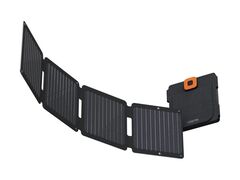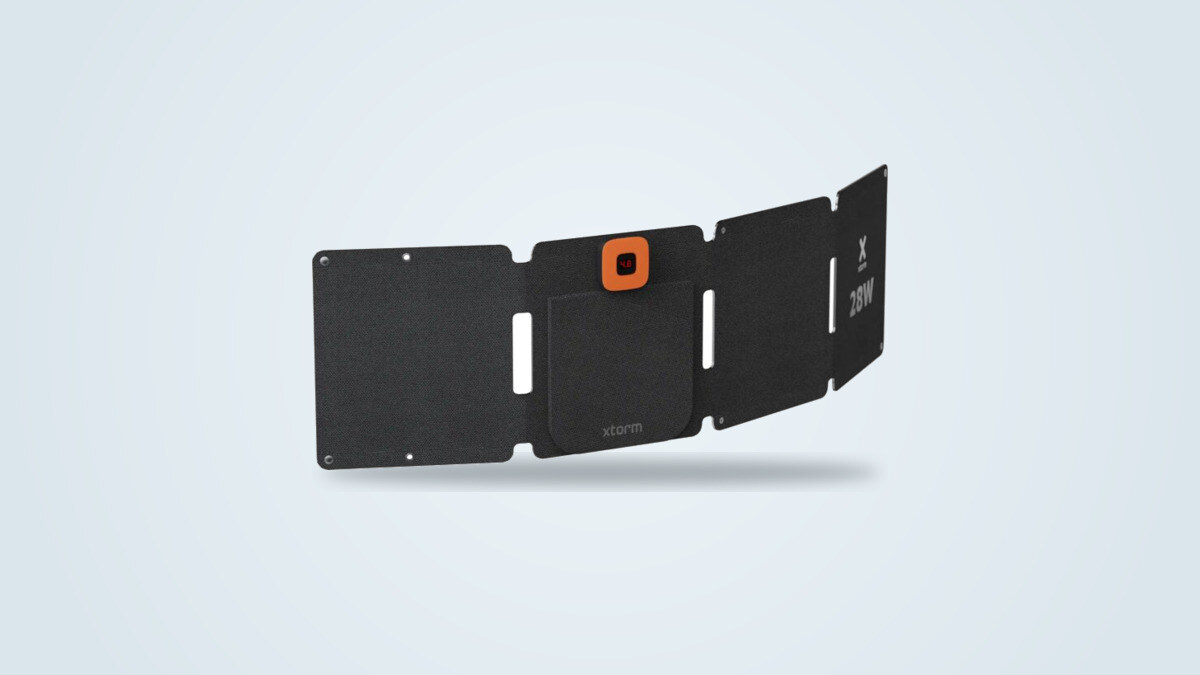
A Gen'24 foldable panel, four SunPower cells
The Xtorm SolarBooster 28W belongs to what the brand itself calls its "Gen'24" lineup. It's a foldable, portable solar panel with no built-in battery, built to charge a phone, tablet, GoPro, or power bank straight off the sun. It unfolds into four panels, each carrying one monocrystalline SunPower cell, for a combined rated output of 28W.
Unfolded, it measures roughly 88.7 x 23.6cm (about 35 x 9.3 inches) at 2.3cm thick. Two USB ports (one USB-A, one USB-C) let two devices charge at once, and a built-in LCD screen shows live amperage output. With no internal battery, this panel stores nothing: a device, or a power bank, has to stay plugged in while the panel sits in the sun for the energy to actually go anywhere.
US pricing, around $170 to $175 depending on the retailer, puts it well above foldable USB panels of comparable output already reviewed on this site, which makes a direct comparison worth doing before buying.
An efficiency rating that never gets a number
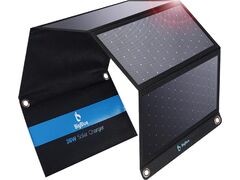
Xtorm's product copy plays up the cell technology (monocrystalline silicon, ETFE build, SunPower branding) and claims better efficiency than standard polycrystalline panels, but it never actually publishes an efficiency percentage for this model. That's a real gap next to the BigBlue 28W, whose own spec sheet states 24% cell efficiency straight out.
No independent measurement exists for this specific model, which holds true for almost every small foldable panel in this category. On panels of comparable rated output, real-world production in full sun typically lands well short of the nameplate number, and drops off hard under cloud cover or at a shallow sun angle, regardless of brand.
In practice, this panel behaves like nearly every small USB panel in its class: output depends heavily on direct sunlight, useful as a top-up over several hours, but no substitute for a wall outlet when you need a fast charge.
910 grams: the heaviest panel in its own lineup
Folded up, the SolarBooster 28W weighs 910 grams and packs into its included carry case. That's a reasonable weight for a panel putting out this much power, but it's also, quite precisely, the heaviest of the four panels Xtorm itself picks to compare against in its own marketing.
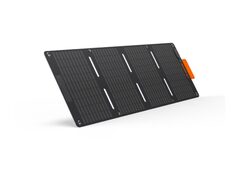
The gap is worst against the BigBlue 28W: at exactly matching rated output (28W), the difference hits 230 grams, or 34% more on the scale. Even the Elfcam 40W, despite pushing 12W more, comes in lighter according to the numbers Xtorm itself publishes in its own comparison table.
The unfolded size (88.7 x 23.6cm, 2.3cm thick) stays compact and fits the included backpack-style case just fine. But on a product whose whole pitch is portability, that extra half-pound next to the closest rival matters when you're deciding.
IPX4: covered against water, silent on dust
The SolarBooster 28W carries an IPX4 rating: it holds up against splashing water and light rain for short stretches, but the "X" standing in for the first digit means no dust or solid-particle protection is claimed for this product at all. That's not the same as zero dust protection, but it's a number the manufacturer simply doesn't give you.
| Product | Xtorm SolarBooster 28W | BigBlue 28W | Elfcam 40W | FlexSolar 25W pocket |
|---|---|---|---|---|
| Claimed rating | IPX4 | IP44 | IPX5 | Splash-resistant (rating unspecified) |
| Dust protection claimed | Not stated | Yes (level 4) | Not stated | Not stated |
On this specific point, the SolarBooster 28W is the only one of the four panels here with zero dust protection claim: the BigBlue 28W (IP44) covers both angles, and the Elfcam 40W claims a higher rating on water alone (IPX5). None of these ratings have been independently verified in public so far; they're all manufacturer numbers.
For everyday camping or overlanding use, this stays a minor point as long as the panel isn't left out in heavy rain or set down on seriously dusty ground for hours at a stretch. Still worth knowing going in rather than finding out the hard way.
The LCD screen and kickstand: the real differentiator
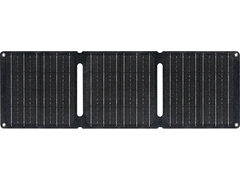
This is where the SolarBooster 28W actually earns a point. Its built-in LCD screen shows live amperage output, which makes it easy to fine-tune the angle toward the sun for the best collection instead of guessing whether the panel is angled right. Xtorm itself states, in its own comparison table, that none of the three panels it stacks itself against (BigBlue 28W, Elfcam 40W, FlexSolar 25W) offer this feature.
On raw connectivity, both ports (USB-A and USB-C) cap out at 15W each (5V/3A), a number that lines up exactly with the BigBlue 28W at identical panel rated output (28W). Neither one offers a DC or MC4 output: this panel can't plug directly into a power station's dedicated solar input, a limit shared by nearly every USB panel in this format.
The real difference shows up elsewhere: the BigBlue 28W offers three ports total (2x USB-C and 1x USB-A) against two on the SolarBooster. For anyone routinely charging more than two devices at once, that's a real practical gap. The SolarBooster makes up some ground with its built-in kickstand, which props it at the best angle to the sun without an improvised prop, and its carabiner, handy for clipping to a backpack on the trail: two ergonomic touches the BigBlue 28W doesn't offer.
Against the BigBlue 28W: same power, wildly different price
At exactly matching rated output (28W), the BigBlue 28W is the SolarBooster's most direct rival, and it's also a product already reviewed on this site. Lined up criterion by criterion, the comparison is fairly one-sided on several objective points.
| Criterion | Xtorm SolarBooster 28W | BigBlue 28W |
|---|---|---|
| Rated power output | 28W | 28W |
| Claimed cell efficiency | Not stated | 24% |
| Folded weight | 910g | 680g |
| Output ports | 2 (USB-A, USB-C, 15W each) | 3 (2x USB-C, 1x USB-A, 15W each) |
| Control screen | LCD (amperage) | None |
| Built-in kickstand and carabiner | Yes | No |
| Claimed weatherproofing | IPX4 | IP44 |
| Claimed warranty | 2 years (3 years under 2+1) | 2 years |
| US price observed | ≈ $170 to $175 | ≈ $60 |
The BigBlue 28W wins on weight, claimed weatherproofing, port count, and price, by a wide margin on that last one. The SolarBooster answers with a genuine LCD screen and ergonomic extras (kickstand, carabiner) the BigBlue doesn't have, plus an extra year of warranty under its 2+1 program. Even so, the price gap here, nearly three to one, is steep against what those two advantages actually deliver day to day.
A solar top-up, not a standalone power source
Like any battery-free foldable panel at this output, the SolarBooster 28W earns its keep as a top-up, not as a primary power source. With no internal storage, the energy it produces has to be used right away by whatever's plugged in, or by a power bank sitting next to it: the second the sun goes or the panel gets unplugged, output stops cold.
The hinges between the four folding panels are pretty stiff, with the end panels tending to fold back on their own unless something holds them flat once the panel is laid out on the ground. That's not a dealbreaker, but it's worth knowing about: weighing down the corners with rocks or the included straps takes care of it.
Used on a multi-day trip, in an overlanding rig, or at a campsite, this type of panel mostly keeps a phone or power bank topped off over several days with no outlet in sight, rather than delivering a fast charge with full self-sufficiency. The SolarBooster's LCD screen actually helps with exactly that kind of top-up use, by making it easy to find the best available sun angle.
Who the SolarBooster 28W makes sense for
Shipped with a USB-A cable and a USB-C cable, the Xtorm SolarBooster 28W suits travelers, hikers, and overlanders who genuinely value the LCD readout and the ergonomic extras (kickstand, carabiner), and who are willing to pay a lot more for those two additions.
For anyone chasing the best balance between price and available power, with no need for a live amp readout, the BigBlue 28W covers the same outdoor USB charging job for a lot less money, with one extra port and 230g less to carry. For anyone who needs more raw power, the Elfcam 40W, cited by Xtorm itself, offers 12W more for a price close to the BigBlue's.
The SolarBooster 28W stays a defensible pick for a specific kind of buyer, one who values visual charge feedback and the standing of an established outdoor-gear brand, rather than an obvious choice for most nomadic solar charging needs.