Weight: the first argument for a portable panel
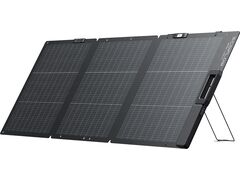
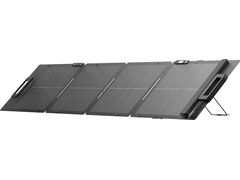
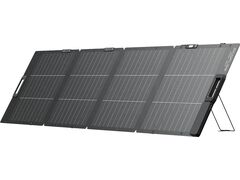
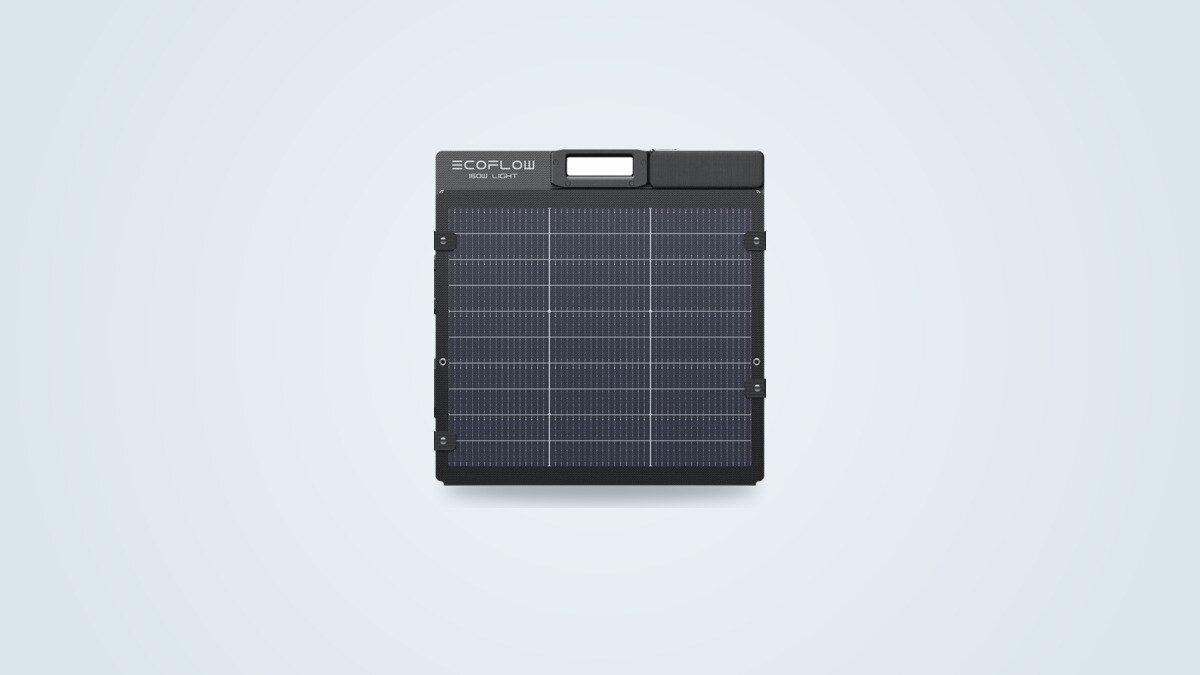
The EcoFlow 160W solar panel, sold in the US as the NextGen 160W, lists an announced weight of 8.4 lb (3.8 kg), with unfolded dimensions of 66.0 x 23.5 in (167.7 x 59.8 cm) and a thickness of 1.0 in (2.6 cm). Folded down into three panels, it packs into a 24.0 x 23.5 in (60.9 x 59.8 cm) footprint, roughly the size of a large binder, with a built-in carry handle. That weight fits a fairly linear progression across EcoFlow's own lineup: the 110W panel weighs 7.3 lb (3.3 kg), the 220W comes in at 11.2 lb (5.1 kg), and the 400W reaches 22.5 lb (10.2 kg).
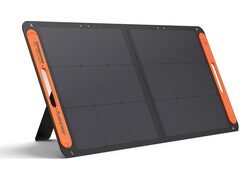
Against other portable panels already reviewed on this site, the 160W sits toward the lighter end: the Jackery SolarSaga 100W weighs 7.9 lb (3.6 kg) for only 100 W, the Goal Zero Nomad 100 climbs to 10.1 lb (4.6 kg) for the same output, and the Anker Solix PS200 (10.6 lb / 4.8 kg) remains the lightest relative to its 200 W. Scaled to 100 W of rated output, the EcoFlow 160W works out to roughly 5.3 lb (2.4 kg), very close to the PS200's figure and well below the SolarSaga's or the Nomad 100's. One reservation worth keeping in mind: this weight figure comes from the spec sheet and has not been cross-checked against an independent weigh-in to date.
Bifacial output: what "up to 25%" really covers
EcoFlow advertises "up to 25% output" for this panel, a phrase worth unpacking: it is not the conversion efficiency of the cells themselves (the share of sunlight turned into electricity), but the production gain the bifacial rear face adds over a monofacial panel of the same rated output. The cells themselves are listed as N-type, a chemistry that tends to hold up better as temperature climbs than the P-type cells more common on entry-level portable panels, which in theory limits the output drop on a hot, sunny day.
The real bifacial gain depends almost entirely on what the panel sits on. On highly reflective ground (albedo), light sand, fresh snow, or concrete, the rear face can genuinely recover a meaningful share of reflected light. On grass or dark soil, the most common surface while camping, albedo typically sits around 0.20, and the resulting bifacial gain usually comes in under 10%, well short of the 25% ceiling the manufacturer highlights. That is not a flaw specific to this panel: it is a physical limit shared by bifacial technology in general, rarely spelled out on the box.
On the electrical side, the spec sheet lists an open-circuit voltage (Voc) of 21.4 V, a short-circuit current (Isc) of 9.2 A, an optimal voltage (Vmp) of 18.8 V, and an optimal current (Imp) of 8.7 A. These are standardized figures from a fixed test condition (1000 W/m² of irradiance and a reference cell temperature), never quite matched outdoors: angle of incidence, cloud cover, and the panel heating up in direct sun all pull real-world output down. No independent figure for the peak power actually delivered by this current generation has turned up so far, which rules out putting a precise number on the gap between the rated 160 W and real-world output.
One product name, two very different versions
Before searching for other reviews of this product, one thing is worth knowing: this panel's name has covered two distinctly different products over time, and it goes by more than one label depending on where you look. In the US, EcoFlow markets the current bifacial version as the NextGen 160W. An earlier version, still turning up in some listings, has no built-in stand at all (the carry bag doubles as a makeshift prop), claims roughly 21 to 22% efficiency, and generally weighs around 15.4 lb (7 kg). The current NextGen version, the one this review covers, includes a folding metal stand, claims up to 25% bifacial gain, and lists an announced weight of 8.4 lb (3.8 kg).
| Feature | Earlier version | Current NextGen version |
|---|---|---|
| Stand | None, carry bag used as a prop | Built-in folding stand |
| Claimed efficiency | Around 21 to 22% | Up to 25% (bifacial gain) |
| Rear face | Not bifacial | Bifacial |
| Announced weight | Around 15.4 lb (7 kg) | 8.4 lb (3.8 kg) |
| Water resistance | IP65 | IP68 |
Outside the US, this same current version is typically sold simply as "160W" or "160W Light" rather than NextGen. The published specifications (bifacial design, adjustable stand, IP68, 5-year warranty) line up across markets, which points to one and the same product marketed under a different name here in the US rather than to two distinct generations.
IP68: weatherproofing on par with the best in class
The panel carries an IP68 rating, the best water and dust protection in this comparison, matching the Jackery SolarSaga 100W and the BigBlue P35, and a clear step up from the earlier version of this same EcoFlow panel, which tops out at IP65. That rating means the panel can stay outside through a rain shower without needing to be rushed indoors.
No hinge or connector failure is known to affect this current generation. Folding into three panels, versus two for the Anker Solix PS200, for instance, slightly increases the number of seams and hinges exposed to moisture and dust compared with a simpler fold, a point that remains theoretical given how little long-term history exists so far for this newer version.
Output ports: built-in XT60, but no USB
The XT60 cable comes already attached to the panel, a genuinely useful touch: nothing to look for or plug in separately to connect the panel to an EcoFlow River or Delta series station. It is the native connector across EcoFlow's own ecosystem, working without an adapter with nearly every generator the brand sells.
The tradeoff is a real limitation: the panel has no USB-A or USB-C output at all. There is no way to charge a phone or a small power bank directly without routing through a station or a charge controller, unlike the Jackery SolarSaga 100W, which adds USB-A and USB-C ports alongside its main output. Connecting this panel to a generator or controller from another brand calls for an XT60 adapter cable to whatever connector it expects (MC4, Anderson, or another proprietary standard): XT60 is common across the portable power station world but does not have the near-universal reach of MC4, which is more widespread on fixed solar installations and on a share of competing portable panels.
Build and warranty: 5 years, the longest here
EcoFlow backs this panel with a 5-year manufacturer warranty, the longest in this comparison, tied with the Anker Solix PS200 and well ahead of the Jackery SolarSaga 100W's 3 years or the BigBlue P35's 2 years.
No recurring manufacturing defect or recall is known to affect this current generation of the panel, which is newer to market than the earlier version described above (no built-in stand, IP65, a lower claimed efficiency figure). Independent history on this current version naturally remains thinner than on a product that has been sold for several years, an honest caveat rather than a proven flaw.
Against other panels of similar output
Against other portable panels of similar output already reviewed on this site, the 160W occupies a middle ground: more powerful than a typical 100W panel, less bulky than a 200W one, with a connector set aimed squarely at its own ecosystem.
| Criterion | EcoFlow 160W | Jackery SolarSaga 100W | Goal Zero Nomad 100 | Anker Solix PS200 |
|---|---|---|---|---|
| Rated output | 160 W | 100 W | 100 W | 200 W |
| Announced weight | 8.4 lb (3.8 kg) | 7.9 lb (3.6 kg) | 10.1 lb (4.6 kg) | 10.6 lb (4.8 kg) |
| Water resistance | IP68 | IP68 | Not specified | IP68 |
| USB output | No | Yes (USB-A and USB-C) | No | No |
| Warranty | 5 years | 3 years | Not specified | 5 years |
The Jackery SolarSaga 100W remains the more versatile of the three for light nomadic use thanks to its built-in USB ports, but it delivers 60 W less at peak. The Goal Zero Nomad 100 leans on the closed Yeti ecosystem, yet its real-world output typically lands between 50 and 80 W out of a rated 100 W, a gap Goal Zero does not disclose at the point of sale. The Anker Solix PS200 goes further on output with a more universal MC4 connector, but costs more. The EcoFlow 160W stands out for its already-attached cable and 5-year warranty, at the cost of a more closed connector setup.
Who this panel is for
The EcoFlow 160W is aimed first at anyone who already owns, or is considering, a compact to mid-size station from the brand (River or Delta series): the already-attached XT60 cable removes any need to hunt for an adapter, and the rated 160 W is enough to recharge that kind of station in a few hours of good sun. Folded down to roughly the size of a large binder, it slots easily into a camper van build or an RV's storage.
Anyone who wants to charge a phone or a small power bank directly without carrying a station is better served by a more modest panel with USB ports, such as the SolarSaga 100W. Anyone with a larger station who wants to recharge it as fast as possible should look toward the 220W in the same lineup, or toward two panels wired in parallel. And anyone running a station from another brand will need an adapter cable, since XT60 is not the most widespread standard outside EcoFlow's own ecosystem.
Price and where it sits in EcoFlow's lineup
EcoFlow lists the NextGen 160W at $449 direct from its own US store, though it is frequently discounted, with various listings and retailers pricing it closer to $200 to $220 at different points in time. It sits between the 110W, cheaper and lighter, and the 220W, pricier and more powerful, a coherent lineup that lets buyers match output to whichever station they own without switching technology or cable ecosystems.
| Model | Output | Announced weight |
|---|---|---|
| EcoFlow 110W | 110 W | 7.3 lb (3.3 kg) |
| EcoFlow 160W | 160 W | 8.4 lb (3.8 kg) |
| EcoFlow 220W | 220 W | 11.2 lb (5.1 kg) |
Before buying, checking the product page for the built-in folding stand and the announced weight (8.4 lb / 3.8 kg) helps avoid confusing this panel with its earlier version, still listed on some marketplaces at a sometimes similar price.