The lightest panel in its class, thanks to CIGS cells
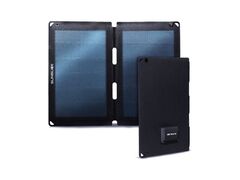
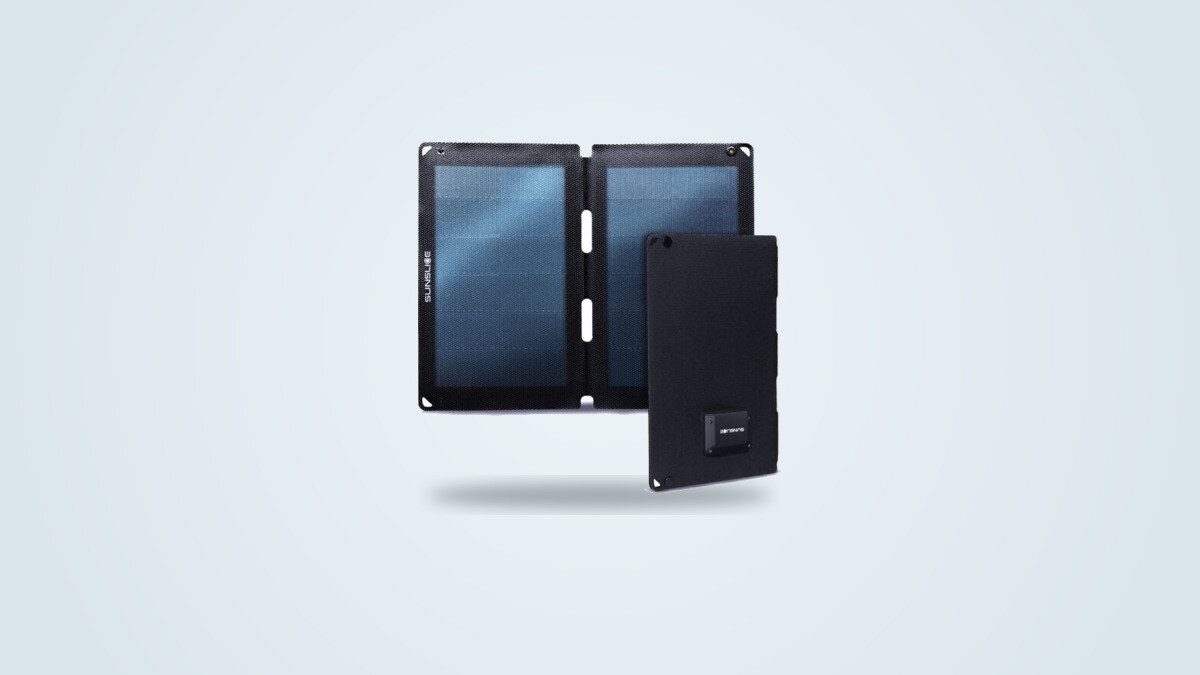
The Sunslice Fusion Flex 12W targets a specific audience: travelers counting every ounce, hikers, bikepackers, cycle tourists. Its technical distinction lies in its thin-film CIGS cells (copper, indium, gallium, selenide), a rarer technology than the monocrystalline silicon found in nearly every other nomadic panel in this catalogue.
Unfolded, it reaches about 11.3 x 15.2 inches of active surface across two panels, then folds down to about letter-page size (11.3 x 7.5 inches) at less than a tenth of an inch thick. A scratch-resistant, water-resistant ETFE coating protects the whole thing, with no built-in battery: charging happens directly, via two USB-A ports.
CIGS versus monocrystalline: this panel's real trade-off
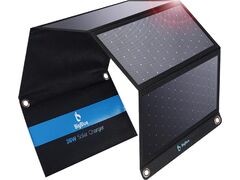
The claimed 16.5% efficiency for CIGS cells sits notably behind the 22 to 25% posted by the monocrystalline panels already reviewed on this site (BigBlue 28W, Allpowers SP001, Allpowers Solax SE60). That's the direct trade-off of the technology choice: thin-film CIGS cells sacrifice some conversion efficiency to gain flexibility and mechanical resilience.
| Panel | Fusion Flex 12W (CIGS) | BigBlue 28W | Allpowers SP001 |
|---|---|---|---|
| Claimed efficiency | 16.5% | 24% | 22 to 25% |
| Technology | Flexible CIGS | Monocrystalline | Monocrystalline |
No independent measurement of this efficiency exists for this model to date. On paper, the gap with monocrystalline is real and significant, but in practice it means a slower charge at equal surface area, not a defective panel: this is a deliberate technology choice, not a manufacturing shortfall.
Half a pound: the new lightest in this comparison
This is where the Fusion Flex 12W changes the game. At roughly half a pound, it comfortably beats the Allpowers SP001 (about 1.3 lbs), until now the lightest nomadic panel already reviewed on this site, and weighs barely more than a smartphone.
| Panel | Fusion Flex 12W | Allpowers SP001 | BigBlue 28W | Allpowers Solax SE60 |
|---|---|---|---|---|
| Output | 12W | 21W | 28W | 60W |
| Weight | ~0.5 lb | ~1.3 lb | ~1.5 lb | ~3 lb |
This weight comes directly from the combination of flexible CIGS cells and lower rated output: fewer watts to produce means less cell surface needed. The result slides into a backpack pocket without a trace, a genuine advantage for anyone traveling light.
ETFE with no IP rating, two USB-A ports capped at 12W
The ETFE coating protects the panel from scratches and makes it water-resistant by construction, but Sunslice states no official IP rating for this model, unlike several rivals certified IP67 or IP68. That isn't necessarily a flaw, but it's a less verifiable claim than a standardized number.
On connectivity, the two USB-A ports deliver 5V/2.4A each, for a combined 12W that exactly matches the panel's rated output, with no headroom. That's a port ceiling consistent with available power, but notably lower in absolute terms than the 18 to 30W on more powerful rivals: no USB-C or DC output is offered at all.
Who the Fusion Flex 12W is for
This panel suits, first and foremost, anyone traveling light who only needs a minimal charging top-up, long-distance trekking, bikepacking, cycle touring, where every ounce saved genuinely matters. The four corner grommets allow it to be attached directly to a pack or bag for charging on the move, a use case few heavier rivals accommodate as easily.
For anyone needing a faster charge or powering a hungrier device, a more powerful, heavier monocrystalline panel (BigBlue 28W, Allpowers SP001, or Solax SE60) remains more effective. The Fusion Flex 12W isn't a universal panel, it's a specialist's choice for a specific use case: weight first, power second.