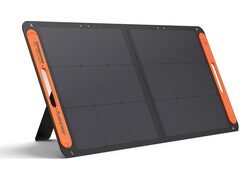
The advertised 100W and 25% efficiency, out in real conditions
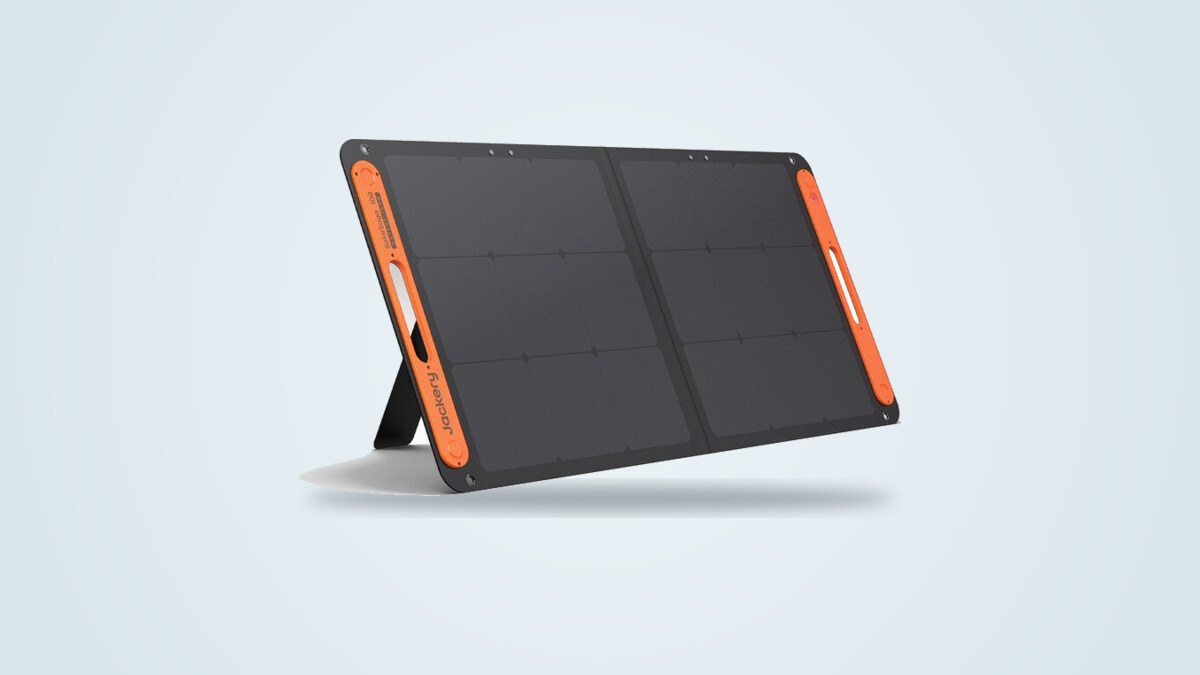
Like any solar panel rating, the SolarSaga's 100W figure corresponds to a standardized value: 1000 W/m² of irradiance, a 77 °F (25 °C) cell temperature, a reference spectrum. It's useful for comparing panels against each other, but it's never quite met outdoors. On this current version (7.9 lb / 3.6 kg, monocrystalline cells with a honeycomb design, ETFE coating), the power actually available at the output varies hugely with time of day, latitude, and cloud cover.
The gap between the two full-sun situations, which swings almost twofold, mostly comes down to the angle of incidence and the thickness of atmosphere the light has to cross: at a more moderate altitude and under slightly hazy light even on an apparently clear day, the direct radiation actually reaching the cells drops sharply. Jackery even builds a small solar-aiming marker into the panel itself, meant to help find the angle that maximizes output quickly, a practical touch on a product where aim often matters more than the spec sheet.
As a rough order of magnitude, ignoring conversion losses: fully recharging a small Explorer 300 Plus station (288 Wh) from empty takes about 3 hours in the best conditions, and close to 6 hours once output drops to 50W. For a much larger station like the Explorer 1000 v2 (1070 Wh), the range runs from roughly 12 hours to more than 21 hours, potentially two full days of charging from this one panel in less favorable conditions.
One name, at least four panels: which generation is actually on sale here
Worth knowing before reading other reviews of this product: the "SolarSaga 100W" name has been carried, and still is in places, by several panels with meaningfully different hardware. This site's product page describes the current version, the one most widely sold overseas: 7.9 lb (3.6 kg), up to 25% advertised efficiency, IP68, a 3 year warranty. An earlier generation of the same name, still turning up in older reviews and on some marketplaces, weighs around 10 to 10.5 lb (4.5 to 4.7 kg) for an advertised efficiency closer to 23%, an IP65 rating, and only a 2 year warranty.
| Spec | Previous generation | Current version (this review) |
|---|---|---|
| Weight | About 10 to 10.5 lb (4.5 to 4.7 kg) | 7.9 lb (3.6 kg) |
| Advertised efficiency | About 23% | Up to 25% |
| Weatherproofing | IP65 | IP68 |
| Warranty | 2 years | 3 years |
| Outputs | DC, USB-A, USB-C | DC, USB-A, USB-C |
Weight and the presence (or not) of an active rear face remain the most reliable way to tell the versions apart: the panel described here only generates from its front face, unlike the Air, Prime, and Light.
IP68: what this weatherproofing actually covers
The current SolarSaga 100W carries an IP68 rating, the best protection against water and dust, and a real step up from the previous generation's IP65. In its own marketing copy, though, Jackery stays more cautious than the IP68 badge alone suggests, describing the panel as splash resistant rather than built for immersion. The ETFE coating on the front face, valued for its resistance to UV and temperature swings, rounds out this protection on the cell side: the manufacturer states an operating range of -4 °F to +149 °F (-20 °C to +65 °C).
Metal grommets along the top edge let it be hung from an awning, a branch, or fencing, a welcome option for aiming it at the sun without relying only on the rear kickstand. No hinge or seam failure turned up for this version after repeated folding cycles; with no independent data on long-term durability, that point is still worth checking over time rather than taking for granted.
Output connectors: a proprietary DC port, no MC4
The SolarSaga 100W outputs exclusively through Jackery's proprietary DC connector (the brand's usual 8mm plug), stated to be compatible with a wide range of Explorer stations (300 Plus, 500 v2, 1000 v2, 2000 v2, and beyond): several panels can be combined to speed up charging on the largest stations. The advertised electrical figures are a 24.8V open-circuit voltage and a 5.4A short-circuit current, with a maximum-power point at 20V and 5A.
This choice has a downside: unlike an MC4-output panel such as the Anker Solix PS200, the SolarSaga 100W won't connect to any third-party station or charge controller without a separately bought adapter. For anyone already inside the Jackery ecosystem, that's no real constraint; for anyone thinking about switching ecosystems down the line, it's worth knowing before buying.
Built-in USB-A and USB-C: handy, but not for fast charging
Unlike a panel built solely to feed a power station, the SolarSaga 100W builds in a USB-A port (5V, 2.4A, or 12W) and a USB-C port (5V, 3A, or 15W), letting you charge a phone, tablet, or camera directly without carrying a station. That's a genuine advantage over similarly powered panels that only offer a bare DC or MC4 output.
The limitation is baked into the figure itself: 15W over USB-C is modest next to the fast-charging standards of most current smartphones, often rated for 25 to 65W depending on the brand. The port is better suited to topping up or slowly rebuilding a charge outdoors than to quickly refilling a drained device, a nuance that marketing these ports as "direct charging" doesn't always spell out.
Portability and folding: light, but a large flat slab once folded
At 7.9 lb (3.6 kg), the panel carries without much effort, over 2 lb lighter than the previous generation of the same name. Unfolded, it measures 48.0 x 21.7 in (122 x 55.2 cm) at 0.8 in (2 cm) thick; folded in half along its center hinge, it shrinks to 24.0 x 21.7 in (61 x 55.2 cm) at 1.4 in (3.5 cm) thick.
This single-hinge fold makes setup quick (only one hinge to open, versus several on a multi-panel design) but leaves, once folded, a fairly large flat footprint (around 3.7 sq ft / 0.34 m²): it packs flatter than tall, worth checking against the available space in a trunk or a van's storage. The panel also lacks a dedicated pouch for the DC cable once folded, a practical detail some rivals include.
Compatibility with Jackery Explorer stations
The manufacturer states direct compatibility, through the DC output, with most of its Explorer station range, from the small 300 Plus up to far higher-capacity models like the 1000 v2 or 2000 v2. Combining several SolarSaga 100W panels on the input side remains the main lever for cutting down a charge time that climbs quickly with the target station's capacity.
This compatibility runs one way only: it does not extend to any other brand's station or charge controller without a separately bought MC4-to-DC8mm adapter, an accessory Jackery does not sell directly as part of its base range. For anyone already inside the Explorer ecosystem, buying in holds no surprises; for anyone weighing up several station brands side by side, this panel's closed connector deserves a place in that comparison.
Against other portable panels
The SolarSaga 100W sits in a segment where connectors often matter more than the headline wattage. Against the Goal Zero Nomad 100, whose sole proprietary 8mm connector shuts out any ecosystem beyond Yeti just as completely, the SolarSaga keeps a genuine edge thanks to its built-in USB-A and USB-C ports, absent on the Nomad 100. Against a more modest add-on panel like the BigBlue 28W, which offers USB only with no station-compatible output at all, the SolarSaga covers both use cases at once.
| Criterion | Jackery SolarSaga 100W | Anker Solix PS200 |
|---|---|---|
| Rated power | 100W | 200W |
| Weight | 7.9 lb (3.6 kg) | 10.6 lb (4.8 kg) |
| Station connector | Proprietary Jackery DC | Native MC4 + included XT-60i adapter |
| Direct USB output | USB-A (12W) + USB-C (15W) | None |
| Advertised weatherproofing | IP68 | IP68 |
| Warranty | 3 years | 5 years |
The SolarSaga 100W trails clearly on warranty length and openness to other ecosystems next to the PS200, but takes back the advantage on direct device charging, entirely absent from the latter.
Build quality, warranty, and reliability
Jackery states a 3 year manufacturer warranty on this current version, versus 2 years for the previous generation of the same name: a genuine improvement, even if it still trails the 5 years offered on the Anker Solix PS200. The ETFE coating and reinforced frame show no manufacturing defect for this version so far. On upkeep, a simple damp cloth to wipe off dust, sand, or sea spray is enough to preserve the advertised efficiency, with no special product needed.
One real friction point remains, common enough that Jackery maintains its own official troubleshooting guide for it: the DC connector's center pin can work loose over time or with heavy use, causing intermittent or interrupted charging. The manufacturer recommends checking this pin regularly and offers a dedicated diagnostic procedure. Like any passive solar panel, the SolarSaga 100W holds no storage cell or complex charging electronics: recalls affecting some other manufacturers' lithium battery products simply don't apply to it by nature.
Who it's for, and at what price
The SolarSaga 100W suits, first and foremost, anyone who already owns, or plans to buy, a Jackery Explorer station: camping, a converted van, or a backup solution at home during a power outage. Its built-in USB ports also make it a sensible pick for anyone who wants a single panel able to top up both a station and a phone on a hike, without carrying two separate charging setups.
By contrast, anyone after universal compatibility with any station or charge controller on the market should look at an MC4-output panel like the Anker Solix PS200 instead. And anyone who only needs to top up a phone or a small power bank, with no station to recharge, will get more out of a lighter, cheaper add-on panel such as the BigBlue 28W.
This exact version is listed in our catalog at $215.29 before tax, in line with standard US retail pricing. It has genuinely become harder to find through mainstream US retailers lately, with more than one listing pointing to it as discontinued or out of stock. Jackery's current US push leans toward the newer Air and Prime panels instead, at broadly similar price points: worth confirming live stock before counting on this specific version.