Real output: from 25 to 160W depending on the light
As with any solar panel, the 200W figure printed on the SP200 corresponds to a standardised rating (1000W/m² of irradiance, 77 °F (25 °C) cell temperature, standard light spectrum), a useful convention for comparing two panels but one that is never actually met outdoors. Angle of incidence, cloud cover and above all the panel heating up in direct sunlight all pull it down, a phenomenon common to this entire product category.
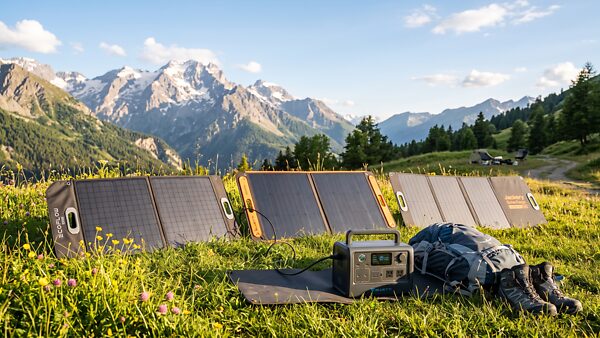
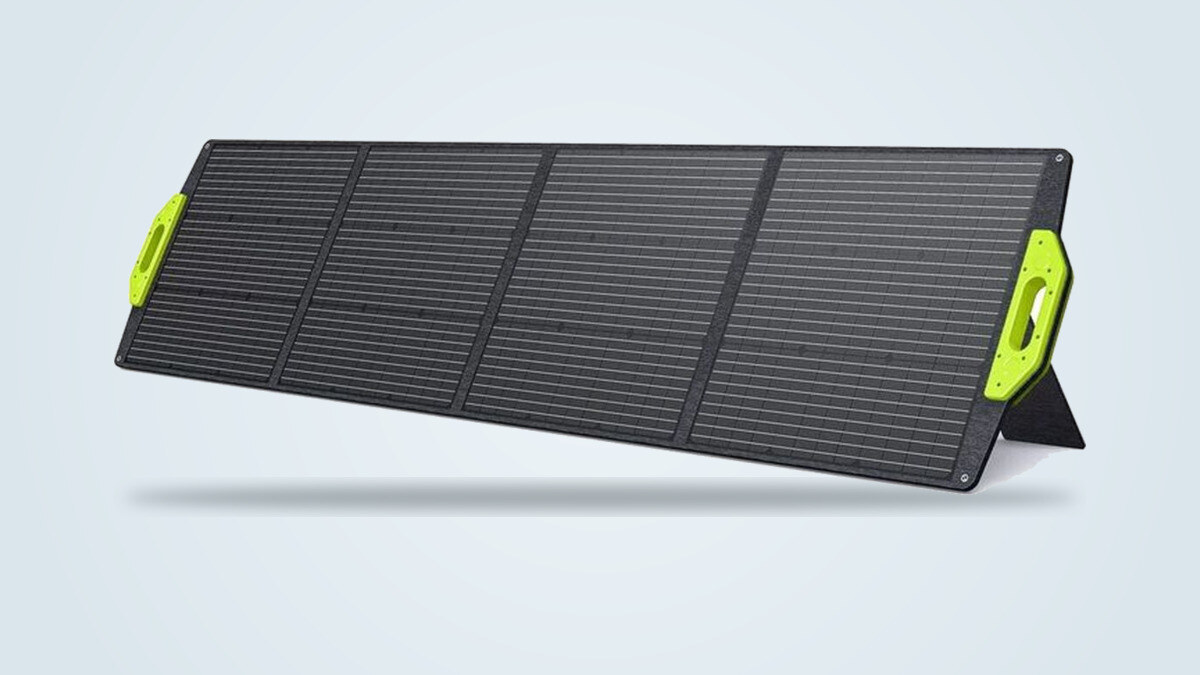
In the field, the output the SP200 actually delivers swings widely with the available light. One case, under a clear sky in high summer, climbs as high as 160W, or 80% of nominal, a favourable ratio for this format. Another, under the low winter sun and reduced brightness, tops out at 78W. And as soon as dense cloud cover rolls in, output drops to around 25W, barely more than an eighth of nominal.
This gap between the spec sheet and reality is nothing unusual for a foldable panel of this power: comparable gaps show up across nearly every nomad panel of this format, and the convention remains standard across the industry, including among the SP200's direct rivals. What sets one panel apart from another is the ratio it reaches in the best case: the 80% achieved under full sun sits at the upper end of the range typically seen for this format, whereas other nomad panels of comparable power tend to top out between 50 and 70% of their own nominal rating under similar conditions.
A weight that stands out from the rest of its class
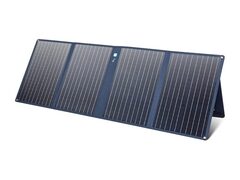
The SP200 weighs 17.7 lb (8.02kg) as listed, a figure that matches across several of the brand's own spec sheets. Against the other foldable 200W panels already reviewed on this site, the gap is clear: the bifacial Anker Solix PS200 weighs 10.6 lb (4.8kg), the Jackery SolarSaga 200W 13.7 lb (6.2kg), and only the rigid Bluetti MP200 solar case comes close, at 17.9 lb (8.14kg).
That comparison is worth dwelling on: a rigid case like the MP200 can justify that weight through the very nature of its protective shell. A soft, four-panel foldout like the SP200 has no such excuse, yet lands at almost the same level, just 0.26 lb (120g) short. Set against the Anker Solix PS200, the SP200 weighs nearly 70% more for an identical nominal power.
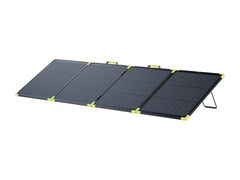
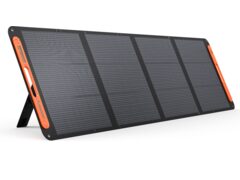
The folded footprint offsets some of that weight: once folded, the SP200 takes up about 3.7 sq ft (25.2 x 20.9in / 64 x 53cm) on the ground, against roughly 5.8 sq ft for the Anker Solix PS200 (31.2 x 27.0in / 79.2 x 68.6cm), over 35% less storage footprint. For anyone packing gear into a tight trunk or a narrow RV locker rather than laying it flat, that trade-off can flip the calculation: heavier to carry, easier to stow. A built-in handle at each end makes it easier to grab for transport.
IP67 on paper, a maker's warning that tempers the promise
Fossibot advertises an IP67 rating on the SP200's active face, presented by the brand itself as enough to survive an unexpected shower or plain splashes, the same protection level as the previous generation of the Anker Solix PS200 and the Bluetti MP200. The ETFE film coating over the cells also guards against scratches and UV, a treatment that has become standard on this type of panel.
In the field, setting the panel up calls for careful placement, especially in wind: the lightweight folding legs can tip the panel over if it isn't wedged properly, a job that's easier with two people than alone. The grommets and other attachment points, for their part, raise no particular concern.
Native MC4 and a multi-tip cable that skips the adapters
The SP200 outputs through MC4, the most widespread standard on the solar market, wired at the factory to a roughly 4.9ft (1.5m) cord. That cable is built into the panel and isn't designed to be detached or swapped out separately, a choice that simplifies manufacturing but rules out replacing it yourself if it wears out or turns out too short.
A genuine strength rounds out that MC4 output: a multi-tip cable ships in the box, covering Anderson, XT60, XT90 and DC5521 connectors. In practice, that means plugging the SP200 into most third-party power stations without buying a separate adapter, a clear edge over the Anker Solix PS200, which includes only a single adapter cable (XT-60i) for its own Solix lineup.
Like nearly every panel at this power level, the SP200 has no USB output: there's no way to charge a phone or a small power bank directly without going through an intermediate station. Its 21.6V open-circuit voltage is also markedly lower than that of higher-power panels like the Anker Solix PS200 (57.6V): an indirect benefit, since it lowers the odds of exceeding the maximum input voltage accepted by a small station or an entry-level solar charge controller.
Compatibility with the Fossibot range, and beyond
The SP200 is advertised as compatible with every standalone station in the Fossibot lineup: F800, F1200, F2400, F3600 and F3600 Pro. The FB3840, sometimes listed alongside them, is actually an expansion battery for the F3600 Pro rather than a standalone station in its own right; it does, however, accept its own solar input of up to 200W, which makes the advertised compatibility accurate in practice.
Beyond the Fossibot ecosystem, the panel carries no charging electronics of its own: MPPT control is handled by the receiving station, as on nearly every nomad panel with an MC4 output. That opens the SP200 in practice to most third-party stations and solar charge controllers that accept an MC4 input within its voltage range, with the bundled multi-tip cable covering the most common proprietary connectors on the market.
How long it takes to recharge a station in the sun
For a rough idea, and reusing the output figures from above, a Fossibot F800 station (512Wh) would fill in a little over 3 hours at the high output seen in full summer (160W), but in close to 6.5 hours at the weaker winter output (78W), and would be all but out of reach in a single day under dense cloud cover (25W, more than 20 hours needed). This simplified math ignores conversion losses and the charge slowing down near the end, but it gives a realistic ballpark.
Two SP200 panels wired in parallel to the same station roughly cut that time in half, provided the receiving station's solar input accepts a combined 400W, which isn't the case for every compatible station.
Build quality, warranty, and a still-young brand
Fossibot was founded in 2022 in Shenzhen: a notably younger brand than Goal Zero (2009) or the bigger generalist names in portable power, without the several product generations those companies can point to. That says nothing in itself about the quality of the SP200, but it's worth keeping in mind: its long-term reliability record is, by definition, shorter to judge than that of a brand that's been around for fifteen years.
No recall has been identified for this panel to date. Its build follows the market standard for this type of product: ETFE coating, a reinforced frame at the corners, and folding hinges across the four panels. The manufacturer's warranty runs 2 years in both the United States and Europe, on the low end for this class: the Anker Solix PS200 stretches to 5 years and the Jackery SolarSaga 200W to 3 years, while the Bluetti MP200 also sits at 2 years.
Up against the direct 200W competition
Compared with the three other foldable 200W panels already mentioned, the SP200 holds a distinctive spot: by far the cheapest, but also the heaviest soft panel in the line-up.
| Criterion | Fossibot SP200 | Anker Solix PS200 | Jackery SolarSaga 200W | Bluetti MP200 |
|---|---|---|---|---|
| Weight | 17.7 lb | 10.6 lb | 13.7 lb | 17.9 lb |
| Waterproofing | IP67 | IP68 | IP68 | IP67 |
| Included cable and adapters | MC4 + 4 tips (Anderson/XT60/XT90/DC5521) | MC4 + 1 XT-60i adapter | MC4 only | MC4 only |
| Warranty | 2 years | 5 years | 3 years | 2 years |
The Anker Solix PS200 clearly beats the SP200 on weight and warranty, for a price that generally runs about $200 higher. The Jackery SolarSaga 200W sits between the two on weight, with a warranty in between as well, but remains the priciest of the three to buy. Against those two, the SP200's case comes down to one line: a noticeably lower price and a multi-tip cable that widens its compatibility out of the box, at the cost of a heavier build and a shorter warranty.
Who the SP200 is really for
The SP200 is aimed first at anyone after a 200W panel at a low price, with no particular need for light weight: parked use in an RV, at a campground, or as a backup power source at home, where the panel stays put once deployed rather than being carried over long distances. Its broad compatibility, multi-tip cable included, also makes it a sensible pick for anyone who already owns a station from a brand other than Fossibot.
On the other hand, anyone who puts weight above everything else, for hiking or backpacking use, will find a better trade-off with the Anker Solix PS200, nearly 70% lighter for identical power. And anyone wanting waterproofing with no caveats from the maker itself would do better with a reference whose own official documentation doesn't contradict itself on that point.
Price and availability
In the US, the SP200 sells for $299 at the time of writing, down from a $499 list price shown by the brand's own US store: a broad, recurring promotion on this product rather than a one-off. The panel is also carried through other retail channels beyond the brand's own direct store, a sign of distribution that goes further than the usual direct-to-consumer channel for a recent Chinese brand.
By comparison, the Anker Solix PS200 sits around $500 and the Jackery SolarSaga 200W around $540, roughly 67% and 81% more than the SP200's price for identical nominal power. That price gap remains the SP200's most immediate selling point, provided the weight and warranty trade-offs detailed above are acceptable. As with any online purchase, sales tax is calculated at checkout and is not included in the price shown.