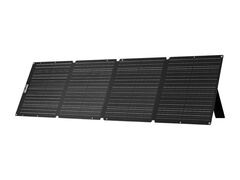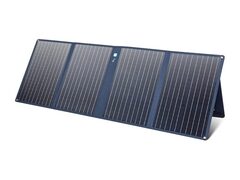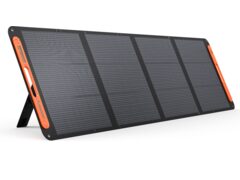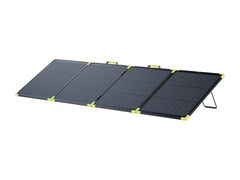
What the 23 to 25% efficiency figure is actually worth
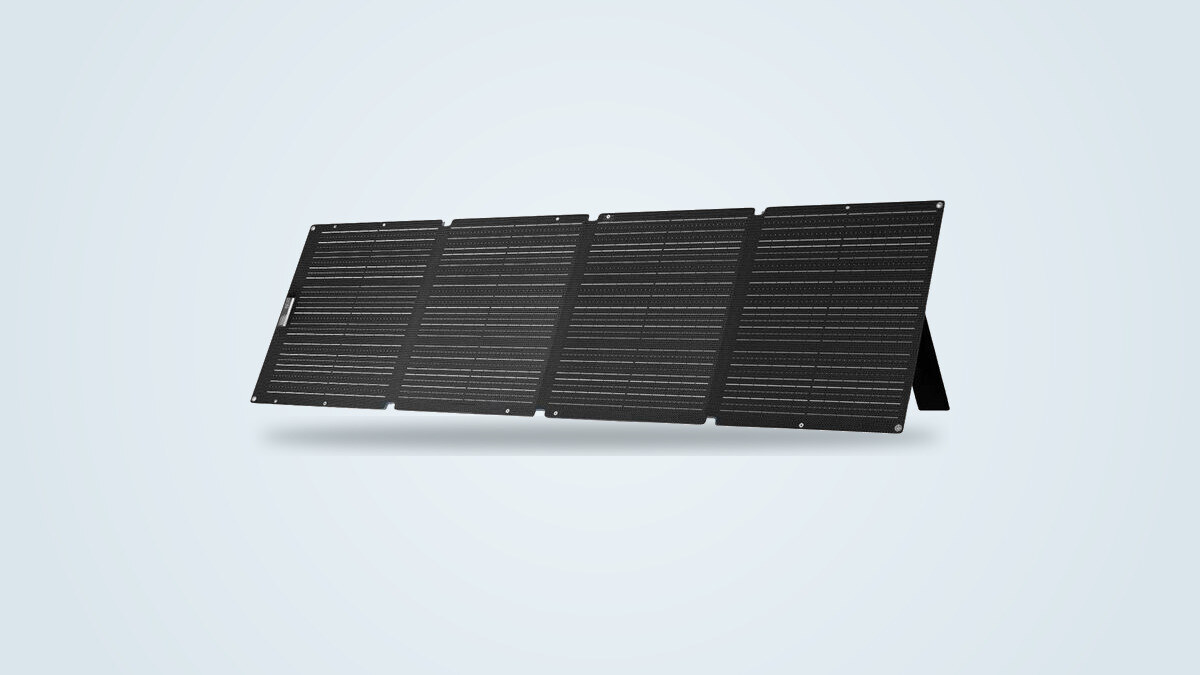
The Allpowers Solax SE200 lists a conversion efficiency of 23 to 25% across its four monocrystalline sections, a figure standardized under the industry's rated test conditions (1000 W/m², 77 °F / 25 °C cell temperature, AM1.5 spectrum). That convention is useful for comparing two panels on paper, but it never shows up outdoors as such: angle of incidence, cloud cover and the panel heating up in direct sun all pull real output down, a trait shared across this entire product category.
In the field, the SE200's output swings widely with conditions. In deep winter, a full exposure session averages around 164W, with a peak of 186W, or 93% of the rated figure: a strong ratio for this format, reached in a season that is far from ideal for solar. As soon as clouds roll in or the angle drifts away from the sun, output drops sharply, down to 30 to 40W in the least favorable cases.
This gap between the spec sheet and reality is nothing unusual: it shows up on nearly every portable panel of this format, and the convention remains standard across the industry, including on the SE200's direct rivals. What sets one panel apart from another is the ratio reached at its best: the 93% obtained here, even in deep winter, sits above the 70 to 80% typically seen on comparable-power portable panels already reviewed on this site.
The cheapest panel in its power class
Priced at $139.00 at the time of writing, discounted from a $189.00 list price, the Solax SE200 sits well below the direct references of the same power. The Anker Solix PS200 generally sells around $500 and the Jackery SolarSaga 200W around $540: the SE200 costs noticeably less for cell efficiency in the same range (23 to 25%) and an IP68 rating that matches or beats both.
The same pattern holds against the Fossibot SP200, the nearest in price at $299: the SE200 still comes out ahead by $160 while pairing a higher nominal waterproofing rating with a smaller footprint. Brought down to price per rated watt, the SE200 lands at around $0.70, one of the more favorable ratios in the 200W segment.
The IP68 rating, and the manufacturer's own caution that tempers it
Allpowers lists an IP68 rating for the Solax SE200, the highest tier on the standardized protection scale, above the IP65 carried by the Jackery SolarSaga 200W and equal to the Anker Solix PS200's own rating. On paper, that tier allows for temporary submersion, well beyond a passing shower. The panel is rated for use from -4 °F to 140 °F (-20 °C to 60 °C), a wide range that covers most outdoor conditions.
The ETFE coating over the cells adds protection against scratches and UV, a treatment that is now standard on this type of panel. The one-piece laminated build, with no exposed metal hinge between the sections, also cuts the risk of cracking at the fold compared with panels hinged the more traditional way.
How long it takes to fill a station in the sun
As a rough guide, and reusing the output figures above, an Allpowers R1500 Lite (1056Wh) would fill in around 5h41 at the peak output reached in deep winter (186W), around 6h26 at that same session's average (164W), and over 30 hours under heavy cloud cover (35W). A larger Allpowers R2500 V2 (1920Wh) would need roughly 10h19 at best and well over two days in the worst case. This simplified math ignores conversion losses and the slowdown near the end of a charge, but it gives a realistic sense of scale.
Two SE200 panels wired in parallel into the same station roughly cut that time in half, provided the station's solar input accepts a combined 400W and a voltage compatible with each panel's 48.96V open-circuit rating.
Native MC4: the right connector choice, but no USB
The SE200 outputs over MC4, the most common and most universal standard on the solar market, well ahead of the proprietary Anderson-style connectors some rivals favor. A compatibility cable ships in the box to extend the connection to third-party stations without a native MC4 input, and to Allpowers stations such as the S2000 Pro, R1500 Lite, R2500 V2, P300 and P1800.
That cable does not fit every station straight out of the box, though: check your own station's exact input connector before buying rather than assuming universal compatibility. Maximum output voltage tops out at 41.6V for roughly 4.8A: stations whose solar input accepts a lower voltage will not be able to draw the panel's full output.
Another real limitation: like nearly every panel at this power level, the SE200 offers no USB output at all. Charging a phone or a small battery pack directly, without going through an intermediate power station fitted with its own ports, is simply not possible.
A middling weight, and a footprint that stays bulky unfolded
The SE200 weighs a rated 15.8lb (7.16kg). Against the other 200W foldable panels already reviewed on this site, it lands in the middle of the pack: heavier than the Anker Solix PS200 (10.6lb / 4.8kg, bifacial, the lightest of the category), but noticeably lighter than the Fossibot SP200 (17.7lb / 8.02kg), and close to the Jackery SolarSaga 200W (13.7lb / 6.2kg).
Folded down, the panel measures 22.0 x 23.1 x 0.8in (559 x 587 x 20mm), easy enough to slide into a trunk or an RV storage bay. Unfolded, though, it runs past 6.7 feet (2056mm) long by 23.1in (587mm) wide: handling it solo becomes a real chore once the wind picks up, a constraint common to this panel format. The built-in kickstands, adjustable from 0 to 180°, let you angle the surface toward the sun without extra hardware, and a built-in handle makes it easier to carry once folded.
Off-grid panel or balcony add-on: one function, two uses
The SE200 is a standalone solar panel, with no battery or inverter built in: it stores no energy of its own and cannot, by itself, power a wall outlet. Its only job is converting light into DC current, to be fed into a power station or a charge controller that stores and delivers it.
That single-purpose design explains its two commercial lives. For camping and van life, it unfolds on the ground or against a windshield, kickstands angled toward the sun. For home use, several retailers also position it as a balcony or patio add-on, propped against a railing or laid flat outside. In that second role, though, it does not replace a full home battery storage system with its own inverter: it still needs a power station or a separate inverter to deliver a complete home setup, an extra cost worth factoring into the total budget.
Against the direct 200W competition
Compared with the three 200W foldable panels already mentioned, the SE200 stands out for a ratio between output and price that is rarely matched in this segment.
| Criterion | Allpowers Solax SE200 | Anker Solix PS200 | Jackery SolarSaga 200W | Fossibot SP200 |
|---|---|---|---|---|
| Weight | 15.8 lb | 10.6 lb | 13.7 lb | 17.7 lb |
| Waterproofing | IP68 | IP68 | IP65 | IP67 |
| Connectors | MC4 + compatibility cable | MC4 + 1 XT-60i adapter | MC4 only | MC4 + 4 tips |
| Warranty | 24 months | 5 years | 3 years | 2 years |
| Observed price | ≈ $139 | ≈ $500 | ≈ $540 | ≈ $299 |
Against the Anker Solix PS200, the SE200 gives up weight and warranty length, but costs $361 less for the same nominal waterproofing tier. Against the Jackery SolarSaga 200W, it comes out ahead on price, waterproofing and winter output. Against the Fossibot SP200, the closest on price, the SE200 is about 1.9lb lighter but ships with a less extensive compatibility cable.
Build quality, warranty and a brand still building its US track record
Allpowers was founded in 2008 in Guangzhou, China, with several development centers across the country. The brand builds its panels around a one-piece laminated construction, a structure that cuts the risk of cracking at the fold compared with panels hinged the more traditional way.
The manufacturer's warranty runs 24 months, extendable by registering the product on the official site. For a defect on arrival, Allpowers offers a 30-day exchange with return shipping covered on its end. No recall has turned up for this panel to date. Next to the Anker Solix PS200's 5-year warranty or the Jackery SolarSaga 200W's 3 years, the SE200's 24 months sit on the low end of its category, a gap worth weighing against its notably lower price.
Founded in 2008, Allpowers carries a longer track record than newer names in the same segment such as Fossibot (2022), though it still trails the decades of history behind the more established generalist brands in portable power.
Who the SE200 suits, and who it does not
The SE200 suits anyone after a capable 200W panel without paying premium-brand prices: camping, a converted van, or backup power at home, where the panel stays deployed in one spot rather than getting carried over long distances. Its MC4 output and included compatibility cable also make it a sensible pick for topping off an existing station from another brand.
On the flip side, anyone chasing the lightest possible panel for backpacking will do better with the Anker Solix PS200, nearly 50% lighter. Anyone wanting to charge a phone directly, without going through a station, needs a smaller panel with its own USB port. And anyone who puts a premium on a long warranty should look toward a reference that beats the SE200's 24 months.