What the rated 400W is really worth
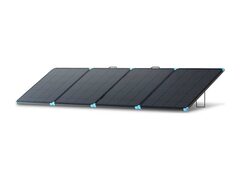
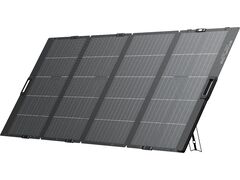
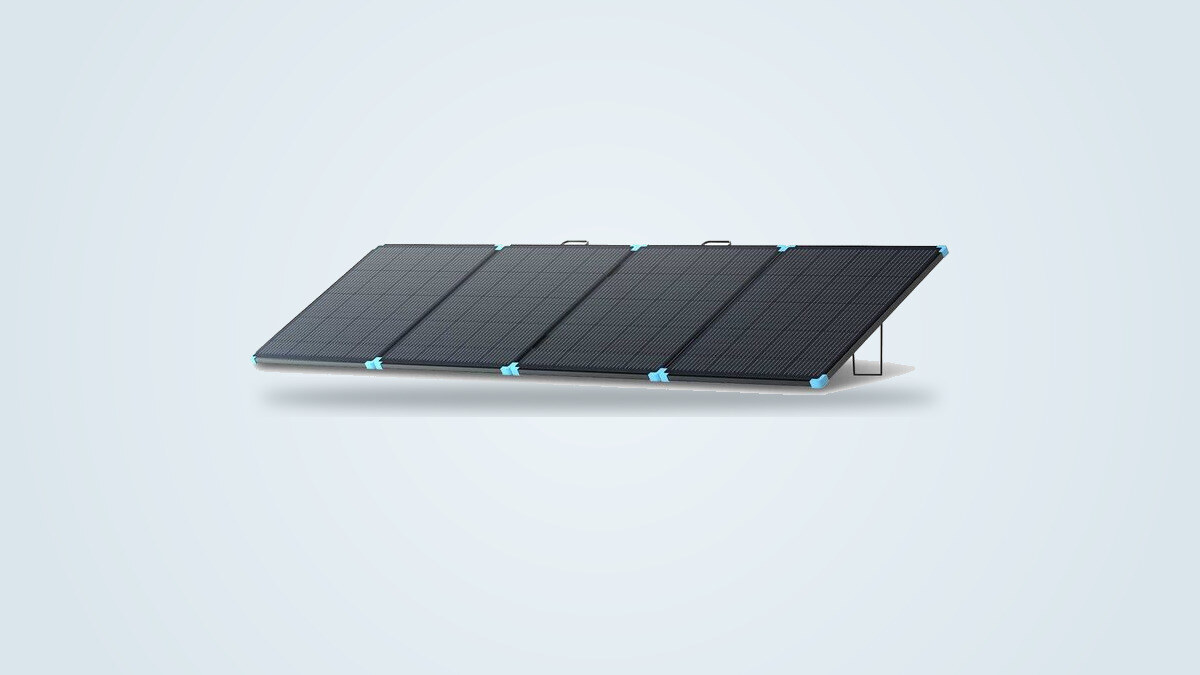
The Renogy 400W Lightweight Solar Suitcase combines four monocrystalline panel segments rated EL-tested Grade A+, with a cell efficiency listed at 23% in the manufacturer's documentation. Its electrical characteristics line up consistently with each other: an optimal voltage (Vmp) of 40V and optimal current (Imp) of 10A, which is exactly 400W at the maximum power point, against an open-circuit voltage (Voc) of 47.2V and a short-circuit current (Isc) of 11A.
As with any solar panel, this 400W figure corresponds to peak power measured under the industry's standard test conditions (1000 W/m², 77 °F / 25 °C cell temperature, AM1.5 spectrum), a convention that allows two panels to be compared but that is never quite reproduced outdoors. The manufacturer's documentation puts daily output at up to 2000 Wh in good sunlight conditions, a figure consistent with the rated power spread over a useful day of exposure.
Like any crystalline cell, this panel's output varies with real temperature and irradiance: under a clear sky and a low cell temperature, output can get close to the rated figure, while strong heat in full sun pulls it back down instead, a physical behavior common to every monocrystalline panel rather than a quirk of this particular model.
No independent measurement of the percentage of rated power actually achieved over a full day was found for this specific model. The 23% cell efficiency, on the other hand, is listed by the manufacturer and consistent with the Grade A+ monocrystalline generation it advertises, slightly above the 22% of the Renogy 200W suitcase from the same brand.
30.2 lb (13.7 kg): what the word "lightweight" is really worth
This is the central claim of the product, and it holds up under scrutiny: at 30.2 lb (13.7 kg) for 400W, this suitcase reaches 13.2 W per pound carried (29.2 W/kg), the best ratio of any 400W nomadic panel already reviewed on this site. It even weighs 5.7 lb (2.6 kg) less than the Renogy 200W suitcase from the same brand (35.9 lb / 16.3 kg), while delivering double the power.
The gap with the Renogy 200W suitcase comes down to design: the lightweight version uses an ETFE laminate reinforced with fiberglass across its four segments rather than a steel frame and a built-in electronic controller, which removes both weight and a function (more on that below). Against the Anker Solix PS400, same power and a fairly similar design (ETFE coating, reinforced frame, integrated kickstands), the 5.7 lb (2.6 kg) gap is tighter but still clear.
Folding in four segments: what it changes in practice
Unfolded, the suitcase measures 111.8 x 33.7 x 0.8 in (2838 x 855 x 20 mm), a footprint of roughly 25.8 sq ft (2.4 m²). Folded down into four, it packs into 27.9 x 33.7 x 3.2 in (708 x 855 x 80 mm), a thickness of 3.2 in that fits most RV lockers and storage bays.
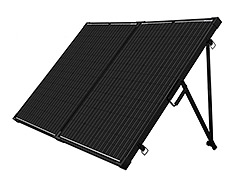
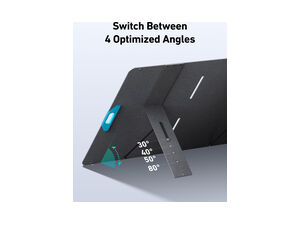
Each of the four panel segments has its own foldable aluminum kickstand, individually adjustable: it is this four-way split, rather than a two-panel design, that lets the suitcase fold down to just 3.2 in thick. The manufacturer claims a full deployment in one minute, with no tools, and includes a canvas carry bag with a dedicated pocket for cables and accessories.
The weight stays concentrated in a single piece once folded: unlike a rigid panel that can be broken down into several parts, these 30.2 lb (13.7 kg) are carried as one unit, using the built-in handle. On uneven ground, the four independent kickstands each need their own adjustment to keep the whole assembly level and stable, an extra step compared with a panel that relies on a single kickstand or just two contact points.
IP67 for the whole unit, IP68 at the connectors
The manufacturer rates the entire panel IP67, protection against dust and temporary accidental immersion, and goes further on the MC4 output connectors, rated IP68. This sets the suitcase apart from its 200W sibling, whose documentation only covers separate IP ratings per component (junction box, connectors, controller), with no single certification for the folded unit as a whole.
The ETFE coating reinforced with fiberglass replaces the tempered glass used on rigid solar panels: more flexible, it holds up better to impacts and the repeated flexing of folding, without the micro-cracks that tempered glass can develop under the same cycles. The manufacturer's stated operating temperature range spans -40 °F to 185 °F (-40 °C to 85 °C), a wide span consistent with industry standards for this type of cell.
No weatherproofing failure or incident has been identified for this specific model. The IP67/IP68 rating remains a manufacturer figure, though, not independently verified: a nuance worth knowing, and one shared by nearly every nomadic solar panel in this segment.
MC4 only, no built-in controller
Unlike the Renogy 200W suitcase from the same brand, this lightweight version has no built-in charge controller: it is designed to be paired with a power station or an external MPPT/PWM controller that already has its own, not to be wired straight into a bare 12V battery. Its output uses MC4 connectors exclusively, the most widespread standard in the solar industry, directly compatible with nearly every portable power station on the market.
No USB output is present, a trait shared by nearly every nomadic panel of this power class already reviewed on this site. Several units can, however, be combined in parallel through the MC4 connectors, up to five panels in total according to the manufacturer's documentation, to exceed the 400W of a single suitcase.
Wiring panels in parallel also adds up their short-circuit current (11A each): before combining several units on the same station, it is worth checking that its maximum solar input current is not exceeded, or the excess power will simply be capped by the station rather than lost. The 47.2V open-circuit voltage of each panel is also worth checking against the solar input range of the target station or controller, particularly for a series wiring setup rather than parallel.
Build quality and warranty: the gap with its 200W sibling
The frame is built around an aluminum structure and an ETFE coating reinforced with fiberglass, paired with EL-tested Grade A+ monocrystalline cells, a screening process that sorts out defective cells before assembly. No recall and no recurring build defect have been identified for this model to date.
This 3-year term puts the lightweight suitcase notably behind the Renogy 200W suitcase from the same brand, warrantied for 10 years on parts and labor and 25 years at 80% power output: two products from the same brand, in the same segment, with very different warranty policies depending on the range. It does, however, beat the 2-year warranty listed on the Anker Solix PS400, another 400W panel already compared on this site.
This warranty gap says nothing on its own about the product's real reliability: it is a commercial policy set by the manufacturer, worth factoring into the decision, not a signal of measured build quality.
Against the direct competition
At around $495.99, this suitcase lines up directly against three other nomadic panels already reviewed on this site: the Renogy 200W suitcase from the same brand, the Anker Solix PS400 at the same power rating, and the Allpowers SP037 400W, listed as a direct alternative on this product's own page.
| Criterion | Renogy 400W Lightweight Suitcase | Renogy 200W Suitcase | Anker Solix PS400 | Allpowers SP037 400W |
|---|---|---|---|---|
| Power | 400 W | 200 W | 400 W | 400 W |
| Weight | 30.2 lb (13.7 kg) | 35.9 lb (16.3 kg) | 35.1 lb (15.9 kg) | ≈ 44.1 lb (20 kg) |
| Power-to-weight | 13.2 W/lb | 5.6 W/lb | 11.4 W/lb | ≈ 9.1 W/lb |
| Cell efficiency | 23 % | 22 % | 23 % | ≈ 22 % |
| Weatherproofing | IP67 (IP68 connectors) | IP65/IP67 per component | IP67 | IP66 |
| Warranty | 3 years | 10 years (25 years power) | 2 years | not disclosed |
| Price observed | ≈ $495.99 | ≈ $319.99 | ≈ $699.99 | ≈ $349.99 |
Against the Renogy 200W suitcase, the gap is sharp on power-to-weight ratio (13.2 against 5.6 W/lb) but reverses completely on warranty (3 years against 10 years parts and labor, 25 years on power output). Against the Anker Solix PS400, same power rating, this suitcase is both lighter (30.2 against 35.1 lb) and better warrantied (3 years against 2 years), but the Anker Solix PS400 reaches 92% of its rated power in full sun according to its own review on this site, a figure that is missing for this model. Against the Allpowers SP037, priced notably lower at around $349.99, this suitcase still wins out clearly on weight (30.2 against roughly 44.1 lb) and weatherproofing (full IP67 against IP66), for a very close cell efficiency, though buyers on a tight budget may still find the Allpowers the better value.
Who it suits, and who it does not
The Renogy 400W Lightweight Solar Suitcase is aimed first at anyone who wants to recharge a 1 kWh-plus power station in an RV, a converted van or an off-grid site, and who has already weighed up the various 400W panels on the market: within this exact power class, it stands today as one of the lightest options already reviewed on this site.
On the other hand, anyone after a genuinely lightweight panel to carry daily, on a backpack or for occasional use, will find a better fit with a folding 200W panel from the market (10.6 to 13.7 lb / 4.8 to 6.2 kg depending on the model), at the cost of half the power output. And anyone who prioritizes a long warranty on their panels, or direct charging of a 12V battery without a separate station or controller, will find in the Renogy 200W suitcase from the same brand an argument this lightweight version does not offer.