
A 23% efficiency rating shared across the line, with a documented heat penalty
EcoFlow states 23 % efficiency for this rigid panel, the figure generally quoted for the whole module (cells, glass and frame included). That is exactly the same figure posted by the 100W rigid panel and by the 100W flexible panel in the same line: a consistency that suggests a shared monocrystalline cell supply chain across the whole EcoFlow line, though that does not amount to an independent measurement.
Per EcoFlow's official documentation, each panel delivers an operating voltage of 31.00V at 12.90A, for a rated output of 400W (open-circuit voltage 37.10V, short-circuit current 13.79A) under standardized STC test conditions (1000 W/m², 77 °F/25 °C, AM1.5 spectrum). As with any solar panel, that figure only shows up in full sun at a near-perpendicular angle.
The most useful part of the technical documentation is a range EcoFlow states itself: on a clear, cloudless day, under 800 to 900 W/m² of irradiance and a panel temperature of 122 °F (50 °C), output lands between 320 and 350 W, or 80 to 87.5 % of rated power. The manufacturer also states a temperature coefficient of -0.38 %/°C on power (-0.35 %/°C on open-circuit voltage, +0.06 %/°C on short-circuit current): every degree Celsius above 77 °F (25 °C) costs a little efficiency, standard behavior for monocrystalline cells but slightly more pronounced than the -0.32 %/°C Renogy states for its own rigid panel, already compared against the 100W panel in this same EcoFlow line.
No independent measurement (lab or specialist forum) turns up online for this exact 400W format at the time of writing: the figures above come solely from EcoFlow's own documentation.
IP68, 130 mph of wind, 113 psf of snow: solid resistance, but not a threshold unique to EcoFlow
EcoFlow states an IP68 rating for this rigid panel, a step above the IP65 or IP67 typically found on rival rigid panels. On the standardized IEC 60529 scale, the second IP68 digit denotes protection against prolonged immersion, which EcoFlow sets at 3.3 ft (1 m) deep for 72 hours for this rigid panel line.
The anti-corrosive aluminum frame and tempered glass withstand, per the manufacturer, a dynamic wind load of 2400 Pa (130 mph, or 209 km/h) and a static snow load of 5400 Pa (113 psf, or 551 kg per square meter). Both thresholds actually correspond to common IEC qualification tiers on certified rigid panels across the market: the Zendure 500W bifacial panel already in the catalog states the exact same values (2400 Pa / 5400 Pa). The stated resistance here is solid and credible, but it is not a feat unique to EcoFlow: it is a certification tier shared by several serious manufacturers in the sector.
These remain manufacturer figures: no independent measurement (hail test, mechanical impact) turns up to confirm or qualify them over time. One isolated case of glass breaking in transit turns up online, resolved with a full refund, without enough volume to conclude on an abnormal breakage rate for this listing: the risk exists for any glass panel this size, not specifically for this model.
This high level of weatherproofing is precisely what allows a permanent, unprotected roof install, unlike a portable panel put away after use.
96.1 lb and 42 sq ft for the pair: a format built for a fixed roof, not necessarily a van
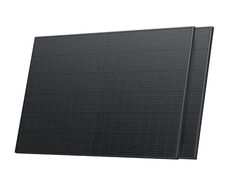
At 67.8 x 44.6 in (172.2 x 113.4 cm) and 1.38 in (3.5 cm) thick, at 48.1 lb (21.8 kg) per panel, this listing changes nature compared with the 100W panel in the same line (13.7 lb/6.2 kg per panel). The footprint runs to close to 21 sq ft (1.95 m²) per panel, about 42 sq ft (3.9 m²) for the pair, and combined weight climbs to 96.1 lb (43.6 kg): two people are needed for handling and mounting at height, a noticeably heavier constraint than the 100W format.
The listing checked on the official US store bundles mounting feet with this 400W pair, a genuine plus over the bare 2-pack sold under some other markets' listings: they let you angle the panels toward the sun rather than laying them strictly flat. Once mounted, the chosen angle stops moving with the seasons, a limitation common to any rigid panel and not specific to this product. Third-party options also exist through several RV specialist retailers: glued corner brackets that need no drilling, or suction-cup mounts for a non-permanent fix, an alternative depending on the surface available.
The product listing plays up van, campervan and boat use. The real-world format tells a different story: at close to 21 sq ft (1.95 m²) and 48.1 lb (21.8 kg) per panel, the full pair more naturally targets a house roof, a garden shed, a garage or a large motorhome with open roof space, rather than a compact van or a campervan whose roof rarely offers several dozen square feet in one clear stretch.
MC4 connectivity: open to third parties, but check the cable for an EcoFlow station
Both panels use MC4 connectors, the near-universal standard across the solar industry. EcoFlow explicitly states compatibility with third-party systems and 48V setups, in addition to its own power stations. The stated maximum system voltage reaches 1500V DC (UL certified) with a maximum fuse rating of 25A, a wide margin that leaves room to wire several panels in series or parallel depending on the controller's input range.
To connect this pair directly to an EcoFlow power station (River or Delta ranges), an MC4-to-XT60i adapter cable is needed: the solar input on these stations is not native MC4. This cable is not confirmed as included in the bundle checked on the official US store, so it is worth verifying before buying (typically budget around fifteen dollars separately if it is not). Some EcoFlow combo kits that pair a station such as the Delta Pro directly with several 400W rigid panels do include this cable along with mounting feet.
For reference across the line, a Delta Pro accepts up to 1600W of simultaneous solar input with four 400W rigid panels wired together: this single pair (800W) therefore covers only half of that maximum charging speed, and a second pack is needed to reach it.
Build quality and warranty: a stated 10 years, double the 100W rigid panel in the same line
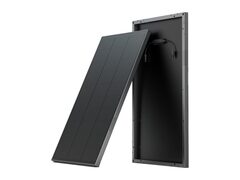
Construction combines an anti-corrosive aluminum frame and tempered glass, the same base as the rest of EcoFlow's rigid line. The stated warranty reaches 10 years, double the 5 years offered on the 100W rigid panel from the same brand: a notable step up that brings this format closer to the standards of generalist photovoltaic panel makers than to typical portable accessories.
A check of CPSC recall records turns up nothing against this EcoFlow rigid panel line. The only notable recall identified for the brand concerns an unrelated product, the Delta Max 2000 power station, subject to a CPSC safety recall (overheating risk, fixed via a firmware update, 2025): neither the technology nor the product category overlaps with this solar panel, which contains no active electronics comparable to a power station.
The published temperature coefficient (-0.38 %/°C on power) is a genuine piece of technical transparency, absent from the 100W panel's own spec sheet in the same line based on the research done for this review: it is a useful, direct comparison point against rivals like Renogy, which states -0.32 %/°C for its own rigid panel.
Charging a large station: up to 1600W of input possible by pairing several packs
This 800W pair suits both a classic photovoltaic setup through a third-party MPPT controller and direct charging of an EcoFlow power station. On a Delta Pro, which accepts up to 1600W of combined solar input with four 400W rigid panels wired together, this single pair only supplies half the maximum throughput; on a more modest station (River or standard Delta), by contrast, 800W is more than enough to saturate the available solar input.
The main practical takeaway: the number of panels needed depends directly on the target station, and buying this single pair does not guarantee reaching the maximum solar charging speed stated for the brand's largest power stations.
Against the competition: the 100W panel in the same line and the Zendure 500W bifacial panel
At $999 for the bundle checked on the official US store (mounting feet included, subject to change with promotions and availability), this EcoFlow 400W rigid panel compares directly with two references already covered on the site: the 100W rigid panel from the same brand, and the Zendure 500W bifacial panel, another heavy rigid panel built for a fixed install.
| Panel | Output | Efficiency | Rating | Weight | Warranty | Checked price |
|---|---|---|---|---|---|---|
| EcoFlow 400W rigid (x2) | 800W | 23% | IP68 | 48.1 lb/panel | 10 years | $999 (feet included) |
| EcoFlow 100W rigid (x2) | 200W | 23% | IP68 | 13.7 lb/panel | 5 years | $379 the pack |
| Zendure 500W bifacial (x2) | 1000W (up to 1300 Wp bifacial) | 22.5% | IP68 | 59.5 lb/panel | not stated | $487.44 the pack |
Against the 100W rigid panel in its own line, this 400W panel keeps the same efficiency (23 %) and the same IP68 rating, but meaningfully improves the warranty (10 years against 5 years) while carrying a far higher weight and footprint, consistent with its quadrupled output; unlike the 100W listing, this 400W bundle also throws in mounting feet. Against the Zendure 500W bifacial panel, the comparison is more nuanced: Zendure claims a slightly lower efficiency (22.5 % against 23 %) but a combined output that can reach 1300 Wp thanks to front-and-back capture, at a higher weight per panel (59.5 lb against 48.1 lb) and with no warranty stated on the listing checked.
Worth noting at the time of writing: this listing shows as unavailable on the official US store, and availability for EcoFlow's rigid panels generally fluctuates by retailer and by period, a point worth checking before buying rather than a lasting shortage. This comparison stays indicative: prices shift regularly at retailers, and the choice between these options mostly comes down to the total output you are after, the mount your roof can support and, for the bifacial panel, whether a reflective surface sits behind the panels.
Who this pair suits, and who it does not
This pair of rigid panels suits, first, anyone equipping a fixed, durable roof able to take close to 42 sq ft (3.9 m²) and 96.1 lb (43.6 kg) spread across two mounting points: a house roof, a garden shed, a garage, or a large motorhome with open roof space. The 10 year warranty, the IP68 rating and the mounting feet bundled into the listing checked make it a solid choice for aiming at 800W in one coherent purchase, with the option to add a second pair later to saturate a large station's solar input.
It suits less well anyone after a nomadic setup moved daily (a foldable or flexible panel serves that need far better), anyone installing solo without help for handling (each 48.1 lb/21.8 kg panel takes two people), anyone with a compact van or campervan roof with limited space, or anyone who needs confirmed inclusion of the direct-to-station charging cable out of the box.