What the 512 Wh rating is actually worth
The Aferiy P010's LiFePO4 battery is rated at 512 Wh at 25.6 V, good for more than 3500 charge cycles before dropping to 85% of its original capacity. As with any inverter-based station, part of that energy is lost in conversion before it reaches an AC outlet or a USB port.
No published full-discharge protocol documents this specific unit to date. Comparable stations in its class, same 512 Wh nominal rating and the same pure sine wave inverter type, typically deliver between 80 and 87% of their stated capacity once conversion losses are accounted for. On that basis, the P010 would sit around 430 Wh of usable output, a category position rather than an independently verified figure.
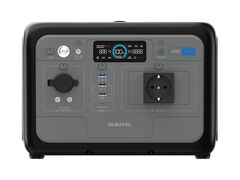
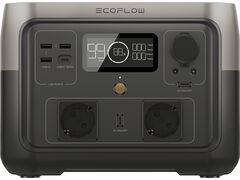
That cycle rating sits in the upper half of its class: the Oukitel P800, same capacity and power, is rated for 4000 cycles, while the less powerful EcoFlow River 2 Max is rated for 3000. A delivered-capacity figure confirmed by a published protocol would inspire more confidence than a position inferred from category comparison, however reasonable it is.
800 W held up, but only one AC outlet at a time
The claimed ceiling, 800 W continuous and 1600 W surge, matches what the manufacturer's documentation sets as the limit. A resistive load around 700 to 800 W (a small kettle, a coffee maker, a space heater on its low setting) sits right at that ceiling rather than comfortably under it; beyond it, the output protection cuts power. The 1600 W surge exists to absorb the startup current of a compressor or a motor, not to power a device continuously at that level. On the US listing, that single AC outlet delivers 120V at 60Hz, rather than the 230V/50Hz output sold on other markets.
This choice isn't unique to the P010: the Oukitel P800, an almost exact match in capacity (512 Wh) and power (800 W, 1600 W surge), also settles for a single AC outlet. The least favorable comparison remains the EcoFlow River 2 Max, less powerful (500 W continuous, 1000 W surge) but better equipped on this specific point.
A 90 minute recharge: mains, solar, and 12 V
From the mains, with the included 400 W adapter, the manufacturer's documentation sets a full recharge at 90 minutes.
| Source | Max power | Stated duration |
|---|---|---|
| Mains (400 W) | 400 W | 90 minutes for a full charge |
| Solar (MPPT, XT60) | 200 W | roughly 3 to 3.5 hours depending on sunlight |
| Combined mains and solar | ≈ 600 W | roughly 1 hour |
| 12 V car socket | 100 W | roughly 5 hours |
That 90-minute figure places the P010 in the solid middle of its capacity class, without being the fastest outright: the Oukitel P800, same capacity and power, states a full charge in 60 minutes on its own spec sheet. The gap likely comes down to the maximum charge current each battery accepts rather than a difference in input power, since both are capped at 400 W from the mains.
The solar input relies on a single MPPT controller and an XT60 connector, across an 11.5 to 50 V range. That's enough for a 200 W nomadic panel, but it caps off-grid recharging speed to this one channel, with no second controller to split a larger panel array.
Noise under 60 dB: quieter than the ceiling suggests under full load
The manufacturer sets the P010's noise level under 60 dB. Under full load, that figure drops to 45 to 50 dB at 3.3 ft (1 m), under the stated ceiling rather than up against it. That's good news for remote work or a bedroom: the fan stays unobtrusive even when the unit is working hard, unlike louder stations from the same brand whose quiet rating only holds under a fraction of their maximum power.
That favorable gap still deserves a caveat: no additional independent protocol confirms this noise level right at the 800 W ceiling, where the fan has to work hardest.
Ports: eight well thought out outputs, old school control
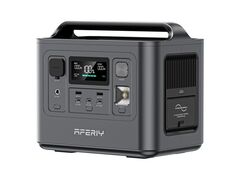
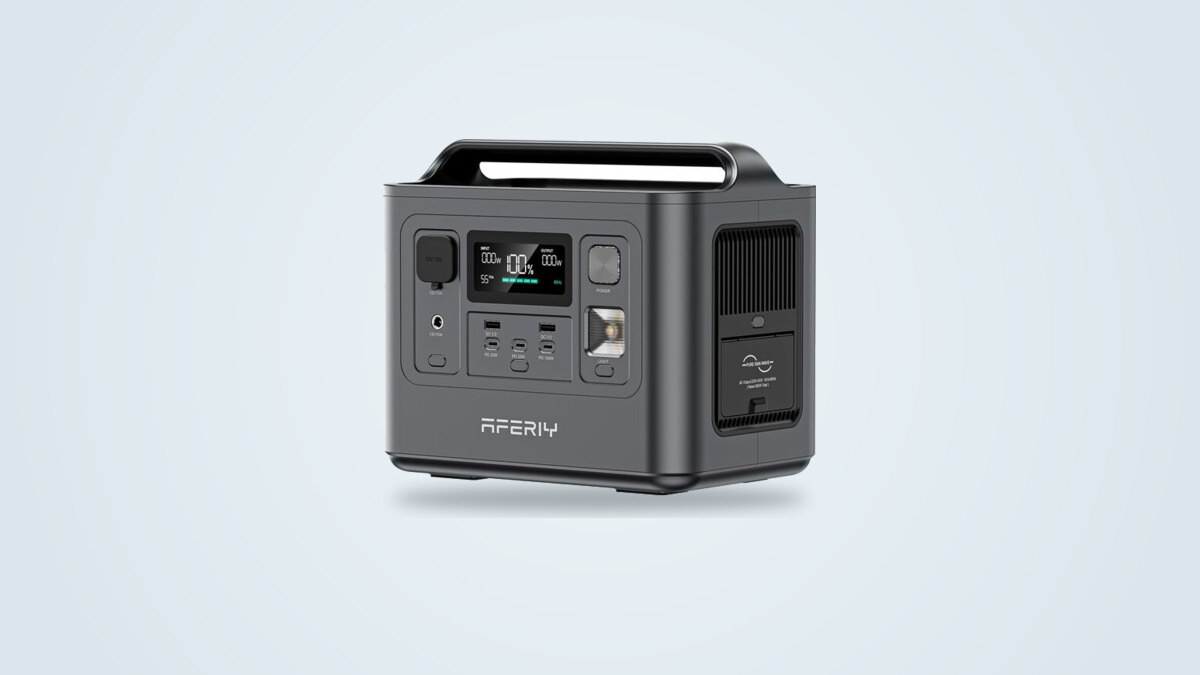
The P010 lines up eight outputs: one AC outlet, three USB-C ports (one at 100 W, two at 20 W), two USB-A QC3.0 ports at 18 W, a 12 V/10A DC6530 output, and a 12 V/10A car socket. The main USB-C port delivers 100 W over USB PD, enough to charge most laptops directly with no separate mains adapter. The US listing also carries a UL certification alongside CE, FCC, PSE, RoHS, and TELEC, a fuller certification list than many similarly priced rivals publish.
The front LCD screen clearly shows charge percentage, input and output power, and output frequency. No Bluetooth, no Wi-Fi, no app: control is entirely limited to that screen and the physical buttons, a simpler but less rich approach than newer, pricier models in the Aferiy lineup that add remote app monitoring.
Against its closest rivals, the port count stays broadly competitive: the Oukitel P800 offers a similar spread, also with a 100 W USB-C port, while the EcoFlow River 2 Max limits itself to a single 100 W USB-C port, backed by lower-power USB-A ports.
The warranty of up to 7 years: what each official page says
The warranty the brand highlights reaches 7 years. Across several other Aferiy references, that figure breaks down into a 2-year base automatically applied at purchase, followed by a 5-year extension conditioned on registering the product for free on the manufacturer's website within the stated window.
For the P010 specifically, the official channels don't fully agree: the printed manual shipped with some units lists a 2-year base without detailing that second stage, while the manufacturer's website and marketing reference registration up to 7 years. The safest move is to register the product online as soon as it arrives, and to keep proof of purchase, rather than assuming the longer figure applies automatically.
Either way, that warranty comfortably beats direct rivals of the same capacity and power: the EcoFlow River 2 Max is rated for 5 years, the Oukitel P800 for just 1.
Nomadic use, remote work, and backup: what the 512 Wh actually covers
For camping or nomadic remote work, the P010's 512 Wh cover a full day of charging a phone, a camera, or a laptop, with an LCD screen to track charge level in real time. The three USB-C ports let several devices charge at once with no power strip.
The UPS switchover, rated under 10 ms by the manufacturer, protects a desktop computer or a home router from a mains outage with no reboot or visible interruption. The pure sine wave output also suits sensitive medical electronics better than a modified sine wave inverter would: Aferiy markets the P010 specifically for CPAP backup on the US listing, since 512 Wh comfortably covers a full night for most machines.
That fast switchover says nothing about how it holds up over time, though. No independent protocol currently confirms how this function behaves over months of unsupervised standby, a fairly common situation for home or medical backup left without constant supervision. Running a few full cycles personally before relying on it for an unsupervised night of treatment is a reasonable precaution.
For heavier home backup (a fridge, a freezer, a sump pump), the 800 W ceiling and the single available AC outlet limit the exercise to one large appliance at a time, and 512 Wh drains quickly against a compressor that keeps restarting.
Against direct rivals in its class
In the crowded segment of 512 Wh, 800 W stations, the P010 runs into two direct rivals: the Oukitel P800, an almost exact match on paper, and the EcoFlow River 2 Max, less powerful but more established.
| Criterion | Aferiy P010 | EcoFlow River 2 Max | Oukitel P800 |
|---|---|---|---|
| Continuous / surge power | 800 W / 1600 W | 500 W / 1000 W | 800 W / 1600 W |
| Capacity | 512 Wh | 512 Wh | 512 Wh |
| AC outlets | 1 | 2 | 1 |
| Full mains recharge | 90 min | 60 min | 60 min |
| Rated cycles | 3500 to 85% | 3000 | 4000 |
| Warranty | up to 7 years | 5 years | 1 year |
| Weight | 14.3 lb (6.5 kg) | 13.4 lb (6.1 kg) | 13.2 lb (6 kg) |
Against the Oukitel P800, the P010 loses out on rated cycles (3500 versus 4000) and mains charging speed (90 minutes versus 60), but gains considerable ground on warranty length (up to 7 years versus 1). Against the EcoFlow River 2 Max, it offers more output power (800 W versus 500 W, 1600 W versus 1000 W surge), at the cost of one AC outlet instead of two and, in the worst case, a warranty two years shorter.
None of the three cancels the others out: the choice mostly comes down to what matters most, power and warranty for the P010, charging speed and cycle endurance for the Oukitel P800, dual AC outlets and brand track record for the EcoFlow River 2 Max.
Who it suits, who it doesn't
It suits anyone after a compact, light station (14.3 lb / 6.5 kg) for camping, nomadic remote work, or the occasional backup for small electronics, with a genuine need for fast charging and a long warranty to protect the purchase for years. The 100 W USB-C port also makes it a credible backup charger for a laptop on the move.
It suits less anyone who needs to run two mains appliances at once, anyone after app or Bluetooth control, or anyone counting on it for critical, unsupervised home backup where UPS reliability over time needs to be guaranteed rather than probable. Registering the product online on arrival remains the surest way to lock in the full 7 years of advertised warranty.