What the claimed 99.2Wh is really worth
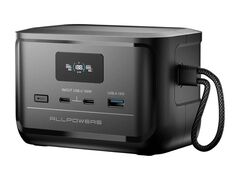
The Allpowers Solax P100 claims 99.2Wh, a figure worth unpacking before going any further. The pack strings together LiFePO4 cells in series under a nominal 16V, for a 6.2Ah capacity. The 31,000mAh figure often used in marketing is the same energy converted at the real nominal voltage of a LiFePO4 cell, 3.2V: 31 x 3.2 = 99.2Wh. That math holds up against the chemistry actually used, unlike a common practice on powerbank-style batteries that convert their mAh figure at a standard lithium cell voltage of 3.6 to 3.8V, inflating the advertised mAh number without changing the energy actually available.
What matters at checkout is how much of that energy actually comes out of the ports. A full discharge extracts 85Wh out of the claimed 99.2Wh, a rate of around 86%.
That rate sits in the upper range for a small, all-USB-C station: no conversion to alternating current, covered further down, removes a whole stage of losses that stations fitted with an AC outlet have to deal with. This figure remains the best estimate available to date for this specific model.
128W claimed, but never 200W across both ports at once
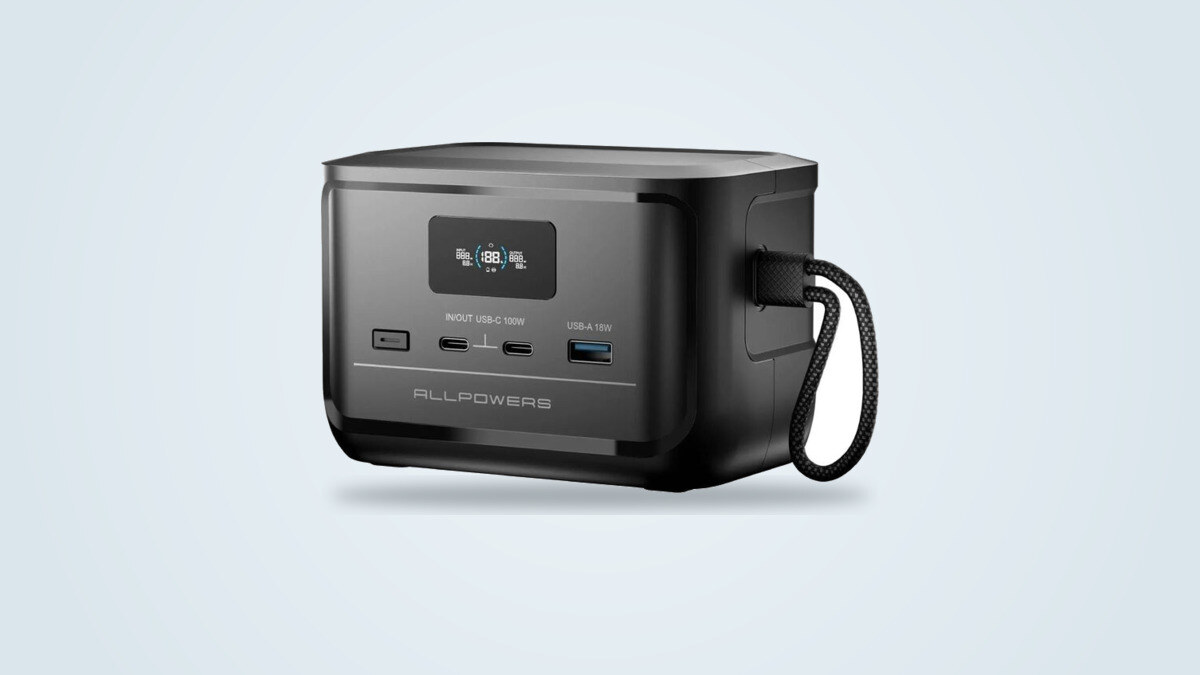
The spec sheet highlights two USB-C ports rated at 100W each, plus an 18W USB-A port, for a 128W total. That total is real and achievable, but not in the way a “2 x 100W” headline suggests: the two USB-C ports never deliver 100W each at the same moment. The manufacturer publishes the breakdown of possible combinations itself, a detail that never appears on marketing images but that the official spec table states without ambiguity.
| Ports in use | Maximum total power |
|---|---|
| USB-C1 alone (or USB-C2 alone) | 100W |
| USB-C1 + USB-C2 together | 110W (65W + 45W) |
| One USB-C + USB-A | 118W (100W + 18W) |
| USB-C1 + USB-C2 + USB-A | 128W (65W + 45W + 18W) |
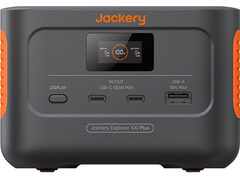
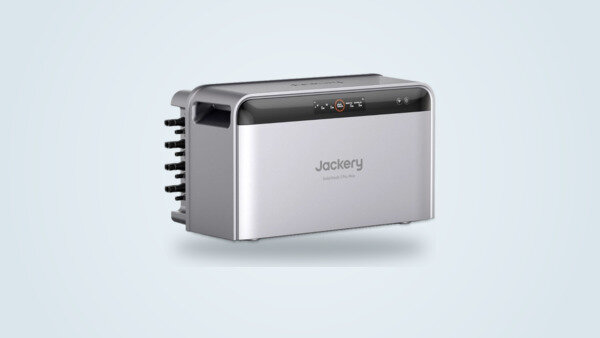
In practice, plugging two laptops into both USB-C ports at once never gives 100W to each: the station splits 65W one way and 45W the other, for 110W combined. A single demanding device gets the full advertised 100W; the moment a second device joins in, both share a common power budget. This behavior, common on stations this compact, is not a hidden flaw: it comes from a single shared conversion stage rather than two independent circuits, an architecture that keeps the case light and affordable. The Jackery Explorer 100 Plus, its closest direct rival, applies the same principle across its own two USB-C ports.
Charging: the product's real strong point
On paper, 99.2Wh going in at 100W works out to 59 minutes at perfect efficiency. No lithium battery charge ever reaches that figure: voltage climbs gradually near the end of a charge and current has to slow down for the last few percent, the same way any smartphone spends longer between 80 and 100% than between 0 and 80%. The Solax P100 is no exception: a full charge on its 100W USB-C port takes around 80 minutes, with input close to 93W to reach 80% in about 50 minutes, then input tapering to around 56W for the remaining 20% over the following 30 minutes.
Reaching that speed requires a USB-C charger that supports a 20V/5A profile: an older USB-C charger capped at 20V/3A (60W) will still charge the station, just noticeably slower. No wall charger ships in the box, only the USB-C cable and the manual: you already need, or must buy separately, a charger powerful enough to reach that advertised speed.
Solar charging (up to 100W, 18 to 27.2V input) and car charging (up to 60W, 11 to 17.5V) both run through the same USB-C ports: there is neither a standard car socket plug nor a dedicated solar connector on the case. For solar, a USB-C to XT60 adapter cable is required and is likewise missing from the box; the manufacturer recommends its own panels (SP027 and SE100, 100W each), though a third-party panel with a USB-C output within the stated voltage range works just as well.
No AC outlet: a deliberate choice, not a hidden flaw
The Solax P100 has only three physical ports: two USB-C and one USB-A. No 230V AC outlet, no inverter, so no conversion of the battery's direct current into alternating current. That choice partly explains the 86% output rate covered above: with no inverter stage to feed, stored energy travels straight from the battery to the USB ports through a single conversion stage instead of two.
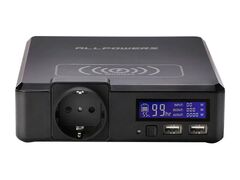
The trade-off is clear: no plugging in a lamp, a mini-fridge, a laptop charger with a standard wall plug, or any device fitted with a regular AC plug. Only devices that charge natively over USB-C or USB-A, or through an adapter from USB-C to their own connector, work with this station. That is a difference in kind from the Allpowers S200 (154Wh), which packs a genuine 200W AC outlet and wireless charging, at a higher weight and price.
There is also no UPS function (automatic switchover during an outage) on the Solax P100, which makes sense for a station with no AC output to switch over in the first place. Worth keeping in mind for anyone after a home backup reserve rather than a reserve for charging on the move.
Size and weight: the promise that actually holds
2.1 lb (950g) for a 5.04 x 3.54 x 3.46 in (128 x 90 x 88mm) case: the Solax P100 fits in one hand and slips into a backpack pocket without drawing attention. The matte black plastic case, dense in the hand, includes a braided strap built into the chassis, handy for hanging it up rather than setting it straight on the ground of a tent or a bag.
That last point matters more than it looks for a product built for travel: most airlines, in line with FAA guidance, allow lithium batteries up to 100Wh in carry-on without prior approval, require approval beyond that, and refuse them outright past 160Wh. At 99.2Wh, the Solax P100 sits just under that first threshold, while the Allpowers S200 (154Wh) falls into the middle band that requires prior approval. Exact rules stay airline-specific and are worth checking before departure, but the Solax P100's positioning is probably not a coincidence.
The missing solar cable: the headline feature meets the box
The box contains only the station, a USB-C cable and a manual. No wall charger, no solar cable. For the solar charging feature the product page leads with, a USB-C to XT60 adapter cable is required and costs extra: without it, there is no way to connect a standard solar panel fitted with an XT60 connector, the most common standard on folding panels on the market.
This is not an unlucky exception for the Solax P100: the Jackery Explorer 100 Plus, its closest rival, imposes exactly the same constraint with its own adapter cable sold separately. On this ultra-compact station format, leaving the solar cable out of the box looks like the segment's norm rather than an isolated penalty.
Once the right cable is in hand, compatibility extends beyond the brand's own panels: any panel with a USB-C output within the stated voltage range (18 to 27.2V, 100W maximum) works, including panels from other manufacturers fitted with a native USB-C output. Anyone who already owns a solar panel from another brand with an XT60 connector only needs to buy the adapter cable; a panel with a native USB-C output needs no extra accessory at all.
Build, certifications and warranty
LiFePO4 (lithium iron phosphate) chemistry remains the safest choice available at this price and capacity point: a stable crystal structure that pushes the temperature threshold at which a lithium battery runs away much further out, compared with denser but more heat-sensitive NMC chemistries. The 2000 cycles claimed before dropping below 80% of original capacity sit in the upper-middle range for recent stations of this size.
The warranty runs to 3 years, a year longer than the Allpowers S200 (2 years) and in line with current standards for this segment. The product claims FCC certification for the US market, plus the UN38.3 transport standard that applies to lithium batteries worldwide and is what allows this type of cell to travel by air and sea.
The Solax P100 carries, to date, no recall or safety incident of its own, on a product launched in mid-2024. Allpowers as a brand shows real after-sales weaknesses across several other products in its range (long response times, warranty replacements promised but never carried through): a cross-cutting point worth keeping in mind for any warranty claim, regardless of this specific model's own reliability. Like any lithium battery left unused for months, a slight self-discharge is normal: recharging it roughly every two months during long storage is a sensible precaution on any device of this kind.
Solax: an Allpowers product line, not a separate brand
The name “Solax” appears on the packaging, the case and part of the documentation, enough to raise a fair question: separate brand, or just a commercial label? The available evidence points to the second answer. On the manufacturer's own store, the spec sheet lists “ALLPOWERS” as the brand, and the product's full name usually reads “ALLPOWERS P100”, with “Solax” appearing only as a line prefix, the same way it does on a handful of the brand's compact solar panels (SE60, SE100, SE200). “Solax” designates a line of ultra-compact products inside the Allpowers catalog, not a separate legal entity.
One point is worth flagging to avoid mixing things up in a further search online: “SolaX Power” is the name of a publicly listed Chinese company that makes residential solar inverters and fixed energy storage, with no connection to Allpowers at all. The two names look alike, both companies are Chinese and active in solar energy, but their products have nothing in common: one makes inverters for rooftop photovoltaic panels, the other makes portable power stations and nomadic charging accessories. A search for “Solax” online easily mixes the two up.
Against the direct competition: Jackery Explorer 100 Plus and Allpowers S200
The Solax P100's product page already compares it with these same two references; this review goes a step further on what actually sets them apart in use.
| Criterion | Allpowers Solax P100 | Jackery Explorer 100 Plus | Allpowers S200 |
|---|---|---|---|
| Claimed capacity | 99.2Wh | 99Wh | 154Wh |
| Full charge (fastest input) | ~80 min (100W USB-C) | ~108 min | ~90 min (AC + USB-C combined) |
| 230V AC outlet | No | No | Yes, 200W |
| Ports | 2x USB-C 100W + USB-A 18W | 2x USB-C 100W + USB-A 18W | USB-C 60W + 2x USB-A + AC + Qi |
| Weight | 2.1 lb (0.95kg) | 2.1 lb (0.965kg) | 2.9 lb (1.3kg) |
Against the Jackery Explorer 100 Plus, the gap in capacity and ports is close to nil: same ports, almost the same claimed energy. The real difference sits in charging speed, clearly in the Solax P100's favor, and in each maker's stated approach: Allpowers highlights speed, while Jackery talks up a gentler charge that preserves the battery over the long run. Both approaches hold up, and the choice mostly comes down to how much weight a quick top-up carries against a more cautious charge.
Against the Allpowers S200, the difference is sharper and more structural: the S200 adds a genuine AC outlet, wireless charging and more capacity, at a higher weight and price. For anyone who only needs to recharge nomadic electronics, the Solax P100 gets the job done for less money and less weight; for anyone who also wants to power a device with a standard AC plug, the S200 remains the sensible choice.
Who the Solax P100 is for, and who should look elsewhere
The Solax P100 suits anyone who wants to keep electronics charged while traveling light, without needing an AC outlet: a smartphone, a tablet, a camera, a drone, or a laptop that charges over USB-C. Its weight and size make it a credible companion for multi-day hiking, a few days of business travel, or a nomadic work session somewhere with no outlet in sight. Its fast charge on a single USB-C port, provided the right charger is on hand, also suits anyone who wants to top up quickly between two meetings.
It does not suit anyone who needs to power a device with a standard AC plug (a lamp, a mini-fridge, a small appliance), anyone after a home backup reserve with automatic switchover, anyone who needs to charge it in freezing conditions (charging stops below 32 °F / 0 °C, even though discharge stays possible down to 14 °F / -10 °C), or anyone who wants to plug in a solar panel straight out of the box without buying an extra cable. In all of these cases, the Allpowers S200 or a more conventional station with an AC output will serve better.