Anker 75W Car Charger: our full review

A retractable USB-C cable built into the body, extending to 29.5 in (75 cm) and stowing itself away: the Anker 75W car charger bets on convenience over raw output, backed by a second USB-C port.

Our rating
4.0/5
Safety and protections: 4.2 out of 5 (weighting 20%)Safety4.2Build and endurance: 3.8 out of 5 (weighting 15%)Build3.8Actually delivered power: 4.0 out of 5 (weighting 25%)Power4.0Multi-port power sharing: 4.0 out of 5 (weighting 20%)Sharing4.0Protocol compatibility: 4.0 out of 5 (weighting 12%)Protocols4.0Size and technology: 3.8 out of 5 (weighting 8%)Size3.8

How is this rating calculated?

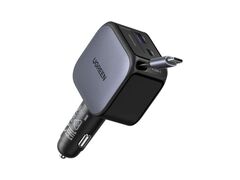
Anker 75W car charger with retractable USB-C cable extended

The essentials

The Anker 75W solves a simple problem with a simple idea: a retractable USB-C cable built right into the body, extending 29.5 in (75 cm) with a pull and stowing itself away. The 75W splits between the cable (45W) and a second USB-C port (30W), enough to charge two devices at once without any noticeable slowdown, and ActiveShield 3.0 technology keeps the whole thing safe. The cable is rated for over 12,000 bend cycles, but it stays thin and non-replaceable, a genuine point to watch over time. With only two outputs and 75W total, it does not rival the more powerful multi-port models from the direct competition. For anyone who mainly wants to stop hunting for a cable in the glove box, it is a clever, well thought out choice.

Strengths

  • Retractable USB-C cable built into the body, always at hand, never left behind
  • 75W intelligently split between the cable (45W) and a second USB-C port (30W)
  • Cable rated for over 12,000 bend cycles and 10,000 pull-and-retract cycles
  • Ultra-compact body (3.9 x 2.0 x 1.1 in / 100 x 50 x 29 mm, 2.7 oz / 77g), barely sticks out of the socket
  • ActiveShield 3.0 technology: continuous monitoring of temperature and voltage

Limitations

  • Thin, non-replaceable cable, with reported signs of wear after very heavy use
  • Only two outputs, against 3 or 4 on several direct rivals at equal or higher power
  • 75W total is modest next to models like the Ugreen 145W for multi-device use
  • No USB-A output, worth checking for anyone still relying on older cables or accessories
  • No independent measurement confirms the charging times Anker states
Anker 75W Car Charger: see the full details and price →

A built-in USB-C cable, the 75W's defining feature

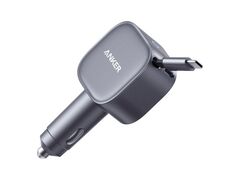
The Anker 75W car charger addresses a simple but frustrating problem: a charging cable forgotten at home or lost in the glove box. Instead of a bare USB-C port, it carries a retractable USB-C cable built right into the body, extending to 29.5 in (75 cm) with a single pull and retracting on its own once charging is done.

75 W
Total power
29.5 in
Cable length extended (75 cm)
2.7 oz
Body weight (77g)

75W split between the cable and a second port

The 75W splits between the built-in cable, delivering up to 45W over Power Delivery, and a second, standard USB-C port, up to 30W. Both outputs work at the same time with no noticeable slowdown on either, enough to charge a smartphone and a tablet, or a laptop and a phone, simultaneously. Anker states, for example, a MacBook Air (2022) charging from 0 to 50% in 34 minutes, and an iPhone 15 Pro in the same window in 25 minutes, figures from the manufacturer to treat as a general guide rather than a guarantee under every condition.

USB PD and PPS, broad device compatibility

The charger supports USB PD and PPS, covering a wide range of devices: iPhone 14 through 16, 14 and 16-inch MacBook Pro, 15-inch MacBook Air (M2), iPad Pro, AirPods, Apple Watch, as well as Samsung Galaxy S22 to S24 and Galaxy Tab S8/S9. Without a USB-A output, though, it will not directly suit anyone still relying on an older cable or accessory that needs one.

12,000 bend cycles, but a thin, non-replaceable cable

The retractable cable relies on manganese-steel bearings, rated for over 12,000 bend cycles and more than 10,000 pull-and-retract cycles. For normal family use, that rated durability comfortably covers several years of daily use.

Worth knowing: the cable stays thin and non-replaceable, unlike a bare USB-C port where you plug in your own cable. Signs of wear are reported after months of very heavy pulling, a point to watch for anyone planning to use it several times a day over a long period.

Compact body and ActiveShield 3.0 technology

The body stays ultra-compact (3.9 x 2.0 x 1.1 in / 100 x 50 x 29 mm, 2.7 oz / 77g), smaller than a computer mouse according to Anker, and barely sticks out of the socket once plugged in. ActiveShield 3.0 technology continuously monitors temperature and voltage, protecting connected devices against overvoltage, short circuits and overheating.

Against the Ugreen 145W and the Anker 167.5W 3-Port

How does the Anker 75W compare with other car chargers sought out for their retractable cable or their power?

Technical comparison: Anker 75W against its main alternatives (observed prices, indicative only)
CriterionAnker 75WUgreen 145WAnker 167.5W 3-PortLamicall 4-in-1 75W
Total power75W145W167.5W75W
Built-in retractable cableYes, 1 cable (29.5 in / 75 cm, 45W)Yes, 1 cable (27.6 in / 70 cm, 60W)No (cable sold separately)Yes, 2 cables
Outputs2 (cable + 1 USB-C)4 (cable + 2 USB-C + USB-A)3 (2 USB-C + USB-A)4 (2 cables + USB-C + USB-A)
Footprint3.9 x 2.0 x 1.1 in (100 x 50 x 29 mm), 2.7 oz (77g)Bulkier1.4 x 1.4 x 3.1 in (36 x 36 x 80 mm), 1.8 oz (50g)Bulkier
Observed price≈ $22≈ $42≈ $38≈ $24

The Ugreen 145W wins hands down on power and the number of devices charged at once, a better fit for a family car. Its own bigger sibling, the Anker 167.5W, offers more watts but no built-in cable, so none of the retractable convenience. The Lamicall 4-in-1 tempts with its price and two cables, with a brand track record less proven than Anker's. For anyone who mainly wants a reliable, compact accessory that gets rid of loose cables, the Anker 75W remains a solid pick, and at this price it is also the cheapest of the four.

Who the Anker 75W is for

This charger is aimed first at individual or couple use, for anyone who values the convenience of an always-present cable over the number of outputs. For a family car where several devices charge at once, or for anyone needing more headroom for a laptop, the Anker 167.5W 3-Port or the Ugreen 145W offer more margin.
The rating in detail

Our rating
4.0/5
Actual charging current not measured
Battery compatibility not measured
Safety and protections 4.2
Build and endurance 3.8
Cables and connectors not measured
Actually delivered power 4.0
Multi-port power sharing 4.0
Protocol compatibility 4.0
Size and technology 3.8
Format and chemistry compatibility not measured
Charging precision not measured
Display and control not measured
Anker 75W Car Charger: see the full details and price →

The product and its alternatives

Anker 75W Car Charger

Anker 75W Car Charger

See price (30)

A 29.5 in (75 cm) retractable USB-C cable built into the body: no need to bring your own. 75W in total to charge two devices at once in the car.

View product
Anker 167.5W Car Charger

Anker 167.5W Car Charger

See price (30)

Three ports, 167.5W in total and 100W on the first USB-C port: this ultra-compact Anker charger can even charge a MacBook Pro from your car's 12V socket.

View product
Ugreen 60W Car Charger

Ugreen 60W Car Charger

See price (22)

The compact, clever cigarette-lighter charger: 60W to charge 3 devices at once, with a 27.6 in (70 cm) retractable USB-C cable always to hand in the car.

View product

Frequently asked questions

Yes, it extends up to 29.5 in (75 cm), comfortably reaching the passenger seat or a center console. A light tug is enough to send it back into the body afterward.

Yes. The built-in cable delivers up to 45W and the second USB-C port up to 30W, for a total of 75W shared automatically between the two connected devices.

To an extent: up to 45W via the built-in cable or 30W via the USB-C port, enough to slow the drain or slowly charge an ultrabook on a trip, though it will not match a 65W-plus wall charger.

It is rated for over 12,000 bend cycles and 10,000 pull-and-retract cycles. Signs of wear are reported after very heavy use, but normal family use is not a concern.

Yes, it plugs into any standard 12V or 24V socket, found in almost every car, van and RV.