45W held, but not for long
The number 45 sits right in the product’s name, and it corresponds to a measurable reality: on a single active port, whether through the InstaCord cable or the separate USB-C port, power genuinely climbs to 45W. The 5V, 9V, 15V and 20V voltage steps are correctly negotiated with the connected device, and PPS support for Samsung and Google Pixel fast charging is unusually complete for such a compact case.
That 45W plateau does not last the whole charge, though: power drops to around 27W after 13 to 16 minutes of continuous charging, then to 20W for the final 20% of capacity.
This taper is not abnormal in itself, every power bank slows down towards the end of a charge to protect its cells. But the gap with the product’s own name is worth knowing before buying: 45W is the opening burst, not a speed it cruises at for the whole charge.
Anker highlights one specific figure to illustrate that opening speed: an iPhone 16 Pro is said to go from 0 to 50% in about 27 minutes. That is a figure the manufacturer states under its own test conditions, consistent with the 45W window described above, but it assumes only one device is plugged in from the start of the charge.
What happens with more than one device plugged in
Three outputs can work at once: the InstaCord cable, the extra USB-C port and the USB-A port. On paper, that is genuine versatility for such a small case. In practice, combined power collapses far faster than a simple proportional split would suggest.
The manufacturer’s own spec sheet caps combined output at 22.5W total, or 7.5W per port if all three are drawing power at once. As soon as a second port is active, every fast-charging protocol, PD, PPS and Samsung Fast Charging 2.0 alike, switches off entirely: each device then falls back to basic USB charging, far below the 45W shown on the box.
| Configuration | Power | Fast-charging protocols |
|---|---|---|
| A single active port | Up to 45W | PD, PPS, Samsung Fast Charging 2.0 |
| Two or three active ports | 22.5W total, about 7.5W each | None, basic charging only |
For anyone charging one device at a time, exactly the scenario shown on the product’s own marketing shots, this limit never shows up. It becomes a real drawback the moment you want to power a phone and a pair of earbuds, or a phone and a smartwatch, at the same time: both drop to slow charging with no fast protocol active at all.
The InstaCord mechanism, day to day
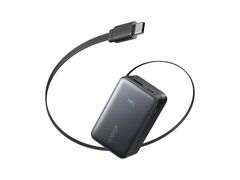
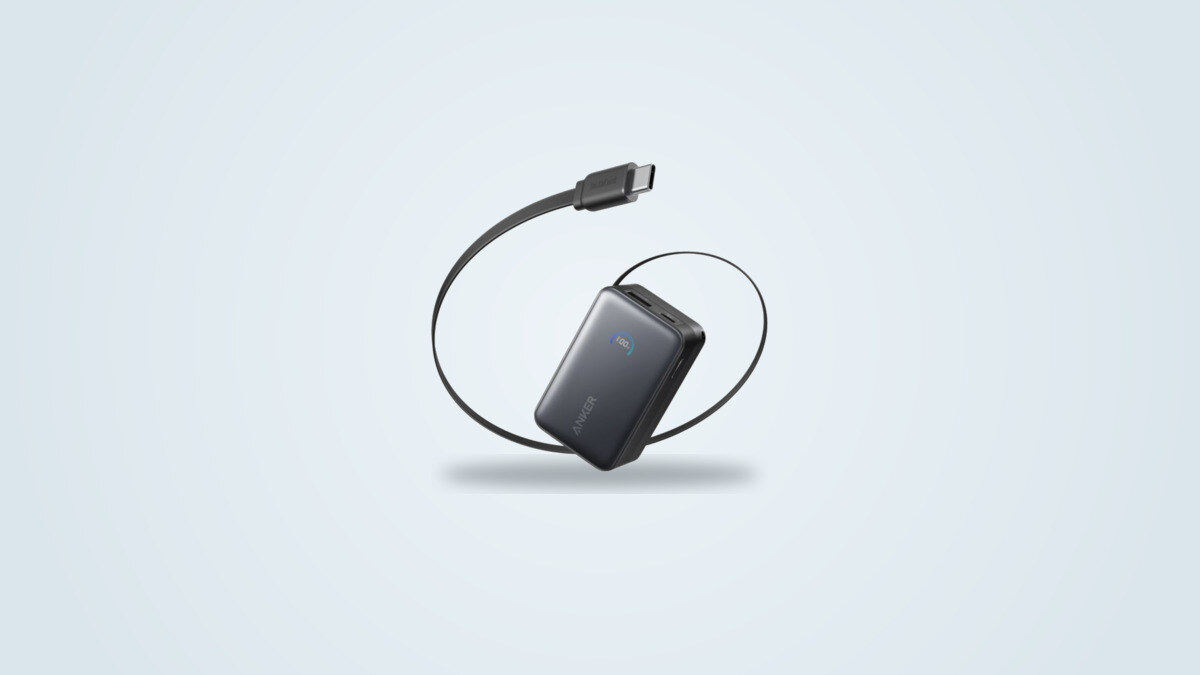
This is the product’s whole pitch. Instead of a fixed cord permanently sticking out of the case, a roller mechanism lets you pull the USB-C plug to unspool the cable, ease off slightly to lock it at the length you need, then let it wind itself back in once charging is done.
The length adjustment is not continuous but works through 8 fixed steps between 2.8in and 27.6in (7cm and 70cm), a detail missing from the main official marketing pages. In practice, that lets you set the cable to the exact distance between the power bank sitting on a table and the phone’s port, with no loose slack trailing about.
The cable sleeve is rated 73% thinner than the brand’s first generation of built-in cables, and Anker rates the mechanism itself for over 20,000 bends and 20,000 pulls. That figure is a manufacturer rating, with no public accelerated-aging test of this specific mechanism to check it against. Absent that kind of track record, it is best read as an engineering promise rather than a proven guarantee over time.
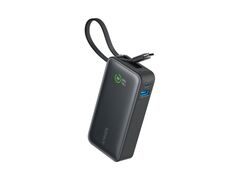
The principle is still worth distinguishing from the fixed built-in cables already common across the Nano range: here, the cable never dangles outside the case when it is not in use, which limits the snag points and the constant twisting at the joint, a frequent wear point on fixed cables.
What the rated 37Wh is actually worth
The 10,000mAh printed on the case is the sum of two cylindrical 21700 cells, badged SunPower (Changhong Sunpower), each rated 5,000mAh at 3.6V and wired in series. The pack therefore actually runs at 7.2V for about 36Wh stored, very close to the 37Wh quoted on the spec sheet once the calculation method is aligned.
That detail is not trivial: it departs from the chemistry usually associated with this kind of compact power bank. Where a flat pouch-style polymer cell is common in this format, this one packs rigid cylindrical cells instead, a layout closer to larger power banks than to the slimmest models on the market.
Out of that 36 to 37Wh stored, 37Wh does not come back out of the USB port: across five different charging conditions, actual delivery sits between 27.4Wh and 31.5Wh, or 74% to 85% of rated energy depending on the voltage and current drawn.
Here too, the closer the output voltage sits to the pack’s own 7.2V, the better the converter’s efficiency: the most favorable 31.5Wh figure comes at low current (5V, 1A), while faster or lower-voltage charging drops back to 27.4 to 27.5Wh. For everyday phone charging, which typically negotiates an intermediate voltage near 9V, real-world delivery sits towards the upper end of that range.
Recharging the bank itself
The bank accepts up to 30W in, on the USB-C port as well as through the InstaCord cable. Anker states around 2 hours for a full cycle; in practice, a full recharge takes closer to 1h53, with peak input near 32W.
That 30W is a decent input for this format, ahead of the 10 to 18W still common on rival compact power banks, though it does not match the 65W-plus input of some higher-capacity models. Pass-through charging is supported: you can charge a phone while the bank itself tops up on wall power, without waiting for one cycle to finish before starting the other.
No wall charger is included in the box, just the bank itself. A USB-C adapter rated 30W or higher, sold separately, is needed to reach the charging speed quoted above; with a more modest charger, a full top-up will take noticeably longer.
The display and thermal monitoring
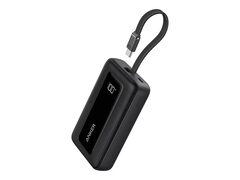
A small light-sensitive display shows the remaining charge percentage, the power delivered on each active port and the battery temperature, all in real time. That is a rare level of detail on a case this size, most rival compact power banks make do with four LEDs or a bare percentage.
Thermal monitoring relies on Anker’s ActiveShield system, which runs over 6 million temperature checks a day to head off overheating. The case gets noticeably warm to the touch during a sustained full-power charge, a pattern consistent with the 45W plateau and the power taper described above: it reads as a thermal response from the system rather than an isolated fault.
No unexpected safety cutoff and no hardware damage tied to that warmth turned up, only a stronger sense of heat than on a less powerful bank used under the same conditions. It is worth keeping in mind for anyone charging it in a pocket during a fast charge, not a red flag.
What is inside the case
The main charging controller is an Injoinic IP5385, a chip widely used across the power bank industry to manage fast-charging protocols, backed by a Chipsea CS32L015K8V6 microcontroller that handles the display among other things. The conversion stages run on five low-resistance Leadteck LTS7906FL transistors, and protection for the two series cells is handled by a dedicated CreWin CM1020-H circuit.
Inside, generic cushioning foam sits alongside a modular build: main board, retractable-cable module and cell pack assembled separately rather than glued into one solid block. Nothing in that construction points to an undersized component or a rushed finish.
The manufacturer warranty runs for 24 months, a standard length for this price bracket. No official recall turned up for this specific model in this research, neither on regulatory databases nor on the manufacturer’s own communication channels.
Size and weight, day to day
The bank measures 3.21 x 1.99 x 1.42in (81.5 x 50.5 x 36mm) for 8.1oz (231g) on the scale. Anker markets it as 16% smaller than its classic fixed built-in-cable models.
The shape still feels denser in hand than a flatter bank of the same capacity: the case is noticeably thicker than its predecessor, the Nano 30W, to make room for the retractable mechanism inside. The weight gap between the two, 8.1oz against 7.6oz (231g against 215g), is modest on paper, but it comes on top of a thicker, denser case, two traits that add up more on a format meant to live in a pocket all day.
At a rated 37Wh, or about 36Wh at the pack level, the bank sits comfortably under the 100Wh cabin limit tolerated without special permission by most airlines, a reassuring point for anyone who travels with it often.
Versus the Nano 30W and direct rivals
The most useful comparison is with its own predecessor, the Anker Nano 30W, already reviewed on this site. Both share the same rated capacity and the built-in-cable idea, but they diverge on three structural points.
| Criterion | Nano InstaCord 45W | Nano 30W | Belkin UltraCharge 20K |
|---|---|---|---|
| Built-in cable | Retractable, 27.6in (70cm), 8 steps | Fixed | Fixed |
| Output power | 45W (one port) | 30W (one port) | 45W |
| Weight | 8.1oz (231g) | 7.6oz (215g) | 13.8oz (390g) |
Against the Nano 30W, the InstaCord charges faster on a single device and swaps the fixed cable for a more practical retractable mechanism day to day. In exchange, it weighs 0.6oz (16g) more and its power drop the moment a second port joins in is proportionally harsher: the Nano 30W keeps 24W shared across two devices, where the InstaCord falls to 22.5W with fast protocols switched off entirely.
Against the Belkin UltraCharge 20K, a direct rival on paper power, the InstaCord stays more compact, but with half the capacity: the comparison only really matters for anyone who rates format above total capacity.
Who it suits
This bank targets one specific person: someone who charges a single device at a time, chiefly a phone, and wants the cable to just be there without ever thinking about it. On exactly that ground, it is hard to fault, the InstaCord mechanism works as advertised, the opening power is real, and the display gives solid information rather than guesswork.
It suits three situations less well. Anyone wanting to fast-charge two devices at once will hit the complete shutdown of fast protocols the moment a second port is used, a genuine limit rather than a minor slowdown. Anyone chasing the lowest possible weight for equivalent capacity will find flatter fixed-cable models a few tenths of an ounce lighter. And anyone who wants a long reliability track record before buying will not get one yet, the retractable mechanism is still too recent for that, even though nothing in this research raised a red flag.
For everyday or on-the-go phone charging, without ever worrying about the cable, it remains one of the most polished entries in Anker’s whole Nano range.