Qi2 15W against standard Qi and the Prime's 25W
The Anker Nano cigarette lighter charger runs on Qi2, an evolution of the wireless charging standard that adds a ring of magnets directly inspired by MagSafe. That addition fixes the historic problem of wireless charging in a car: alignment. On a standard Qi charger, placing the phone even a few millimeters off the center of the coil is enough to cut the power it receives, a real annoyance the moment the road gets bumpy. With Qi2's magnetic alignment, the phone centers itself on the coil and stays there, even on a rough surface.
That automatic alignment lets the Nano make full use of the 15W allowed under the current Qi2 standard, against 7.5W for a standard Qi cigarette lighter charger without magnets. The product page itself cites an iPhone 16 Pro gaining 20% charge in 16 minutes, twice as fast as on a standard 7.5W charger, a manufacturer figure that no independent measurement has confirmed to date.
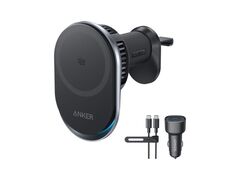
The Nano isn't the top of this Anker lineup, though. The newer, pricier Prime pushes the same Qi2 magnetic alignment up to 25W thanks to active cooling the Nano lacks. The Nano is therefore the logical entry point into this category: it delivers the essentials, automatic alignment and a steady 15W, without the added cost of active cooling or the compatibility restriction that comes with it on the Prime, whose full potential stays limited to updated iPhone 16 and 17 models.
16N magnets, but a ceiling set by the standard itself
The phone is held by magnets rated 16N by the manufacturer, stronger than the Prime's 13N despite the Prime costing more and arriving later, and stronger than the roughly 12N typically found on direct rivals like Belkin or ESR on equivalent magnetic car mounts. An entry-level charger can therefore hold on tighter than a premium model from the same brand, the real difference between the two lying elsewhere, in charging speed and thermal management rather than raw magnetic strength.
The manufacturer itself explains a limit shared by every Qi2 charger: the standard caps the usable magnetic force, specifically to keep accessories and phones from different brands compatible with one another. A Qi2 charger can't simply bolt on stronger magnets to improve its grip, unlike a proprietary mount that would be free of that constraint.
Another useful detail from the manufacturer: the magnetic pull on the phone-facing side of the pad is weaker than on the mount-facing side. In practice, that means that when detaching the phone from the charger, the pad is more likely to stay stuck to the phone than the other way round, a counter-intuitive behavior worth knowing before mistaking it for a fault. The manufacturer recommends using the original case with its magnetic plate, or a compatible case, to limit this.
The memory-alloy arm and the 3M adhesive: an install that punishes improvisation
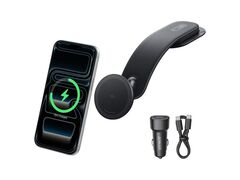
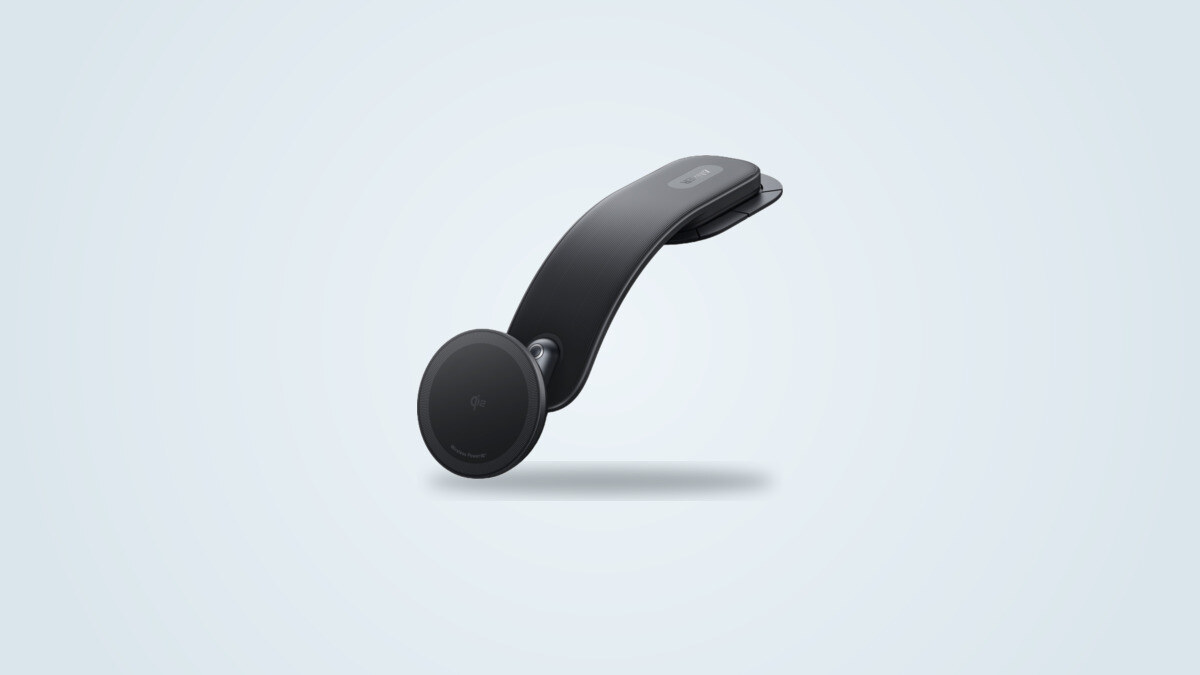
The mount attaches with an automotive-grade 3M adhesive, rated by the manufacturer to hold up to 22.5 lb (10.2 kg) and withstand up to 140 °F (60 °C), a relevant figure for an accessory left facing the sun in summer. This deliberately large oval base (3.7 x 2.5 in (93 x 63mm) according to the manufacturer) improves load distribution and shear resistance, at the cost of a more visible footprint on the dashboard than a simple suction mount.
Unlike a mount that clips onto an air vent and moves in seconds, installing the Nano is therefore near permanent once the adhesive is applied: moving the mount to another car, or even just repositioning it on the dashboard, means starting the whole process over. In exchange, this method works on surfaces no air vent serves, including a touchscreen or windshield, and sidesteps entirely the vent-blade shape or depth issue that rules out certain vehicles for vent-clip rivals (Tesla, Mercedes-Benz and Honda, in the case of the Prime).
The memory-alloy arm bends up to 180° to follow a curved dashboard, and the manufacturer notes it's normal to need some force to adjust it, deliberate resistance meant to avoid play or rattling while driving. Once positioned, the pad rotates a full 360° and tilts up to 45°, enough to switch between portrait and landscape depending on the app in use without removing the phone.
The manufacturer's promise, 20% in 16 minutes, and its hidden conditions
The Nano's central selling point is a comparison: an iPhone 16 Pro gaining 20% charge in 16 minutes, twice as fast as a standard 7.5W wireless cigarette lighter charger. That figure comes from the manufacturer's own internal testing, carried out under conditions it doesn't fully detail (ambient temperature, starting charge level, exact iPhone model).
The manufacturer's own support documentation spells out several conditions that qualify this promise. First, the 15W figure assumes a power source of at least 20W; below that, the charger can't deliver its full output, not a risk with the included 25W adapter but one that appears if that adapter is swapped for a weaker cigarette lighter charger already on hand. Second, charging speed adjusts dynamically based on battery level, temperature and device condition, described as normal behavior built in for safety.
The most concrete caveat concerns the very use case this mount is built for: the manufacturer explicitly states that using the phone at the same time as it charges, for instance to follow turn-by-turn navigation, reduces charging speed. Yet a cigarette lighter charger overwhelmingly exists to power a phone while it displays a map continuously, exactly the situation where its output drops. That's not a hidden flaw, but a physical trade-off rarely spelled out this plainly by a manufacturer.
iPhone and case compatibility: the exclusions matter as much as the inclusions
The Nano is designed and certified for iPhone 12 to 17, with one notable exception: the iPhone 16e. That's not an arbitrary choice by Anker: the iPhone 16e shipped without the built-in MagSafe magnets on the back of its case, a hardware difference rather than a simple software setting. No case and no update can make up for that, the phone simply won't clip onto the mount.
For every other compatible model, the case in use heavily shapes the outcome. The manufacturer recommends a magnetic case, either official MagSafe or with a built-in Qi2 ring, no more than 0.1 in (2.5mm) thick. A metal case, a non-magnetic case, or one fitted with a card holder, key holder or pop grip degrades alignment and therefore charging efficiency, or can prevent the magnetic hold from working at all while driving.
| Setup | Effect on charging |
|---|---|
| MagSafe case or Qi2 ring, under 0.1 in (2.5mm) | Normal 15W charging |
| Non-magnetic case | Degraded alignment, slower or no charging |
| Metal case or attached accessory | Possible interference, charging not guaranteed |
| iPhone 16e | Incompatible, no built-in MagSafe magnets |
On the Android side, the Nano carries no official certification: the manufacturer designs and tests it for the iPhone ecosystem. An Android phone fitted with a compatible magnetic-ring case can theoretically clip on and charge in free placement, with the manufacturer guaranteeing neither the power delivered nor the reliability of the hold in that scenario.
Footprint and how discreet it looks on the dashboard
With no fan or active cooling module, the whole unit stays compact and light: the manufacturer states about 5.7 oz (161.5g) for the complete mount (arm, ball joint and pad), a figure that puts the Nano well below a system with a built-in fan like the Prime. The mount's overall footprint reaches 8.15 x 2.36 x 1.8 in (207 x 60 x 46mm) once extended.
The trade-off for this light weight shows up on the dashboard footprint: the 3.7 x 2.5 in (93 x 63mm) adhesive base is deliberately large, with the manufacturer explaining that this surface improves load distribution and lowers the risk of the mount peeling off over time. A smaller base would look more discreet but hold up worse over time, a fairly classic trade-off for this type of permanent mount.
On the technology side, the absence of any moving part (no fan, no Peltier module) makes the whole assembly simpler than the Prime's, at the cost of a charge that gets no active thermal regulation in a hot cabin. That's a trade-off consistent with the Nano's price point, not a design flaw in itself.
Against the Anker Prime 25W: what the lower price leaves out
The Nano and the Prime share the same underlying technology, Qi2 magnetic alignment, but they're built for different needs. The table below sums up the most meaningful gaps between these two mounts from the same manufacturer.
| Criteria | Anker Nano 15W | Anker Prime 25W |
|---|---|---|
| Wireless power | 15W (Qi2) | 25W (updated iPhone 16/17) |
| Active cooling | No | Yes (TEC + fan) |
| Magnet strength | 16N | 13N |
| Mounting | 3M adhesive, near permanent | Air vent, removable |
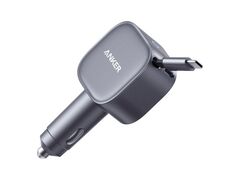
| Adapter included | 25W, 1 port | 60W, 2 ports |
| Price positioning | Affordable | Noticeably higher |
That lower price leaves out three specific things: 10W of maximum power (reserved anyway for updated iPhone 16 and 17 models on the Prime), the active cooling that limits heat build-up on long drives, and the adapter's second port that allowed charging an extra device. In exchange, the Nano offers stronger magnets and an adhesive mount that works on vehicles with no compatible air vent at all, Tesla, Mercedes-Benz and Honda among them, three brands explicitly excluded from the Prime's compatibility list.
The choice between the two really comes down to one factor: anyone who drives a lot with navigation running continuously on a recent iPhone gets more value from the Prime, while more occasional use, an older iPhone, or a vehicle whose air vent doesn't suit a clip-on mount naturally points toward the Nano.
Build quality, safety and warranty
The Nano carries the manufacturer's MultiProtect system, combining foreign object detection, radiation shielding, overvoltage protection and overcurrent protection. The unit complies with the IEC 62368-1 safety standard, the basis for the UL 62368-1 certification used in the US market for this type of consumer electronics.
The absence of a fan or active cooling module removes one moving mechanical part compared with the Prime, a point that favors long-term reliability: the fewer moving parts a device has, the fewer potential failure points it carries over years of use in a cabin exposed to dust and temperature swings. No recall or recurring build defect has been reported for this model to date.
The commercial warranty runs 24 months at Anker, in line with the brand's usual standard on its charging accessories. The product has been on sale for a bit over a year at the time of writing, a still-limited track record but a longer one than the newer Prime.
Who it's for, and who should look elsewhere
This charger makes the most sense for anyone who wants to try magnetic wireless in-car charging without paying extra for active cooling, drives a vehicle whose dashboard has no air vent suited to a clip-on mount, or simply owns an iPhone that wouldn't benefit from the Prime's 25W anyway (every model except an updated 16 or 17). The 16N magnets and the high-strength adhesive make it a particularly solid choice for a car used daily on uneven roads.
It makes less sense for anyone chasing the fastest possible charge with navigation running continuously on long drives (the Prime does better here), anyone who wants to move their mount easily between cars (the adhesive makes that a chore), anyone with an iPhone 16e or an Android phone without a compatible magnetic case, or anyone who wants to charge a second device directly from the included adapter, limited to a single output.