The 20W on the Label, Genuinely Available at the Port
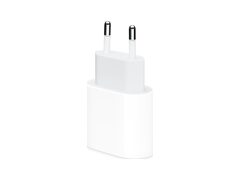
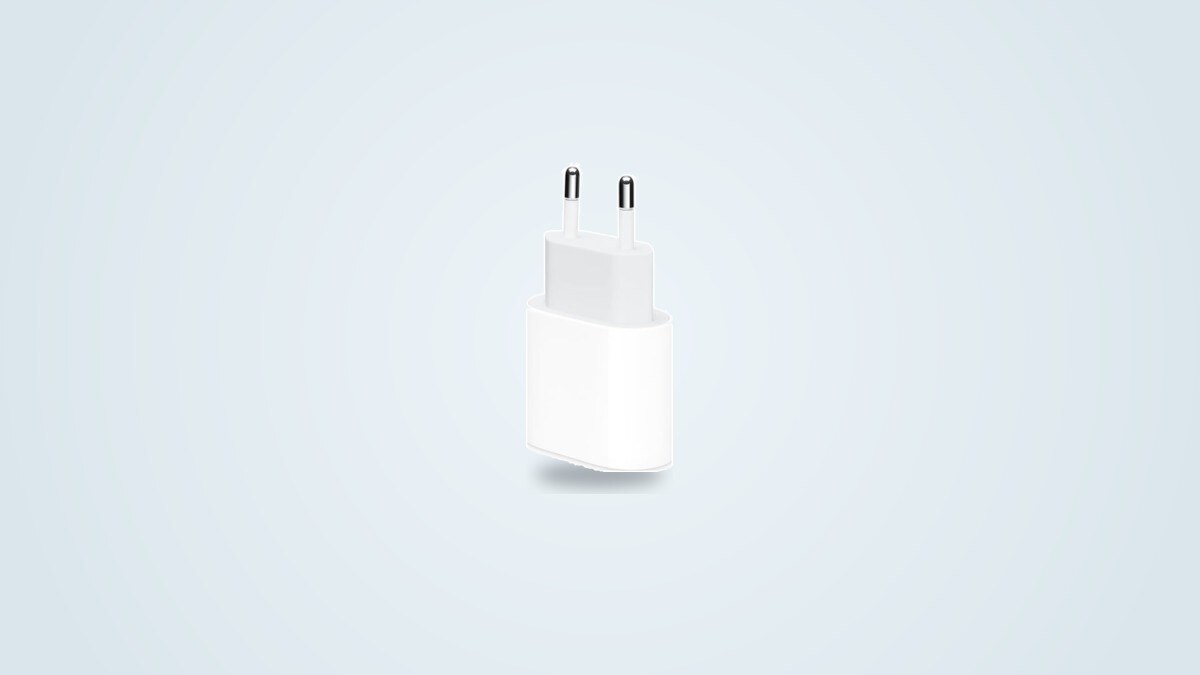
Launched in 2020 to replace the 5W, then 18W charger that used to ship with the iPhone, this model has remained Apple's standard entry-level USB-C wall adapter ever since. The figure in its name matches what its single port genuinely delivers: two fixed USB Power Delivery profiles, 5V at 3A and 9V at 2.22A, for a maximum output very close to 20W. No intermediate protocol, no hidden step: a compatible device negotiates one of these two profiles and receives the matching power, with no gap between the marketing name and what actually comes out of the port.
Conversion efficiency, the share of the power drawn from the mains that actually comes out as USB-C, varies with the load: it sits around 83% at light load and climbs to 88.8% at full power, a typical profile for a switching supply this size, more efficient near its rated capacity than below it. An iPhone plugged in at full charge can draw up to roughly 19W at the port, nearly the entire 20W rating: the advertised figure matches what a recent device can actually pull, not a theoretical ceiling.
On heat, the shell stays at moderate temperatures even under sustained full-power charging, with the warmest spot on the underside rather than the top. The adapter does not appear to reduce its output after prolonged charging, unlike far more powerful models that step down after a few dozen minutes of sustained use: at the scale of its 20W, the promise holds over time, not just at the first plug-in.
A Single Port, So Nothing to Share
Unlike multi-port chargers that must divide their power between several devices plugged in at once, this adapter offers only one USB-C port. The sharing question, central on a 3 or 4-output model where total power drops as soon as several devices are connected together, simply does not arise here: the port always has the full 20W available, whichever device is connected.
This choice has an obvious downside: charging several devices at once means one adapter per device, where a multi-port model gathers everything into a single unit on a single outlet. For a household with several Apple devices to charge every evening, that can quickly mean several separate bricks plugged into different outlets rather than one central charger.
In exchange, the electrical simplicity of a single port removes every possible throttling scenario: no sharing table to remember, no port priority to guess, no risk that a device plugged in last is left with only a residual trickle. What the port promises, it delivers in the only usage scenario that exists, since there is only one: itself, with a single device on the other end.
Full Compatibility with Apple, More Limited with Android
The adapter handles USB Power Delivery on its two fixed profiles (5V/3A and 9V/2.22A), without support for PPS (Programmable Power Supply) or AVS, the protocols that fine-tune voltage in small steps to reach the fastest charging speeds. Within the Apple ecosystem, this limit has no consequence at all: iPhone, iPad and AirPods use neither protocol, and get everything the port can offer.
On the Android side, the effect is real. Samsung Galaxy phones reserve their fastest charging speeds (25W or 45W depending on the model) for PPS-compatible chargers: plugging a Galaxy into this Apple adapter charges it normally, but only through the standard fixed steps, without reaching its top rate. Google Pixel phones and most other standard USB PD Android devices, by contrast, charge without any particular restriction on this model.
On iPhone specifically, the power needed for the fastest charging speed keeps rising with each recent generation.
| Device and charging mode | Minimum Apple adapter | Does this 20W work? |
|---|---|---|
| iPhone 8 to iPhone 17e, wired charging | 18W | Yes, slightly exceeds it |
| iPhone 15 and earlier, 15W MagSafe | 20W | Yes, exactly the threshold |
| iPhone 16 and later, fast MagSafe | 30W | No, falls short |
| iPhone 17 / 17 Pro / 17 Pro Max, fastest wired charging | 40W | No, charges normally but slower |
This 20W adapter therefore remains a sound choice for the vast majority of iPhones in use today, and it is in fact exactly the threshold Apple itself recommends for fast 15W MagSafe wireless charging on the iPhone 15 and earlier. It is less well suited to the newest lineup if the goal is the fastest wired charging speed those models can reach.
Beyond the iPhone: iPad, AirPods and Generic USB-C Devices
Apple explicitly recommends this adapter for charging the iPad Pro and iPad Air, two lineups it ships with depending on configuration. On these tablets, its 20W will not reach the fastest charging speed the larger models support, which accept more powerful adapters, but it covers a normal day-to-day charge without any issue. AirPods, which only need a few watts, obviously have no trouble with this port either, just like any USB-C charging case on the market.
Beyond the Apple ecosystem, the standard USB-C port works with any USB Power Delivery compatible device: cameras, e-readers, headphones, small speakers, or certain laptops with very light standby or top-up charging needs. The 20W ceiling obviously rules out fast-charging a typical laptop, which usually needs 45W or more, but it is enough to maintain or slow the discharge of a device plugged in for light use.
The Weight Apple Publishes Nowhere
Unlike most of its other accessories, Apple lists neither weight nor precise dimensions for this adapter on its official product page.
Figures available elsewhere converge around 1.9 to 2.0 oz (55 to 58 g), for a shell roughly 1.77 x 1.46 x 0.94 in (45 x 37 x 24 mm), folding prongs included.
This small gap between sources likely comes down to the regional version (US flat prongs and European folding round prongs do not weigh quite the same) and to the different generations of internal components covered further down. This lack of an official figure is not a small thing for an accessory whose compact size is itself part of the sales pitch: there is no way to objectively compare its advertised weight to a rival's, since that advertised weight simply does not exist on Apple's side. In practice, the size stays close to that of a large sugar cube, well within the norm for a single-output 20W charger, without standing out either way.
One Reference, Several Generations of Internal Electronics
Sold with no change to its outward look or commercial reference since 2020, this charger has nonetheless changed internal components several times. The control chip, the transformer and the rectifier stage have each been replaced more than once over the years, to the point that at least 4 distinct versions of the internal electronics exist today under one single external reference.
In practice, a unit bought today can contain meaningfully different electronics from one bought in 2020 or 2022, with nothing on the packaging, the label or the shell to reveal it at the point of sale. Output power and the overall efficiency profile stay equivalent from one version to the next: this is not a gradual decline, more a quiet string of manufacturing optimizations, cost or component availability, that Apple never announces publicly.
For the buyer, the day-to-day consequence is nil: the advertised performance, the 20W and the two PD profiles, holds regardless of which version arrives in the box. It is still worth knowing out of technical curiosity, and it explains why two units of the same model bought years apart can show different internal references if ever repaired.
Without GaN, a Shape That Shows Its Age Next to Newer Rivals
This charger relies on a classic silicon switching design, without gallium nitride (GaN), the technology most rival brands now use to shrink wall chargers of equal or higher power. Direct consequence: at 20W, this shape stays closer to chargers sold several years ago than to recent GaN models.
| Model | Power | Technology | Catalogue price |
|---|---|---|---|
| Apple 20W USB-C | 20W | Silicon, no PPS | $17.99 |
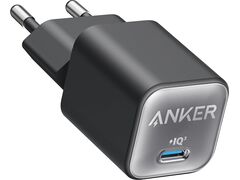
| Anker Nano 3 (511) | 30W | GaN, PPS | $15.99 |
| Belkin BoostCharge 30W | 30W | PPS, USB-IF certified | $32.99 |
The Anker Nano 3 delivers 10W more in a shell advertised as 70% smaller than a classic charger, and actually costs less than this Apple adapter in our catalogue. The Belkin BoostCharge 30W adds PPS support and USB-IF certification, but at a noticeably higher price in the US, nearly double this Apple adapter, unlike the picture on eurozone markets where that same Belkin model typically undercuts Apple's charger instead. Technically, the lack of GaN changes nothing about reliability or the power actually available at Apple's port: it only affects bulk and, to a lesser extent, how wide its compatibility runs with the newest Android phones.
For anyone who values the brand first and the guarantee of flawless Apple compatibility, that trade-off stays secondary. For anyone chasing a smaller, more powerful charger at a lower price too, the Anker Nano 3 beats this Apple adapter on every count; the Belkin alternative wins on size and speed but not on price in the US market.
Safety and Reliability: A Clean History, an Occasional Hum
No safety recall covers this model since its 2020 launch. That clean record is worth noting given that Apple mains adapters have, in the past, been the subject of very real recalls in several markets: older two- and three-pin travel adapters sold internationally between 2003 and 2015 carried a real shock risk if they cracked, and were recalled at scale outside the US. That risk concerned an entirely different type of accessory, a mains plug adapter rather than a USB charging brick, and never touched the USB-C charger range in any market, the US included.
The shell includes the standard protections expected on this type of product, cutting out on overvoltage, overheating or a short circuit, consistent with the standard one-year manufacturer warranty on an Apple accessory. A faint electrical hum, a trait common to switching power supplies running at high frequency, shows up on some units without affecting charging: this is not really a manufacturing fault, more an audible quirk of the technology, most noticeable in a quiet room with an ear close to the shell.
The one-year warranty, standard for Apple, sits at the low end of the market: several rivals offer 18 to 24 months on comparable products, without that necessarily reflecting any real difference in reliability.
An Extra Cable, and an Official Price Higher Than It Looks
Like most wall chargers sold separately today, this adapter includes no cable in the box. A USB-C to USB-C cable is needed for an iPhone 15 or later, as well as for most recent iPads, or a USB-C to Lightning cable for an iPhone 14 or earlier, bought separately.
On price, the gap between Apple's own store and a partner retailer is real, if modest. Apple's own listed price sits around $19, against $17.99 through a partner retailer in our catalogue, a modest saving on the same product, smaller than the gap seen on eurozone markets for the same adapter.
Price against power is a mixed picture here: dollar for watt, this charger actually costs less than the Belkin BoostCharge 30W below, which runs nearly double the price in the US despite delivering 10W more, though it still costs more per watt than the Anker Nano 3 above, which undercuts this Apple adapter on both price and power. The difference comes down mainly to the brand and to flawless compatibility with the rest of the Apple ecosystem, not to a consistently better or worse power-to-price ratio.
Who This Adapter Suits, and Who It Does Not
This charger makes the most sense for anyone who already owns one or more Apple devices, iPhone 8 or later, iPad, AirPods, and wants a reliable spare to leave at the office, at a relative's place or in a travel bag, without worrying about compatibility or charging protocols. It also works perfectly as a MagSafe charger for 15W fast wireless charging on an iPhone 15 or earlier, a use case Apple explicitly names it as the minimum adapter for.
It suits a mostly Android household less well, Samsung Galaxy owners especially, who will never reach their fastest charging speed on this adapter for lack of PPS support. Owners of an iPhone 17, 17 Pro or 17 Pro Max chasing the fastest possible wired charge will also do better elsewhere, since this model sits well below the 40W now needed to reach it. Finally, anyone chasing the smallest, lightest possible shape, down to the ounce, will find better answers among recent GaN models, often for less money too.
For every other use, it is a choice with no bad surprises: the advertised power is genuinely available, compatibility with the Apple ecosystem is total, and the product's track record shows no structural problem since launch.