What that advertised 5000 mAh figure is really worth
On the spec sheet, the Anker Nano A1665 lists 5000 mAh, around 18.5 Wh under the usual power-bank voltage assumption of 3.7 V. The cell actually fitted inside, a LiPo unit from LS, in fact runs at a nominal 3.87 V, which puts the pack's real energy at around 19.4 Wh, a slightly better figure than the printed one. A gap of this size is common for this type of product: the advertised mAh figure is a conversion, never a direct measurement of usable energy.
In practice, this capacity works out to a single smartphone charge in the vast majority of cases, and a full charge only on the least power-hungry models. On a large Pro or Pro Max model, the available figures range from 77 to 95% of a charge before the power bank taps out, never a full 100% in one cycle. That is not a hidden flaw: Anker has never promised more than one charge, and the product's ultra-thin format mechanically forces this capacity ceiling. The real takeaway lies elsewhere: at an equal price, a thicker competitor with the same rated capacity generally delivers a fuller charge, precisely because it has not sacrificed as much internal volume for thinness.
15 W on Qi2: a ceiling, not a guaranteed rate
The number that sells this product is 15 W wireless charging, twice the speed of a standard Qi charge capped at 7.5 W. The built-in charging circuit (a CVS controller identified by its part number during a teardown) actually runs three distinct tiers: 5 W in basic Qi mode, 7.5 W in classic MagSafe mode for backward compatibility with older accessories, and 15 W only in full-power Qi2 mode. That top tier assumes near-perfect alignment, usually only achieved on a bare phone or with a very thin case, which is why real-world results swing noticeably from one use to the next.
Another number worth treating with caution: the flagship marketing claim, presented as "25% charge in X minutes" on a recent iPhone, shows up in at least three different versions depending on which manufacturer page you check, with gaps of several minutes for the same promise. None of these figures comes with a detailed measurement protocol, and no independent measurement available settles the question with any precision. The most solid number remains the overall result already mentioned: an iPhone 16 Pro charge brought to a little over three quarters before the power bank runs dry, a result slightly behind the best direct competitor measured under the same conditions.
Heat: the most persistent friction point
An infrared thermometer reading shows around 100 °F (38 °C) at the housing's hottest point during wireless charging, under the 104 °F (40 °C) threshold Anker states. That number sits next to a noticeably less flattering picture elsewhere: warmth runs distinctly higher, particularly on the thinnest iPhone models such as the iPhone Air, to the point of limiting use to a single occasional charge rather than a comfortable full one. Across UK marketplace listings, heat comes up as a theme in more than sixty product reviews, making it the single most cited friction point on this product.
Anker itself devotes a question in its official FAQ to "why does my phone get warm while charging," a sign the phenomenon is frequent enough to be anticipated rather than accidental. The housing nonetheless packs in a graphene sheet and two separate temperature sensors, one on the cell side and one on the wireless charging coil side, identified during a teardown. This warmth therefore looks less like a flaw than a consequence of the physics of fast magnetic charging inside a very thin housing: less thickness means less material to dissipate heat, a trade-off the product's record-setting format makes hard to avoid entirely.
0.34 in (8.6 mm): the product's real strength
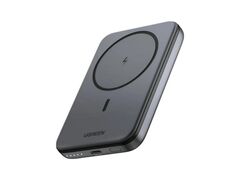
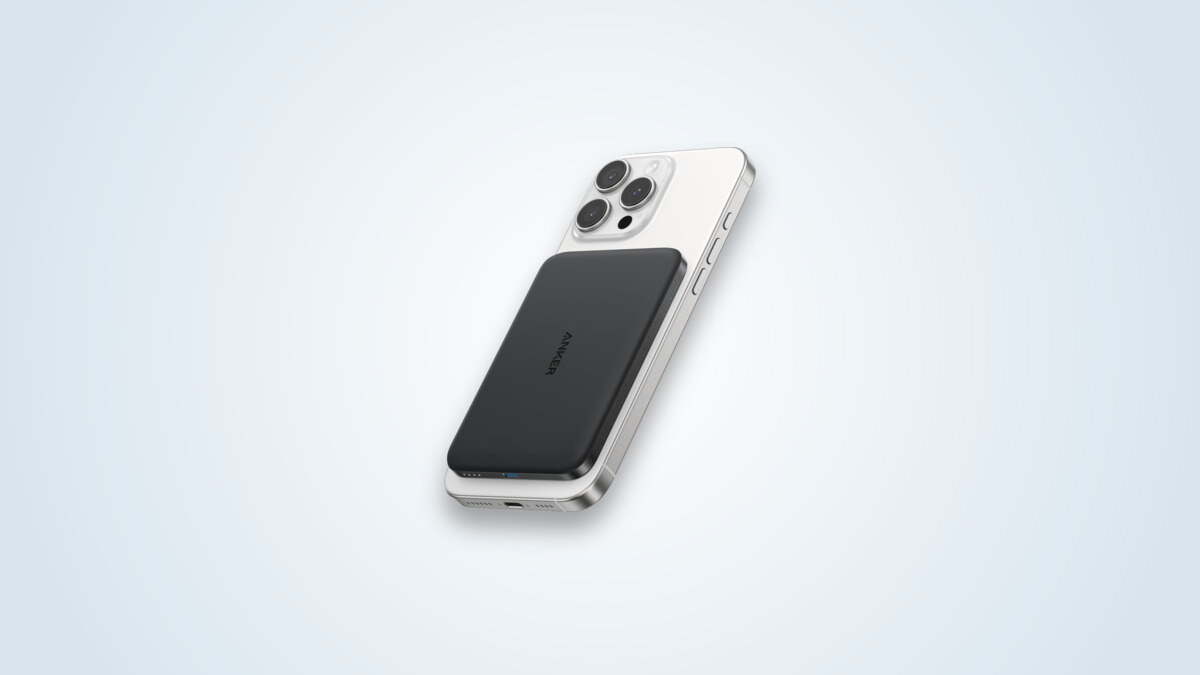
This is the one spot where the Anker Nano A1665 draws no real criticism. At 0.34 in (8.6 mm) thick and 4.30 oz (122 g), it ranks among the thinnest MagSafe power banks on the market, noticeably below the segment's usual references: the Ugreen Nexode Mini 5000 mAh measures 0.52 in (13.1 mm) for 5.11 oz (145 g), and the range's own bigger sibling, the Anker MagGo 10K, reaches 0.78 in (19.8 mm) for 8.82 oz (250 g). Once attached to the back of an iPhone, the Nano A1665 adds barely more bulk than a standard protective case, a claim neither of those two competitors can make.
| Criterion | Anker Nano A1665 | Ugreen Nexode Mini 5000 mAh | Anker MagGo 10K |
|---|---|---|---|
| Capacity | 5000 mAh | 5000 mAh | 10,000 mAh |
| Thickness | 8.6 mm | 13.1 mm | 19.8 mm |
| Weight | 122 g | 145 g | 250 g |
| Wireless charging | Qi2 15 W | 7.5 W | Qi2 15 W |
| USB-C | 20 W | 60 W (cable included) | 27 W |
Magnetic hold in daily use backs up this design choice: on a bare phone, alignment stays put with no slipping or detectable play, even under deliberate force. This format is not free, though: it directly explains both the capacity ceiling at 5000 mAh (less internal room for the cell) and the heat sensitivity covered above (less material to carry heat away). Thinness and battery life pull in structurally opposite directions on this product format, and Anker has clearly picked a side.
A specified limit: thick, non-magnetic cases
Anker officially advises against using the Nano A1665 with a non-magnetic case thicker than 0.1 in (2.5 mm): beyond that point, magnetic alignment degrades and charging speed suffers directly as a result. A bulky, reinforced-style protective case will noticeably throw off alignment and slow down charging, which favors either a thin magnetic case or going caseless. This is a real constraint worth planning around before buying, especially for anyone who already owns a sturdy case that is not MagSafe-compatible: it means either switching cases or living with degraded alignment and charging.
Versus the MagGo 10K: the same trade-off, scaled up
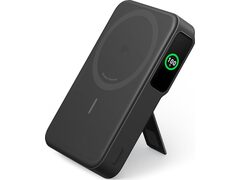
The Nano A1665 shares its Qi2 15 W charging tech with the MagGo 10K, the higher-tier model in the same Anker lineup, already reviewed on this site. The MagGo doubles the rated capacity (10,000 mAh) but gives up thinness entirely: 0.78 in and 8.82 oz (19.8 mm and 250 g), more than double the Nano A1665 on both measurements. Its wireless output at full power tops out at a little over three quarters of the stated energy, a gap similar to the one affecting the Nano A1665 with the iPhone 16 Pro. So this point applies to the whole lineup, not just this one model: Qi2 magnetic charging looks structurally short of its rated value whenever charging power hits its maximum, a pattern tied to the technology itself rather than to any single product.
The choice between the two really comes down to format rather than technological reliability: the Nano A1665 for discretion and everyday carry, the MagGo 10K for battery life and a fuller status display, at the cost of noticeably more bulk and weight.
Build quality, wear, and customer support
The Nano A1665's metal frame makes a solid first impression in hand, a consistent point across the material available. Over extended use, a few cosmetic wear marks do show up: a logo that fades after several weeks of daily use, a paint chip on the edge after being carried while loaded down, without any of these marks affecting how the product actually works. A display glitch found on the charge indicator of one unit got resolved through a straightforward replacement from Anker's customer support, a positive sign of how responsive support is when a real problem crops up.
Who should buy the Anker Nano A1665?
This format suits, above all, anyone looking for a daily top-up charge without adding bulk to a pocket: a commute, an evening out, a day of travel where the iPhone's battery dips by late afternoon. The promise it keeps is a clear one, a single smartphone charge in a format that all but disappears once clipped to the phone. For anyone needing to cover several days without a recharge, or who already owns a thick non-magnetic case, a bulkier power bank such as the MagGo 10K or an equivalent competitor remains the better fit: the Nano A1665's record thinness is paid for directly in battery life and tolerance for sturdy protective cases.