What the advertised 10,000 mAh is really worth
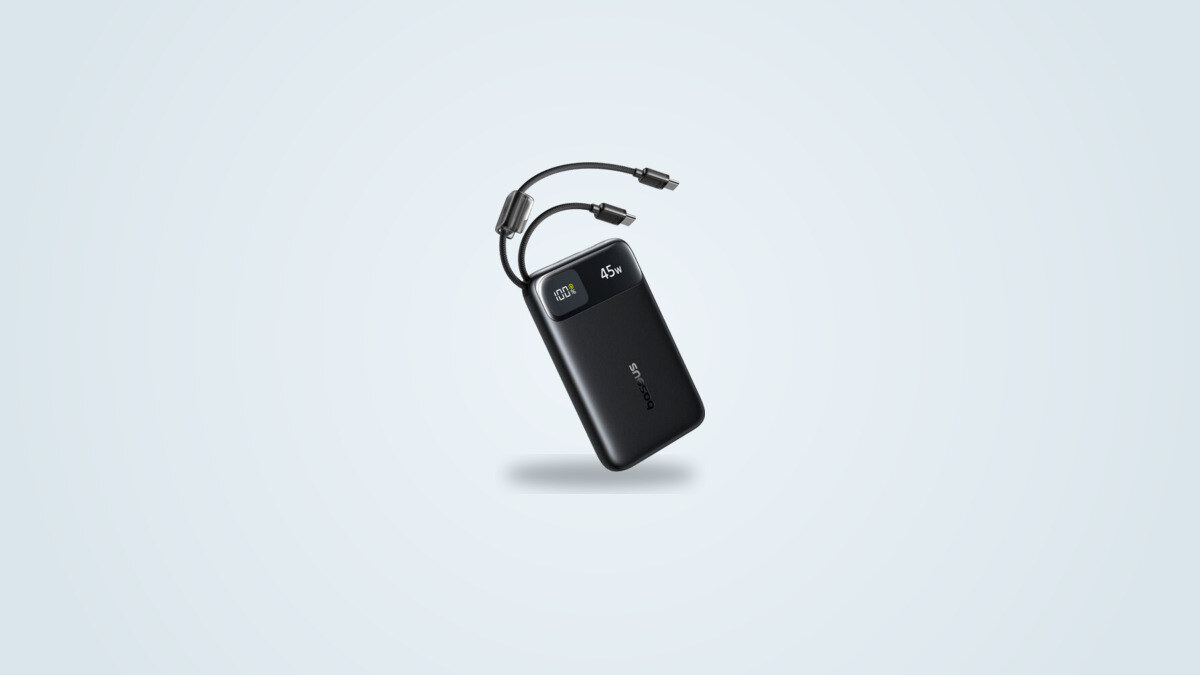
The number printed on the case, 10,000 mAh, corresponds to two Li-ion cells of 5,000 mAh each, a figure Baseus states itself. Converted at a cell's nominal voltage (3.7 V), that works out to 37 Wh, a consistent, checkable figure with no flattering rounding.
That number is still a cell capacity, not energy delivered to the phone or tablet plugged in. Between the cell and the output port, the conversion electronics, the circuitry that steps the battery's 3.7 V up to the 5, 9, 12 or 15 V used by USB Power Delivery, take their share as heat. Here Baseus makes a choice that is rare at this price point: stating outright a real-world output of 5,500 to 6,500 mAh depending on the device, or roughly 27.5 to 32.5 Wh once converted to a common basis, averaging close to 30 Wh.
An efficiency of roughly 81 % (30 Wh delivered out of 37 Wh stored) sits at a decent average for a classic Li-ion pack of this size: well above the very low floor of around 65 % seen on some high-capacity packs on the market, without matching the best performers in the category, which clear 90 % at their lowest charging tiers. In practice that works out to roughly two full charges of a recent smartphone, an estimate Baseus itself owns up to rather than letting the headline 10,000 mAh figure imply a third charge that never quite arrives.
A real 45 W: what changes against 20-30 W models
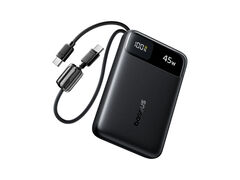
The main USB-C port and the two built-in cables deliver up to 45 W over USB Power Delivery, with PPS (Programmable Power Supply) support fine-tuning voltage for compatible devices. That puts the FC11 well ahead of the three references its own product page compares it against: 30 W for the Anker Zolo 10000, 22.5 W for the Nitecore Pocket 10000 and for the Xiaomi Mi Power Bank 3.
Baseus also states that an iPhone 17 Pro regains 67 % of charge and a Galaxy S25 Ultra regains 60 % in half an hour on the main port, a manufacturer figure not independently verified for this specific 10,000 mAh version. It remains physically plausible: recent smartphones accept 25 to 45 W of wired charging and commonly reach that kind of percentage in thirty minutes from empty.
The USB-A port, for its part, tops out at 22.5 W over the SCP protocol, a standard figure that covers fast charging on most Android phones without a USB-C input.
Four devices at once: what actually gets shared
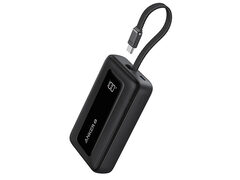
The FC11 stands out for its four usable simultaneous outputs: the two built-in USB-C cables, a spare USB-C port and a USB-A port. None of the three references compared on the product page reach that total: the Anker Zolo 10000 stops at three outputs (one built-in cable, one USB-C port, one USB-A port), while the Nitecore Pocket 10000 and the Xiaomi Mi Power Bank 3 are limited to two devices at once.
In everyday use, a phone, a pair of earbuds, a smartwatch and an e-reader at the end of the day can each get their charge without a single extra cable being needed. That is the product's central promise, and it rests on a verifiable fact: the number of physical ports and built-in cables, a spec-sheet figure rather than a measurement.
Two built-in cables: handy day to day, a limit if one breaks
Here too the FC11 goes further than most built-in-cable packs on the market, which usually offer only one. The two USB-C cables tuck into the edge of the case and pull free one-handed; once stowed, they form a small strap against the shell. In practice, two devices can be served without a single cord leaving the bag, and the second cable earns its keep more often than expected: helping out a friend, running a camera while the phone charges on its own line.
Recharging the FC11 itself: 30 W, the fastest in its comparison
The USB-C input accepts up to 30 W, a figure that beats the 20 W of the Anker Zolo 10000 and the 18 W of both the Nitecore Pocket 10000 and the Xiaomi Mi Power Bank 3. On paper, filling the battery's 37 Wh at a constant 30 W would take a little over an hour and a quarter; in practice, the final charging taper always slows down the last stretch, which puts the real-world figure closer to an hour and a half with a charger that genuinely holds that wattage.
The FC11 also supports pass-through charging: it can recharge a connected device while it recharges itself from a single outlet, a handy feature in the evening or in a hotel room with only one socket free. No wall charger is included in the box: a USB-C charger genuinely capable of delivering 30 W is still needed to get that speed.
Size and weight against the direct competition
At 7.2 oz (203 g) for 4.33 x 2.68 x 0.71 in (110 x 68 x 18 mm), the FC11 fits in a jacket pocket without an oversized bulge. Against the three references its own product page compares it to, the result is better than expected for a case carrying two cables and 45 W: it is both lighter and thinner than the Anker Zolo 10000 (7.6 oz/215 g, 0.98 in/25 mm thick), which nonetheless offers only one cable and 30 W.
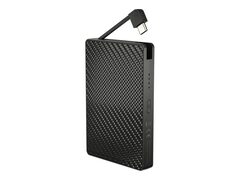
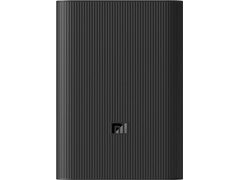
The Nitecore Pocket 10000 nonetheless remains out of reach on this single criterion: at 5.6 oz (160 g) for 0.49 in (12.5 mm) thick, it makes the opposite trade-off, sacrificing power (22.5 W) and the number of outputs (two) for an even smaller footprint. The Xiaomi Mi Power Bank 3, with no built-in cable, weighs 7.1 oz (200 g), nearly the same as the FC11 despite a noticeably lighter feature set.
Line reliability and the brand's track record
Baseus states protection against overcharging, overvoltage, overheating, over-discharge and short-circuits, paired with NTC temperature regulation, standard but necessary features on a product that often stays plugged in unattended. The manufacturer warranty runs 2 years, matching the Anker Zolo 10000 and beating the single year covered by the Nitecore Pocket 10000. The product carries China's CCC certification.
The product is too recent to have built up several years of real-world track record: no recurring fault or characteristic failure shows up so far for this specific reference, an honest result rather than a long-term guarantee.
Don't confuse it with the 20,000 mAh version of the same name
Baseus sells a second battery under the same EnerFill FC11 name that is twice the size: 20,000 mAh, a rated 73 Wh, in a case that is noticeably heavier and thicker (12.8 oz/362 g against 7.2 oz/203 g, about 1.26 in/32 mm thick against 0.71 in/18 mm). Both versions share the same marketing dress, 45 W, two built-in USB-C cables, a digital display, which keeps fueling confusion online.
This naming overlap is not unique to Baseus: several built-in-cable battery makers reuse the same commercial prefix for very different capacities. It remains an annoying case here, though, since the two versions look nearly identical at a glance.
Carry-on flights and everyday travel
At 37 Wh, the FC11 stays well under the 100 Wh threshold beyond which most airlines require prior approval to carry a lithium battery in the cabin. Like any battery of this kind, it must travel in carry-on luggage and never in checked baggage, per FAA and TSA rules for lithium batteries.
Its pocket size and four simultaneous outputs make it a sensible pick for a short business trip or a weekend away, where several small devices (phone, earbuds, watch) need to last the day without a wall charger at every stop. For heavier use, such as a long-haul flight with a laptop to recharge, the 45 W and 37 Wh on hand are enough to slow a discharge in progress rather than deliver a fast full recharge.
Who the Baseus FC11 10000 is for, and who should look elsewhere
This model suits anyone who wants to power several small devices without ever hunting for a cable at the bottom of a bag, with genuinely fast charging on the main device. Frequent business travelers and families sharing one battery across several phones will find a natural use for it.
It is a weaker fit for anyone chasing the smallest possible footprint (the Nitecore Pocket 10000 does better on weight and thickness, at the cost of power and output count), anyone who wants to fast-charge a laptop at full speed (45 W remains a top-up, not a wall-charger replacement), or anyone who would rather be able to replace a worn cable independently of the case. Budget planning should also account for picking the right reference: check explicitly for "10,000 mAh" before buying, or the 20,000 mAh version, pricier and twice as heavy, could end up in the cart by mistake.