The advertised 25W Qi2.2: a tier that depends on the iPhone model
Qi2.2 is the newest version of the Wireless Power Consortium's magnetic charging standard: it raises the wireless charging ceiling to 25W, up from 15W for the previous Qi2 and 7.5W for the original MagSafe standard. The Baseus PicoGo AM52 is among the first power banks certified on this new tier.
The most common marketing shorthand sums up compatibility as "25W on iPhone 16 and 17." The real picture has one more tier: the iPhone 16 and 16 Pro, the two standard-size models, cap out at 22.5W, and only the iPhone 16 Plus, 16 Pro Max, and the entire iPhone 17 lineup reach the full 25W. An iPhone 15 gets 15W; on an iPhone 12, 13, or 14, charging drops to 7.5W.
This last tier has a physical explanation, not a commercial one: the original MagSafe (iPhone 12 to 14) reserves its 15W for accessories carrying Apple's own MFi certification; without that proprietary certification, a third-party magnetic charger stays capped at 7.5W on those models. The iPhone 15 changed things by natively adopting Qi2, an open Wireless Power Consortium standard that grants its 15W tier to any Qi2-certified accessory, without going through the MFi program. The PicoGo AM52 carries a Qi2/Qi2.2 certification, not Apple's MagSafe MFi one: that's what explains the lower tier on older iPhones.
In practice, an iPhone 17 Pro goes from 0 to 50% in 30 to 34 minutes, and an iPhone 16 reaches a 10 to 80% range in about 40 minutes despite its 22.5W ceiling: charging speed naturally slows down as it approaches 80%, regardless of the peak available earlier in the cycle.
45W wired: the highest output in its class
The USB-C cable built into the case delivers up to 45W of wired charging, the highest output among the four 10,000mAh magnetic power banks compared in this review.
That cable only works one way, though: it exclusively feeds an external device, not the PicoGo AM52 itself (see below). On a Galaxy S24 Ultra, Qi2 certified but not Qi2.2, wired charging climbs from 15 to 90% in 50 minutes, a speed that depends as much on the phone's own charging ceiling as on the 45W available from the power bank; wirelessly, that same phone caps out at 15W, a reminder that the 25W tier remains reserved for the newest certifications.
Size: among the thinnest, not necessarily the lightest on the spec sheet
At 4.0 x 2.6 x 0.63 in (102 x 67 x 16mm), the PicoGo AM52 ranks among the thinnest magnetic power banks in its class, within a hair of the EcoFlow Rapid Mag (0.63 in / 15.95mm), and well ahead of the Anker MagGo (0.78 in / 19.8mm) and Ugreen MagFlow (0.83 in / 21mm).
| Model | Thickness | Weight |
|---|---|---|
| PicoGo AM52 (built-in cable) | 0.63 in (16mm) | 7.1 to 7.4 oz (202 to 211g) |
| EcoFlow Rapid Mag | 0.63 in (15.95mm) | 8.1 oz (230g) |
| Anker MagGo (10K) | 0.78 in (19.8mm) | 8.8 oz (250g) |
| Ugreen MagFlow 10000 | 0.83 in (21mm) | 9.0 oz (254g) |
On weight, one gap is worth flagging: the manufacturer's general spec sheet lists 7.0 oz (198g) for the cell alone, meaning the version WITHOUT the built-in cable. With the built-in cable (the version sold here), the real weight sits more between 7.1 oz (202g), the figure Baseus itself gives for this exact version, and up to 7.4 oz (211g) depending on the unit.
Once that's sorted out, the PicoGo AM52 still ends up the lightest of the four, built-in cable included: a genuine plus for something worn in a pocket or clipped to the back of a phone all day.
Heat and the triple-layer cooling system
The case combines three cooling mechanisms: a graphene heat-conducting layer, an aluminum alloy body that also acts as a heat sink, and temperature monitoring that checks charging status up to 18,000 times an hour, or about five times a second. The whole system carries a TÜV Rheinland certification for its low-temperature control.
In real use, surface temperature reaches 97.5 °F (36.4 °C) while charging two devices at once, well below the point where a case becomes uncomfortable to touch. Baseus separately claims a gain of up to 14 °F (8 °C) over industry standards for this type of product, a figure that remains a manufacturer marketing value rather than an externally verifiable comparison.
Cooling relies entirely on passive conduction, with no fan at all: a sensible choice given how thin the case is, but one that can limit how long the device holds its 25W peak during a very long wireless charging session at full power. Nothing alarming for a typical use, topping up a phone in a few dozen minutes, but worth keeping in mind for anyone hoping for sustained fast charging over several hours in a row.
Recharging the PicoGo AM52 itself
The PicoGo AM52 recharges separately, through a dedicated USB-C port distinct from the built-in output cable, at up to 30W. A charger that actually holds that power continuously refills the pack's 10,000mAh in 90 to 100 minutes, with an extra cable included in the box for this purpose.
This puts the PicoGo AM52 well ahead of the Anker MagGo (10K), whose full recharge takes about 165 minutes on its 20W-capped input, a gap of nearly an hour. No wall charger ships in the box: reaching 30W on input means already owning a suitable USB-C PD charger.
The built-in cable and ports: handy, but not expandable
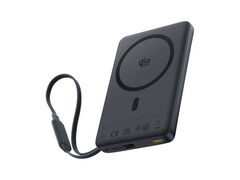
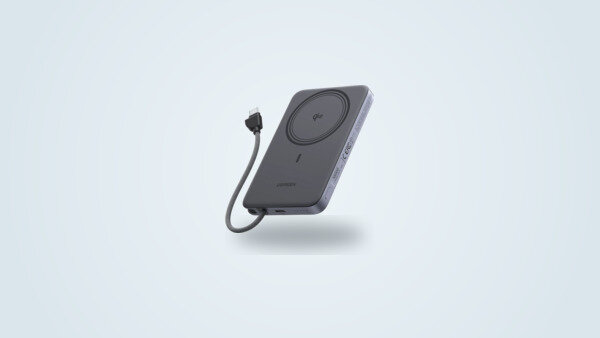
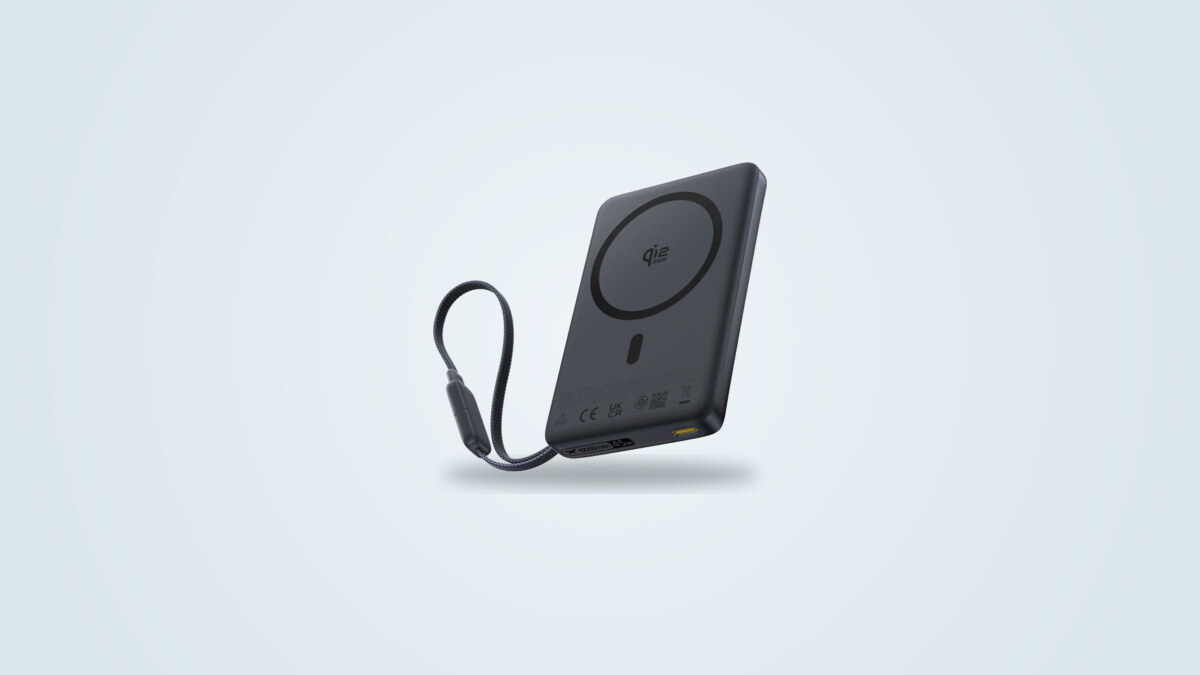
The connector layout keeps things simple: the wireless charging surface on the back, a permanent USB-C cable coiled along the edge for output (45W), and a separate USB-C port that doubles as a second output and a recharge input. A strip of five LEDs on the edge shows the charge level in roughly 20% steps, with no digital screen at all. The manufacturer claims up to three devices can charge at once: the phone wirelessly, plus two wired devices.
That versatility has a real limit: as soon as several outputs are used together, total shared power drops sharply, to around 15W split between the connected devices, far below the 25W and 45W touted individually. That's a behavior common to nearly all multi-output magnetic power banks of this type, not a quirk specific to this model.
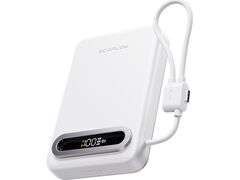
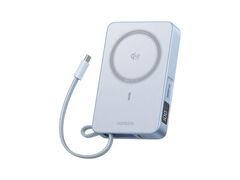
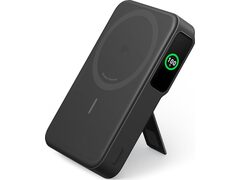
Two features found on direct rivals are missing here: a digital screen, even a basic one, and a built-in folding stand. The EcoFlow Rapid Mag offers a simple display and a stand, the Ugreen MagFlow a full digital screen, and the Anker MagGo combines an LCD screen with a stand. The PicoGo AM52 is the only one of the four to settle for five LEDs with no digital display at all. The case instead bets on thinness and wired power, a deliberate trade-off rather than an oversight.
Against the direct competition: EcoFlow, Ugreen, and Anker
In the segment of fast-charging 10,000mAh magnetic power banks, three names come up regularly in comparisons: the EcoFlow Rapid Mag Qi2.2 25W, the Ugreen MagFlow 10000, and the Anker MagGo (10K).
| Criterion | PicoGo AM52 | EcoFlow Rapid Mag | Ugreen MagFlow | Anker MagGo |
|---|---|---|---|---|
| Max wireless | Qi2.2, 25W (22.5 to 25W by iPhone) | Qi2.2, 25W (iPhone 17 / Pixel 10 Pro) | Qi2, 25W | Qi2, 15W |
| Max wired | 45W | 36W | 30W | 27W |
| Built-in cable | Yes (output) | Yes (output) | Yes (output + wrist strap) | No |
| Display | 5 LEDs, no screen | Simple display | Digital screen | LCD screen |
| Built-in stand | No | Yes | No | Yes |
| Weight | 7.1 to 7.4 oz (202-211g) | 8.1 oz (230g) | 9.0 oz (254g) | 8.8 oz (250g) |
| best-batteries.com rating | 4.1 / 5 | 4.1 / 5 | 4.0 / 5 | 4.1 / 5 |
The PicoGo AM52 wins on two concrete fronts, wired power and lightness, while matching the EcoFlow Rapid Mag's peak wireless speed. The Ugreen MagFlow remains a credible alternative on Qi2 25W but delivers proportionally less total energy than its rivals at the same rated capacity. The Anker MagGo, older on the wireless standard, compensates with an LCD screen and a stand that neither the PicoGo AM52 nor the Ugreen MagFlow offer. None of the four checks every box: the choice mostly comes down to priorities, power and thinness here, screen and stand with the Anker MagGo.
Against its own lineup: the real progress since the AM41
Baseus spreads its PicoGo lineup across several power tiers: the 10,000mAh AM41 tops out at Qi2 15W, the 5,000mAh AM41 doesn't go beyond 7.5W (the original Qi standard), and the 5,000mAh AM31 also caps at 15W. On the same iPhone 17 Pro, over 30 minutes of wireless charging, the gap shows up directly.
| Model | Standard | Max wireless | Charge in 30 min |
|---|---|---|---|
| PicoGo AM52 | Qi2.2 | 25W | 45% |
| PicoGo AM41 (10,000mAh) | Qi2 | 15W | 40% |
| PicoGo AM31 (5,000mAh) | Qi2 | 15W | 30% |
| PicoGo AM41 (5,000mAh) | Original Qi | 7.5W | 21% |
The PicoGo AM52 marks a genuine generational leap within Baseus's own lineup, not just a cosmetic name change: for the same charging window, it delivers a bit more than a full extra charge over the slowest 5,000mAh model in the same family.
Brand reliability: a recall on other models, a fresh certification on this one
In 2024, Baseus worked with the U.S. Consumer Product Safety Commission (CPSC) on a voluntary recall of two other wireless magnetic power bank models: the Magnetic Mini Wireless Fast Charge Power Bank, 2022 generation, model PPCXM06, and the Magnetic Wireless Charging Power Bank, model PPCXW06, both exposed to a lithium-ion cell overheating risk. The published tally lists 171 reports, including 132 cases of battery swelling and 39 fire starts, with 13 burn injuries and roughly $20,000 in property damage. The remedy offered was a full refund with proof of purchase.
It's still part of the brand's documented track record on this same product family, wireless magnetic power banks, and it's worth knowing rather than glossing over. The PicoGo AM52, launched in March 2026, is built on a different cooling architecture, with a TÜV Rheinland certification specific to thermal control. No comparable safety issue involves this model as of this review's publication, but the product is still too recent to have several years of track record behind it: a reasonable trust reserve, not a defect found on this specific model.
Android and broader compatibility
On Android, the 25W tier stays rare: among the Pixel 10 lineup, only the Pixel 10 Pro XL, the top model, reaches the full 25W. The standard Pixel 10 and 10 Pro cap out at 15W, the Pixel 8 and 9 at 12W, and accessories like AirPods are limited to 5W. The same pattern of tiers by model size or tier shows up on Google's side just as it does on Apple's.
A Samsung Galaxy S24 Ultra, Qi2 certified but not Qi2.2, caps out at 15W wirelessly on the PicoGo AM52: a charge from 15 to 100% then takes about 3 hours. Wired, through the separate USB-C port and a suitable cable, that same phone climbs from 15 to 90% in 50 minutes, a speed that depends on the connected device's own charging ceiling as much as on the 45W available from the power bank.
For any other Android device, only USB-C wired charging is available, at whatever power the phone itself accepts, without depending on any magnetic certification.
Who the PicoGo AM52 is for, and who should look elsewhere
It's a good fit for anyone who wants the highest wired power in its class in a thin, light case, with a USB-C cable always on hand to help out a second device. It also suits anyone with an iPhone 16 Plus, 16 Pro Max, or 17, the only models that get the full 25W wireless speed, or anyone mainly after a fast recharge of the power bank itself.
It's a weaker fit for anyone with a standard iPhone 16 or 16 Pro expecting the advertised 25W without caveats, anyone with an iPhone 12 to 14 hoping for fast wireless charging rather than the 7.5W tier actually on offer, and anyone who cares about a status screen or a built-in folding stand, both missing here but available on at least one direct rival.