What the rated 1,004.8Wh is really worth
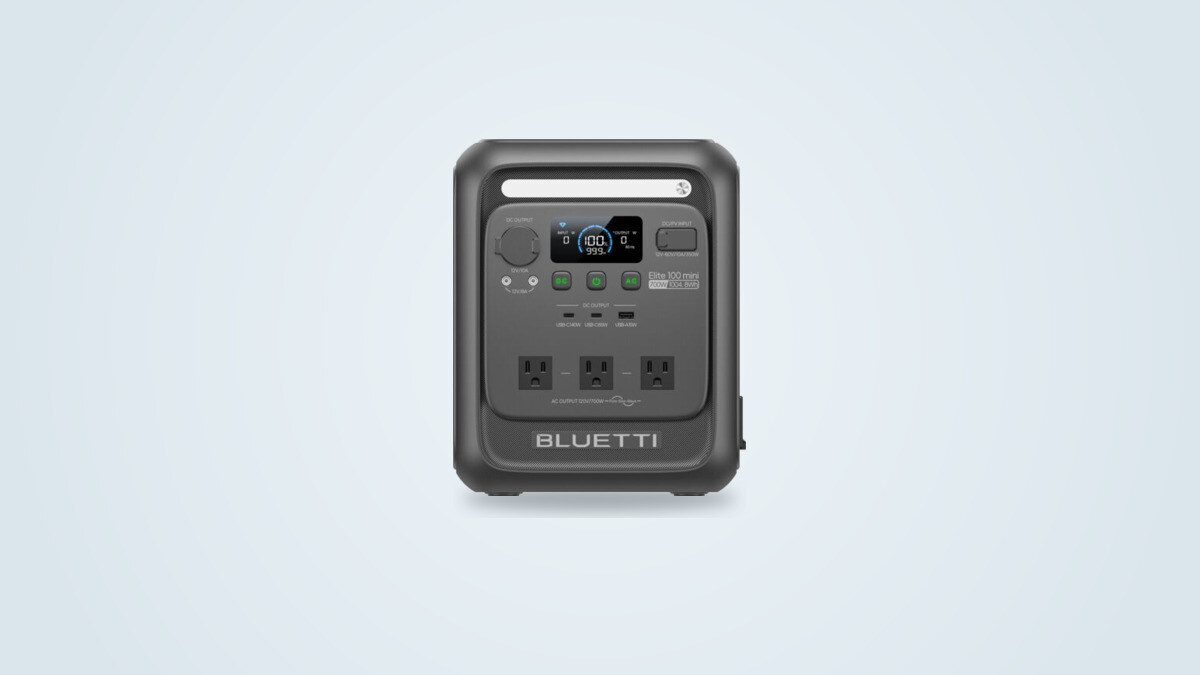
The Elite 100 mini is rated at 1,004.8Wh, a LiFePO4 UltraCell figure measured ahead of the inverter, as with any station of this type. Bluetti rates it for more than 6,000 cycles before dropping to 80% of original capacity, roughly seventeen years of daily use according to the manufacturer. This cell architecture is the same family used in the Elite 100 V2, the bigger sibling in the range.
On the AC outlet, the unit returns about 903Wh from its rated 1,004.8Wh, close to 90%. That's a good result for this compact class, comparable to the upper end of the range seen on the Elite 100 V2 (87 to 92% depending on the load drawn). The exact output level behind this figure isn't specified, which calls for some caution: it's a single data point for now, with no confirmation from a second measurement on another continent.
This figure still needs confirming over time. The Elite 100 mini only launched in early September 2026: no second measurement, from another continent or under a different protocol, is available yet to check the cross-source agreement normally sought on this kind of data.
A launch this fresh: what it means for this review
The Elite 100 mini was unveiled at IFA 2026 and went on sale on September 2, 2026, shipping directly from Bluetti's own store and from Amazon. This review is therefore written just days after the unit actually became available, an unusual situation in this catalogue and one worth stating plainly upfront: the data below rests on what is available at this date, not on months of field use.
Buyers can already order the Elite 100 mini today, no waiting required. But a launch window this short means some real signal, long-term reliability, firmware behavior after several updates, a broader base of owner feedback, simply hasn't had time to build up yet.
700W rated, up to 1,400W in a dedicated mode: does the power hold?
The Elite 100 mini is rated for 700W of continuous output across its three AC outlets, a shared total rather than a per-outlet figure. A triple 4K-monitor desktop setup, drawing around 600W, kept running through a simulated mains disconnect, well within the rated range. Pushed further under general use, the safety cutoff instead lands around 900W, a real margin of roughly 200W above the rated continuous figure.
A Power Lifting mode, switched on from the BLUETTI app and not active by default, separately raises the ceiling to 1,400W, reserved for resistive appliances such as a kettle or a hair dryer. It's the same idea as the Elite 100 V2's TurboBoost: a real peak figure, but gated behind a setting the buyer has to turn on to actually use it.
Either way, the unit holds the power it advertises rather than presenting it optimistically: that's the more important question on this axis, ahead of the raw wattage figure itself.
Charging and solar: an unremarkable speed
On AC, charging at 700W reaches 80% in 90 minutes according to the manufacturer, with no accelerated mode equivalent to the Elite 100 V2's TurboBoost: it's the only speed on offer, on or off. No independent measurement currently confirms or contradicts this figure.
Solar input tops out at 350W, against 1,000W on the Elite 100 V2. For an almost identical capacity (1,004.8Wh), that's a wide gap that mechanically stretches out a full charge off the grid, worth weighing for anyone planning to rely mostly on solar rather than a wall outlet. Vehicle charging (12V/24V) and the separately sold BLUETTI Charger 1 alternator accessory round out the charging options without changing this input-power ceiling.
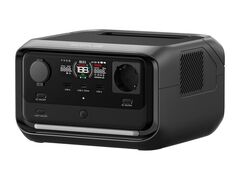
The most compact unit in the Elite 100 range: what's the real gain?
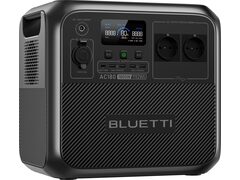
At 23.6 lb (10.7 kg) and 9.3 x 8.5 x 11.5 in (235 x 215.5 x 293mm), the Elite 100 mini weighs about 7% less than the Elite 100 V2 (25.4 lb / 11.5 kg) and takes up a slightly smaller footprint, for an almost identical capacity. Against the AC180, the brand's older flagship compact, the gap is far wider: roughly 35% less weight and 45% less volume, at the cost of a lower capacity and power ceiling too.
| Criteria | Elite 100 mini | Elite 100 V2 | AC180 |
|---|---|---|---|
| Capacity | 1,004.8 Wh | 1,024 Wh | 1,152 Wh |
| Weight | 23.6 lb | 25.4 lb | 36.2 lb |
| Approx. volume | ~14.8 L | ~17.2 L | ~26.6 L |
| Continuous power | 700 W | 1,800 W | 1,800 W |
| Max solar input | 350 W | 1,000 W | 500 W |
The real gain of the Elite 100 mini isn't capacity, which is nearly identical to the Elite 100 V2's, but size and weight, cut down for anyone who values one-handed carrying or storage in a tight space. That choice has a direct cost, covered in the next two sections: power and solar input both cut by more than half.
The 10ms UPS function: the product's real promise
The Elite 100 mini's central argument remains its UPS (uninterruptible power supply) function: on a mains outage, the switch to battery happens in a rated 10ms, fast enough to avoid interrupting a sensitive device. That figure has held up in two concrete scenarios so far: a triple 4K-monitor desktop setup stayed on through a simulated mains disconnect, and a CPAP medical device with a heated humidifier ran all night without interruption through a mains outage that lasted more than 20 hours.
That's exactly the kind of use the UPS function targets first: a router, a home network box, a desktop computer, or a medical device, rather than a whole-house backup. With 700W of continuous output and 1,004.8Wh in reserve, runtime on this kind of light load stretches into the tens of hours: the unit's screen has shown projections above 90 hours under light load and above 24 hours under heavier use, comfortably keeping phones, a handheld console and a small fridge topped up at once.
This switchover hasn't yet faced a load close to the 700W ceiling, or a string of outages a few minutes apart, a tougher scenario for the switching electronics. That's a point worth revisiting as more real-world data comes in.
Screen, app and ports: a full lineup for the format
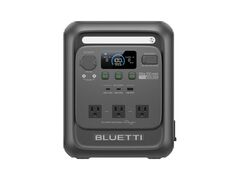
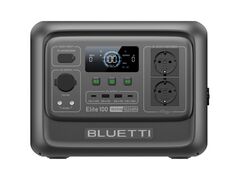
The port lineup stays full for this class of station: 3 AC outlets, 2 USB-C ports (140W and 65W), 1 USB-A port, a 12V car socket, and two further DC ports, nine outputs in total across 6 DC ports and 3 AC outlets. The 140W USB-C port is enough to charge a demanding laptop without a separate AC adapter, a real plus for such a compact unit.
The built-in color screen shows an estimated runtime in hours rather than a plain charge percentage, a reading many find more concrete than the usual indicator. Remote control runs through the BLUETTI app, which supports both Wi-Fi and Bluetooth (unlike some models in the brand's lineup limited to Bluetooth only), with remote wake, sleep mode and a schedulable timer. A built-in LED light rounds things out, with three modes (warm, cool, SOS) and a rated runtime of up to 264 hours in light-only use.
Against its own big brother, the Elite 100 V2: a price gap worth questioning
The Elite 100 mini launched at $429 before tax, against $649 for the Elite 100 V2 on the same catalogue basis, a gap of about 51%. In return, the Elite 100 V2 offers 2.6 times more continuous power (1,800W vs 700W) and 2.9 times more solar input (1,000W vs 350W), for barely 7% more weight (25.4 lb vs 23.6 lb). The ratio between the price gap and the spec gap therefore works against the mini on paper: it costs less, but it gives up proportionally more power than it gains in lightness.
One more thing worth knowing before comparing the two prices on any given day: Bluetti regularly runs deep discounts on the Elite 100 V2, which has already dropped below $400 more than once during sales events. If that happens again, it would further shrink the price edge the Elite 100 mini shows at launch. Checking both current prices remains the only reliable way to decide at the point of purchase.
Build quality, safety, and a field track record that doesn't exist yet
Bluetti rates the Elite 100 mini with 50 built-in safety mechanisms, a figure in line with other Elite ranges in the catalogue. No recall or safety incident is identifiable for this model or for the brand at the time of writing. Warranty length, however, doesn't yet appear on the manufacturer's own official page listing coverage by model, a documentation gap already seen on the Elite 100 V2 at its own launch, and one that seems to affect the catalogue's newest entries.
The most honest thing to say on this axis is the near-total absence of a track record: the Elite 100 mini has been on sale for only a few days. That isn't a flaw in itself, just a confidence caveat worth knowing before buying: no failure rate, no medium-term reliability trend, and no extended usage feedback exists yet, in either direction.
Who the Elite 100 mini suits, and who it doesn't
The Elite 100 mini is aimed first at anyone after a light, compact energy reserve for a targeted use: protecting a router, a home network box or a sensitive medical device during a mains outage, charging electronics on the move, or having a backup that's easy to store and carry one-handed. Its UPS function and estimated-runtime screen make it a coherent choice for that specific kind of use.
It suits less anyone who needs to run appliances or power-hungry tools continuously: the Elite 100 V2, barely heavier, more than doubles the power on tap for a price gap that can shrink sharply during a sale. It also doesn't suit, for now, anyone after a product with a proven track record: that condition isn't met yet at the time of writing this review.