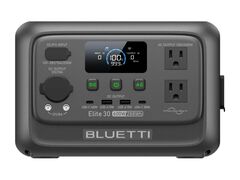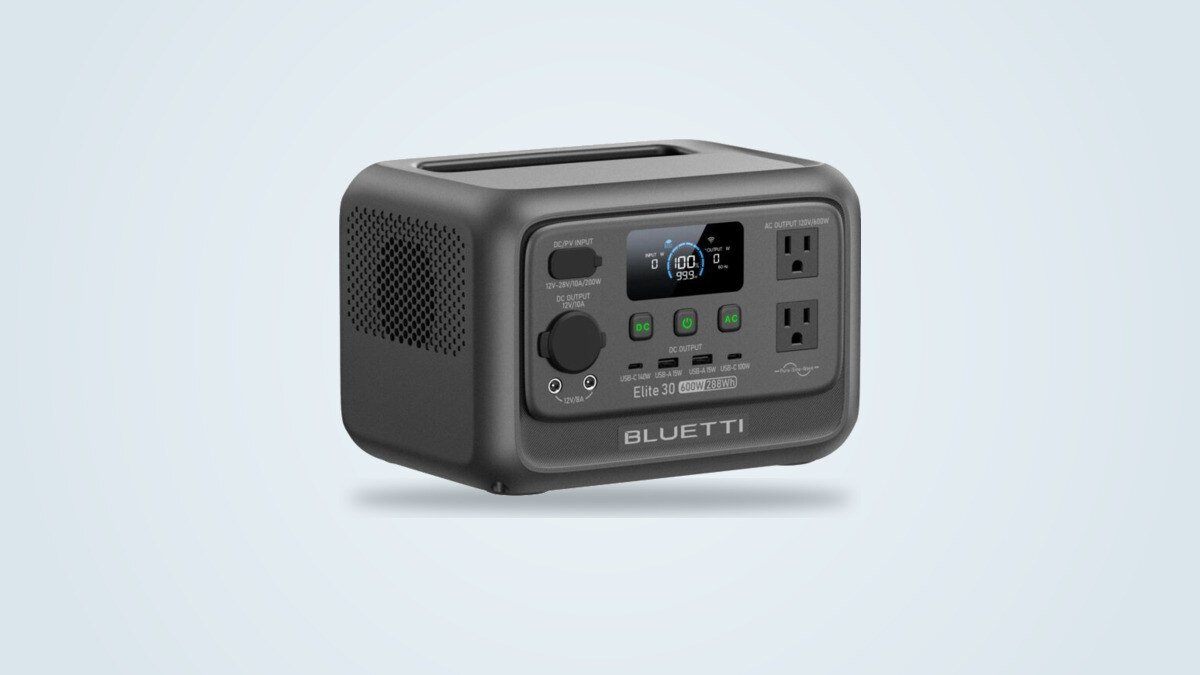
What the advertised 288Wh are really worth
The 288Wh printed on the Bluetti Elite 30 V2's casing is a LiFePO4 cell capacity, measured upstream of the inverter. As with any inverter-based station, the energy actually available at the outlet or USB ports always falls short of this nominal figure, due to conversion losses inherent to the power electronics.
On this compact model, real-world output settles around 245Wh, or roughly 85% of the advertised 288Wh. That's a typical figure for a pure sine wave inverter of this size, neither outstanding nor disappointing: the best stations in the catalogue climb above 90%, the more modest ones sometimes drop below 80%. A 200W rice cooker running for 18 minutes used around 20% of the capacity, and an electric kettle actually drawing 476W (against a listed rating of 500W) dropped the charge from 78% to 61%: two cases consistent with this efficiency range.
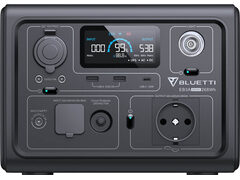
This 288Wh figure also marks progress over the EB3A, the model the Elite 30 V2 replaces in Bluetti's lineup: that one topped out at 268Wh, for 0.7 lb (300 g) more weight. The new generation gains capacity while shedding weight, a genuine step forward rather than a simple rebrand.
9.5 lb (4.3 kg) on the scale: does the lightweight promise hold up?
The Bluetti Elite 30 V2's headline argument comes down to one number: 9.5 lb (4.3 kg) on the scale for 288Wh and 600W. Real-world weight sits very close to that figure, around 9.5 to 9.7 lb (4.3 to 4.4 kg) depending on the unit, a gap that stays within the normal range for a production item.
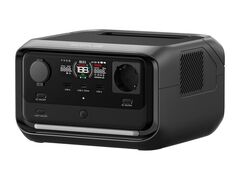
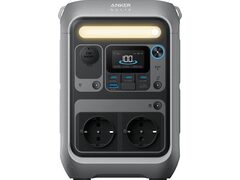
Against similar-capacity rivals, this format compares well: the EcoFlow River 3 Plus (286Wh) weighs around 10.4 lb (4.7 kg), and the VTOMAN Jump 600X (299Wh) climbs to 14.6 lb (6.64 kg), over 5 lb more for barely any extra capacity. Only the Anker Solix C300 (also 288Wh) does slightly better on the scale, at 9.1 lb (4.13 kg), but with half the continuous power (300W versus 600W).
With its 9.8 x 7 x 6.6 in (250 x 178 x 167.5 mm) footprint and built-in handle, the station carries with one hand all the way to camp or into a hiking backpack without becoming a burden. Discharge is still rated down to -4 °F (-20 °C), a real asset for winter or high-altitude use, where other lithium chemistries (outside LiFePO4) simply stop working.
Lightning recharge: the advertised 45 minutes largely holds up
On paper, the Bluetti Elite 30 V2 promises 80% in 45 minutes and a full recharge from an outlet in just 70 minutes, thanks to a charging power of up to 380W in fast mode. In practice, charging reaches 50% in 29 minutes and 100% in 70 minutes, matching the manufacturer's claim rather than falling short of it.
This speed does assume the maximum charging power is actually being used. Under other conditions, a full recharge can take noticeably longer, sometimes close to double. The difference seems to come down to a fast-charging mode that isn't necessarily on by default on every unit and that switches on from the mobile app: without it, real charging power stays lower, and charging takes longer as a result. Checking this setting before writing off the charging speed is the most useful habit here.
Power in practice: 600W held, 1500W needs a caveat
The Bluetti Elite 30 V2 advertises 600W continuous and up to 1500W at peak through its Power Lifting mode, switched on manually for appliances that exceed the continuous rating. The first figure holds up without reservation: an electric kettle actually drawing 476W ran without any issue, and a 650W hair dryer (above the 600W continuous limit) ran for around twenty minutes in Power Lifting mode without tripping the overload protection.
A remarkably quiet performer
The advertised noise level for the Bluetti Elite 30 V2 is among the lowest in its class: under 30dB, a clear improvement over the 50dB of the EB3A it replaces. During daytime use, it stays inaudible from about 3 ft (1 m) away; up close, right against the unit, a faint operating hum remains.
This quiet running is partly explained by the unit's modest continuous power (600W) compared with multi-kWh stations, whose cooling fans are noticeably louder under fast charging. For overnight use, in a tent or next to a bed, this noise level shouldn't cause any disturbance, even while charging from an outlet.
Ports and control: complete for the format, two caveats
For such a compact format, the port selection stays complete: two USB-C ports (one up to 140W, enough to charge a demanding laptop at full speed), two 15W USB-A ports, two DC5521 outputs, a 12V car outlet and one AC outlet. Control runs through a built-in LCD screen and a mobile app over Wi-Fi and Bluetooth.
That single AC outlet is the norm rather than the exception for stations of this size: the EcoFlow River 3 Plus and the Anker Solix C300, both close in capacity, make do with just one AC outlet too. The gap only really shows up for anyone needing to plug in two large appliances at the same time, a use case that exceeds the 600W continuous rating anyway.
Solar input: the spec sheet's weakest promise
The Bluetti Elite 30 V2's solar input accepts up to 200W (12 to 28V, 10A maximum), through a single MPPT tracker and an XT60 connector. That's a reasonable figure for this format, higher than several direct rivals of similar capacity.
The clearest catch concerns what's missing from the box: the solar charging cable isn't included, even though the 200W input is listed on the spec sheet. An AC charging cable and a car charging cable are included, but reaching the advertised maximum solar power means buying a compatible panel and its connecting cable separately, an extra cost and an extra step to plan for before buying.
Solar charging speed depends heavily on the panel's own power: with a smaller panel (60 to 120W), a full charge takes several hours, while a panel closer to the 200W maximum brings that down to a little over two hours in full sun. As with any solar charging, weather and panel orientation matter more than the spec sheet for the final result.
What 288Wh really covers day to day
With around 245Wh actually available, the Bluetti Elite 30 V2 covers short, specific needs rather than extended runtime. A Wi-Fi router (around 15W) lasts around 13 hours, a CPAP machine without a humidifier (around 30W) around 8 hours, a laptop on charge (around 45W) around 4.5 hours, and a camping fridge (60 to 70W) around 3.5 hours. These figures stay consistent with the actual available capacity, whatever the power draw.
Power Lifting mode extends this range to hungrier resistive appliances, but always for short spells: a 650W hair dryer ran for around twenty minutes without tripping the overload protection, a duration suited to a quick blow-dry rather than extended use.
Reliability, warranty and the EB3A's legacy
The Bluetti Elite 30 V2 is covered by a 5-year warranty and a LiFePO4 battery rated for over 3000 cycles before dropping to 80% of its original capacity, figures in line with current standards for its category. No safety recall or recurring manufacturing fault is known for this model to date.
Against the EB3A it replaces in Bluetti's lineup, the progress is clear on several fronts at once: capacity rises from 268 to 288Wh with no weight penalty (10.1 lb / 4.6 kg for the EB3A versus 9.5 lb / 4.3 kg here), the advertised peak power climbs from 1200 to 1500W, the advertised noise level drops from 50 to 30dB, and UPS switchover falls from 20ms to under 10ms. It's a succession that improves the formula on nearly every measurable front, rather than a simple rebrand.
Against its direct rivals
Around the 288Wh mark, the Bluetti Elite 30 V2 goes up against a small, well-defined group of direct rivals: the EcoFlow River 3 Plus, the Anker Solix C300 and the VTOMAN Jump 600X.
| Criterion | Elite 30 V2 | River 3 Plus | Solix C300 | Jump 600X |
|---|---|---|---|---|
| Capacity | 288Wh | 286Wh | 288Wh | 299Wh |
| Continuous / peak power | 600W / 1500W | 600W / 1200W | 300W / 600W | 600W / 1200W |
| Full recharge from an outlet | 70 min | ~60 min | ~2h30 | ~3h |
| Weight | 9.5 lb (4.3 kg) | 10.4 lb (4.7 kg) | 9.1 lb (4.13 kg) | 14.6 lb (6.64 kg) |
On continuous power, the Elite 30 V2 doubles the Anker Solix C300 (600W versus 300W) for very similar weight. Against the EcoFlow River 3 Plus, the closest match on paper, the gap comes down to weight (0.9 lb / 400 g less) and the advertised peak power (1500W versus 1200W, though that lead narrows once real-world peak output is taken into account, see above). The VTOMAN Jump 600X costs a little less but is noticeably heavier, 5.1 lb (2.3 kg) more for barely 11Wh of extra capacity.
Who it suits, and who it doesn't
The Bluetti Elite 30 V2 is best suited to light nomadic use: hiking with an overnight camp, compact camping, occasional outdoor remote work, or short power outages at home. Its class-leading weight and fast recharge make it a credible companion for anyone who wants a genuine power station without the weight penalty of higher-capacity models.
It suits less well anyone needing to run several large appliances at once (only one AC outlet), anyone planning to rely on it for several days of backup without recharging (288Wh, or around 245Wh usable, drains quickly beyond light loads), or anyone after real weatherproofing for exposed outdoor use, since no IP rating is advertised for this model. For these needs, a higher-capacity station or one with more AC outlets will serve better.