What the claimed 7.5 Wh is really worth
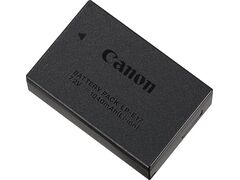
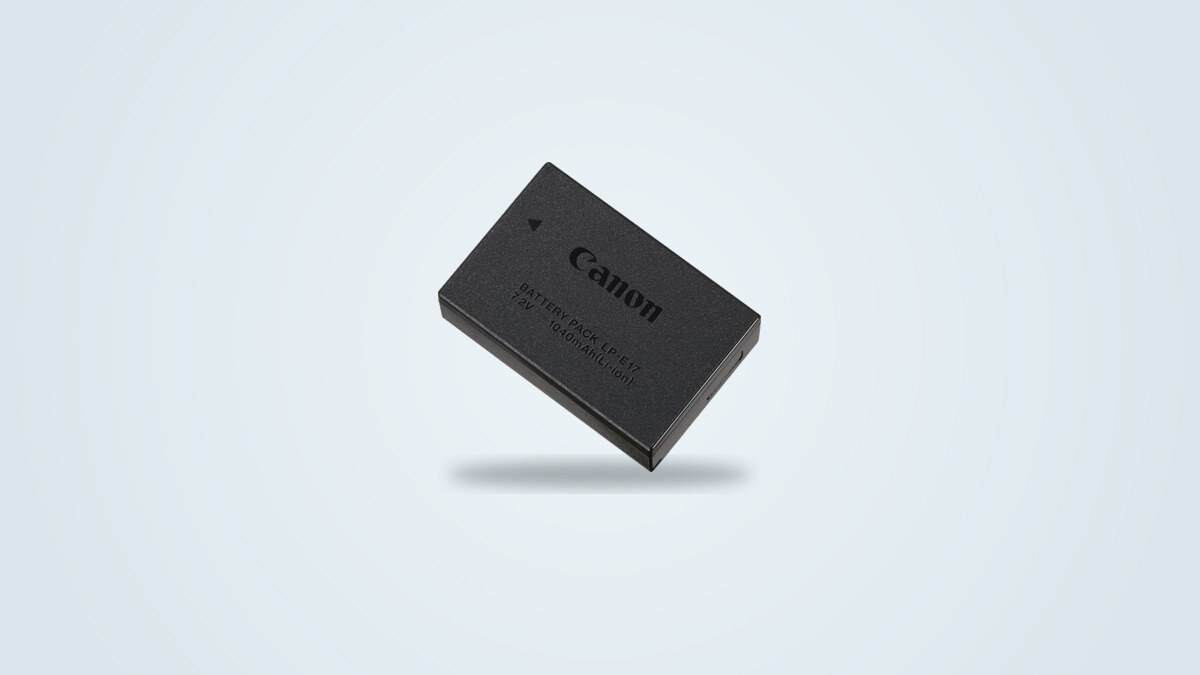
The LP-E17 is rated 7.2 V and 1040 mAh right on its shell, next to the Canon logo. The math works out to 7.49 Wh, rounded to 7.5 Wh: that is exactly the figure printed on the product, with no gap between the claim and the physical label. The cell measures 1.3 x 0.55 x 1.93 in (33 x 14 x 49 mm) for 1.6 oz (45 g), small enough to slip into a lens pouch or a jacket pocket without anyone noticing.
For comparison, 7.5 Wh is roughly a third of what a recent flagship smartphone battery holds, but that is plenty for a camera cell that never has to power a permanently lit touchscreen or a constant network connection. The exact model sits right on the label: part number 9967B002, EAN code 4549292020984, a Canon part reference that makes it easy to tell the genuine article apart from a compatible one carrying a similar commercial name.
On a cell this size, voltage sag under load stays modest: a camera draws at most 1 to 2 A at peak, far below the load a cordless power-tool battery has to handle, which can top 15 A. The energy actually usable therefore sits closer to the rated value than it does on more current-hungry product categories, even though no independent figure exists today to check that specific point on an LP-E17 that has aged for several years.
A 1-to-5 spread by camera body: the same battery, very different results
The LP-E17 fits 14 Canon bodies, from entry-level DSLRs to a full-frame mirrorless. On that very same 7.5 Wh cell, the number of shots per full charge ranges from 210 on the EOS RP in electronic-viewfinder mode to 1070 on the EOS 250D in optical-viewfinder mode: a spread of more than 1 to 5, with no change of battery at all.
The mechanism is simple. On a DSLR, the optical viewfinder draws next to nothing between two shots: the mirror sends the image straight to the eye, and the sensor only switches on at the moment of capture. On a mirrorless body, the screen or the electronic viewfinder stays lit continuously to frame the shot, which draws on the battery without a break for as long as the camera is active. That is what separates the EOS 850D's 800 shots in optical mode from the same body's 310 shots in Live View, on the very same battery and the very same sensor.
Among the mirrorless bodies, the gap comes down mostly to sensor size and format: 210 shots on the EOS RP (full-frame, electronic viewfinder), against 310 shots in electronic-viewfinder mode on the EOS R50 (APS-C) and 260 on the EOS R10 (APS-C). Between these extremes, the rest of the range spreads out continuously: 305 shots on the mirrorless EOS M6 Mark II, 440 on the older EOS 750D and 760D DSLRs, 600 on the EOS 77D and 800D. No sharp break separates the generations: viewfinder mode remains the dominant factor, well ahead of how old the body is or which sensor generation it uses.
On the full-frame R8 and RP, the same small battery shows its limits
The two full-frame bodies fitted with the LP-E17, the EOS RP and the EOS R8, post the tightest figures in the whole range: 210 shots in electronic-viewfinder mode for the RP, 220 for the R8. One figure explains why: both cameras reuse the same small battery as the entry-level DSLRs and the APS-C mirrorless bodies, rather than the larger cell reserved for higher-end full-frame cameras.
The LP-E6NH, fitted to the EOS R6, R6 Mark II and R5, packs 16.2 Wh, a little over twice the energy of the LP-E17. That accounts for much of the battery-life gap between these ranges, regardless of any difference in electronic efficiency between the bodies. For an entry-level full-frame camera like the RP or the R8, that choice keeps cost and bulk down, but it means living with tight battery life as soon as the electronic viewfinder is used continuously, on a reportage job or any extended session away from an outlet.
In video, the gap narrows a little: a continuous video feed draws on the screen or the viewfinder the same way regardless of body, which erases the advantage optical-viewfinder DSLRs have in stills, since an optical finder is useless while recording. For mostly video use, the difference between an LP-E17 and an LP-E6NH therefore comes closer to the plain energy ratio (a little over double) than to the stills gap, which can exceed 1 to 5 depending on the body.
In everyday use, the number of shots obtained generally exceeds the figure shown above, which stands as a conservative baseline rather than a hard ceiling: real-world shooting mixes framing time with standby in a way that figure does not capture exactly. The gap against that figure stays modest either way, and does not change the overall picture on these two specific bodies.
Charging: 2 to 2.5 hours, slower in the cold
The LC-E17 mains charger (LC-E17E or LC-E17C depending on the market) fills a flat LP-E17 in 2 to 2.5 hours at room temperature. Charging happens between 32 °F (0 °C) and 104 °F (40 °C): below 50 °F (10 °C), the process slows down and can take up to about 4 hours. The genuine charger offers no fast-charge option: it is a standard recharge, no surprises but no records either.
The newer mirrorless bodies in the range (EOS R8, R10, R50, RP) add an option older DSLRs lack: charging the battery in-camera over USB, without removing it. Handy on the road with a power bank or a phone charger, but it is no substitute for a second LP-E17 on a session that cannot afford any interruption.
Reliability: no known structural fault on the genuine part
No recall or safety notice targets the genuine LP-E17. The warnings Canon has published about leakage, overheating or fire risks specifically concern non-genuine lithium-ion batteries sold under third-party brands, not the official part. A security hologram on the packaging lets a buyer check authenticity in case of doubt.
Built-in protection circuitry cuts power in the event of overcharging, a short circuit or excessive heat, protection Canon presents as a distinguishing feature of the genuine part, and one it says is missing or insufficient on a share of the non-genuine references in circulation.
Like any lithium-ion cell, capacity fades gradually with time and charge cycles. Canon recommends storing an unused battery at a partial charge rather than fully charged or fully flat, to slow that natural wear. No degradation or cycle-count figures are published specifically for this reference, which leaves that question open beyond a few years of use.
Against compatible batteries: the safety gap Canon points to
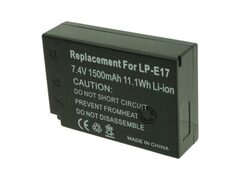
Compatible batteries exist under several brands, at a fraction of the genuine part's price: in Japan, for instance, the gap runs from 5,000 to 6,500 yen for the genuine LP-E17 down to 1,000 to 3,000 yen for a compatible equivalent. The difference is not just about price.
| Feature | Genuine LP-E17 | Undecoded compatible | Recent decoded compatible |
|---|---|---|---|
| Charge display | Precise percentage (recent RF bodies) | Rough icon or a warning on startup | Correct percentage on some bodies |
| Charges on a genuine Canon charger | Yes | No, needs a dedicated charger | Yes for a share of references |
| Manufacturer warranty | 1 year (US) | Variable, often shorter | Variable, sometimes longer |
| Price on the shelf | The highest on the market | A third to a quarter of the genuine price | In between |
The oldest compatible batteries fail to communicate properly with the camera body: no charge percentage shown, just a plain warning on startup, and no charging at all on a genuine Canon charger. One specific case illustrates the gap: a compatible battery going flat after only 25 shots during a session, while a genuine LP-E17 keeps delivering its stated shot count time after time. A newer generation of compatible batteries, described as decoded, fixes part of these limits and now shows a correct percentage on some bodies, a sign the gap is narrowing without fully closing when it comes to charging on the genuine Canon charger.
That price gap shows up on every market, in broadly similar proportions: a compatible reference typically trades at a third or a quarter of the genuine part's price, whatever the country. That ratio has held steady for several years, which rules out a one-off sale on either side. Going genuine remains the safest call for anyone who does not want to risk their camera's charging electronics, particularly on a recent mirrorless body where battery authentication gates certain display features.
A stable platform since 2015, across three Canon mounts
The LP-E17 first appeared in February 2015 with the EOS 750D and 760D, on the EF-S DSLR mount. It went on to power the EF-M mirrorless bodies (M3, M5, M6, M6 Mark II), then the RF mirrorless line from 2019 with the EOS RP, all the way to the more recent EOS R8, R10, R50 and R100. Three distinct Canon mounts, a single battery: few references in this space hold that kind of stability for close to a decade.
| Mount | Bodies | Period |
|---|---|---|
| EF-S DSLR | 750D, 760D, 77D, 800D, 850D, 200D, 250D | 2015 to 2019 |
| EF-M mirrorless | M3, M5, M6, M6 Mark II | 2015 to 2019 |
| RF mirrorless | RP, R10, R100, R50, R8 | 2019 to 2023 |
That continuity has a real, practical upside: a photographer moving from an EOS 800D DSLR to an EOS R10 mirrorless keeps their batteries and charger, with no need to reinvest in a new set of accessories. That is rare enough among camera makers to be worth pointing out: most switch battery references with every new sensor generation or mount. Across the ten DSLR and mirrorless bodies released between 2015 and 2020, the LP-E17 never went through a reference revision or a compatibility break: a battery bought in 2015 still works without restriction in an EOS R50 launched nearly a decade later, genuine charger included.
Build and interface: plain, with a real edge on newer bodies
The plain black plastic shell carries the Canon logo and the raised electrical rating. The four gold-plated contacts show no known mechanical wear issue on this specific reference. The sliding latch that holds it in place works the same way it did back in 2015, a sign of a design that got it right from the first version rather than one patched up along the way.
Unlike some laptop batteries, the LP-E17 has no screen or standalone check button of its own: its charge level can only be read through the camera body or the charger, never on its own inside a bag or a drawer.
The real interface difference plays out on the body side rather than the battery side: recent RF bodies show a precise charge percentage in their menus, while older DSLRs settle for a multi-segment icon. The battery sends the same information either way: it is the body's own software that chooses how finely to use it.
The manufacturer warranty is set at 1 year in the US from the purchase date, Canon's standard limited-warranty term for this class of accessory. No automatic extension applies outside of specific registration or purchase programs Canon runs from time to time.
Professional use: no battery grip, plan a backup routine
Neither the EOS RP nor the EOS R8 offers a vertical grip with a slot for a second LP-E17: unlike higher-end mirrorless bodies, battery life on these two cameras rests entirely on the single internal cell. The older EF-S DSLRs in this segment (77D, 800D, 850D) do not offer that option either.
For sustained professional work (a wedding, a reportage job, a full day of filming), the most reliable approach remains carrying several LP-E17 batteries rather than relying on a grip: their low weight (1.6 oz (45 g) each) and compact size make it easy to carry four or five without any real bulk, for a combined cost that still comes in below a single battery for a flagship professional body.
Price and availability on the shelf
The genuine LP-E17 is listed at around $65 on this market, and the price actually charged tends to vary noticeably from one retailer to another rather than staying fixed. That gap runs well above what most Canon accessories of this type see, which makes it worth comparing prices before buying rather than trusting a single shop. A kit bundling two batteries with a dual charger usually works out cheaper than two separate purchases of the battery alone, an option worth considering for anyone fitting out a body for the first time.
The reference stays actively stocked by every major camera retailer, with no sign of production winding down or of a replacement in the pipeline: it still powers the newest bodies in Canon's range to this day.
Who it suits, and who should look elsewhere
It suits any photographer or videographer with a Canon body on this list who wants a reliable second battery, free of error messages or electrical risk, so a session never gets cut short. It suits EF-S DSLR owners (77D, 800D, 850D, 250D) particularly well, where optical-viewfinder battery life comfortably clears a full day of shooting.
It suits less anyone filming or shooting continuously on an EOS RP or EOS R8 without planning for at least a second battery: electronic-viewfinder battery life on these two bodies remains the tightest in the whole compatible range. Buyers on the tightest budget might also look at a recent decoded compatible battery, accepting a warranty and a long-term track record that is not as well established as the genuine part's.