What the 74 Wh (20,000 mAh) are really worth
The Blavor PN-W12 Pro's spec sheet lists two figures: 20,000 mAh, and 74 Wh. The first is the total charge held by the lithium polymer (LiPo) cells that make up the pack, counted at a voltage close to 3.7 V. The second is the energy that charge actually represents, the figure that lets you compare packs of different cell voltage on equal footing. It is this 74 Wh figure, not the 20,000 mAh, that matters for judging real capacity.
With the conversion losses typical of this kind of device (15 to 25% between energy stored and energy actually delivered to a connected device), the nominal 74 Wh translate to roughly 55 to 63 Wh of usable output. Against a recent smartphone (12 to 18 Wh of battery depending on the model), that works out to somewhere between three full charges for a large phone and just over four for a smaller one, in line with the roughly four charges generally credited to this product. No independent measurement of the PN-W12 Pro's real delivered energy after conversion losses is available to go further.
At 74 Wh, the PN-W12 Pro stays comfortably under the 100 Wh threshold most airlines allow in carry on luggage without special paperwork, a useful point for travel or trekking abroad. This capacity puts it at double its closest cousins in the site's solar power bank niche, the Xtorm XR104 and XR203, both capped at 37 Wh, and level with the Xtorm XR202, which drops the solar panel entirely in exchange. Only the elzle 26800 beats it on raw capacity, at 99 Wh.
Four foldable solar panels: a real top-up, not a substitute
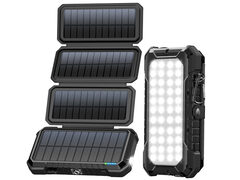
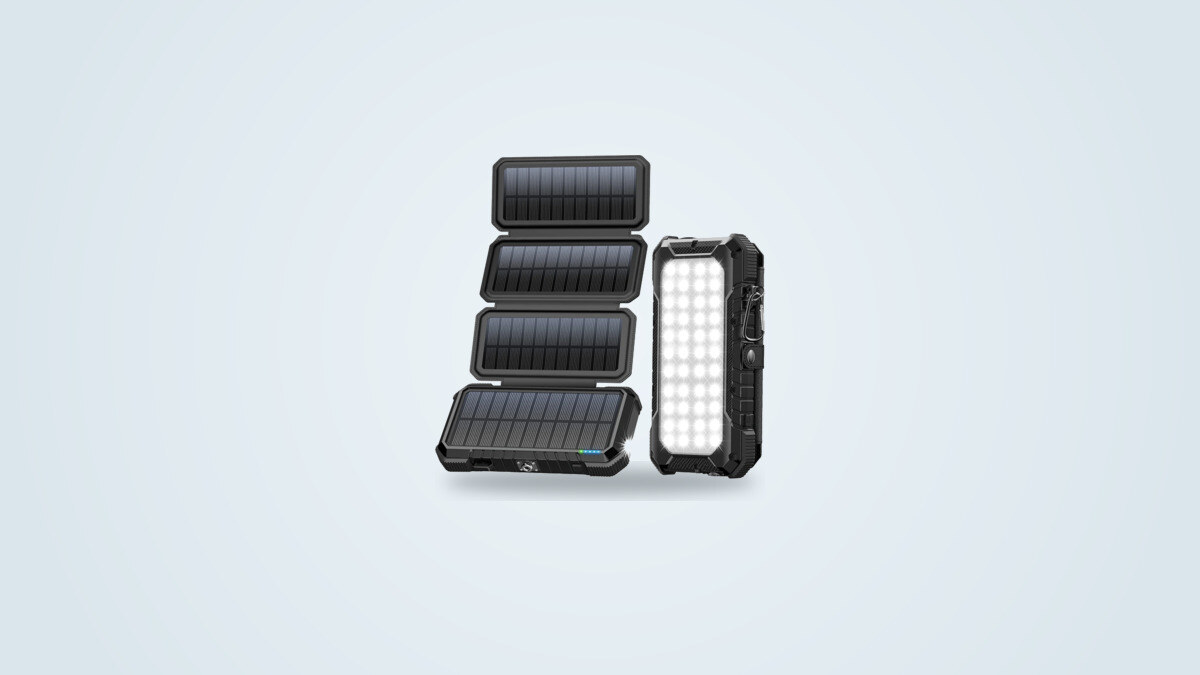
The solar panel is the whole point of this catalog niche, and the PN-W12 Pro's stands out by its count: four foldable panels linked to the main unit by a flexible hinge, rated at up to 1.2 A (4 x 300 mA) under 25,000 lux. That is well ahead of the Xtorm XR104's single fixed panel (about 1.2 W), and the maker claims roughly seven times the output of a single panel.
25,000 lux corresponds to strong midday sun with no cloud, a light level that only holds for a few hours a day even in summer, and drops sharply once the sun moves off the vertical or a cloud passes. Under cloud cover, this current generally falls to 0.3 to 0.4 A, barely above a quarter of its peak value.
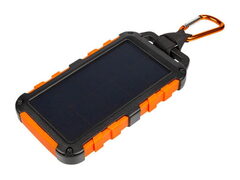
Once that is clear, the folding design keeps a real edge over a single built in panel: folded, it shields the photovoltaic surface from scratches and knocks during transport; unfolded, it offers a far larger collecting surface without growing the main unit. That is a better trade-off than the Xtorm XR104's, whose fixed panel stays permanently exposed for a much lower output.
USB-C charging: 6 hours for a full charge, average for its capacity
On the wired side, the PN-W12 Pro charges through its single USB-C port, rated to accept up to 18 W (USB PD and Quick Charge 3.0 protocols), for a full recharge rated at 6 hours. The same port also serves as the main output, a bidirectional design that avoids duplicating fast charging hardware.
Against its 74 Wh, that works out to roughly 12.3 Wh per hour, an average charging speed for the segment rather than a standout.
| Model | Blavor PN-W12 Pro | Xtorm XR104 | Xtorm XR203 | elzle 26800 |
|---|---|---|---|---|
| Capacity | 74 Wh | 37 Wh | 37 Wh | 99 Wh |
| Full USB-C recharge | 6 h | 3h30 | 2h30 | 8 to 9h |
| Approximate rate | ≈ 12.3 Wh/h | ≈ 10.6 Wh/h | ≈ 14.8 Wh/h | ≈ 11.6 Wh/h |
The Xtorm XR203, half the capacity (37 Wh), still beats it on rate at 2h30 for a full charge; the Xtorm XR104, same capacity as the XR203 but a different port setup, falls to 10.6 Wh per hour; the elzle 26800, the largest of the group at 99 Wh, charges at a rate very close to the PN-W12 Pro's own. No pass-through function, which would let a connected device draw power while the PN-W12 Pro itself recharges, is documented for this model. Best to treat charging the PN-W12 Pro and charging a device from it as two separate operations rather than simultaneous ones, a limitation the Xtorm XR203 does not share.
Three ports, 18 W at peak: what you can actually plug in
The PN-W12 Pro offers three outputs: one USB-C Power Delivery port up to 18 W, and two USB-A ports up to 15 W each on their own. All three can be used together to power up to three devices at once.
As with nearly every compact power bank, these per port figures do not add up: total output stays capped by the internal electronics, with no official table detailing the exact split between active ports. A single phone on the USB-C port gets the full PD output; that same phone alongside a headlamp and a GPS unit on the two USB-A ports will have to make do with a much smaller share of the total power available.
This limitation is nothing unusual for a pack of this size and price, and it is shared by most solar power banks already reviewed on the site. It is simply worth knowing before counting on the PN-W12 Pro to fast charge several power hungry devices at once. The PN-W12 Pro also has no screen or detailed per port power readout, just a basic charge level LED on the front face.
IPX5: a middling rating within its own solar niche
The PN-W12 Pro carries an IPX5 rating, a code worth reading precisely rather than assuming. The "X" in the dust position means that criterion was simply never evaluated: the casing is neither certified dust tight nor certified otherwise. The "5" in the water position guarantees resistance to water jets from any direction, a notably tougher bar than simple splash resistance.
| Model | Blavor PN-W12 Pro | Xtorm XR104 | Xtorm XR203 | elzle 26800 |
|---|---|---|---|---|
| Rating | IPX5 | IPX4 | IP65 | IPX5 |
| Dust | Not evaluated | Not evaluated | Fully sealed | Not evaluated |
| Water | Jets, any direction | Splashes | Jets, any direction | Jets, any direction |
Within its own solar power bank niche on the site, this rating lands between the two extremes: better than the Xtorm XR104's IPX4 (simple splashes), but behind the Xtorm XR203's IP65, the only one of this group with full dust sealing. The elzle 26800 shares the exact same IPX5 rating as the PN-W12 Pro. The PN-W12 Pro's rubberized, reinforced casing, visible in official photos, is built to take everyday outdoor knocks, a mechanical toughness distinct from water and dust sealing and not covered by an IP rating.
Camping light, compass and carabiner: the outdoor kit
Beyond the battery and the panels, the PN-W12 Pro carries a built in LED light on its back face, with several modes according to the maker's documentation (steady light, SOS, strobe), plus a compass and a carabiner with a strap. These accessories are what earn it a place in the catalog's outdoor range rather than among ordinary everyday power banks.
The light, arranged as an LED grid across much of the back face, suits ambient lighting (inside a tent, a camp table, finding something in a bag) better than throwing a tight beam like a headlamp. No lumen figure is published for this function, nor a runtime independent of the main battery's charge.
The carabiner, attached to a fabric strap built into the casing, lets the PN-W12 Pro clip onto the outside of a backpack so it can catch the sun while walking, exactly the use its unfolded solar panel is built for. The built in compass, on the other hand, stays a bonus accessory rather than a precision instrument: its close proximity to the unit's electronics and magnets structurally limits its reliability, a limitation shared by nearly every compass built into an electronic device.
1.1 lb, 148 Wh per kilogram: the best density after the elzle 26800
On the scale, the PN-W12 Pro comes in at 1.1 lb (500 g) for a footprint of 6.5 x 3.3 x 1.4 in (165 x 84 x 35 mm), panels folded. That is a noticeable weight for a power bank, though it stays in line with an outdoor battery carrying integrated solar panels and a reinforced casing.
Set against the energy it carries, the sum is flattering: at 148 Wh per kilogram (74 Wh for 1.1 lb / 500 g), the PN-W12 Pro reaches the second best energy density among the four solar power banks compared in this review, right behind the elzle 26800.
This result mostly comes down to the ratio between its doubled capacity (74 Wh against 37 Wh) and a weight that does not climb in the same proportion against its Xtorm cousins. The Xtorm XR104, at 0.6 lb (289 g), stays lighter in absolute terms and so more pleasant to carry on a multi day trek, but holds half the energy. The Xtorm XR203 carries a weight close to the PN-W12 Pro's own at 1.1 lb (506 g) for half the capacity, which leaves it well behind on density.
Watch for the exact listing: several Blavor 20,000 mAh units coexist
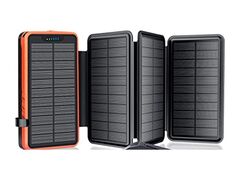
Blavor sells several solar power banks rated at 20,000 mAh under very similar names, a real source of confusion when shopping. The PN-W12 Pro covered in this review is identified by two specific absences: no wireless charging, and no cables built into the casing. Another unit from the same maker, also rated at 20,000 mAh and sold with a very similar look (dark casing with reinforced edges, four foldable panels), adds a wireless charging pad and built in cables instead, alongside a slightly higher rated wired output.
Both share the same brand, an identical rated capacity and a comparable outdoor positioning, which makes the two easy to mix up from a thumbnail photo alone. Before buying, check that the listing mentions the 18 W USB-C Power Delivery output and the absence of wireless charging, the two signatures that identify the PN-W12 Pro covered here rather than a neighboring listing.
Brand, build quality and warranty
Blavor has specialized in portable solar chargers since it was founded in 2013, with a range built around power banks with integrated or foldable panels. The PN-W12 Pro has been on sale since June 2019 and remains active in several retailers' catalogs seven years on, a sign of commercial staying power for this type of product.
The maker's documentation lists an operating temperature range of 14 °F (-10 °C) to 104 °F (40 °C). No recall or safety fault specific to the PN-W12 Pro has been identified. The product also shows a very large volume of favorable customer reviews accumulated since launch, a substantial sample for this kind of accessory.
The standard warranty is capped at one year, well short of the two years, extendable to three, now common among several newer direct competitors such as Xtorm's Xtreme Series. This paper gap genuinely weighs on the maker's long term commitment, even if it does not by itself predict real world reliability: seven years on the market with no recurring fault on record point the other way.
Against its direct solar rivals on the site
Priced roughly in the $30 to $60 range depending on the retailer, the Blavor PN-W12 Pro competes against several solar power banks sought after for the outdoors. Here is how it stacks up against three references from the catalog.
| Criterion | Blavor PN-W12 Pro | Xtorm XR104 | Xtorm XR203 | elzle 26800 |
|---|---|---|---|---|
| Capacity | 20,000 mAh (74 Wh) | 10,000 mAh (37 Wh) | 10,000 mAh (37 Wh) | 26,800 mAh (99 Wh) |
| Peak power | 18 W (USB-C PD) | 20 W (USB-C PD) | 20 W (USB-C PD) | 15 W (USB-C) |
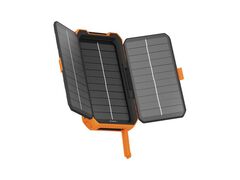
| Solar panel | 4 foldable, 1.2 A max | 1.2 W fixed | 5.1 W, 3 folding flaps | 4 foldable |
| Water/dust rating | IPX5 | IPX4 | IP65 | IPX5 |
| Weight | 1.1 lb (500 g) | 0.6 lb (289 g) | 1.1 lb (506 g) | 1.2 lb (556 g) |
| USB-C recharge | 6 h | 3h30 | 2h30 | 8 to 9h |
| Warranty | 1 year | 2 years (3 registered) | 2 years (3 registered) | 2 years |
The table sums up the PN-W12 Pro's position well: it does not lead on any single criterion, and its one year warranty leaves it clearly behind the other three on that specific point. Its combination of double the capacity of both Xtorm units, solid energy density and a contained price still makes it a credible compromise for anyone who wants runtime above all without paying the premium of full dust sealing (XR203) or minimal weight (XR104). The elzle 26800, still more capacious, remains the reference of the group for anyone who cares only about Wh carried.
Who it suits, and who should look elsewhere
The PN-W12 Pro suits anyone after a rugged, well equipped, general purpose outdoor power bank (light, compass, carabiner) for hiking, camping or travel, with comfortable capacity for several days off grid and a genuine solar top-up on sunny days. Its solid energy density makes it a sensible pick for anyone who wants to carry plenty of Wh without an excessive weight penalty.
It suits less anyone hoping to truly do without an outlet thanks to the sun alone: as with every power bank in this niche, solar stays a multi day top-up, not a daily charging source. It also suits less anyone who prioritizes full dust sealing (the Xtorm XR203 does better), the lowest possible weight (the Xtorm XR104 does better), or a long warranty, since the PN-W12 Pro settles for one year where several direct competitors offer two to three.