Two functions in a single 1.5 lb box
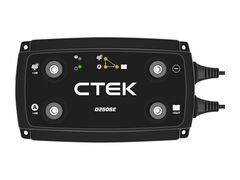
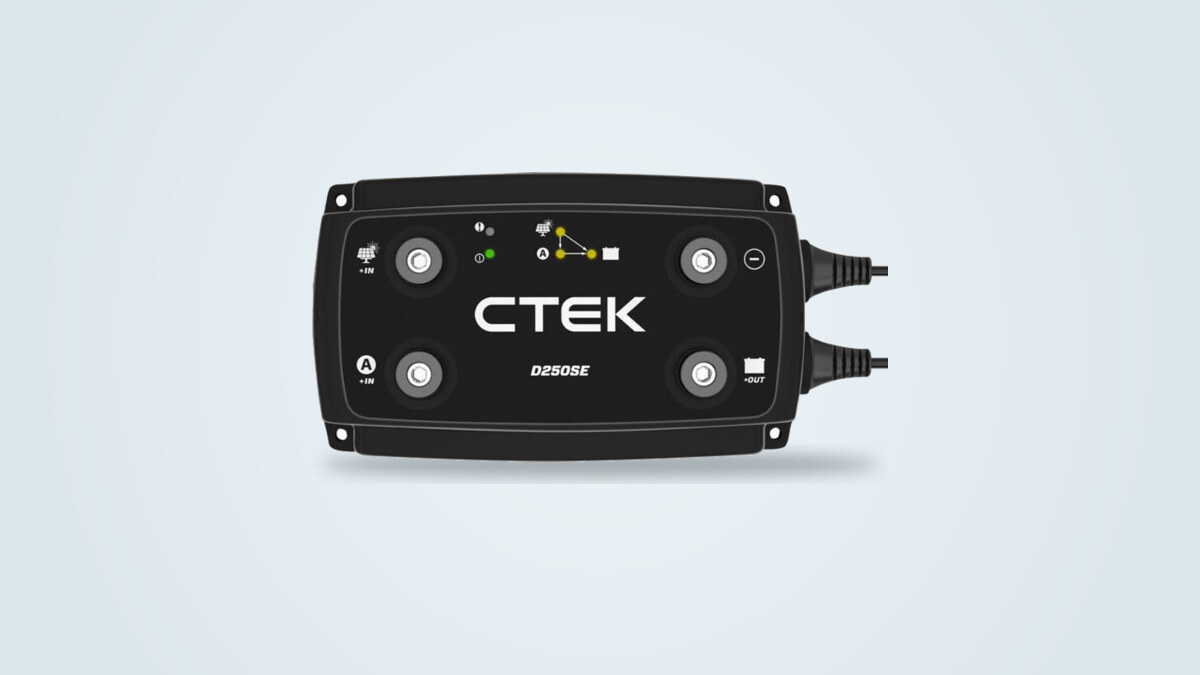
The CTEK D250SE combines two functions in a single box: a standard DC-DC charger wired to the vehicle's alternator, and a solar MPPT (Maximum Power Point Tracker) regulator for a photovoltaic panel, with no separate second unit required. Built for camper vans, RVs, 4x4s and boats without shore power, it charges the house battery from either source, or both at once.
Charging follows a five-step cycle: desulphation, main charge (bulk), absorption, maintenance (float) and periodic pulses to keep the battery between 95 and 100% once full. CTEK states that the desulphation step can extend the life of a sulphated lead-acid battery by two to three times, a manufacturer figure that no independent measurement confirms so far. Once the house battery is charged, the unit automatically switches to maintaining the starter battery with 3-second solar pulses, useful during extended parking without running the engine.
What the advertised 20 A is really worth
CTEK rates the D250SE at up to 20 A of charge current to the house battery, whichever source is used (alternator, solar, or both combined). That figure only holds up to an ambient temperature of 77 °F (25 °C), however: the official datasheet shows a power reduction to 16 A from that point, then to 13 A at 122 °F (50 °C), a 35% drop from the rated current. The unit remains usable from -4 °F (-20 °C) to 122 °F (50 °C), but mounting it near the engine or inside a poorly ventilated locker regularly pushes it into that derated zone during the summer months.
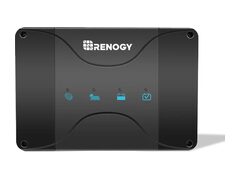
On the solar side, the input accepts 11.5 to 23 V and up to 25 A, for a recommended panel power of 50 to 300 W. That is a noticeably narrower range than the rival Renogy DCC50S, which handles up to 660 W: the D250SE suits a modest roof-mounted top-up panel, not a solar setup sized to cover most of the vehicle's power needs. The built-in MPPT regulator stays active whichever source is charging, including when the alternator and the solar panel are both feeding it at once: the unit manages the split between the two inputs on its own.
Six lead-acid profiles and a dedicated lithium mode
The D250SE handles six distinct charge profiles for lead-acid batteries: WET (flooded), EFB, Ca/Ca, MF, AGM and GEL, on top of a dedicated profile for LiFePO4 lithium batteries (and the Li-Fe, Li-iron, LFP variants). Each family gets its own charge voltage, and the supported house battery capacity runs from 40 to 300 Ah.
| Profile | Chemistries covered | Charge voltage |
|---|---|---|
| Normal | WET, EFB, Ca/Ca, MF | 14.4 V |
| AGM | AGM, GEL | 14.7 V |
| Lithium | LiFePO4, Li-Fe, Li-iron, LFP | 14.2 V |
On the lithium profile, an initial "accept" test stage checks for one to two hours that the battery takes charge correctly before moving to the main stage, a precaution that avoids pushing current into a faulty battery or one whose BMS has tripped. The main charge stage can then run for up to 20 hours before reaching 14.2 V, against a maximum of 8 hours for the equivalent lead-acid stage: a more cautious pace, consistent with a 20 A current applied to capacities that go up to 300 Ah.
One thing to know before buying: the starter battery itself must stay lead-acid. The D250SE has no profile for a lithium starter battery.
No screen, no app, not even as an option
Control of the D250SE is limited to a three-position selector cable (Normal, AGM, Lithium) wired once at installation, and two indicator lights on top of the unit that signal, through color and blink pattern, which of five states is active: charging from the alternator, charging from solar, combined charging from both sources, pulse maintenance once the battery is full, or a power-saving mode with no charging under way. No screen, no digital readout, no current or voltage figure readable directly on the unit.
The unit does handle the automatic switch between alternator and solar without any input, and stays compatible with variable-voltage smart alternators, increasingly common on vehicles with an engine start-stop system, via a dedicated cable, with no complex electronic setup beyond correct wiring at installation.
One setting to get right: the battery selector cable
Two small cables determine the D250SE's behavior, and a wiring mistake can go unnoticed for a long time. The red cable signals whether the alternator is conventional (not connected) or smart (connected to an ignition signal); the black cable sets the charge profile applied: not connected for Normal, tied to ground for AGM, tied to +12 V for Lithium.
| Red cable | Alternator type | Black cable | Profile applied |
|---|---|---|---|
| Not connected | Conventional | Not connected | Normal |
| Connected | Smart | Tied to ground | AGM |
| Connected | Smart | Tied to +12 V | Lithium |
If that black cable ends up on the wrong setting, the unit keeps running but applies a charge voltage that does not match the battery actually installed, with no distinct fault code to flag the configuration error: the house-battery fault indications in the official documentation all read "connection problem" and point to checking the wiring and the fuse, not the selected profile specifically. Installation also calls for a 30 A fuse on the alternator side and a minimum cable gauge of AWG12 (4 mm²) on short runs.
Charging also starts and stops on timed voltage thresholds: on a conventional alternator, it takes at least 13.1 V for 5 seconds to start charging, and a drop below 12.8 V for 10 seconds to stop it; on a smart alternator, those thresholds drop to 11.8 V and 11.4 V respectively. That few-second delay keeps the normal voltage dip during engine cranking from starting or stopping the charge by mistake.
Very low idle draw, but no reverse-polarity protection
The D250SE draws less than 1 Ah per month at idle, which very effectively limits the risk of draining the starter battery during extended parking. Output current ripple stays under 4%, a figure that protects the charged battery's lifespan. A temperature sensor adjusts the charge voltage (23 mV per degree Celsius below 77 °F (25 °C)), and a thermal cut-off kicks in above 140 °F (60 °C).
A fully documented datasheet, a standard two-year warranty
The D250SE's official datasheet leaves no gray area: IP65 protection (dust and splashes), an operating range of -4 °F (-20 °C) to 122 °F (50 °C), a weight of 1.5 lb (0.7 kg), dimensions of 7.6 x 4.3 x 2.6 in (192 x 110 x 65 mm) and a 2-year manufacturer warranty are all spelled out in black and white, unlike some competitors that stay quieter on these points. On the other hand, CTEK does not publish any conversion efficiency figure for this model, not even as a rough indication.
The unit can be scaled up: paired with the SMARTPASS 120S (sold separately), the D250SE becomes part of a system capable of up to 140 A of combined charging current to a house battery of up to 800 Ah. The SMARTPASS 120S also adds deep-discharge protection (cutting off consumers below 11.5 V) and a start-assist function that briefly ties the house battery to the starter battery for 10 seconds if the starter battery drops below 6 V, two functions absent when the D250SE is used on its own.
Against the Renogy DCC50S and the Victron Orion-Tr Smart
How does the CTEK D250SE stack up against other alternator chargers on the market?
| Criterion | CTEK D250SE | Renogy DCC50S | Victron Orion-Tr Smart Isolated | Sterling BB1230 |
|---|---|---|---|---|
| Charge current | 20 A | 50 A | 30 A | 30 A |
| Solar MPPT input | Yes (300 W max) | Yes (660 W max) | No | No |
| LiFePO4 lithium compatible | Yes | Yes | Yes | Yes |
| Bluetooth / app | None | Optional | Built-in | Not stated |
| Weight | 1.5 lb (0.7 kg) | Not stated | 3.5 lb (1.6 kg) | 2.6 lb (1.2 kg) |
| Observed price | $495.89 | $247.58 | $243.95 | $227.80 |
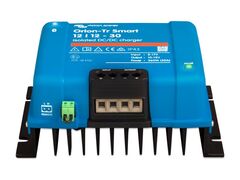
The Renogy DCC50S delivers more current and handles a higher solar wattage for a lower price, but its product sheet stays quiet on several points (IP rating, temperature range, weight). The Victron Orion-Tr Smart Isolated offers built-in Bluetooth control and full galvanic isolation, at the cost of having no solar input at all. The CTEK D250SE stands out for the granularity of its lead-acid charge profiles and for the completeness of its official datasheet, but remains the least powerful of the three and the only one with no remote-monitoring option whatsoever. Against the cheaper Sterling BB1230, which also lacks a solar input, the D250SE keeps the argument of a single box for anyone who genuinely wants to combine both sources.
Who the CTEK D250SE is for
The CTEK D250SE suits anyone who wants to combine alternator and solar charging in a single compact box, has no need to track charging from an app, and values a fully documented datasheet over the highest current on the market. It is aimed first at a camper van or RV already fitted with a modest roof solar panel, with a house battery that stays within the 300 Ah the unit can handle. For more charge current and higher solar wattage at a near-identical price, the Renogy DCC50S remains a serious alternative. For built-in Bluetooth control and full galvanic isolation, with no need for integrated solar, the Victron Orion-Tr Smart Isolated is the reference.