What the claimed 37Wh are really worth
The number printed on the box, 10000mAh, works out to a nominal capacity of 37Wh once converted at the usual lithium-ion cell voltage (3.7V). That is a cell-level calculation, not the energy that actually reaches a phone or tablet: between the cell and the output port, the conversion electronics step the battery's 3.7V up to the USB protocol's 5V, 9V or 12V, and that conversion loses part of the energy as heat.
On this power bank, the gap is significant. The energy that actually comes out of the ports sits close to 21.4Wh, an efficiency near 58 to 60%. That is well behind directly comparable rivals of the same capacity elsewhere in this category: one competing 10000mAh power bank states a real output close to 30Wh itself (81% efficiency), another reaches around 27.5Wh (74%).
In practice, that works out to one or two full smartphone charges depending on the model, an estimate consistent with the technical information available for this product. The bare 10000mAh figure alone would suggest an extra charge that never actually arrives.
IP67: a promise kept to the letter
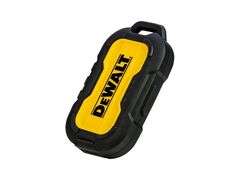
The IP67 rating reads as two digits. The 6 means complete protection against dust. The 7 means protection against accidental immersion up to 3.3 feet (1 meter) deep, typically for around 30 minutes. On this power bank, that protection only holds once the rubber cover over the USB ports is properly closed: with the port open, it no longer applies, a point the manufacturer states itself in its documentation.
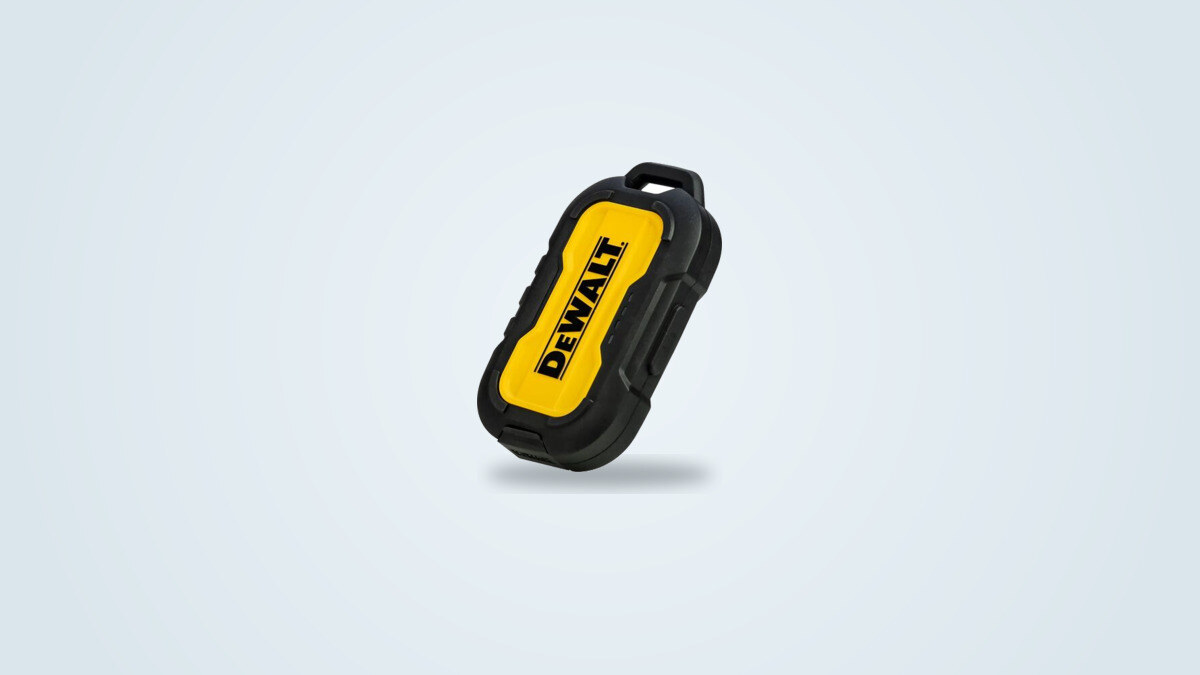
The thick rubber shell, the brand's signature black and yellow color scheme, and the built-in carabiner clip all confirm this jobsite-first design over a smartphone-pocket one. In practice, that covers an unexpected downpour, a drop in the mud, or dust from a workshop, but not a prolonged dunk or use with the port left open in the rain.
The weight of a design built for the jobsite
At an official 7.7 oz (218g) for roughly 4.9 x 2.8 x 1.0 in (125 x 70 x 25mm) (a figure closer to 8.5 oz / 240g also appears on some spec sheets for this model, a plausible gap depending on whether the carabiner and port cover are included on the scale), this power bank sits at the heavier end of the 10000mAh models compared on this page, without being excessive: the Anker Zolo 10000 weighs 7.6 oz (215g) at the same 1.0 in (25mm) thickness, an almost identical weight despite an unreinforced shell.
The real difference shows up elsewhere: the Baseus FC11 10000 (7.2 oz / 203g, 0.7 in / 18mm) and especially the Nitecore Pocket 10000 (5.6 oz / 160g, 0.5 in / 12.5mm) bet on slimness over armor. This DeWalt makes the opposite choice, a thick rubber shell that absorbs impacts at the cost of a less discreet footprint in a pants pocket. The built-in carabiner partly offsets that bulk by offering an external attachment point, an option the slimmer models lack.
18W at the top: modest output power
The power bank offers two active ports: a USB-C port with Power Delivery support and a Quick Charge USB-A port, for a maximum stated output of 18W on either port. On the USB-C port, the USB Power Delivery voltage steps (5V and 9V, up to 18W) are held with no notable gap between the expected and delivered values, a technical point correctly handled.
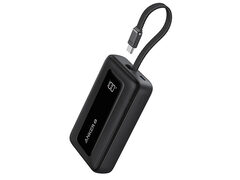
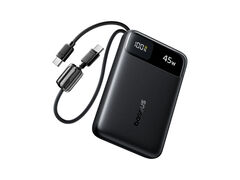
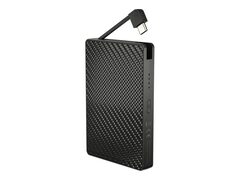
That 18W ceiling remains the lowest among the compact 10000mAh power banks compared on this page: the Nitecore Pocket 10000 reaches 22.5W, the Anker Zolo 10000 hits 30W, and the Baseus FC11 10000 goes up to 45W.
In practice, 18W charges a smartphone comfortably, just more slowly than a recent 25W-plus charger. For a tablet or a laptop, that output slows down a battery drain during use rather than delivering a genuinely fast recharge.
Recharging the DeWalt itself: one of the slowest in its class
This power bank's own input port also tops out at 18W. On paper, filling its 37Wh at that rate would take a little over two hours. In practice, expect closer to 3 hours for a full recharge, a gap that the final charging taper, slower by nature on any lithium-ion battery, does not fully explain on its own.
That pace sits closer to a trickle charger than a fast one, despite the 18W figure printed on the spec sheet. Under sustained use, the shell can approach 104 °F (40 °C) during this recharge phase, a moderate warmth with nothing unusual for this format.
Two ports, one waterproof cover: living with it day to day
The port selection is limited to two active outputs at a time: a USB-C Power Delivery port and a USB-A Quick Charge port, both protected by a single rubber cover that must be properly closed to keep the IP67 rating intact. That approach protects the electronics effectively, at the cost of an extra step at every plug-in, a hassle that non-waterproof power banks do not impose.
Remaining charge shows on four LED dots, a simple gauge with no precise percentage or per-port power detail, behind the digital displays that several rivals of the same capacity now offer. The kevlar-reinforced USB-C cable included in the box, roughly 3.3 feet (1 meter) long, remains a genuine plus though: several direct rivals include no cable at all.
Up against the compact 10000mAh rivals
In the crowded compact 10000mAh power bank segment, this DeWalt stands out less for its charging numbers than for its positioning: none of the direct rivals cited on this page offer an IP67 rating or a lifetime warranty.
| Product | Max power | Weight | Thickness | Warranty |
|---|---|---|---|---|
| DeWalt 10000 (18W) | 18 W | 7.7 oz (218g) | 1.0 in (25mm) | Lifetime (limited) |
| Nitecore Pocket 10000 | 22.5 W | 5.6 oz (160g) | 0.5 in (12.5mm) | 1 year |
| Anker Zolo 10000 | 30 W | 7.6 oz (215g) | 1.0 in (25mm) | 2 years |
| Baseus FC11 10000 | 45 W | 7.2 oz (203g) | 0.7 in (18mm) | 2 years |
The Nitecore Pocket 10000 goes much further on sheer size, a genuinely smaller footprint, but leaves out power and any protection against water or dust. The Anker Zolo 10000 and the Baseus FC11 10000 both deliver more power for a similar or lower weight, without claiming any immersion resistance. The choice comes down to priorities rather than one model beating the others on every count.
Who this power bank suits, and who should look elsewhere
This model suits first anyone working or spending time in dusty or wet conditions: tradespeople, construction workers, hikers, anglers or travelers who worry more about a drop in the mud or a sudden downpour than about a slightly slow charge. The built-in carabiner and rubberized shell make sense here, as does the lifetime limited warranty that covers the purchase over the long run.
It suits less anyone after the best energy efficiency for its capacity (several compact 10000mAh rivals top 74% efficiency against 58 to 60% here), the fastest charge (18W against 30 to 45W elsewhere), or a precise charge display. For purely urban or office use, with no real exposure to water or dust, a more capable power bank of the same format will serve better day to day.
Cabin travel and outdoor use
At 37Wh, this power bank stays well under the 100Wh threshold beyond which most airlines require prior approval to carry a lithium battery in the cabin. Like any battery of this type, it must travel in carry-on luggage, never in checked bags.
The compact format and built-in carabiner make it a sensible choice for a hiking backpack, a work truck, or travel luggage exposed to the elements. For heavier use, such as a long-haul flight with a laptop to recharge, the 18W output and the 21Wh actually available are just about enough to slow down a battery drain during use, not to deliver a fast full recharge.
Brand reliability and history
DeWalt backs this power bank with a lifetime limited warranty, well beyond the 1 to 2 years typical of general-purpose power bank makers. The product does not appear on any recall list to date: the only recent recall affecting the brand in Europe (2024-2025) concerns a separate 20V tool battery (DCBPS0554) over an overheating risk, and does not involve this model or this product category.
The lack of long-term track record cuts both ways, though: no recurring failure or defect specific to this unit has turned up to date, an honest finding rather than a guarantee over several years of use.