The 2560 Wh versus lead-acid: what the 24V format changes
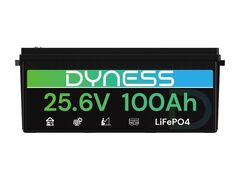
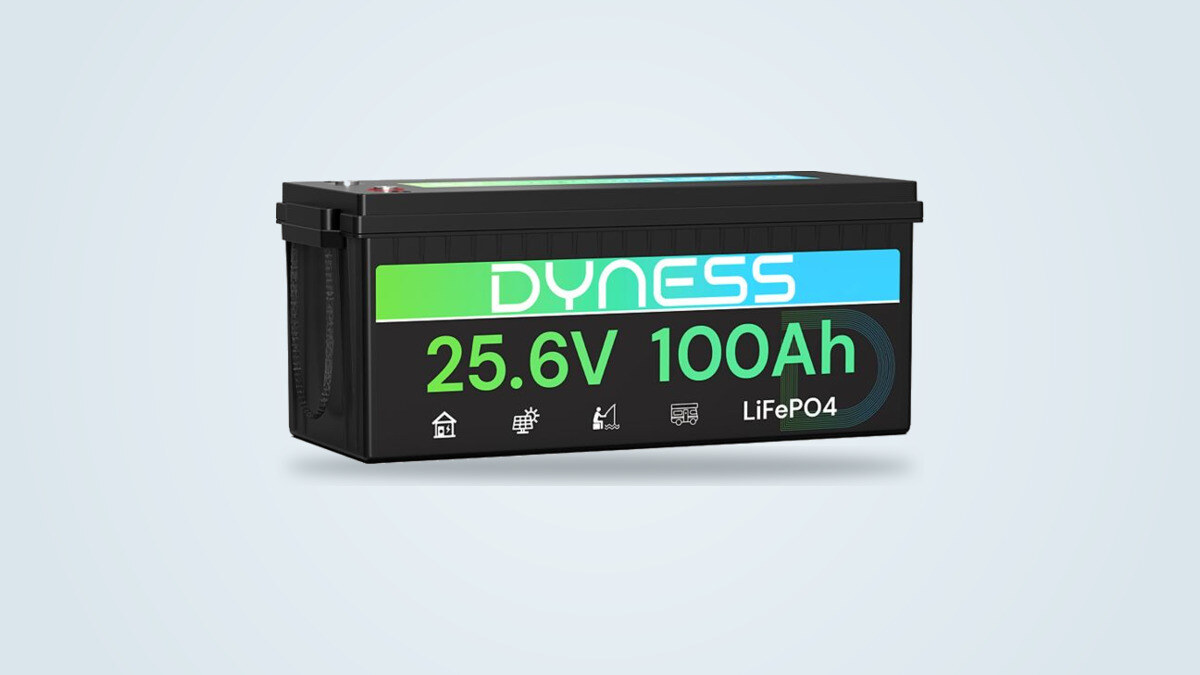
The Dyness 24V 100Ah is rated at 2560 Wh (25.6V nominal for 100 Ah) with a claimed 100% depth of discharge, a trait specific to LiFePO4 chemistry. A lead-acid battery should never be drained past 50% without noticeably shortening its lifespan, so matching the same usable energy as these 2560 Wh would require a lead-acid setup with a substantially higher nominal capacity to begin with.
The Dyness 24V 100Ah is built to directly replace two 12V 100Ah lead-acid batteries wired in series, a common setup on a 24V RV, boat or solar kit installation. In a single 20.9 x 8.1 x 8.5 in (531 x 206 x 217 mm) case, it cuts the cabling in half (one set of terminals instead of two batteries wired together) and frees up part of the space previously taken by two separate cases.
| Criterion | 2 x AGM 12V 100Ah in series (reference) | Dyness 24V 100Ah (this product) |
|---|---|---|
| Nominal capacity | 100 Ah at 24V (2400 Wh) | 100 Ah at 25.6V (2560 Wh) |
| Recommended discharge | 50% maximum | 100% claimed |
| Actual usable energy | About 1200 Wh | 2560 Wh |
| Weight | 123 to 132 lb (56 to 60 kg) | 42.6 lb (19.3 kg) |
The manufacturer also claims over 4000 cycles at 100% depth of discharge for this model, a figure that shows up consistently across its official documentation for this exact rating. No independent measurement of the actual delivery of the claimed 2560 Wh could be cross-checked so far for this portable case: it's a manufacturer figure, not a third-party verified one, and it remains a confidence gap rather than an established flaw.
No Bluetooth, no screen: the cost of a deliberately stripped-down lineup
This Dyness 24V 100Ah is the lineup's entry point: no Bluetooth, no WiFi, and no screen or charge-level indicator on the case. The only way to know the exact state of charge is a multimeter clipped to the terminals, or the display of a connected solar controller, charger or inverter capable of showing pack voltage.
Dyness nonetheless sells, under the same brand and for the same nominal rating (24V, 100Ah, 2560 Wh), two more complete tiers. A Bluetooth version adds a mobile app that shows state of charge, voltage and current in real time, for a higher price but otherwise identical BMS specs (100A, 4000 cycles at 100% discharge, 20.48 kWh ceiling). A newer WiFi version goes further still: it claims 6000 cycles and double the expansion ceiling this time, 40.96 kWh instead of 20.48 kWh, for a higher claimed output power (3328 W). Choosing this base version isn't just about giving up an app, then: it also means settling for the oldest of the three platforms in terms of claimed cycle count and expansion ceiling.
For straightforward use (a direct swap for a lead-acid setup, with no remote monitoring), the lack of Bluetooth isn't a dealbreaker: the BMS manages its protections fully on its own, with no need for a phone nearby. It's mainly for quick troubleshooting, or for keeping an eye on several units wired in series or parallel, that having no interface at all is felt.
The 100A BMS and its surge current: a clear spec, a vague duration
The built-in BMS is rated for 100A continuous, in both charge and discharge, for a maximum continuous power of 2560 W at nominal voltage. It covers the protections expected of a modern LiFePO4 battery this size: overcharge, deep discharge, overcurrent, short-circuit and overheating. For electric motor use (a 24V trolling motor, auxiliary boat propulsion), the manufacturer also specifies a 300A surge current, meant to absorb the current draw at the moment the motor starts.
That 300A figure is worth a closer look: the manufacturer's documentation presents it as an instantaneous starting current, without specifying its exact duration or measurement conditions, a less clear phrasing than at least one direct competitor in the same segment, which explicitly states its discharge peak at 500A for 1 second on a comparable product. The underlying idea is the same (a protection threshold above the continuous rating, not a permanent operating mode), but the exact duration of the Dyness peak isn't specified as clearly.
The IP65 rating protects against dust and water splashed from any direction, a level suited to an open boat locker exposed to spray or an RV floor exposed to light leaks. It isn't an immersion rating, though: a battery left submerged for any length of time isn't covered by this level of protection.
Watch out when comparing spec sheets online: a lookalike DL2.5 case exists, rated only IP20
Searching for additional specs online hides a trap: Dyness also sells, under a distinct reference (DL2.5) but for the same nominal rating shown (24V, 100Ah, 2.56 kWh), an entirely different module from the one reviewed here. This DL2.5 is a flat case measuring 18.9 x 8.7 x 5.2 in (481 x 221 x 133 mm) at 50.7 lb (23 kg), rated IP20 only (light dust protection, no protection against water at all), built for an indoor home-storage rack rather than mobile or marine use.
Both cases share the same nominal voltage and the same advertised capacity, which explains the frequent mix-up between the two in search results, but their charge voltage thresholds, maximum current and recommended use differ noticeably from one spec sheet to the other. Going by weight, shape (a compact block with handles versus a flat plate with none) and the stated IP grade quickly settles any doubt.
Cold-weather performance: automatic cutoff, no self-heating
Charging is automatically cut below 32 °F (0 °C) and resumes above 41 °F (5 °C), while discharging (actual use) stays available down to -4 °F (-20 °C). The manufacturer also claims discharge operation up to 140 °F (60 °C), and a storage range of 14 °F to 122 °F (-10 °C to 50 °C). That's a wide window for mobile use, and notably more forgiving than a classic NMC lithium chemistry, which handles a cold charge very poorly.
For a boat or RV used through shoulder-season weather, this automatic cutoff heads off lithium's main cold-weather risk (metallic lithium plating on the electrode during a too-cold charge, which permanently degrades the cell) without any input from the owner. This base version has no cell self-heating function at all: the cutoff below 32 °F (0 °C) is a passive protection, not an active cold-weather fix. A charge attempted on a chilly morning simply won't start until the temperature climbs back above the threshold.
Charging and solar input: what Dyness specifies
The manufacturer recommends a charge voltage of 28.8V (plus or minus 0.4V) and a charge current of 20A, or roughly 0.2C. For direct solar charging, an input of at least 700W is recommended to reach a full recharge in about 5 hours from empty, a useful figure for sizing an MPPT controller on a 24V kit.
A charger or solar controller built for a generic 24V LiFePO4 chemistry works fine, as long as it respects this charge voltage and the temperature thresholds already covered. These figures make it possible to properly size an MPPT controller or a dockside charger without under- or over-sizing the setup paired with this battery.
Expandable to 20.48 kWh in 4P2S: real headroom, already outpaced by Dyness's own WiFi tier
The manufacturer claims expandability up to a 4P2S configuration (4 strings in parallel, 2 in series), or 8 units forming a 51.2V 400Ah system, for a combined 20.48 kWh. That ceiling turns this replacement battery into the building block of a more ambitious solar or marine system, while staying just as usable one unit at a time for a simple lead-acid swap.
For comparison with the manufacturer's own lineup: the newer WiFi version of the same rating claims double the ceiling, 40.96 kWh in a 4P4S configuration, or twice as many units combinable in series. To stay reliable, any series or parallel build like this calls for batteries from the same batch, brought to a matching charge level before being wired together, a precaution that applies to any LiFePO4 chemistry combined this way and not just to this brand. For a more modest setup (a boat or RV), a single unit swapped in for two lead-acid batteries remains the simplest and most common use case.
5-year warranty and brand reliability
The advertised warranty on this portable battery lineup is 5 years. The manufacturer's general warranty policy, common to its whole product range, stays fairly broad on the exact duration depending on the market, but clearly states what voids coverage: misuse, accidental damage, unauthorized modification or disassembly, use of unapproved third-party parts, purchase from an unauthorized reseller, an altered serial number, or the lack of valid proof of purchase. No clause requiring a minimum recharge frequency during long-term storage, or mandatory online registration before use, was found for this lineup, a point that sets it apart from at least two direct competitors already reviewed on the site, where such a clause exists explicitly.
Dyness is a manufacturer specializing in energy storage since 2017, active in more than 100 countries, with a two-sided business: fixed residential storage systems (stackable cabinets for the home) on one side, and a lineup of portable batteries for RVs, boats and off-grid solar on the other, sold under the DynessPower brand this product belongs to. That's a different profile from a recent single-product brand with no verifiable industrial track record.
No independent measurement or teardown has been found so far for this specific 24V 100Ah portable model, a confidence gap shared with every battery in this segment already reviewed on the site rather than a weakness specific to this reference.
Against the direct competition
In the still-narrow segment of 24V 100Ah LiFePO4 batteries, the Dyness faces three rivals frequently compared online: the LiTime 24V 100Ah, a long-standing reference in the mobile power market; the Power Queen 24V 100Ah, also in the catalog in a 12V version; and the Redodo 24V 100Ah, a very active alternative in this segment.
| Criterion | Dyness 24V 100Ah | LiTime 24V 100Ah | Power Queen 24V 100Ah | Redodo 24V 100Ah |
|---|---|---|---|---|
| Energy | 2560 Wh | 2560 Wh | 2560 Wh | 2560 Wh |
| BMS / continuous discharge | 100 A | 100 A | 100 A | 100 A |
| Claimed cycles | 4000+ (at 100% DoD, stated) | 4000 to 15000 (DoD not always stated) | Up to 15000 (DoD not always stated) | 4000 to 15000 (DoD not always stated) |
| Water resistance | IP65 | IP65 | IP65 | IP65 |
| Warranty | 5 years | 5 years | 5 years | 5 years |
With near-identical specs on paper (energy, BMS, water resistance, warranty length), the real difference lies in how transparently cycle counts are stated: Dyness explicitly ties its 4000-cycle figure to a full 100% discharge, while all three competitors advertise much higher numbers (up to 15000) without always specifying the matching depth of discharge, a nuance that matters since that kind of figure usually corresponds to a partial discharge rather than a full one. On price, the Dyness sits clearly below these three references at comparable specs, making it the most accessible option in the segment for anyone who doesn't need Bluetooth monitoring.
Who it's for, and who should look elsewhere
This battery is best suited to anyone building or upgrading a 24V setup (solar kit, RV, boat, trolling motor) and looking to replace two 12V lead-acid batteries with a single, lighter case, without needing to track the state of charge from a phone. Its price, clearly below direct competitors at the same capacity, also makes it a solid entry point for anyone building a system that can grow in stages, up to 20.48 kWh.
It suits less well anyone wanting remote monitoring from day one (the Bluetooth or WiFi version from the same manufacturer fits that better, with the WiFi version also bringing better cycle and expansion specs along the way), anyone chasing the highest cycle count on the market without reading the matching discharge conditions, or anyone relying on an onboard screen for a quick visual check without a multimeter. Double-checking the exact reference (and not DL2.5) before buying remains a useful precaution for anyone comparing several spec sheets found online.