What the rated power actually means
The 7200 W figure on the spec sheet is the rating for this North American configuration (120/240 V) of the base module, the one sold in the US. Across the Atlantic, on Europe's single-phase 230 V grid, the official documentation for the same module lists a continuous output of 6900 W instead, about 4% less: the gap comes down to local electrical certification, not a different component. The rest of the spec sheet does not change from one market to another.
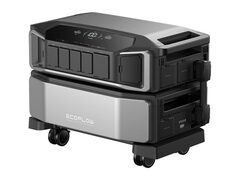
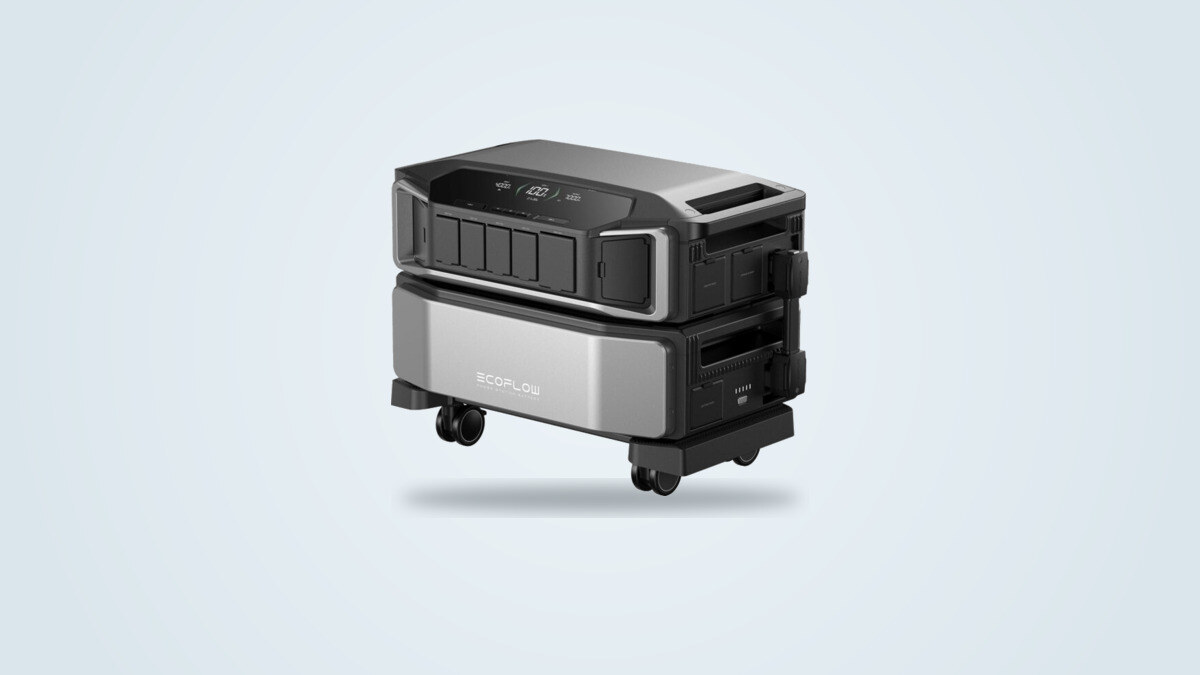
The architecture rests on two separate building blocks: an inverter (the top unit, with the screen and outlets) and one or more 6144 Wh LiFePO4 batteries (the bottom units). A single inverter accepts up to 5 batteries, i.e. 30 kWh, and up to 3 inverters can be combined to reach 90 kWh and 21.6 kW combined. This range is the real point of the product: most portable stations top out at 2 to 3 kWh, while the Delta Pro Ultra is aimed squarely at residential storage.
| Market | Mains | Continuous output |
|---|---|---|
| North America | 120/240 V | 7200 W |
| Europe | 230 V | 6900 W |
Real-world efficiency and the cost of usable energy
Under a load close to its maximum rated output (around 6000 W, sustained for close to an hour), the conversion efficiency reaches 98%. Against the battery's nominal 6144 Wh, that works out to roughly 6020 Wh actually available at the AC output at that load, a very strong result for a station in this power class. No reliable data, however, indicates how this efficiency behaves under small, sustained loads of a few hundred watts: nearly all the available figures cover high loads, close to the rated output.
The base module's price (from $4199) needs to be read against this capacity: per usable kWh, it sits in the upper range of modular home systems, though well below many fixed wall batteries sold with installation included. Expansion is incremental: an additional 6 kWh battery runs close to $1967, roughly $328 per kWh, since it carries no inverter of its own, which makes scaling up more attractive than buying a second complete system.
The fast-charging promise, and what it actually requires
The most prominent charging claim is an 80% charge in 60 minutes on mains power. That figure assumes a setup able to deliver the unit's full input power: in practice, on a dedicated residential installation, going from 0 to 80% is closer to 1h45min to 2 hours. On a standard, non-dedicated household outlet, which only delivers a fraction of that power, a full charge takes around 4 hours and draws noticeably more energy from the meter than the capacity actually stored, the difference coming from conversion losses during a slow charge.
Solar charging follows a similar pattern: with the 5600 W maximum input split across two MPPT inputs, a full charge takes a little over an hour in full sun at maximum power, a similar order of magnitude to fast mains charging. That speed, however, assumes a solar array sized accordingly, which represents a sizeable footprint, rarely available on a standard residential roof.
Handling load: startups, overloads and edge cases
Across repeated central air conditioner startups (several dozen cycles, spread over multiple sessions), the unit absorbs the inrush current without a single trip, with a comfortable margin under its peak power ceiling. The same holds for an electric dryer running at around 5500 W: dozens of consecutive cycles, with no throttling or cutoff.
Pushed deliberately beyond its 7200 W continuous rating, the unit holds a load close to 9200 to 9300 W for about 10 seconds before shutting down to protect itself. That is well below the peak figure listed on the spec sheet (14,400 W), but the latter describes a very brief spike, on the order of a motor startup, not a sustained load: the two figures answer different questions and are not contradictory.
One specific case is worth flagging: on an inductive load of just 2200 W (a vehicle lift), the unit can become unstable and struggle to hold the required power, despite a large theoretical margin. This type of load, with a strong inrush current, appears to behave differently from an air conditioner compressor or a dryer: the exact cause is not known. A second edge case concerns cross-charging: the generator input does not pass current through to the outlets while the unit is itself charging from that same input, a real limitation for anyone planning a combined mains, generator and battery backup setup.
Noise: silent under light load, far less so beyond it
Below 2000 W, the unit genuinely runs at 0 dB: no fan kicks in, and the total-silence claim holds at that load. Once the drawn power increases, the fan ramps up through five speed settings, with sound levels measured at 0.5 meters ranging from about 27.5 dB at the lowest setting to 56 dB at the highest. Sustained operation at high power, several kilowatts continuously, exactly the use case the unit is built for, results in clearly audible fan noise, around 50 to 52 dB at close range, a level generally perceived as intrusive indoors above 45 dB.
This contrast is not a manufacturing flaw: it is the expected physical consequence of an inverter converting several kilowatts continuously and needing to shed the resulting heat. Total silence therefore only applies to light loads (computing, lighting, a fridge), not to the heavy appliances that justify buying the unit in the first place.
Home installation, the real hidden cost
Assembled, with the inverter and one battery stacked, the base module comfortably exceeds 176 lb (80 kg): the inverter alone weighs over 66 lb (30 kg), and each battery around 110 lb (50 kg). This is not something moved around daily; once installed, it is meant to stay put, optionally on the wheeled cart sold as an accessory.
To back up a full household panel rather than just a few appliances plugged directly into its own outlets, a transfer switch or the brand's own Smart Home Panel must be installed by a licensed electrician, at the buyer's expense: the manufacturer requires this for any connection to the home's panel. The Smart Home Panel itself runs from about $1400 to $1900 depending on the bundle, and a licensed electrician typically adds another $150 to $400 for a simpler transfer-switch hookup, more for a full panel integration, before any additional wiring work. A poorly executed connection, a double neutral-to-ground bond in particular, can disrupt the whole system's operation: this is not an installation to improvise.
Used standalone, plugging appliances directly into its own outlets, the station skips this step and its cost entirely: only backing up a full panel requires it.
Software reliability and after-sales support
On the hardware side, the LiFePO4 chemistry, the 5-year warranty and the absence of any known recall for this specific model form a reassuring base. State-of-charge tracking can nonetheless prove unstable in some configurations, even after a full charge followed by enough rest time for cell balancing. Scheduled charging (time-of-use planning around off-peak hours) has also seen bugs where the 24-hour plan failed to update, since fixed through successive firmware updates to both the system and its Smart Home Panel.
Still on the hardware side, one isolated case of a glitching inverter display screen was resolved with a warranty replacement, and one case of a brief dropout on one of the outlets protected by the online UPS caused a connected network device to reboot unexpectedly, an ironic outcome for a feature whose whole point is to prevent exactly that kind of interruption. These incidents do not appear to be widespread, but are worth noting: a system of this scale, with its share of embedded software, is not immune to the same kinds of glitches as a simpler device.
Against direct home-system competitors
Within the category of modular home systems, as opposed to simple portable stations, two things genuinely set the Delta Pro Ultra apart: the power available per inverter, the highest in the segment, and the 90 kWh expansion ceiling when combining several inverters, higher than equivalent competing systems. Its 5600 W solar input per inverter also sits above most direct references.
| Criterion | Delta Pro Ultra | Market benchmark |
|---|---|---|
| Power per inverter | 7200 W (6900 W in Europe) | The highest among equivalent modular systems |
| Maximum expansion | 90 kWh, 3 inverters | Higher than direct competing systems |
| Warranty | 5 years | In line with modular systems, shorter than fixed home batteries (up to 10 years) |
The trade-off is a price-per-kWh that is nothing special once the system is expanded: it sits in the upper-middle range of lithium iron phosphate home systems, well ahead of the cheapest fixed wall batteries but without a clear pricing edge over equivalent modular systems. The comparison with fixed home batteries still has its limits: those are neither portable, nor movable, nor usable outside of a fixed installation.
Who the Delta Pro Ultra is really for
This system is built for a genuine home energy infrastructure project: backing up a full panel during extended outages, heavy solar self-consumption, or an off-grid site needing power close to that of a standard household connection. The entry budget, from $4199 for the base module alone, installation not included once a full panel is involved, and the sheer weight of the unit, make it a considered investment rather than an impulse purchase.
For nomadic use (RV, van, outdoors), the weight and bulk of the base module make more compact stations from the same brand a far better fit. For simple, occasional backup of a few sensitive devices (computing, networking, a fridge), a much smaller capacity is usually enough, at a far lower entry cost. The Delta Pro Ultra earns its place when the real need clearly exceeds these uses: a whole house to secure, or a solar project sized to cover a full day's consumption. Its discharge operating range, from -4 °F (-20 °C) to 113 °F (45 °C), adds a useful safety margin for outdoor use or an unheated space.