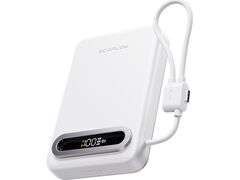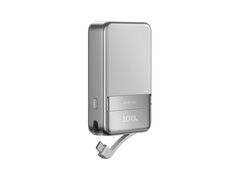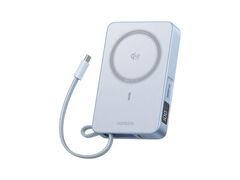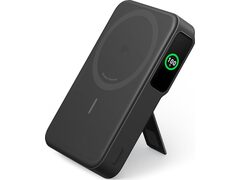
The advertised Qi2.2 25W: a speed reserved for one iPhone so far
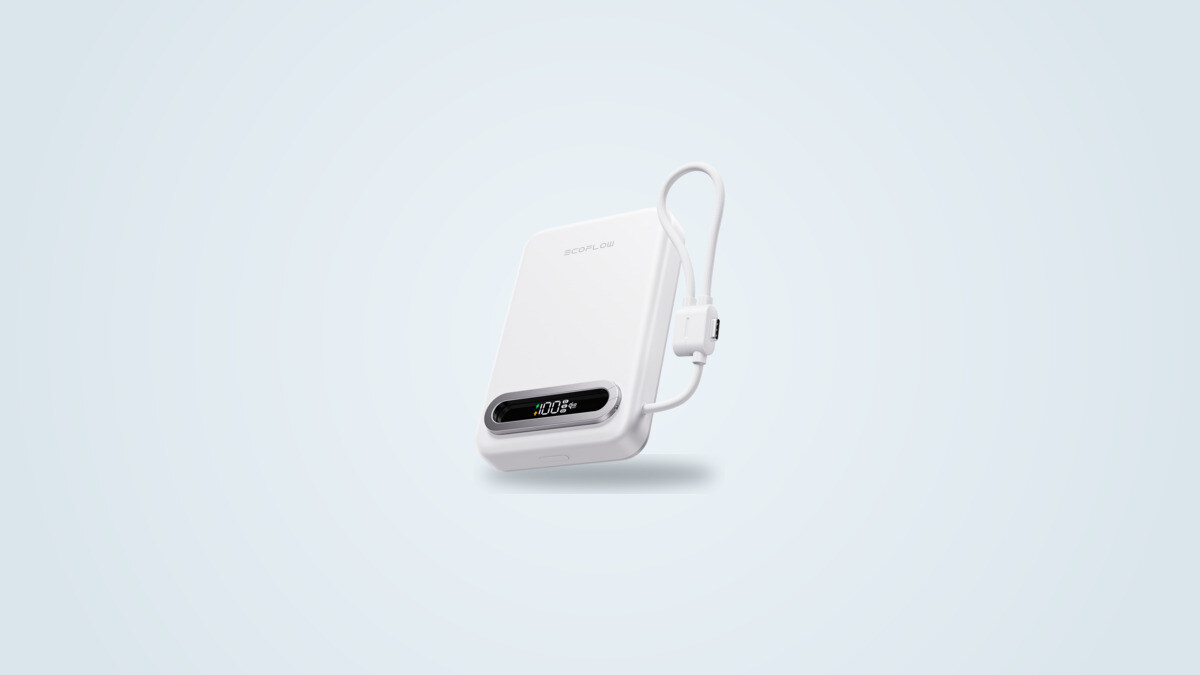
The EcoFlow Rapid Mag 10,000mAh is one of the very first external batteries certified for Qi2.2, the version of the wireless charging standard that officially allows 25W over magnetic charging, against 15W for the previous Qi2 generation and just 7.5W for the original Qi1. On paper, that is more than three times the speed of first generation wireless.
In practice, that 25W figure only benefits a handful of devices today. The Qi2.2 standard needs hardware support on the phone's side, and only the iPhone 17 and the Pixel 10 Pro carry it so far. Every earlier iPhone, from the iPhone 12 to the iPhone 16, stays capped at 15W wirelessly no matter which charger is used: that is a limit set by the phone's own electronics, not by the power bank.
EcoFlow states that an iPhone 17 Pro reaches 50% charge in 19 minutes. The same maker states that an iPhone 16, capped at 15W, needs 30 minutes to reach that same 50% mark. The gap between those two figures, both supplied by EcoFlow itself, shows exactly what Qi2.2 really changes: not the battery, but the speed at which the phone agrees to accept the energy.
In practice, an iPhone 17 or Pixel 10 Pro owner gets a real gain over the previous generation. An iPhone 12 to 16 owner, by far the majority of the installed base today, charges at exactly the same speed as on the cheaper Qi2 15W version in the same EcoFlow lineup. Android also benefits from the standard once a phone carries Qi2.2 hardware, but very few models do so today outside the Pixel 10 Pro.
Built-in cable, extra port: the real connectivity beats the spec sheet
The Rapid Mag's spec sheet lists a single USB-C port. In practice, the device offers two separate wired connection points: the 36W USB-C cable built into the body, and a second, separate USB-C port positioned on the edge so it stays reachable even with the stand deployed. Combined with wireless charging, these two wired ports let it power up to three devices at once, with no extra cable to carry.
The built-in cable measures about 6.9 in (17.5cm) unrolled, noticeably shorter than the built-in cables on two direct rivals in the same segment (about 8.1 in/20.5cm and 9.4 in/24cm). That is enough to reach a phone sitting next to the bank on a desk, but a little short for use in a jacket pocket, or for charging a laptop on the floor while holding the bank in hand.
On wired output, the built-in cable is rated at 36W. On an iPhone 17 Pro, the power actually delivered sits around 32.2W, and around 31.7W on a MacBook Air, roughly 88 to 89% of the rated figure: a modest gap, in line with what most converters of this size lose between the rated output and the power that actually reaches the connected device.
That last figure is the most important one to know before buying: as soon as several devices are plugged in at once, the total power budget drops to about 15W shared between them, far below the 25W and 36W individual maximums that get top billing. Using the Rapid Mag for a single device at a time gets its full potential; asking it to serve three devices at once only suits small accessories (earbuds, a smartwatch) alongside a phone or laptop charged as the priority.
The magnet and the stand: the mechanical side
EcoFlow rates the magnetic holding force at 11N, achieved with magnets the maker describes as N54 grade, a neodymium quality above the more common N52 used on this type of product. In practice, that amounts to a holding force of about 2.5 lb (1.12kg), more than enough to stop the phone coming loose while walking, cycling, or working out.
One practical point too often missing from spec sheets: compatibility with a protective case. EcoFlow states reliable holding through cases up to 0.06 in (1.6mm) thick, which covers the large majority of thin, semi-rigid cases on the market, but excludes the thickest or ruggedized ones.
The built-in stand folds flat against the body at rest, and unfolds into an adjustable kickstand able to hold the phone upright or in landscape. That works well for watching a video, joining a video call, or keeping a notification screen active, with no external accessory at all. Unlike a stand bolted on as an afterthought on other products, this one sits flush with the body and never feels flimsy.
Over a full charge from a completely empty battery, an iPhone 17 Pro reaches 100% in 116 minutes, a little under two hours. By comparison, an iPhone charged on a previous generation Qi2 15W charger generally needs close to 3 hours for the same full run: the time saved by Qi2.2's 25W, when the phone allows it, is real and substantial, on the order of an hour over a full charge.
Heat: a safety promise kept closely
Charging a phone wirelessly at high power always generates heat, through resistive losses in the coils and conversion losses: that is a physical constraint shared by every magnetic power bank, not a weakness specific to this one. The question that matters is what ceiling gets reached, and how the device manages it.
EcoFlow states a target temperature ceiling of 107.6 °F (42 °C) for the cell, held through continuous thermal monitoring and an entirely fanless design. While charging an iPhone 17 Pro, the phone's own temperature climbs to about 104 °F (40 °C), and the metal part of the Rapid Mag's stand reaches about 105.8 °F (41 °C). The gap between that stated ceiling and this real-world high point is under a degree: the two figures line up closely, a reassuring sign of consistency on this point.
In practice, the body stays warm to the touch at the end of a fast charge, without becoming painful or giving off any smell. The protection mechanism follows the usual approach for this type of product: power tapers off gradually as the threshold approaches, rather than cutting the charge abruptly, avoiding unwanted interruptions while still protecting the cell.
No safety anomaly (uncontrolled overheating, swelling, unexpected shutdown) has been reported so far for this specific model in the feedback reviewed. Since the product is still recent on the market, this lack of reports is a favorable sign rather than a certainty built on several years of use.
Size: the thinnest and lightest in its class
The Rapid Mag weighs 8.1 oz (230g) at 4.33 x 2.81 x 0.63 in (110 x 71.3 x 15.95mm), a form factor EcoFlow sums up as just over half an inch thick. Against several other Qi2.2 25W certified magnetic banks on the market, it comes out as the lightest of the group, and its 0.63 in (15.95mm) thickness holds up both in the maker's own figures and on units available on the market.
That slimness comes from a choice of high density lithium cobalt (LiCoO2) cells, the same chemical family used inside iPhone batteries, rather than the thicker, more conventional cylindrical lithium-ion cells found in general-purpose power banks. The usual trade-off of that chemistry, a cycle life generally shorter than the LiFePO4 used in large power stations, could not be pinned down precisely for this particular model.
The body itself is described as thin and well finished, with a soft-touch material said to evoke the quality of an iPad Pro Magic Keyboard rather than cheap plastic. It slips into a jacket pocket or a small bag without bulging, a real advantage over rivals that run several tenths of an inch thicker.
| Model | Wireless | Thickness | Weight |
|---|---|---|---|
| Rapid Mag 10000mAh (Qi2.2) | 25W | 0.63 in (15.95mm) | 8.1 oz (230g) |
| Rapid Mag Qi2 15W (same brand) | 15W | 0.9 in (22.9mm) | 9.1 oz (258g) |
Set against its own Qi2 15W sibling at 0.9 in (22.9mm) thick and 9.1 oz (258g), the Qi2.2 25W version is therefore both faster, for anyone with the right phone, and more compact: a clear step forward on both counts, with no trade-off in form factor.
Against its own cheaper sibling: the Rapid Mag Qi2 15W
EcoFlow sells two very similarly named power banks at the same time, with opposite technical choices on several points. The mix-up is easy: both are called Rapid Mag, both share the same 10,000mAh rated capacity, and both use a very similar magnetic body.
The Qi2 15W version, launched back in April 2025, bets on the wired side: its built-in cable delivers up to 65W, well above the Qi2.2 version's 36W, and its own recharge reaches 70% in 33 minutes according to the maker. It also carries a full color (TFT) screen, an EcoFlow app with a find-my-battery feature, and Bluetooth connectivity, none of which the Qi2.2 25W version has.
The newer Qi2.2 25W version (launched in July 2025) flips that priority: it gives up wired speed (36W versus 65W) and the connected features to gain wireless speed (25W versus 15W, but only on an iPhone 17 or Pixel 10 Pro), slimness (0.63 in/15.95mm versus 0.9 in/22.9mm), and weight (8.1 oz/230g versus 9.1 oz/258g).
| Criterion | Rapid Mag Qi2.2 25W | Rapid Mag Qi2 15W |
|---|---|---|
| Wireless | 25W (Qi2.2) | 15W (Qi2) |
| Built-in cable | 36W | 65W |
| Screen | Basic display | Full color TFT |
| App, Bluetooth | No | Yes, with find-my-battery |
| Thickness | 0.63 in (15.95mm) | 0.9 in (22.9mm) |
| Weight | 8.1 oz (230g) | 9.1 oz (258g) |
The choice comes down to actual priority: wired speed and connectivity for the Qi2 15W, with its full screen and app, or slimness, weight, and wireless speed for the Qi2.2 25W, provided you own an iPhone 17 or a Pixel 10 Pro to make the most of it. Without one of those two phones, the Qi2 15W version offers noticeably faster wired charging (65W) for a weight difference of just 1 oz (28g).
Against the direct competition
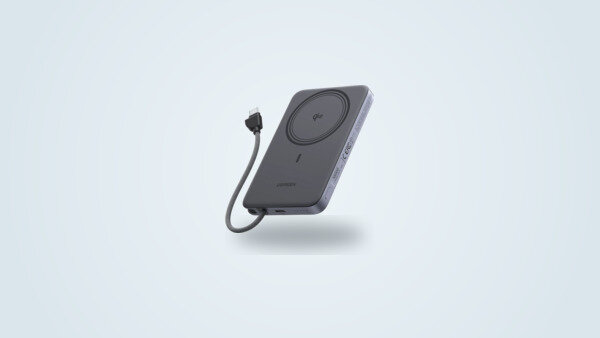
In the segment of fast-charging 10,000mAh magnetic power banks, three names keep coming up in comparisons: the Ugreen MagFlow 10000mAh, the Anker MagGo 10K, and the Baseus MagPro.
| Criterion | EcoFlow Rapid Mag | Ugreen MagFlow 10000 | Anker MagGo 10K | Baseus MagPro |
|---|---|---|---|---|
| Wireless charging | Qi2.2 25W | Qi2 25W | Qi2 15W | 15W |
| Built-in cable | Yes, 36W | Yes, 30W | No | No |
| Built-in stand | Yes | No | Yes | No |
The Ugreen MagFlow 10000mAh is the closest rival on paper: it also claims 25W wirelessly, but under the Qi2 standard rather than Qi2.2 certification, a nuance that could matter for future compatibility as more phones adopt the newer standard. Its built-in cable tops out at 30W, behind the Rapid Mag's 36W, and it has no built-in stand at all.
The Anker MagGo 10K matches it on a comparable built-in stand, but stays on the Qi2 15W generation and skips the built-in cable, which means carrying a separate cable for wired charging. The Baseus MagPro, the simplest of the three, sticks to 15W with neither a cable nor a stand built in, a cheaper but less complete positioning.
On this comparison, the Rapid Mag wins on the combined criteria (the newest wireless speed, the most powerful built-in cable, a built-in stand), with none of the three rivals beating it on any single point among the data available.
Reliability, warranty, and what is still unknown
EcoFlow covers the Rapid Mag Qi2.2 25W with a 24 month warranty, longer than several chargers and power banks sold at a similar price point. No guaranteed charge-cycle count ahead of capacity loss could be found specifically for this model: that figure, published for other products in the lineup, is not available here so far, and it would be wrong to carry over a number specific to a different model in the range.
Launched at a premium reference price through EcoFlow, the Rapid Mag Qi2.2 25W regularly sells for around half that on promotion, both through the maker and through retailers, a price swing that is common for this type of product in the months after launch.
Since the product came out in mid 2025, no recurring failure pattern has been identified specifically for it so far, whether in how the magnet holds up over time or in the reliability of the built-in cable after extended use. That lack of widespread reports is reassuring, but it does not replace the years of track record enjoyed by older products: it is a trust reserve worth keeping in mind rather than a proven flaw.
The body carries no stated water or dust resistance rating, which calls for caution around rain or splashes, a point shared with most magnetic power banks of this format.
Who it suits, who it does not
It suits anyone who already owns an iPhone 17 or a Pixel 10 Pro and wants to genuinely make use of the 25W magnetic wireless charging, as well as anyone looking for the thinnest, lightest magnetic power bank in its class for everyday pocket use. It also suits anyone who wants to power up to three devices at once (a phone magnetically, plus two wired devices) without carrying an extra accessory.
It does not suit anyone with an iPhone 12 through 16 or a phone without Qi2.2 support who is chasing speed above all: in that case, charging tops out at 15W, exactly as on the cheaper Qi2 version from the same brand, which also offers a wired cable twice as powerful (65W) and a full screen. It also does not suit anyone who regularly charges several power-hungry devices at once, since total shared power then drops to around 15W.