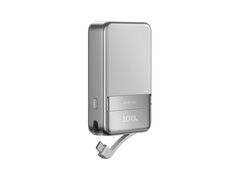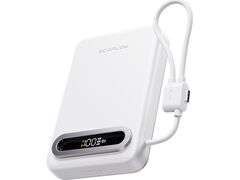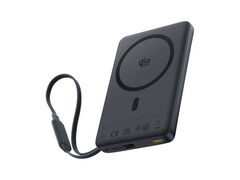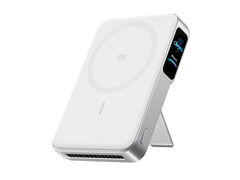
The built-in 65 W USB-C cable: the highest wired power in its category
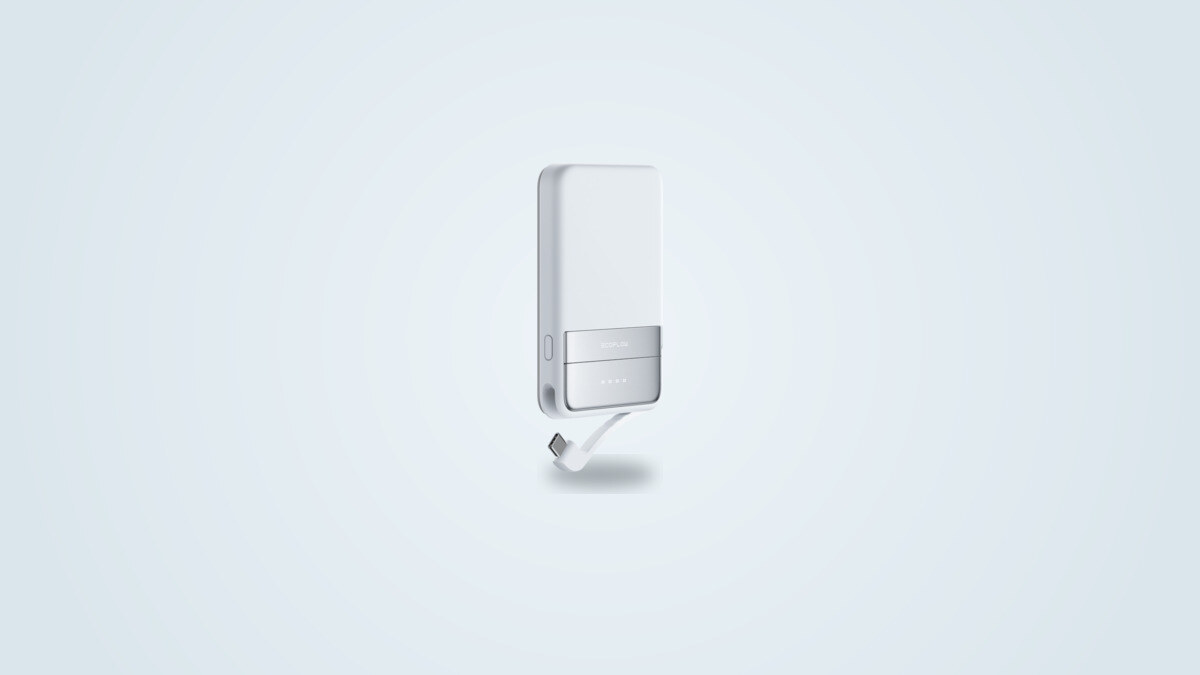
The Rapid Mag Qi2 15W has a USB-C cable built directly into the case, capable of delivering up to 65 W of output. That is the highest wired power among the 10,000 mAh magnetic power banks compared on this site, well ahead of the 45 W of the next closest built-in cable and the 20 to 36 W of several other direct rivals.
This power is not just a brief startup peak. On output, the charge holds at 65 W for roughly the first quarter of the connected device's charge, then steps down, to around 45 W and then 30 W as it approaches three quarters. That is enough to genuinely help out a slim laptop: plugging a 13 inch MacBook Air into the built-in cable adds several hours of extra runtime, a use case that most rival magnetic power banks, capped at 20 or 30 W, cannot match under the same conditions.
A second USB-C port, separate from the built-in cable, rounds out the connectivity and can also work as either an output or an input. The built-in cable is still built around a USB-C connector: iPhones older than the iPhone 15, still fitted with a Lightning port, cannot use it directly and instead rely on the separate USB-C port with their own cable, or on wireless charging.
Against the direct competition in its own category (see the full comparison further down), no other 10,000 mAh magnetic power bank claims this much wired power: second place, shared by two models, tops out at 45 W, a third less.
The rated 15 W Qi2 wireless charging: a real gap with the power actually received
On the back of the case, the magnetic charging surface follows the Qi2 standard and is rated at up to 15 W, twice the 7.5 W of first generation Qi. That is a solid figure for inductive charging, technically certified and real on paper.
In practice, the power a Qi2 compatible iPhone receives over a full charge sits closer to 8 to 9 W on average, with a real ceiling around 8.9 W rather than the rated 15 W. This is not specific to this model: any inductive charge sees its power taper off as the phone's battery fills up, and the magnetic conversion itself dissipates part of the energy as heat. But the gap remains clear between the figure on the spec sheet and the average power actually transferred over a full charge.
On an Android phone that does not support Qi2, charging drops to the original Qi ceiling, 7.5 W at best: in practice, a recent model limited to Qi1 receives closer to 6 to 7 W, and magnetic alignment is not guaranteed without a compatible case, since the phone lacks a built-in magnet ring. The latest Google Pixel 10 models, which ship with a factory Qi2 magnet ring, align correctly and reach the same tier as compatible iPhones.
Recharging the power bank itself: still the fastest in its category
The power advantage is not limited to output. The separate USB-C port also accepts up to 65 W of input to recharge the 10,000 mAh pack, and the built-in cable can take up to 60 W in the same direction. The result: 0 to 70% in under 33 minutes, and a full 0 to 100% charge in 59 minutes.
That pace puts the Rapid Mag Qi2 15W ahead of its category on this specific point.
| Model | Max input | Recharge time |
|---|---|---|
| Rapid Mag Qi2 15W | 65 W | 59 min (0 to 100%) |
| Anker MagGo 2 Pro | 45 W | 52 min (0 to 80%) |
| Baseus PicoGo AM52 | 30 W | 90 to 100 min |
| Anker MagGo (1st generation) | 20 W | 165 min |
That leaves a gap of more than two hours between the slowest and the fastest model in this comparison, for the same product family and a very similar rated capacity from one model to the next. For everyday use, that means a power bank that goes from empty to full during a lunch break rather than overnight.
Recharging the pack at full power requires a USB-C PD charger capable of supplying those 65 W: a more modest charger still recharges the battery without issue, just over a longer stretch than the best-case figures above.
LCD screen, app, Bluetooth and location: the best equipped model in the range
The Rapid Mag Qi2 15W keeps an LCD screen that shows remaining capacity, output power and estimated charging time, customizable from the Bluetooth-connected EcoFlow app. The same app also offers an optimized charging mode meant to preserve battery lifespan over time.
The location feature built into the app is worth clarifying: it relies on a simple buzzer triggered remotely, useful for finding the power bank when it slips to the bottom of a bag or gets wedged between cushions. It does not rely on Apple's Find My network and shows no position on a map, unlike a dedicated Bluetooth tracker such as an AirTag: a handy occasional aid rather than a genuine locating tool.
The built-in stand folds flat against the case at rest and unfolds into an adjustable kickstand, with continuous tilt rather than a fixed-position ratchet, to hold the phone upright or sideways. It supports iPhone StandBy mode while charging, provided the installed iOS version supports it, turning the propped-up phone into a small always-on display.
This complete package clearly sets the Rapid Mag Qi2 15W apart from its own younger sibling, the Rapid Mag Qi2.2 25W, which dropped the screen, the app and Bluetooth to gain slimness (see the detailed comparison between the two further down).
The trade-off: the heaviest and one of the thickest in its category
All that electronics, screen, Bluetooth module, a built-in cable capable of 65 W, takes up room and adds weight. EcoFlow rates the Rapid Mag Qi2 15W at 9.1 oz (258 g); the real weight sits closer to 9.7 oz (275 g). Its 4.25 x 2.76 x 0.9 in (108 x 70 x 22.9 mm) footprint also makes it one of the thickest magnetic power banks in its category.
| Model | Weight | Thickness |
|---|---|---|
| Rapid Mag Qi2 15W | 9.1 to 9.7 oz (258 to 275 g) | 0.9 in (22.9 mm) |
| Xtorm FS5W101 | 8.1 oz (229 g) | 0.94 in (24 mm) |
| Ugreen MagFlow 10000 | 9.0 oz (254 g) | 0.83 in (21 mm) |
| Rapid Mag Qi2.2 25W (sibling) | 8.1 oz (230 g) | 0.63 in (15.95 mm) |
| Anker MagGo 2 Pro | 7.8 oz (220 g) | 0.70 in (17.8 mm) |
| Baseus PicoGo AM52 | 7.1 to 7.4 oz (202 to 211 g) | 0.63 in (16 mm) |
In this comparison, only the Xtorm FS5W101 is thicker than the Rapid Mag Qi2 15W, due to its own built-in metal kickstand, yet it remains close to 1.6 oz (46 g) lighter. At the other end, the Baseus PicoGo AM52 and the Anker MagGo 2 Pro both trade the most powerful cable for extra slimness.
This extra weight and bulk has a straightforward physical explanation, not a design flaw: fitting a 65 W capable cable, a second USB-C port, an LCD screen and a Bluetooth module into the same case as Qi2 wireless charging simply needs more internal volume than a stripped-down version. EcoFlow's own newer Qi2.2 25W sibling, which dropped that equipment, gained 1 oz (28 g) and 0.28 in (7 mm) of thickness in the same move.
In a pants pocket, the difference is genuinely noticeable; set on a desk or slipped into a bag, it becomes largely secondary next to the comfort of the screen and the wired power on tap.
Real-world compatibility: iPhone, iPad, MacBook, AirPods and Android
On the wired side, compatibility is broad: official documentation covers iPhone from the 12 series onward, iPad, MacBook and AirPods charging cases, all of which can draw power from the USB-C port or the Qi2 surface depending on the device. A MacBook mostly benefits from the 65 W built-in cable rather than wireless charging, which is reserved for devices with a suitable coil.
Pass-through support lets you recharge a phone resting on top while the power bank itself recharges through the separate USB-C port, handy for waking up to both devices full without waiting for one cycle to finish before the other.
On Android, it comes down entirely to the phone. Recent models that ship with a factory Qi2 magnet ring, such as the latest high-end Google Pixel phones, align and charge normally. Most other Android phones have neither a magnet ring nor always Qi2 certification: they can charge resting on the surface at the Qi1 ceiling of 7.5 W at best, and closer to 6 to 7 W in practice on a recent model limited to that standard, but without the magnetic grip that is the whole point of the format. Wired charging through the separate USB-C port remains the more reliable option in that case, at whatever power the phone itself accepts.
Against its own younger sibling, the Rapid Mag Qi2.2 25W
EcoFlow sells two magnetic power banks in parallel that are very close in name and rated capacity, with opposite technical choices. The Rapid Mag Qi2 15W, covered here, is the older of the two and leans on wired power and connected features. The newer Rapid Mag Qi2.2 25W flips that priority: it drops the screen, the app and much of the wired power to gain wireless speed, slimness and lighter weight.
| Criteria | Rapid Mag Qi2 15W | Rapid Mag Qi2.2 25W |
|---|---|---|
| Wireless | 15 W (Qi2, all compatible phones) | 25 W (Qi2.2, iPhone 17 and Pixel 10 Pro; 15 W elsewhere) |
| Built-in cable | 65 W | 36 W |
| Screen | Full LCD | Simple display |
| App, Bluetooth | Yes, with location | No |
| Thickness | 0.9 in (22.9 mm) | 0.63 in (15.95 mm) |
| Weight | 9.1 oz (258 g) | 8.1 oz (230 g) |
The Qi2.2 25W's wireless speed boost only benefits two phones so far, the iPhone 17 and the Pixel 10 Pro: on any other device, it falls back to exactly the same 15 W Qi2 tier as this model. The Rapid Mag Qi2 15W, on the other hand, keeps a built-in cable that is nearly twice as powerful, 65 W versus 36 W, along with a full screen, Bluetooth and the app, at the cost of a heavier, thicker case.
The choice mostly comes down to actual priorities: wired power and connected features for this model, or slimness and peak wireless speed, provided you own a recent compatible phone, for its younger sibling.
Against the direct competition: Baseus, Anker, Ugreen and others
In the segment of fast-charging 10,000 mAh magnetic power banks, a handful of names come up again and again: the Baseus PicoGo AM52, the Anker MagGo 2 Pro and the Ugreen MagFlow 10000, each striking a different balance between wireless power, wired power and features.
| Criteria | Rapid Mag Qi2 15W | Baseus PicoGo AM52 | Anker MagGo 2 Pro | Ugreen MagFlow 10000 |
|---|---|---|---|---|
| Max wireless | 15 W (Qi2) | 25 W (22.5 to 25 W depending on iPhone) | 25 W (Qi2.2) | 25 W (Qi2) |
| Max wired | 65 W | 45 W | 45 W | 30 W (built-in cable) |
| Screen | Full LCD | 5 LEDs, no screen | Full LCD | Digital screen |
| App, Bluetooth | Yes | No | Yes | No |
| Weight | 9.1 oz (258 g) | 7.1 to 7.4 oz (202 to 211 g) | 7.8 oz (220 g) | 9.0 oz (254 g) |
| best-batteries.com rating | 4.1 / 5 | 4.1 / 5 | 4.1 / 5 | 4.0 / 5 |
The Baseus PicoGo AM52 comes closest on wired power (45 W) without ever reaching the Rapid Mag Qi2 15W's 65 W, and settles for five LEDs with no screen and no app. The Anker MagGo 2 Pro matches that same 45 W tier and adds a comparable screen, app and Bluetooth, plus an active fan that is new to this type of product, but it has only just gone on sale and has no track record to speak of yet. The Ugreen MagFlow reaches 25 W wireless, the highest in the group on that front alongside EcoFlow's own Qi2.2 25W sibling, but its built-in cable tops out at 30 W, less than half of the 65 W available here.
In this comparison, the Rapid Mag Qi2 15W clearly wins on wired power and sits in the upper half on connected features, but none of the rivals listed here is as heavy or as bulky: the trade-off plays out squarely between wired versatility and compactness.
Reliability, warranty and availability: what we know, what remains unclear
The Rapid Mag Qi2 15W carries a 2 year manufacturer warranty, a common duration for this type of product. It has been on the market for more than a year now, a longer track record than several direct rivals launched in 2026, with no safety issue, uncontrolled overheating, swelling or recall, tied to this specific model.
EcoFlow has separately issued a voluntary recall on an entirely different product in its range, a portable power station, over an overheating risk fixed through a firmware update: that recall covers a completely different category of device, with no technical link to this magnetic power bank, but it is part of the brand's verifiable track record and worth knowing about.
It went on sale in the United States first, before reaching other markets, including France, some months later. In Japan, it followed the more modest 5,000 mAh version of the same range by several months, that smaller model having gone on sale first in that particular market.
Box contents stay minimal: beyond the unit itself and its built-in cable, only a warranty document ships in the box, with no printed user guide and no explanation of how the screen or the app work. No water or dust resistance rating is announced for this model either, a trait shared with most magnetic power banks of this format.
Who it suits, and who it does not
It suits anyone who wants a single power bank that can help out both a phone and a slim laptop thanks to its 65 W cable, and who values a full screen, an app and Bluetooth over the slimmest possible case. It also suits anyone who often needs to recharge the power bank itself in a hurry, thanks to one of the fastest recharge times in its category.
It suits less anyone chasing the fastest possible wireless charging day to day: the rated 15 W Qi2 tier only translates into 8 to 9 W received on average on an iPhone, and a newer power bank from the same brand genuinely climbs higher on the very latest compatible phones. It also suits less anyone who prioritizes a slim, light case in a pocket: at 9.1 to 9.7 oz (258 to 275 g) and 0.9 in (22.9 mm) thick, it is one of the bulkiest magnetic power banks in its category.