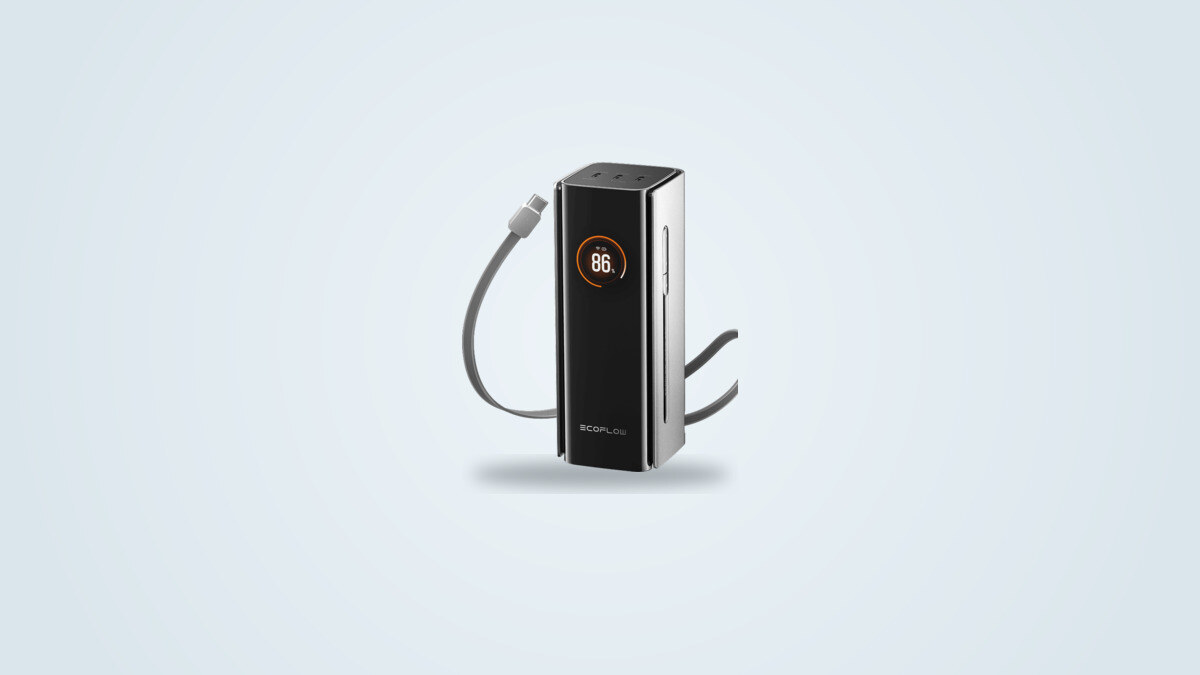
What the advertised 72 Wh are really worth
The Rapid Pro 20K is rated at 20,000mAh, or 72 Wh using the 3.6V-per-cell convention most makers rely on for this calculation. That figure sits well below its two bigger siblings, the Rapid Pro 27K and the Rapid Pro X, both rated at 99.54 Wh: this 20K is not a lighter version of the same pack, it is a separate model built around a smaller cell.
The 20,000mAh headline number has a real advantage for shopping comparisons: it matches exactly the rated capacity of the Anker Prime 20000 200W and the Ugreen Nexode 20000 145W, its two closest rivals in this size class. Unlike cross-brand comparisons that rely on different voltage conventions, all three products here start from the same round number, which makes comparing their other specs more straightforward.
The direct consequence plays out at airport security. The TSA and most airlines worldwide forbid carry-on batteries above 100 Wh. At 72 Wh, the Rapid Pro 20K carries a 28 Wh margin under that ceiling, comfortably more than it needs to, with no dependence on a tight voltage convention. This is where it stands apart from its own siblings: the Rapid Pro 27K and the Rapid Pro X have only 0.46 Wh of margin, a figure that comes entirely from choosing a lower per-cell voltage to stay under the limit.
In use, a phone such as a Galaxy S24 Ultra charges fully in 1 hour and 7 minutes on the main port. On a long-haul flight, the capacity is enough to charge a phone three times with room to spare. A laptop such as a MacBook Pro reaches 50% charge in about 30 minutes on the 100W USB-C port.
230W across four ports: an arithmetic that does not add up
The spec sheet lists 230W of total output, spread across four USB-C outputs: the built-in retractable cable (100W), a fixed port (100W), and two secondary ports (65W each). Add those four individual maximums together and you get 330W, or 100W more than the total actually shared across all four outputs.
This is not an inconsistency, it is a common engineering choice for this kind of product: a single internal conversion circuit feeds every output, under one overall ceiling. As long as only two devices are plugged in, each can aim for its own maximum (100W and 100W, or 200W, under the 230W ceiling). Once a third and then a fourth device join the first two, the remaining budget, at best 30W to split between the two secondary ports, forces a sharp cut well below their rated 65W.
On protocols, the Rapid Pro 20K recognizes USB PD 3.0, PPS and Quick Charge 3.0 on output, a combination that covers the vast majority of recent smartphones and laptops with a USB-C port. That breadth of compatibility matters as much as raw power: a strong output that a connected device does not recognize is worth nothing.
Against the two main rivals in its capacity class, the Rapid Pro 20K remains the most powerful on paper: 230W against 200W for the Anker Prime 20000 200W and 145W for the Ugreen Nexode 20000 145W. But neither competitor offers four simultaneous outputs either, which puts the comparison in perspective: the Anker and the Ugreen make do with two USB-C ports each, without the same four-way balancing act.
The built-in cable: the argument for leaving your spare at home
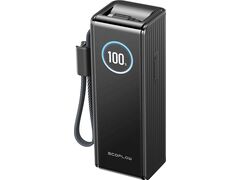
The 23.6 in (60 cm) USB-C cable is built directly into the shell, retractable, and works both ways: it serves as the main 100W output and as an input for recharging the battery itself. Pass-through charging is supported as long as the upstream charger delivers at least 20W, a low bar that covers the vast majority of USB-C wall chargers sold in recent years.
Day to day, this integration changes how the object is used: no more digging through a bag looking for the right cable, and no risk of leaving one behind on a trip. The retraction mechanism tucks away cleanly into the shell once the cable is stowed.
One limit is length. Nearly two feet is plenty to connect the battery sitting next to a laptop on a desk, but it is short for use on your lap, where the charging device and the battery need to stay close to each other.
Unlike the Rapid Pro X from the same maker, which houses its cable in a removable magnetic module that can be replaced independently of the pack, the Rapid Pro 20K builds its cable straight into the main shell, the same approach as the Rapid Pro 27K. No reliable information on this cable's repairability in case of failure could be confirmed specifically for this 20K model: caution recommends not carrying over a neighboring model's experience to this specific product.
Charging: fast for the first half, slower for the second
Three ways to recharge the battery itself coexist, each with its own speed up to 50% charge: 39 minutes on a single 100W port, 25 minutes combining the main port and the built-in cable to reach 120W, and 19 minutes on the optional RAPID Pro 320W charging station, sold separately and connected through magnetic pins under the shell.
On that same station, EcoFlow also states 80% charge in 47 minutes. The math is telling: the first 50% takes 19 minutes, the next 30 points, up to 80%, take 28 minutes more, on the same unit and the same charging method. The charging rate slows down markedly once the halfway mark is passed, a behavior consistent with how lithium cells finish charging in constant-voltage mode rather than constant-current mode.
This is not unique to the Rapid Pro 20K: lithium cells almost always slow down how much current they accept toward the end of a charge, to protect their lifespan. What sets one product apart from another is how pronounced that slowdown is and where it starts to bite. Here, the turning point sits clearly past the halfway mark.
No official time is published for a full cycle to 100%, on either the single port or the station: the stated milestones stop at 50% or 80% depending on the charging method used.
Weight and size: heavier per watt-hour than its big sister
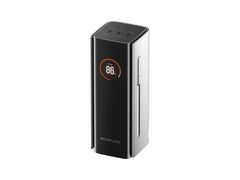
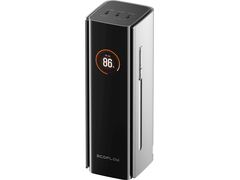
The Rapid Pro 20K weighs 1.24 lb (564 g) for 5.7 x 2.2 x 2.2 in (145 x 55 x 56 mm), a size that fits a large jacket pocket or the side pocket of a bag, without quite being a trouser-pocket item given its thickness.
Weighed against its energy, it comes to 7.83g per Wh. That is, across the maker's whole Rapid lineup, the least favorable ratio: the Rapid 25K (92 Wh, 1.28 lb / 580 g) drops to 6.30g/Wh, and the Rapid Pro 27K and Rapid Pro X (99.54 Wh each, around 1.54 lb / 700 g) sit at roughly 7.03 and 7.07g/Wh.
| Model | Capacity | Weight | g per Wh |
|---|---|---|---|
| Rapid Pro 20K | 72 Wh | 1.24 lb (564 g) | 7.83 |
| Rapid 25K | 92 Wh | 1.28 lb (580 g) | 6.30 |
| Rapid Pro 27K | 99.54 Wh | 1.54 lb (699 g) | 7.03 |
| Rapid Pro X | 99.54 Wh | 1.54 lb (700 g) | 7.07 |
The mechanism is straightforward: the screen, the retractable cable mechanism and the shell weigh roughly the same regardless of the size of the cell pack behind them. On a smaller pack, that fixed weight carries proportionally more. The Rapid Pro 20K is therefore not the lightest in the lineup relative to the energy it actually carries, even though it remains the lightest in absolute terms.
This does not undermine its intended use, daily carry in a bag, but it is worth knowing before buying on the assumption that the smallest model is automatically the lightest pound for pound.
Heat and protections: what the shell is built to handle
EcoFlow states an operating range of 32 °F (0 °C) to 104 °F (40 °C), and a storage range of -4 °F (-20 °C) to 104 °F (40 °C), for use up to 9,800 ft (3,000 m) of altitude. The shell meets the V0 flame-retardant rating, and an internal temperature sensor continuously monitors cell heating.
The protection mechanism follows a standard approach for this type of product: output power steps down before temperature reaches a critical threshold, rather than cutting the charge abruptly. No precise threshold in degrees could be confirmed specifically for this 20K model, unlike figures established for other products in the lineup: caution recommends not carrying over a measured figure from a neighboring model to this specific product.
The 9,800 ft (3,000 m) altitude ceiling covers the vast majority of ordinary travel and hiking use, including in the mountains, but is worth keeping in mind for very high altitude or unpressurized flight use.
The EcoFlow app relays temperature and charge status in real time, alongside the built-in screen, making it possible to keep an eye on the battery without pulling it out of a bag.
The shell is also rated to withstand a 3.3 ft (1 m) drop, a robustness level consistent with backpack or carry-on use rather than permanent outdoor exposure.
Facing the competition in its own 20,000mAh class
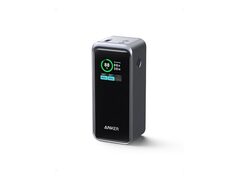
At an equal rated capacity (20,000mAh), three batteries compete for the same shelf space: the Rapid Pro 20K, the Anker Prime 20000 200W and the Ugreen Nexode 20000 145W. All three list the same rated capacity, but make very different choices on power, screen and cable.
| Criterion | Rapid Pro 20K | Anker Prime 20000 200W | Ugreen Nexode 20000 145W |
|---|---|---|---|
| Total output | 230W | 200W | 145W |
| Number of outputs | 4, including the built-in cable | 2 | 2, including the built-in cable |
| Built-in cable | Yes, 100W | No | Yes |
| Screen | LCD | LCD | LED |
| Weight | 1.24 lb (564 g) | 1.20 lb (545 g) | 0.99 lb (450 g) |
| Current price | ≈ $80 | ≈ $115 | ≈ $50 |
The Rapid Pro 20K wins clearly on raw power and on the number of simultaneous outputs, with the practical benefit of a cable that is always at hand. The Anker Prime 20000 200W matches its LCD screen but still lacks a built-in cable and costs more. The Ugreen Nexode 20000 145W is the lightest and cheapest of the three, and also has a built-in cable, but far less total power and a more basic screen.
The choice comes down to priority: power and output count for the Rapid Pro 20K, a polished cable-free screen for the Anker, a tight price for the Ugreen.
Not to be confused with the rest of the Rapid Pro range
EcoFlow splits its Rapid lineup into several close models, with different packs and power levels despite similar names. The Rapid Pro 20K is the smallest and most affordable of the Pro versions, clearly distinct from the Rapid 25K (no Pro in the name), and from the Rapid Pro 27K and Rapid Pro X, which share a strictly identical 99.54 Wh pack.
| Model | Capacity | Max output | Margin under the carry-on limit |
|---|---|---|---|
| Rapid Pro 20K | 72 Wh | 230W | 28 Wh |
| Rapid 25K | 92 Wh | 170W | 8 Wh |
| Rapid Pro 27K | 99.54 Wh | 300W | 0.46 Wh |
| Rapid Pro X | 99.54 Wh | 300W | 0.46 Wh |
The higher the capacity climbs in this lineup, the tighter the margin under the 100 Wh threshold gets. The Rapid Pro 20K is, by far, the most comfortable of the four on this specific point, making it a simpler default choice for frequent travelers who would rather not check their airline's exact tolerance every time.
In exchange, it remains the least powerful of the three Pro versions (the other two target 300W), and does not get access to the same higher-end accessories such as the Rapid Pro X's interchangeable magnetic covers.
Reliability, warranty and cycle life
EcoFlow backs the Rapid Pro 20K with a 2-year warranty, and states 300 charge cycles before dropping to 80% of original capacity. The product offers neither a user-replaceable battery nor a user-replaceable cable: should either fail after the warranty period, the whole unit is affected.
Translated into real use, one full charge every day would use up that cycle budget in a little under ten months. A pace closer to one full charge a week, more typical for a backup battery that is not used daily, pushes that point out to five or six years. It all depends on how intensively it is used.
Launched in mid-2025, the Rapid Pro 20K listed at a considerably higher price before settling near its current level. Today's price, around $80, sits well below the roughly $176 compare-at price still shown by some retailers, a common trajectory for this kind of product once its first year on the market has passed.
Being a recent product, no recurring failure pattern could be identified for it specifically so far. This lack of track record should not be read as confirmed long-term reliability, only as a gap in data that time will eventually fill.
Who it suits, who it does not
It suits anyone who wants a single power bank for daily use and travel, with a cable always on hand, enough power for a laptop, and a comfortable margin under the carry-on limit. It also suits anyone charging several small devices at once (phone, earbuds, watch) alongside a main device.
It does not suit anyone after EcoFlow's maximum output (300W on the Rapid Pro 27K and Pro X), or anyone who wants to plug in four demanding devices at full speed at the same time: the two secondary ports give up most of their power as soon as the two main ports are themselves in use. Nor does it suit anyone after the lightest ratio of weight to energy carried, a role the Rapid 25K, cheaper and without the Pro name, fills better within the same lineup.