What the advertised 99.54 Wh are really worth
The Rapid Pro X pack is rated at 27,650mAh, or 99.54 Wh counting cells at 3.6V each, the convention that keeps it under the airline threshold. That nominal figure is not what actually reaches the device plugged in: the share lost in conversion depends directly on the power drawn.
On this pack, delivery starts at 75.1 Wh, only 75%, when drawing a small 10W load, the typical case of a phone charging at 5V. It climbs as the power drawn increases: 85.6 Wh at 27W, a maximum of 87.5 Wh (88%) around 60W, then a slight dip to 85.5 Wh near 140W. Twelve watt-hours separate the worst case from the best, on the same pack and the same full charge.
The explanation lies in the onboard electronics: the screen, the management chip, Bluetooth and Wi-Fi draw current continuously, whatever the output power. At 10W, that fixed draw weighs heavily on the total; at 60W, it becomes negligible. Beyond that point, conduction losses take over and pull the ratio slightly back down.
Across the useful range, a reasonable average sits around 83 Wh, or 83% of the advertised 99.54 Wh: a very good score for this format, as long as the target load stays above roughly 30W.
The same pack as the Rapid Pro 27K, a price gap that doesn't buy power
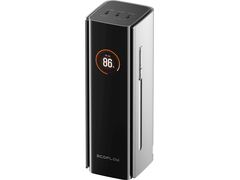
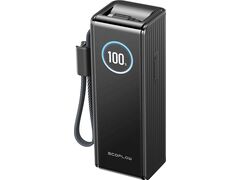
EcoFlow sells two power banks built around a rigorously identical pack. Not one watt-hour or one watt separates them: the same 99.54 Wh, the same 300W on the label, the same optional charging station. What changes between the Rapid Pro 27K and this Rapid Pro X comes down to a handful of specific points, and none of them is capacity or raw power.
| Criterion | Rapid Pro X | Rapid Pro 27K |
|---|---|---|
| Capacity | 99.54 Wh | 99.54 Wh, identical |
| Total output | 300W (with module) | 300W, built in |
| Ports built into the body | 3, the 4th via a module | 4, all built in |
| Screen | 3.9-inch, customizable | 1.54-inch |
| Main cable | removable magnetic block | soldered into the body |
| If the cable fails | block is replaceable | output is lost for good |
The price gap between the two, typically several tens of dollars, buys a large customizable screen, a magnetic accessory ecosystem, and a cable that can finally be repaired, not more energy or more watts. Conversely, the Rapid Pro X loses one hard-wired port: on the 27K, all four outputs are built into the body, while the Pro X only carries three as standard.
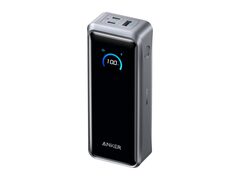
Against another power bank of similar capacity, the Anker Prime 26250 (300W), the difference plays out elsewhere: that model weighs around 1.27 to 1.28 lb (577 to 580 g) against 1.5 lb (700 g) here, and recharges its own pack faster. The Rapid Pro X compensates with its screen and with a cable that can be repaired, two arguments the Anker Prime does not offer in this form.
300W in practice: the port you have to pay extra for
The advertised 300W genuinely exist on paper, but reaching the full figure depends on a purchasing choice the packaging does not highlight. As standard, the Rapid Pro X carries three USB-C outputs on the body: one at 140W and two at 65W. The total available from these three outputs alone caps at 270W, not 300.
To unlock the 4th port and the full 300W, the Magnetic Block with retractable cable, sold separately, has to be clipped onto the base; it adds a fourth USB-C output rated up to 140W, connected through spring-loaded pogo pins. Without that block, the unit works perfectly well, but stays under the 300W figure printed on its own shell.
On the two most powerful built-in outputs used together, the power available on this platform's shared architecture sits around 87 to 93W per port, comfortably enough for two laptops charging side by side without either one holding the other back. The PPS protocol, on the other hand, stays capped at 11V on this platform's main ports, which denies some recent smartphones their fastest charging tier even though the raw power would be available.
Recharging: fast over cable, slower than promised on the station
Over a simple USB-C cable on the 140W main port, the Rapid Pro X reaches 80% in 40 minutes, and a full charge in a little under an hour on this architecture. That is fast for a reserve of nearly 100 Wh: many batteries of this format take twice as long.
The headline claim is different: 80% in 20 minutes, but only with the optional EcoFlow 320W charging station, sold separately and connected through the same spring-loaded contacts as the cable module. On that same pack-and-station pairing, the time actually needed for that 80% turns out to be noticeably longer than advertised: the station itself heats up and throttles before the pack has finished taking in its full power. The weak link that slows the charge down is therefore not the battery, it is the accessory charging it.
With both main ports connected to two separate chargers, combined input climbs to 280W, which brings the 80% mark down to around 26 minutes without going through the proprietary station, using just two compatible USB-C wall chargers instead. In practice, that is the more dependable option for anyone who genuinely wants speed without carrying an extra accessory.
Heat and protection: what the shell has to absorb
Pushing 300W through a body this size inevitably generates heat. On this platform's shared architecture, after several minutes of charging near 100W, the front face climbs to around 105.3 °F (40.7 °C), the back face to around 117.9 °F (47.7 °C), while the core of the body stays closer to 92.5 °F (33.6 °C).
Protection kicks in over two stages. Around 104 °F (40 °C) of internal cell temperature, the main output steps down from 140 to 100W: charging continues, just more slowly. Near 118 °F (48 °C), protection cuts the output outright. In between, the unit arbitrates between its ports rather than slowing everything down at once.
A screen that actually changes daily use, and rethought ergonomics
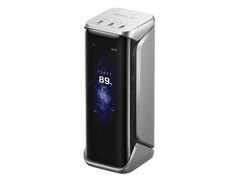
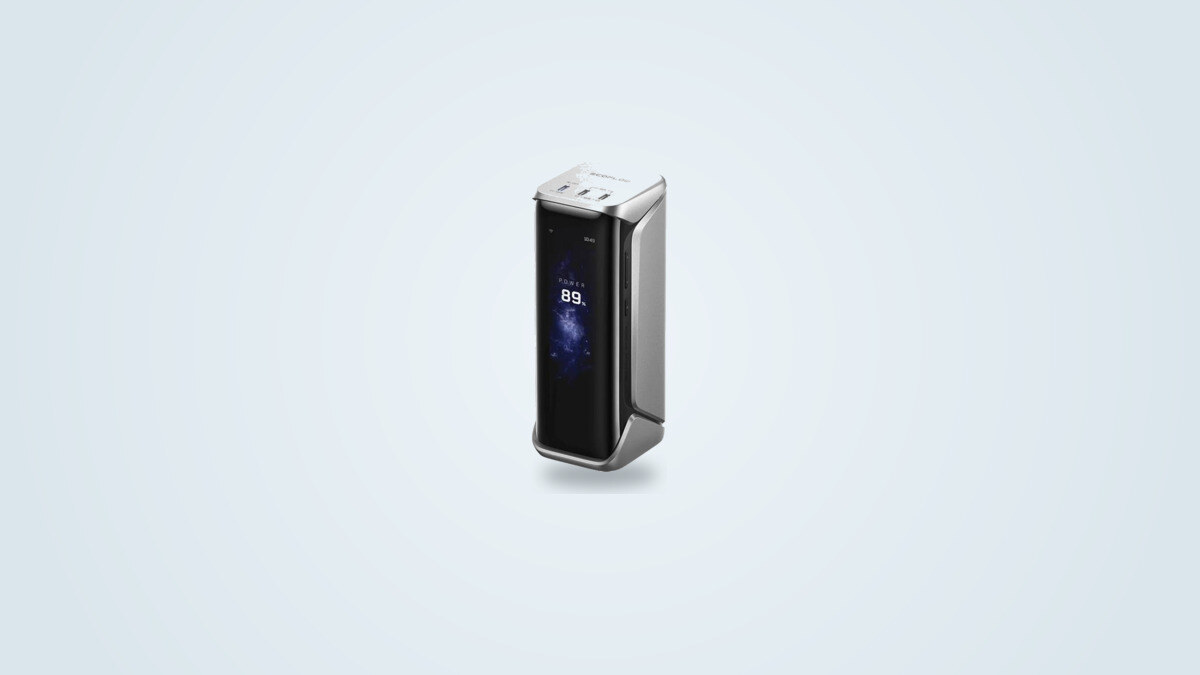
The most visible difference from the rest of the Rapid Pro line is the screen: a 3.9-inch color panel against a 1.54-inch one on the base model. Beyond sheer size, the EcoFlow app lets owners customize the standby display with a photo, an AI-generated image or a QR code, in addition to the usual monitoring screens (percentage, watts per port, temperature, cycle count).
Navigation itself works differently: alongside the regular buttons, a touch strip on the side is operated with the thumb, and a motion sensor wakes the screen as soon as the unit is picked up, with no button to hunt for.
The removable cable and X-Guard safety: the answer to the previous model's real flaw
On the Rapid Pro 27K, the main USB-C cable is soldered into the body: if the retraction mechanism fails, an issue already reported on that model, the priority 140W output is lost for good, on a unit that otherwise still works fine. The Rapid Pro X fixes this directly: the retractable cable sits inside a removable magnetic block, held by spring-loaded contacts. A mechanism failure now only takes out the accessory, which can be replaced independently of the pack.
EcoFlow brands this generation with an "X-Guard" label: cells described as aviation-grade, a dedicated temperature sensor, and a fire-resistant outer shell. These are genuine construction elements, consistent with the product's modular design, but nothing so far allows their actual benefit to be quantified against the protection already standard on the Rapid Pro 27K.
The interchangeable magnetic cases follow the same attachment principle as the cable: they swap without tools and let owners personalize the unit, with no effect on charging performance.
Under the 100 Wh limit: the same constraint as the rest of the line
At 99.54 Wh, the Rapid Pro X stays under the 100 Wh threshold beyond which most airlines ban external batteries from the cabin, so it travels in carry-on, never in checked baggage (still worth confirming with your airline). The margin, 0.46 Wh, is tiny and depends entirely on the voltage used for the calculation: 3.6V per cell. The same energy counted at 3.7V would show 102.3 Wh and fall outside the limit.
The shell's labeling makes checks easier: capacity is printed in both milliamp-hours and watt-hours, with an airplane icon, exactly what a security officer looks for. Many competing batteries print only the milliamp-hour figure and leave the conversion to guesswork.
Real-world battery life: how many devices, how many times
Based on its rated capacity, the Rapid Pro X recharges an iPhone 16 about 4.5 times, or a recent Android phone 3 to 4 times depending on its battery size. Enough to last several days away from an outlet for phone-only use.
On a laptop, the reference figure drops to about 1.3 full charges of a MacBook Air. This is precisely where the Rapid Pro X delivers best on its promise, rather than on a phone: real-world delivery is at its best around the kind of power a laptop draws, not around the power a phone charger draws.
Who it's for, who it isn't for
It suits anyone who wants a single travel battery for a demanding laptop, with a customizable screen and a cable that can be replaced if it fails, and who is happy to pay more for that comfort than for the screen-less version in the same line.
It does not suit anyone planning to power four devices at full speed without buying an extra accessory, nor anyone who mostly recharges a smartphone: that is precisely where the pack's efficiency is at its weakest, and a lighter battery would do just as well for less money.